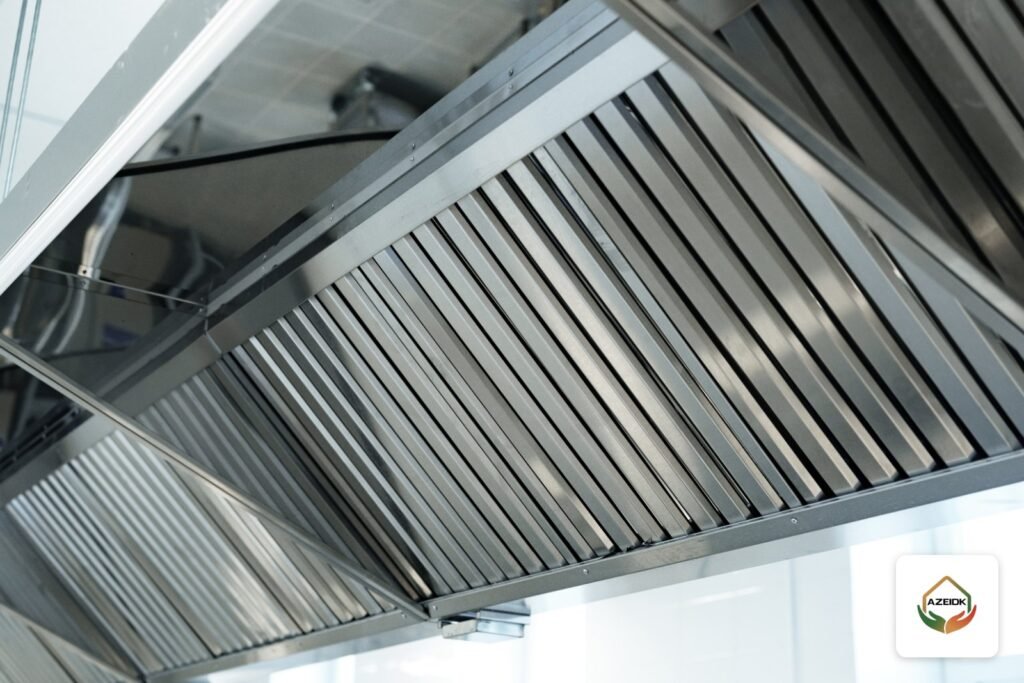
An event hall kitchen fire suppression system is an automatic wet chemical system fitted in the kitchen hood and ductwork. When cooking oil ignites, it discharges agent onto the appliances and shuts off the gas. A wedding hall kitchen runs on an intermittent load: quiet days, then a wedding night cooking for hundreds of guests at once. That is why design and maintenance differ from a restaurant with a steady load.
Here we cover what sets event hall kitchens apart, how the system is selected and linked to gas shut-off and the fire alarm, and when to service the system and clean the hood. AZEIDK supplies and installs kitchen suppression systems from ANSUL, Hood Safer, American Fire Control and Falcon Gold, as listed on our Kitchen Fire Suppression Systems page.
Key points
- Commercial kitchen suppression systems are tested to UL 300 and use a wet chemical agent designed for grease fires.
- The system is interlocked to shut off gas and power to the cooking appliances on discharge, and the shut-off is tested at every service visit.
- As a reference value, NFPA 96 calls for service at least every six months by a qualified person; the binding rules in Saudi Arabia are SBC 801 and Civil Defense requirements.
- Hood and duct inspection for grease buildup follows cooking volume: monthly for solid fuel, quarterly for high volume, semiannually for moderate, annually for low, with cleaning when buildup is found.
- Any appliance added or moved after design may fall outside nozzle coverage.
In this article
- Why an event hall kitchen fire suppression system is different
- System components and how it works
- Linking to gas shut-off and the fire alarm
- Maintenance and cleaning between seasons
- The hall and the caterer: who is responsible for what?
- What to request at supply and installation
- Common mistakes in hall kitchens
- Frequently asked questions
- Summary
Why an event hall kitchen fire suppression system is different
Peak load
On event nights every burner, fryer and oven runs together for hours, and grease builds up quickly in filters and ducts. Hood cleaning should therefore be planned around actual cooking volume during the season, not the quiet weeks.
Changing appliances
Many halls work with caterers who bring their own equipment or rearrange the line: large pots on floor burners, an extra fryer, a charcoal grill. The system was designed for specific appliances in specific positions, with each nozzle aimed at a given appliance per the manufacturer’s design manual. Any appliance outside the hood or nozzle coverage is unprotected.
Solid fuel cooking
Grilling on charcoal or wood changes the hazard. NFPA 96 puts solid fuel cooking in the highest grease-inspection frequency (monthly), and such appliances may need specific treatment in the design.
Extra cooking areas outside the kitchen
For large events a back yard or canopy may be used to cook whole lambs and large pots. The hood system does not cover that area at all, so it needs a separate assessment by the engineering office: whether cooking is allowed there, what extinguishers and distances apply, and where gas cylinders are stored. Do not assume that a kitchen system protects every place food is cooked on the premises.
System components and how it works
- Wet chemical cylinder, sized for hood length and appliance count.
- Nozzles over each appliance, in the duct and in the filter plenum.
- Fusible links or heat detectors on the detection line that release the system automatically.
- Gas shut-off valve (mechanical or electrical) that closes on discharge.
- Manual pull station, clearly marked, accessible and on the kitchen exit route.
- Signal output to the hall’s fire alarm panel.
On discharge the agent forms a foam layer over the burning oil, cooling it and cutting off oxygen, while fuel and power shut-off prevent re-ignition. Systems are compared in Ansul R-102 vs American Fire Control, and UL 300 listing is explained in UL 300, NFPA 17A and NFPA 96.
| Item | What to check in an event hall kitchen |
|---|---|
| Nozzle coverage | Each nozzle matches the appliance actually below it, not an old drawing |
| Gas shut-off | Valve on the supply serving all hood appliances; manual reset after discharge |
| Power shut-off | Electric appliances under the hood are isolated on discharge |
| Manual release | Visible, on the exit route, never blocked by pots or trolleys |
| Alarm interface | Discharge signal reaches the hall fire alarm panel |
| Class K extinguisher | Placed beside the appliances as the manual backup |
Linking to gas shut-off and the fire alarm
Fuel and power shut-off on discharge is a core part of the system, not an optional extra. Maintenance guidance based on NFPA 96, such as the Kansas State Fire Marshal’s hood suppression bulletin, lists testing of the automatic fuel or power shut-off at every service visit. In a wedding hall the gas usually comes from an external tank or cylinders, so the valve is fitted on the line feeding the kitchen and tested to confirm it actually closes on discharge.
The system is also linked to the fire alarm panel so management knows immediately, and evacuation may start according to the approved cause and effect matrix. The panel itself is covered under Fire Alarm Systems.
Maintenance and cleaning between seasons
The binding rules in Saudi Arabia are the SBC 801 Fire Code and Civil Defense requirements, with NFPA 96 used as a reference: guidance based on it calls for kitchen suppression systems to be serviced at least every six months by a qualified person. In an event hall it makes sense to schedule one of the two visits just before the holiday and wedding season. The visit covers cylinder and pressure checks, fusible link replacement per the manufacturer, cleaning nozzles and caps, and testing gas shut-off and manual release. The checklist is in kitchen suppression inspection and maintenance.
Hoods and ducts are inspected for grease buildup at the frequency in NFPA 96 Table 11.4, by cooking volume: monthly for solid fuel, quarterly for high volume, semiannually for moderate and annually for low volume, and cleaned whenever buildup is found. A busy hall kitchen may be high volume during the season.
If the system does discharge, the kitchen should not reopen before cleaning, recharging and resetting; see recharging a kitchen suppression system after discharge.
The hall and the caterer: who is responsible for what?
Where a caterer runs the kitchen, the system remains a hall asset and the owner’s or operator’s responsibility before the authorities. The catering contract should therefore state clearly:
- No cooking appliance is added or moved, under or outside the hood, without informing hall management.
- The maintenance company is told of any change so it can re-check nozzle layout against the manufacturer’s design manual.
- Nothing is stored in front of the manual release or the gas valve.
- Kitchen staff are shown how and when to use the Class K extinguisher and the manual release.
- The hood and filter cleaning schedule is kept during peak months.
Responsibilities are discussed more broadly in landlord and tenant fire safety responsibility.
What to request at supply and installation
Ask for the datasheet and the design and installation manual for the model supplied, proof of its UL 300 listing, a nozzle layout drawn on your actual appliances, and the discharge and gas shut-off test record at handover. AZEIDK issues the safety equipment installation certificate for systems it installs, as part of Civil Defense approval support. Installation steps from survey to commissioning are in commercial kitchen suppression installation.
Common mistakes in hall kitchens
- An extra fryer or floor burner placed outside the hood on peak days.
- Appliances moved after cleaning and no longer under their nozzles.
- A gas valve never tested for years that fails to close when needed.
- Manual release blocked by trolleys or shelving.
- A powder extinguisher instead of a Class K unit beside the appliances.
- Hood cleaning postponed until after the season.
Frequently asked questions
Does a wedding hall kitchen need hood suppression?
It is normally required for commercial kitchens producing grease-laden vapours under a hood; the approved drawing and Civil Defense requirements for the activity decide.
How often is the system serviced?
At least every six months per NFPA 96 as a reference, alongside whatever the Salamah licence requires, ideally with one visit scheduled before the season.
Does the system protect pots on floor burners?
Only if they sit under the hood and within designed nozzle coverage. Anything outside that is unprotected.
What happens to the gas on discharge?
The gas valve closes automatically and is reopened only by a manual reset after the cause is dealt with.
Can a kitchen extinguisher replace the system?
No. The Class K extinguisher is a manual backup, not a substitute for automatic protection of the hood and ducts.
Summary
An event hall kitchen combines heavy load on specific nights with appliances that may change with every caterer. A sound system is designed for the actual appliances, linked to gas shut-off and the hall alarm, serviced before the season, and backed by a hood cleaned to match cooking volume. For more on the sector, see Entertainment and Event Halls.
Does your hall kitchen need a suppression system or a review? Send photos of the hood, the appliance list and the gas type, and we will propose a system with survey, installation and maintenance. Contact the AZEIDK team
Related guides
- What Is Firefighting Foam? AFFF, AR-AFFF and Where Each Type Is Used
- Intercom for Villas and Apartment Buildings in Saudi Arabia: Audio, Video, IP and Mobile App (Hikvision and Dahua)
- Fire Sprinkler Hydrostatic Testing Before Handover: Pressure, Duration and Records
- Fire Doors in Riyadh: Supply and Installation of Fire Rated Doors for Towers, Warehouses and Hospitals