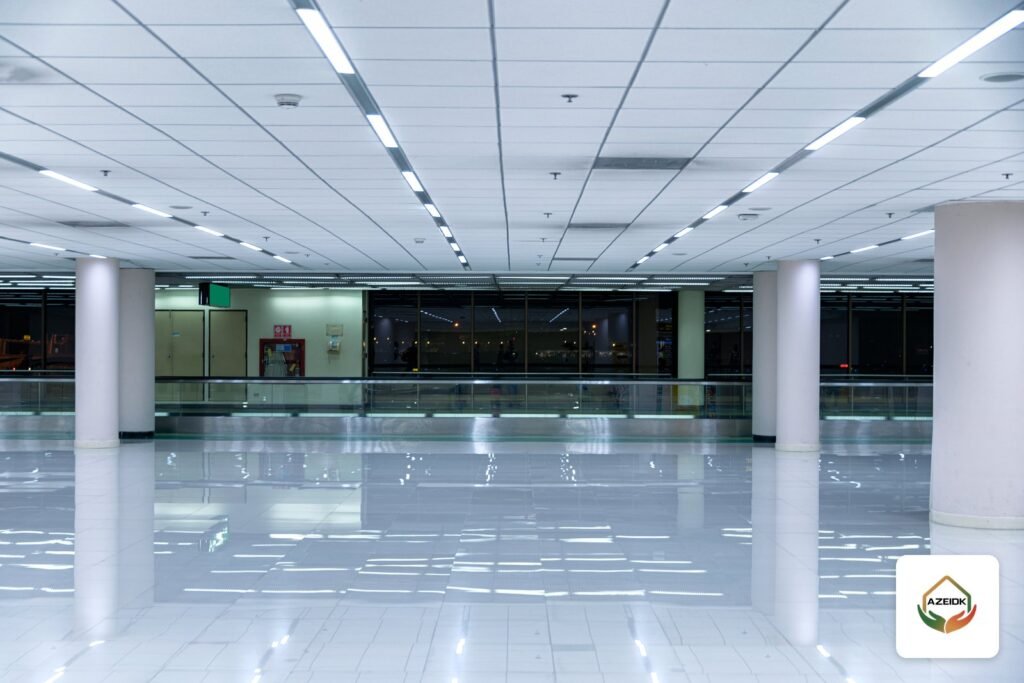
A Salamah certificate for malls is not one certificate that covers everything under the roof. The shopping centre needs Civil Defense approval before it is licensed, and every tenant trading under its own commercial registration applies for a licence for its own premises and activity on the Salamah platform. Mall management answers for the shared building systems; the tenant answers for its fit-out and for not weakening those systems.
This article sets out where each licence starts and stops, how responsibility splits between the owner, mall management and tenants, and what to prepare before an inspection. Under its Civil Defense approval support service, AZEIDK prepares and follows licence files on Salamah. See also what we do for the sector on the malls and commercial buildings page.
Key takeaways
- The Ministry of Municipalities and Housing requirements for commercial complexes (2024) require Civil Defense approval before the complex licence is issued.
- The municipal licence for a complex is issued to the complex management office only; shops hold licences for their own activities.
- Salamah issues the Civil Defense licence per facility and splits activities into direct (low to medium risk) and indirect (high risk).
- A licence is valid for one year from final approval, and renewal can be requested one month before expiry.
- Shared systems (sprinklers, fire alarm, fire pumps, smoke extraction, emergency exits) stay with mall management; any change to them inside a unit needs management approval.
In this article
- Does every shop in a mall need its own Salamah certificate?
- Salamah certificate for malls: building licence vs tenant licence
- Who is responsible for shared fire systems in a mall?
- What does the tenant handle inside the unit?
- How does a tenant fit-out affect the building licence?
- What does Civil Defense check in shopping centres?
- What documents are needed for a mall or a mall shop?
- Third-party liability insurance and crowded places
- Common mistakes between mall management and tenants
- Frequently asked questions
- Summary
Does every shop in a mall need its own Salamah certificate?
In most cases, yes. According to Elm, the company that developed the platform, Salamah lets an investor issue, renew, cancel and transfer the Civil Defense licence for its facility. A shop with its own commercial registration and activity is a separate facility in that sense. Its owner applies, and the licensing path follows the shop’s activity, not the mall’s classification.
On the building side, the Ministry’s requirements for commercial complexes and popular markets state that the municipal licence for a complex goes to the complex management office only, and that Civil Defense approval is needed before the licence is issued. So there are two levels:
- Building level: the complex licence, held by mall management or the owner, covering the building and its shared systems.
- Unit level: the tenant’s activity licence, covering its floor area, activity and fit-out inside the unit.
A shop licence does not replace the building licence, and the building licence is not issued on behalf of the shops. For the shop-side steps and how they tie in with the Balady licence, read Salamah certificate for retail shops.
Salamah certificate for malls: building licence vs tenant licence
The table shows the practical difference. The licensing columns follow the Ministry requirements and the Salamah platform description; the split of responsibilities is the usual practical arrangement, normally written into the lease and the mall’s tenant handbook.
| Item | Building licence (mall management) | Unit licence (tenant) |
|---|---|---|
| Who applies | Complex management office or owner | Holder of the activity’s commercial registration |
| Scope | Whole building, shared systems, corridors, car parks, plant rooms | Unit area, fit-out and activity |
| Salamah path | Set by activity classification and risk | Set by the shop’s activity: direct or indirect |
| Technical documents | System maintenance contracts, approved drawings, inspection records | Safety tools invoice or technical report, or a maintenance contract for high-risk activities |
| Validity | One year from final approval for each licence; renewal opens one month before expiry | |
Who is responsible for shared fire systems in a mall?
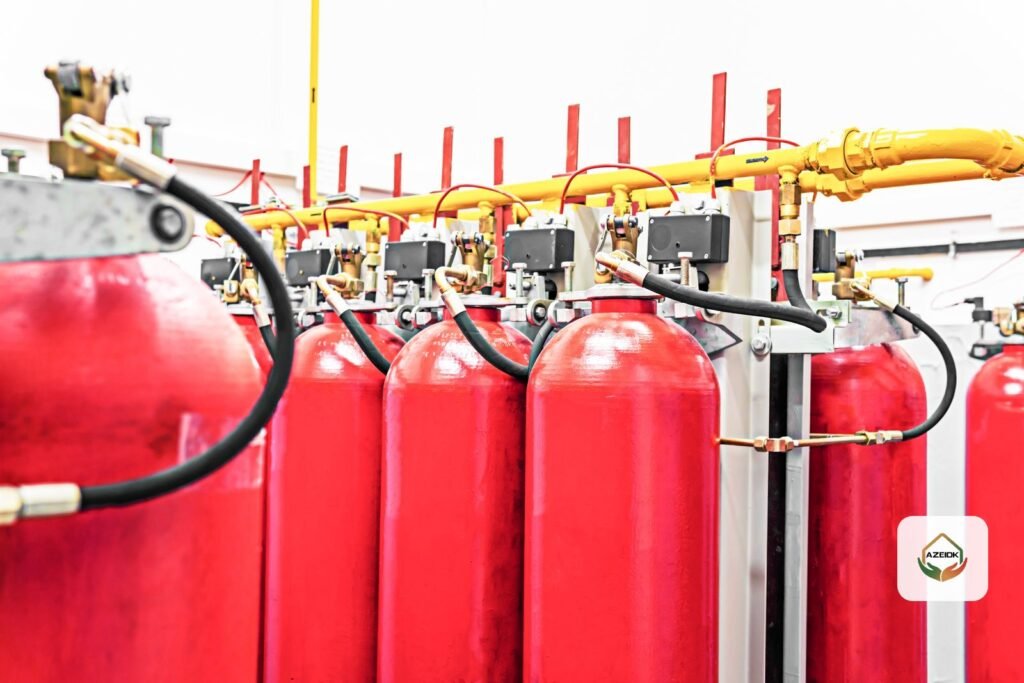
Systems that serve the whole building belong to the owner or mall management. They are part of the building licence, and tenants have no authority to operate or alter them. The Ministry requirements call for periodic and preventive maintenance of structural elements and all installations, and refer fire requirements to the Saudi Fire Protection Code (SBC 801). In practice, management holds:
- The fire pump room, water storage, sprinkler mains and zone control valves.
- The main fire alarm panel, detectors and manual call points in common corridors, plus voice evacuation where installed.
- Smoke extraction and emergency ventilation in corridors and atriums.
- Emergency exits, stairs, exit signs and emergency lighting in common areas.
- Hose reel cabinets and extinguishers in corridors, car parks and plant rooms.
- CCTV, which the requirements say must follow the Security Surveillance Cameras Law and its regulations; see CCTV cameras for malls.
Engineering detail for each mall zone is in our mall and commercial building fire safety guide, so we do not repeat it here. For indirect activities, Salamah requires maintenance contracts with a qualified safety company before inspection, which is where annual maintenance contracts come in.
What does the tenant handle inside the unit?
The tenant answers for everything it adds inside its unit, and for making sure its works do not weaken building systems. This is a common split in tenant handbooks, not a clause from a specific regulation:
- Extinguishers suited to the activity and floor area, and internal exit signage.
- Keeping sprinkler and detector coverage intact after false ceilings, shelving and partitions go in.
- Kitchen hood suppression for restaurants and cafes cooking with oil, interfaced with the building alarm with management approval.
- No storage of materials unrelated to the activity, which the Ministry requirements prohibit.
- Keeping the shop exit and the corridor in front of it free of stock and display stands.
Shop-level requirements are covered in safety requirements for retail shops.
How does a tenant fit-out affect the building licence?
Fit-out is the biggest source of change to a mall’s fire systems after handover. A new false ceiling can block sprinklers, a partition can create a room with no detector, and a mezzanine can add area the network does not cover. The Ministry requirements allow a larger mezzanine, up to one half of the floor below, only where the floor has an approved automatic suppression system and audible alarm. A mezzanine decision in a shop is therefore tied directly to building systems.
That is why mall managers usually require approved shop drawings before works start, a hot work permit, and isolation of any sprinkler zone taken out of service, restored before opening. If a fit-out leaves a defect on shared systems, it can surface in the building inspection or at renewal, not only in the shop file. AZEIDK recommends that the fit-out contractor hands over for every unit:
- As-built sprinkler and detector layout.
- Pressure test record for any new pipework.
- Test record for added detectors and their connection to the main panel.
- Written management approval of the changes.
What does Civil Defense check in shopping centres?
The official sources we reviewed do not publish a mall-specific inspection checklist. The technical reference named in the Ministry requirements is SBC 801, and Salamah links high-risk activities to maintenance contracts followed by inspection. The list below comes from preparing files and is meant for self-review before a visit:
| Item | What to have ready | Usually owned by |
|---|---|---|
| Fire pumps and network | Healthy automatic start, valves open and secured, periodic test log | Mall management |
| Fire alarm | Panel free of faults, detector coverage in units after fit-out, interface tests | Management, and the tenant inside its unit |
| Smoke extraction | Extract fans and make-up air openings operating on alarm | Mall management |
| Emergency exits | Clear routes, doors opening in the direction of travel, working lights and signs | Management, and the tenant at its frontage |
| Extinguishers and hose cabinets | Serviceable, inspected and in place | Each party in its area |
| Restaurants | Kitchen hood suppression and its maintenance | Tenant |
| Documents | Maintenance contracts, fire safety log book, approved drawings | Each party for its own licence |
What documents are needed for a mall or a mall shop?
It depends on the path. Per the Salamah platform description, direct activities need a safety tools invoice from a qualified safety company or a technical report from an engineering office approved on the platform, entered with the application. Indirect activities need a contract with a safety company and maintenance contracts before Civil Defense starts inspection. The Ministry requirements also call for a valid commercial registration that lists the activity being licensed. The platform’s “investor journey” service (salamah.998.gov.sa) shows which category an activity falls into. For a full explanation of each document, see the Civil Defense Salamah certificate guide.
Third-party liability insurance and crowded places
On 16 August 2026 the Insurance Authority, with the General Directorate of Civil Defense, launched a cooperative third-party civil liability policy for crowded places and high-risk activities, based on Council of Ministers Decision No. (103). It is a requirement of the Civil Defense licence for the activities it covers and will be applied in phases. The announcement gives economic, commercial, recreational and health activities as examples but does not name malls specifically, so mall management should watch what Salamah asks for at renewal.
Common mistakes between mall management and tenants
- Assuming the mall licence covers the shops, so a tenant opens without a licence for its activity.
- A tenant’s contractor fitting out without the base-build contractor reviewing the sprinkler layout.
- A building maintenance contract that does not list the systems actually installed, or that expires before the licence.
- Closing a zone valve for shop works and not reopening it.
- A new food court unit whose hood suppression is not interfaced with the building alarm.
- Stock in common corridors and exit routes during sale seasons.
- Changing a shop’s activity or area without amending the licence, even though that can change its path.
Frequently asked questions
Does a Salamah certificate for a mall cover the tenant shops?
No. The complex licence is issued to its management and covers the building and shared systems. Each tenant with its own commercial registration and activity applies for its own licence on Salamah.
How long is a Salamah licence valid?
One year from final Civil Defense approval. Renewal can be requested one month before expiry using the renewal icon next to the licence.
Can a commercial complex be licensed without Civil Defense approval?
No. The Ministry of Municipalities and Housing requirements for commercial complexes require Civil Defense approval before the licence is issued.
What does the Salamah platform do?
It is the Civil Defense portal for issuing, renewing, cancelling and transferring licences. Safety companies issue invoices and maintenance contracts on it, and engineering offices issue technical reports.
Do small shops face the same requirements as the mall?
No. Requirements follow the activity classification: low to medium risk activities are licensed on a safety tools invoice or technical report, while high-risk activities need maintenance contracts and an inspection.
What does a Salamah licence for a mall shop cost?
It depends on the activity and its path, missing tools or systems in the unit, whether a technical report or maintenance contract is needed, and how much the fit-out changed. The cost is set after a site survey.
Who closes Civil Defense observations on shared systems?
Mall management, as holder of the building licence and its maintenance contracts. Where a tenant’s works caused the issue, the lease usually makes the tenant fix it.
Summary
A Salamah certificate for malls is a two-layer file: a building licence that management carries along with the shared systems and their maintenance contracts, and a licence for each tenant activity according to its Salamah classification. The two meet at fit-out, and controlling it with approved drawings and test records before each shop opens protects both licences.
Running a mall or fitting out a unit in a shopping centre? Send us the activity, drawings and system status, and we will set out the path, documents and open items before you apply on Salamah. Talk to the AZEIDK team
Related guides
- Bakery Safety Requirements in Saudi Arabia: Gas, Tannour, Hood and Kitchen Extinguisher
- AFC OS&Y Gate Valves: Types and Valve Position Supervision in Saudi Projects
- Kitchen Fire Suppression System Price in Saudi Arabia: What Drives the Cost (Hood Length, Appliances, Automatic Gas Shut-off) and How to Compare Quotations
- WATEX Fire Pumps: The Complete Guide to WATEX Pumps in Saudi Arabia (Models, Approvals, Capacities)