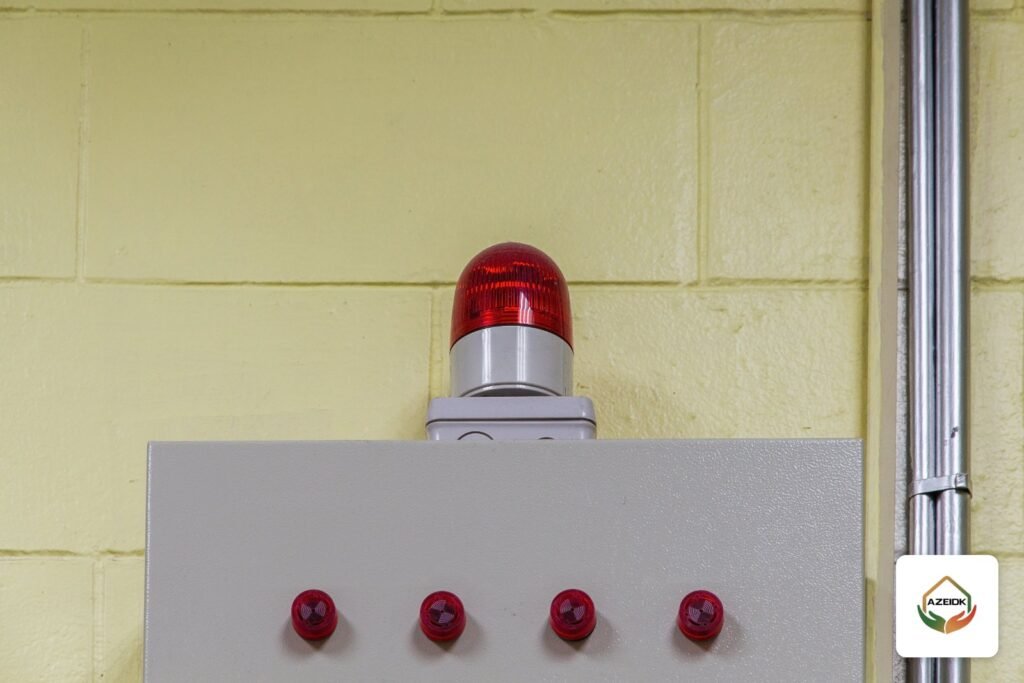
An outdoor fire alarm sounder (weatherproof sounder) is an audible, or audible and visual, alarm device in an enclosure sealed against dust and water jets, used on roofs, in car parks, yards and open plant areas. AZEIDK supplies seven IP65 Context Plus models in Saudi Arabia: four for conventional systems (CP400SR, CP450SER, CP550DB and CP750CDB) and three for addressable systems (CON430A/CX/DR/65, CON433A/CX/DR/65 and 55000-005IMC).
For how conventional and addressable systems compare, see our guide to choosing a fire alarm system for Saudi projects.
This guide explains what IP65 actually means, compares the seven models using the figures on their product pages, and shows how to choose between conventional and addressable, and between sound only and sound with a beacon, in Saudi conditions.
Key takeaways
- IP65 means fully dust-tight and protected against water jets from any direction, under IEC 60529.
- Standard indoor sounders rated IP21C or IP33C are not suitable for roofs and open yards.
- Conventional systems: CP400SR and CP550DB for sound, CP450SER and CP750CDB for sound with a beacon.
- Addressable systems: CON430A/CX/DR/65 for 103 dB sound, CON433A/CX/DR/65 and 55000-005IMC for sound with a beacon, all with a built-in isolator.
- The IP rating is not enough on its own: check approval, sound level, current and mounting position for each location.
In this article
- What does IP65 mean for an outdoor fire alarm sounder?
- Outdoor sounders for conventional systems
- Outdoor sounders for addressable systems
- Where do you need a weatherproof sounder?
- How to choose the right model
- Installation tips for outdoor locations
- Maintaining outdoor sounders
- Frequently asked questions
- Summary
What does IP65 mean for an outdoor fire alarm sounder?
The IP code in IEC 60529 has two digits. The first digit, 6, means the enclosure is dust-tight: no dust enters in a dust chamber test. The second digit, 5, means water jets aimed at the enclosure from any direction cause no harmful effect, tested with a 6.3 mm nozzle at 12.5 litres per minute from 2.5 to 3 metres for 3 minutes.
In Saudi Arabia the first digit matters a great deal: dust and sandstorms in yards and open warehouses. The second matters in car parks washed down with hoses, roofs exposed to rain, and wet pump and plant rooms. Heat and sunlight are not covered by the IP code, so check the operating temperature limits on each model’s datasheet.
Outdoor sounders for conventional systems
| Model | Type | Published sound level | Voltage and current | Notes |
|---|---|---|---|---|
| CP400SR | Wall sounder | Up to 100 dB(A) | 8 to 28 V, 13 mA at 24 V | 4 tones, volume control, third wire for second-stage alarm |
| CP450SER | Sounder beacon | 103 dB(A) per order code | 20 to 28 V | 4 tones, high-brightness LED with Fresnel lens |
| CP550DB | FirePlus sounder | 82.1 / 97.6 / 102.3 dB(A) | 24 V, 8.3 / 16.4 / 30.8 mA | 32 tones plus override, base lock, EN 54-3, LPCB approved |
| CP750CDB | FirePlus sounder beacon | 79.7 / 95.4 / 99.1 dB(A) | 24 V, 10.8 / 19.9 / 34.4 mA | 32 tones, beacon-only mode, sounder to EN 54-3, Intertek approved |
The three values for the CP550DB and CP750CDB are the low, medium and high settings for tone 1 at 1 m. Current roughly doubles with each step, so setting every device to high raises the alarm circuit load and battery capacity.
Outdoor sounders for addressable systems
| Model | Type | Sound level | Alarm current | Notes |
|---|---|---|---|---|
| CON430A/CX/DR/65 | Wall sounder | 103 dB(A) at 1 m | 5 mA at 24 V | Built-in isolator, 7 volume levels, up to 15 tone pairs, 114 mm diameter, 132 mm deep |
| CON433A/CX/DR/65 | Sounder beacon | 103 dB(A) at 1 m | 14 mA at 24 V | W-2.4-8.2 beacon, built-in isolator |
| 55000-005IMC | Sounder beacon, red lens | 100 dB(A) nominal | 8 mA | 17 to 28 V, built-in isolator, EN 54-3, LPCB approved, typically up to 15 per loop subject to loading calculation |
Addressable models draw power from the loop, are supervised as individual devices, and their built-in isolator separates a short in the outdoor cable from the rest of the loop. This matters for cables run across roofs and boundary walls, which are more exposed to damage than indoor cabling.
Where do you need a weatherproof sounder?
- Open and semi-open car parks: dust, floor washing and exhaust. A beacon helps because engine noise can mask sound.
- Roofs and exposed plant areas: HVAC units, generators and water tanks.
- Warehouse and loading yards: drivers and staff working outside must receive the alarm. See warehouses and logistics.
- Factories and pump rooms: moisture, industrial dust and high noise, as in industrial fire alarm systems.
- External entrances and assembly points: where the design calls for an audible alarm outside the building.
How to choose the right model
- System type first: conventional sounders go on the sounder circuit of a conventional panel, addressable ones on the loop. One cannot replace the other.
- Sound level against noise: the alarm must be clearly heard above ambient noise. Open yards have no walls to reflect sound, so more devices or a higher-output model may be needed. See fire alarm bells, sounders and strobes.
- Visual signal needed? In noisy areas or where staff wear ear protection, add a beacon. The W-2.4-8.2 rating of the CON433A means wall mounting at 2.4 m with at least 0.4 lux throughout a coverage volume with an 8.2 × 8.2 m base, under EN 54-23.
- Required approval: the pages list EN 54-3 and LPCB for some models, Intertek for the CP750CDB, and EN54 compliance for the CP400SR and CP450SER. Request the certificate for the exact model and match it to the project specification.
- Electrical load: total the current of every sounder at the chosen setting; the gap between 8.3 and 30.8 mA on the CP550DB is significant across a project.
Installation tips for outdoor locations
- Use the deep base and surface wiring cover; the CP550DB and CP750CDB come with a removable cover for surface wiring.
- Enter cables from below where possible and use suitable glands so the IP65 rating is not lost at the entry.
- Avoid mounting in a drainage path or directly under roof gutters.
- Use cable suited to outdoor routing with mechanical protection, as discussed in fire alarm cables.
- Test audibility on site during commissioning, not only on paper.
Maintaining outdoor sounders
Outdoor devices face what indoor ones do not: dust building up on sound openings and beacon lenses, seals ageing in the heat, and cable entries loosened after other work on the roof. Periodic visits should check the housing, seal and cable entry, clean the lens, operate the device to confirm clear sound and flash, and record the result in the system log. These devices can be included in a preventive maintenance contract for fire systems, as in fire alarm system maintenance.
Frequently asked questions
What is the difference between an outdoor and an indoor fire alarm sounder?
Outdoor models have an IP65 enclosure, dust-tight and protected against water jets. Indoor models are often rated IP21C or IP33C, which is not suitable for exposed locations.
What is the highest sound level among Context Plus outdoor sounders?
103 dB(A) at 1 m on the CON430A/CX/DR/65 and CON433A/CX/DR/65, the same figure given in the CP450SER order code.
Is IP65 enough for locations in direct sun?
IP65 covers dust and water only. Temperature limits and UV resistance are checked on each model’s datasheet.
Can the CP750CDB beacon run without sound?
Yes, the product page lists a switch-selectable beacon-only setting.
How many 55000-005IMC sounders can go on one loop?
The page states typically up to 15 per loop, subject to the project’s loop loading calculation.
Can I use a conventional sounder with an addressable panel?
Not directly on the loop. A conventional sounder needs a conventional sounder circuit or a suitable control module, per the manufacturer’s instructions.
Summary
A good outdoor sounder combines three things: an IP65 enclosure for dust and water, a sound level suited to open space, and an approval that matches the project specification. Choose from the conventional or addressable models to suit your system, and add a beacon where noise masks sound. For complete solutions see fire alarm systems.
Have a roof, car park or yard that needs a clear alarm? Send us the drawing and system type, and the AZEIDK team will select the models, quantities and sound level. Contact the AZEIDK team
Related guides
- Comprehensive vs Non-Comprehensive Fire and Security Maintenance Contracts: Spare Parts, Emergency Call-Outs and How to Choose
- Upgrading an Old CCTV System: IP, HD over Coax (PoC/Turbo HD), and What to Keep or Replace
- License Plate Recognition Camera (ANPR/LPR) for Car Park Entrances: How the Hikvision DS-TMC407-EH All-in-One Entry/Exit Unit Works and What Drives Read Accuracy
- Building Compliance Certificate on Balady: Civil Defense and Fire System Tests Before Occupancy