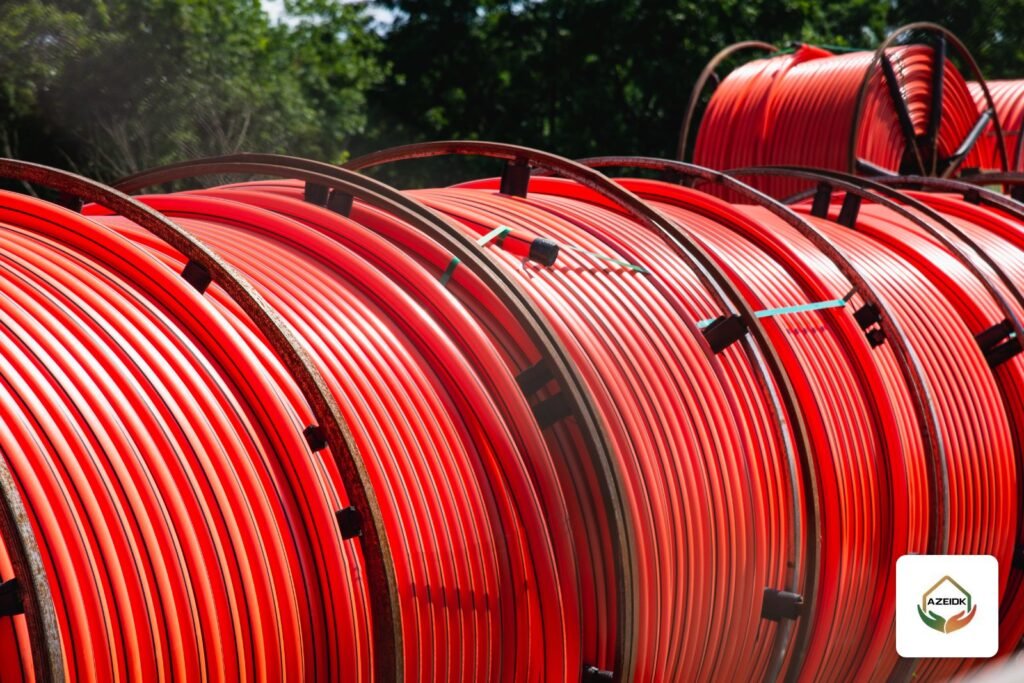
A fire alarm cable rated FPLR, such as the Belden 9581, is tested to limit flame spread in a riser; it is not tested to keep a circuit working in a fire. A fire-resistant cable, such as the Belden 79001FS Safe-T-Line rated BS 6387 CWZ, is tested for circuit integrity under flame. The approved design decides which circuits need which.
AZEIDK supplies both families in Saudi Arabia within its fire alarm cables range: Belden, the Fire World FPLR cable and the Falcon Gold shielded cable, plus the Belden 3107A for RS-485 panel networks. This guide compares them using the manufacturers’ datasheets.
Key takeaways
- FPLR is a US cable type under NEC Article 760: a power-limited fire alarm cable suitable for risers. It describes flame-spread behaviour, not survival in a fire.
- BS 6387 CWZ, EN 50200 and IEC 60331-2 are circuit integrity tests: the cable keeps carrying the signal while in the flame for a stated time.
- Belden 9581 is a 2 x 14 AWG FPLR cable with PVC insulation; Belden 79001FS is a 2 x 1.5 mm² fire-resistant cable with silicone rubber insulation and an LSZH jacket.
- A foil shield reduces electrical interference. It adds no fire resistance.
- When a quotation calls a cable “armoured”, check whether it means a foil shield; the 9581 has a shield, not metal armour.
In this article
- FPLR fire alarm cable vs fire-resistant cable: what is the difference?
- What does FPLR mean on a fire alarm cable?
- What do BS 6387 CWZ, EN 50200 and IEC 60331-2 mean?
- Belden 9581: what the datasheet says about this FPLR cable
- Belden 79001FS Safe-T-Line: the BS 6387 fire-resistant cable
- Comparison of the fire alarm cables AZEIDK supplies
- When do you need a fire-resistant cable instead of FPLR?
- Where does Belden 3107A fit in a fire alarm system?
- What to check on the datasheet before the submittal
- Common site mistakes
- How AZEIDK helps you choose a fire alarm cable
- FAQ
- Conclusion
FPLR fire alarm cable vs fire-resistant cable: what is the difference?
Each test answers a different question. The FPLR test asks whether a burning bundle of cables in a riser will carry fire from floor to floor. The fire-resistant test asks whether the circuit still carries its signal or power while the cable itself is in the fire.
A cable can pass the flame-spread test and still lose its insulation within minutes of direct fire exposure, which opens the circuit. That is acceptable only for circuits that are not required to survive the fire. The general rules are covered in our fire alarm cables and circuit integrity guide; this article applies them to specific products.
What does FPLR mean on a fire alarm cable?
Article 760 of the US National Electrical Code (NFPA 70) divides power-limited fire alarm cables into three types by installation space:
- FPLP: plenum (air-handling spaces), the most demanding flame and smoke test.
- FPLR: riser, i.e. vertical runs between floors, tested to the UL 1666 riser test or equivalent.
- FPL: general use.
These cables are listed to UL 1424 (Cables for Power-Limited Fire-Alarm Circuits). A higher-rated type can replace a lower one: FPLP may be used where FPLR is permitted, not the reverse. None of the three carries a circuit integrity rating; circuit integrity cables have their own NEC type (CI), with the hourly rating printed on the jacket.
What do BS 6387 CWZ, EN 50200 and IEC 60331-2 mean?
These British, European and international standards test whether a circuit survives fire. The Belden 79001FS datasheet explains the three BS 6387 letters:
| Test | What it checks | Condition as stated by the source |
|---|---|---|
| BS 6387 category C | Fire alone | 950°C for 180 minutes |
| BS 6387 category W | Fire, then water | 650°C, 15 minutes fire then 15 minutes fire with water spray |
| BS 6387 category Z | Fire with mechanical shock | 950°C for 15 minutes with repeated impacts |
| EN 50200 (PH15 to PH120) | Fire with shock, small cables up to 20 mm diameter | PH rating = minutes of maintained circuit integrity; Annex E adds water spray |
| IEC 60331-2 | Fire with shock, cables up to 20 mm diameter | At least 830°C, cables rated up to 0.6/1 kV |
Where the consultant writes British specifications, note that Prysmian states BS 6387 is no longer required by UK codes of practice for alarm systems, and that BS 5839-1 asks for PH30 plus BS EN 50200 Annex E for “standard” cables and PH120 with additional testing for “enhanced” cables. Match the submittal to the reference written in the specification.
Belden 9581: what the datasheet says about this FPLR cable
According to the Belden datasheet published on the AZEIDK product page, the 9581 has two 14 AWG solid bare copper conductors, 0.56 mm PVC insulation, an overall Beldfoil aluminium/polyester shield with 100% coverage and a 16 AWG tinned copper drain wire, and a red 1.1 mm PVC jacket with a nominal diameter of 7.77 mm.
- Ratings: NEC Article 760 FPLR; UL 1666 riser, FT4 and IEC 60332-1-2 flame tests; CPR Euroclass Eca.
- Voltage and temperature: 300 V UL rating; operating range -40 to +105°C.
- Electrical: nominal conductor DCR 2.62 ohm/1000 ft.
- Installation: minimum bend radius 117 mm; maximum pull tension 56.2 kg.
- Applications listed by Belden: fire alarms, indoor applications, low-voltage analogue signals (4-20 mA, 0-10 V) and low-voltage control such as 24 V.
The datasheet lists no circuit integrity test. It is a standard fire alarm cable, not a fire-resistant one.
Belden 79001FS Safe-T-Line: the BS 6387 fire-resistant cable
Belden describes the Safe-T-Line 79001FS as an LPCB approved fire-resistant multi-conductor cable for circuit integrity. Datasheet highlights:
- Construction: 2 x 1.5 mm² solid bare copper (brown and blue), 0.7 mm silicone rubber insulation to BS 7655 EI2, aluminium/polyester shield with 100% coverage and a 0.8 mm tinned copper drain wire, LSZH jacket, nominal diameter 7.85 mm.
- Fire resistance: BS 6387:2013 CWZ; EN 50200 PH30, PH60 and PH120; EN 50200 Annex E30; IEC 60331-2.
- Jacket behaviour: IEC 60332-1-2 and IEC 60332-3-24/-25 flame propagation, IEC 60754-1 halogen content, IEC 61034-2 smoke density with minimum 60% transmittance.
- Voltage and temperature: 300/500 V; operating -40 to +90°C; installation 0 to +70°C.
- Electrical and installation: maximum conductor DCR 12.1 ohm/km; minimum installation bend radius 47 mm.
- Applications listed by Belden: circuit integrity, intercom/PA, sound systems, control systems, fire alarm, voice evacuation, emergency and safety systems.
It is supplied in red and white on 100 m and 500 m reels.
Comparison of the fire alarm cables AZEIDK supplies
| Item | Belden 9581 | Belden 79001FS | Fire World FPLR | Falcon Gold shielded |
|---|---|---|---|---|
| Family | FPLR alarm cable | Fire-resistant cable | FPLR alarm cable | Shielded alarm cable |
| Conductors | 2 x 14 AWG solid copper | 2 x 1.5 mm² solid copper | 2 x 14, 16 or 18 AWG solid copper | 2 x 16 or 18 AWG CCA |
| Insulation | PVC | Silicone rubber | PVC | PVC |
| Jacket | Red PVC | LSZH | Red PVC | Red PVC |
| Stated reference | NEC 760 FPLR, UL 1666 | BS 6387 CWZ, EN 50200 PH120, IEC 60331-2, LPCB | UL 1424 (FPLR) | No circuit integrity rating stated |
| Circuit integrity | Not stated | Yes, per the tests above | Not stated | Not stated |
Fire World and Falcon Gold data come from the AZEIDK product pages. The Fire World cable comes in three sizes with order codes FPRL-UL14FW, FPRL-UL16FW and FPRL-UL18FW, operates up to 105°C and is associated with UL file E543704 according to the supplied documentation. The Falcon Gold cable uses copper-clad aluminium (CCA) conductors, is rated up to 300 V and comes on 100 m or 305 m reels; its page describes the PVC as fire-resistant, which describes the material, not a circuit integrity rating. See also our Fire World article.
When do you need a fire-resistant cable instead of FPLR?
On Saudi projects, the design approved under the Saudi Fire Protection Code (SBC 801) and Civil Defense requirements sets the rating of each circuit. Many consultants use NFPA 72 as the technical reference for alarm systems, which grades pathway survivability in levels. Consulting-Specifying Engineer summarises them for the 2025 edition as follows:
- Level 0: no survivability provisions.
- Level 1: standard fire alarm cable in a fully sprinklered building, provided it runs in metal conduit or is metal-armored cable.
- Level 2: 2-hour circuit integrity cable, a 2-hour cable system, a 2-hour rated enclosure or protected area, or a 2-hour alternative approved by the AHJ.
- Level 3: Level 2 measures plus full sprinkler protection.
- Level 4: added in the 2022 edition; one-hour fire-rated cables or enclosures.
The levels are not a single hierarchy but options with different performance criteria; the approved design sets the level for each pathway.
The need usually arises in voice evacuation circuits that use partial evacuation or in-building relocation, and in control circuits that must work during a fire. Detector and call point circuits on many projects can use FPLR unless the design says otherwise.
One point that is often missed: PH120 or BS 6387 category C does not automatically equal “2 hours” in the NFPA 72 sense, because the test methods differ. If the specification is US-based, the consultant and the authority decide whether a cable tested to British and European standards is acceptable, before supply, not after.
Where does Belden 3107A fit in a fire alarm system?
The Belden 3107A is not an alarm cable in the sense above. It is an RS-485 data cable with two pairs of 22 AWG (7×30) tinned copper conductors, foam PE insulation, Beldfoil (100%) plus 65% tinned copper braid shielding, and an oil-resistant PVC jacket rated CM and PLTC. The AZEIDK product page lists networking fire alarm panels and repeaters and BMS buses among its uses.
Before using it between panels, check three things: the panel manufacturer accepts this cable type, its rating suits the installation space, and the network path itself does not require survivability, because the 3107A has no circuit integrity rating.
What to check on the datasheet before the submittal
- The model number printed on the jacket, and that it matches the BOQ.
- Conductor size and material (copper or CCA) against circuit length, voltage drop and panel manufacturer requirements.
- The reference the specification asks for: FPLR, CI, an EN 50200 PH class or BS 6387 CWZ.
- The test or listing body certificate (such as LPCB or UL) for that exact model, verified in the body’s official directory.
- Installation temperature limits, bend radius and the fixing method the cable was tested with.
Common site mistakes
- Treating a red cable as fire-resistant because of its colour.
- Reading “armoured” as fire protection when it means a foil shield.
- Fixing a fire-resistant cable with plastic clips that fail in a fire, which defeats the cable.
How AZEIDK helps you choose a fire alarm cable
AZEIDK supplies these cables with the official datasheet for each model. Our team reviews your cable schedule and riser diagram, matches each circuit with the right type through our technical supply service and prepares the approval file for the consultant. See also our fire alarm systems solutions and the fire alarm cable types and sizes guide.
FAQ
Is FPLR cable fire-resistant?
No. FPLR covers flame spread in risers. It does not mean the circuit keeps working in a fire. Fire-resistant cables carry a separate rating such as EN 50200 PH, BS 6387 or CI.
What does BS 6387 CWZ mean on a fire alarm cable?
C: 950°C for 3 hours. W: fire at 650°C followed by water spray. Z: 950°C with mechanical shock for 15 minutes. The circuit must stay intact in all three.
Is a shielded cable better in a fire?
No. The shield only reduces interference. Fire resistance comes from the insulation and the test it passed, such as the silicone insulation of the Belden 79001FS.
Which fire alarm cable size should I choose?
Circuit length, device load, voltage drop and panel manufacturer requirements decide. 14, 16 or 18 AWG are common for FPLR circuits and 1.5 mm² for fire-resistant cables.
Can Belden 3107A replace a fire alarm cable?
No. It is an RS-485 data cable for panel and network links, with no FPLR or fire-resistant rating, used only where the panel manufacturer and the design accept it.
Conclusion
Choosing a fire alarm cable starts with one question: must this circuit keep working during a fire? If not, an FPLR cable such as the Belden 9581 or Fire World does the job. If it must, you need a fire-resistant cable such as the Belden 79001FS, with a rating that matches the project specification and suitable fixings.
Have a cable schedule for a fire alarm project? Send the drawings, BOQ and specification, and we will propose the right type for each circuit with datasheets. Contact the AZEIDK team