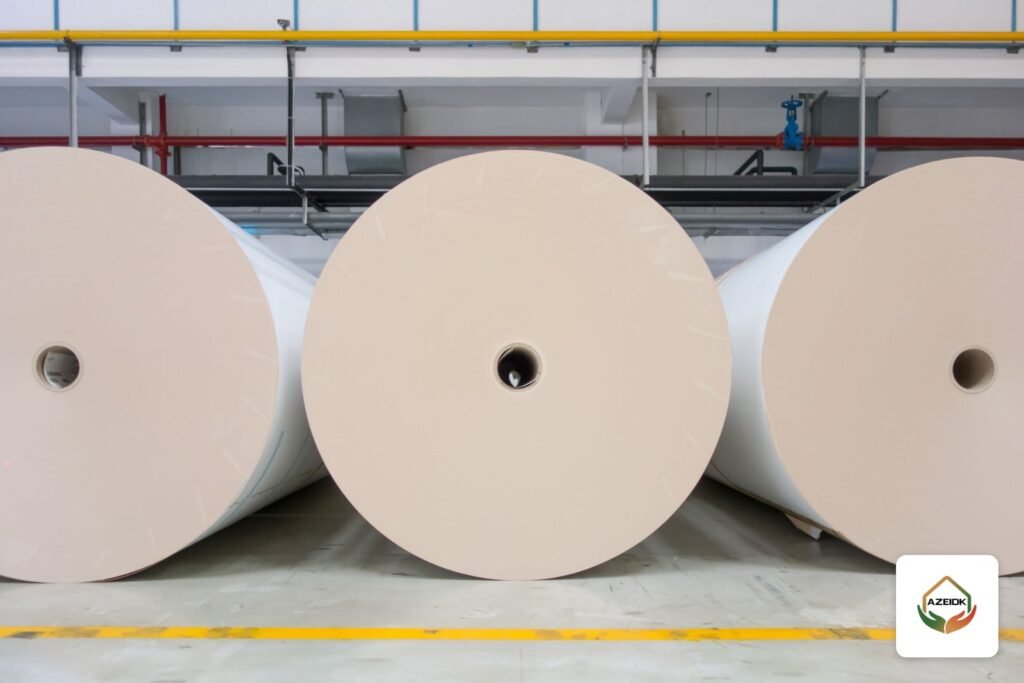
Printing press fire protection differs from protecting an ordinary factory because a print plant brings three hazards together: flammable inks and solvents, large stocks of roll paper and finished print, and electrically driven presses running long shifts. A printing plant and its paper store therefore need correct occupancy classification, separation between the press hall, paper store and ink room, a zoned fire alarm, sprinklers designed for the way paper is stored, and extinguishers matched to each fire type. The municipal requirements for factories call for Civil Defense approval before licensing and compliance with SBC 801. This article explains how that protection is planned for printing presses and paper stores in Saudi Arabia.
Key takeaways
- The Municipal Requirements for Factories (Ministry of Municipalities and Housing, 1447 AH / 2025) require Civil Defense approval and an engineering report before licensing, fire barriers between occupancies per SBC 201, and compliance with SBC 801.
- Storage attached to a factory is capped at 25% of the licensed area or 150 m², whichever is smaller; beyond that (up to 50% of the area), storage must be added as a licensed activity under the warehouse requirements.
- Roll paper storage has its own criteria in NFPA 13, separate from general storage, because rolls burn differently.
- Inks and solvents are kept in a separate room in limited quantities, designed to flammable liquid requirements.
- Local suppression on a press or ink room is a designer’s decision based on the hazard, and does not replace sprinklers where the code requires them.
In this article
- Why does printing press fire protection need special planning?
- How are a print plant and paper store classified?
- What do the municipal factory requirements ask of a print plant?
- Roll paper storage: why does it have its own criteria?
- Inks and solvents: a separate room and limited quantities
- Fire alarm in a print plant: how should zones be split?
- Suppression: sprinklers, local suppression and extinguishers
- Operating habits that cut fire risk in a print plant
- Licensing and maintenance
- Frequently asked questions
- Conclusion
Why does printing press fire protection need special planning?
A print plant fire rarely starts in the paper itself. It usually starts from a heat source or spark reaching an easily ignited material nearby, then finds a large fuel load in the stored paper and spreads fast. The main hazards:
- Inks, solvents and cleaning agents: some are flammable liquids, used daily around presses and for cleaning cylinders.
- Roll paper: large rolls stored on end or on their sides, where storage height and arrangement set fire severity.
- Finished print and cartons: large quantities of combustible material in the finished goods store.
- Machines and electrical panels: motors and control panels running for hours, plus dryers on some press types.
- Paper trim and dust: builds up around cutting and binding machines if not cleaned regularly.
How are a print plant and paper store classified?
In the International Building Code (IBC), whose structure SBC 201 follows, “printing or publishing” and “paper mills or products” are listed under the factory group F-1, while “books and paper in rolls or packs” are listed under storage group S-1. A print plant with a large paper store is in practice a building with two occupancies: industrial for printing and storage for paper and finished print.
The final classification is set by the designer from SBC 201, but the idea matters because it explains why the municipal requirements call for fire barriers between occupancies, and why the store’s protection is designed around storage arrangement rather than around the press hall.
What do the municipal factory requirements ask of a print plant?
The Municipal Requirements for Factories issued by the Ministry of Municipalities and Housing (1447 AH / 2025) do not name printing presses, but they are the municipal reference for industrial facilities. The fire and security items:
| Clause | Requirement | What it means for a print plant |
|---|---|---|
| 2.1 Licensing | Approval of the General Directorate of Civil Defense and an engineering report proving the building is suitable | Safety systems are part of the licensing file |
| 4.2 Building | Fire barriers between occupancies per SBC 201; walls, ceilings and finishes of fire-resistant materials | Separate the press hall from the paper store and ink room per the design |
| 4.2 Site | Enough space for fire appliances to manoeuvre on site | The yard is not filled with paper pallets |
| 4.4 Fire protection | Refer to all requirements of SBC 801 | Alarm, sprinklers and extinguishers come from the design |
| 4.5 Attached storage | Medium and low hazard storage up to 25% of the licensed area or 150 m², whichever is smaller; more (up to 50% of the area) requires adding storage as an activity under the warehouse requirements | A large paper store is licensed and designed as a warehouse |
| 5.4 CCTV | Security cameras under the Security Surveillance Cameras Law | Planned with the other low current systems |
Note also that the Requirements for Warehouses and Stores exclude facilities storing highly flammable or explosive materials and direct them to industrial zones. If solvent quantities are large, that is a question for the designer at licensing stage, not after.
Roll paper storage: why does it have its own criteria?
A paper roll does not burn like a carton. Outer layers peel away as they burn, exposing fresh layers, and fire climbs quickly up rolls stored on end. Rolls that absorb water can swell and stacks can lose stability. This is why NFPA 13 contains dedicated criteria for roll paper storage, separate from general commodity storage; the chapter number depends on the edition.
Roll paper is grouped by basis weight in storage standards, as described in an article published by Fire Engineering:
| Class | Examples | Fire behaviour |
|---|---|---|
| Heavyweight | Linerboard and carton board | Slightly slower to ignite, but spreads rapidly once established |
| Mediumweight | Newsprint and computer paper | Described in the article as perhaps the most prevalent paper type |
| Lightweight | Thin papers and light wrapping paper | Spreads faster than heavyweight |
| Tissue | Facial and bathroom tissue | The fastest burning of the rolls |
What the designer needs from you: paper type, storage arrangement (on end or on side), storage height, clearance to the ceiling, and whether rolls are banded or wrapped. These set sprinkler type and design density. If paper type or storage height changes later, the design must be reviewed.
Inks and solvents: a separate room and limited quantities
- Keep inks, solvents and cleaning agents in a separate room or dedicated cabinets, not next to paper rolls or presses.
- Keep only the daily working quantity in the press hall.
- Flammable liquid storage is designed under SBC 801, with NFPA 30 (Flammable and Combustible Liquids Code) as a common technical reference.
- Rags and wipes soaked in solvent go into covered metal containers emptied daily.
- Extinguishers near the ink room are suited to liquid fires (Class B), such as CO2, powder or foam depending on the materials.
Fire alarm in a print plant: how should zones be split?
Zone the alarm by department so the supervisor can read on the panel where a fire started:
- Press hall: the designer selects detector type based on ceiling height and the air in the hall. Vapours and heat around some machines can make a heat detector a better choice than a smoke detector at certain points. See heat detector types.
- Paper store and finished goods store: early detection, with a separate zone for each store.
- Ink and solvent room: its own zone, with devices suited to the space per the design.
- Cutting, binding and packing: its own zone, keeping in mind that paper dust can trigger alarms if not cleaned.
- Electrical rooms, compressor rooms and offices.
What happens on alarm, such as stopping ventilation or releasing fire doors held open on magnetic holders, is set in the cause and effect matrix. Supply, installation and programming come under fire alarm systems.
Suppression: sprinklers, local suppression and extinguishers
Sprinklers: whether they are required is set by SBC 801 based on occupancy and area; in the paper store they are designed to the NFPA 13 storage criteria for the paper type and height. Installation is part of fire fighting systems, and system types are compared in wet, dry, preaction and deluge sprinklers.
Local suppression: some plants need extra protection for a specific area, such as an ink room, a large press control cabinet or an electrical room. The system type (clean agent, CO2 or another) is chosen by the designer based on the hazard and whether people are present. These systems sit under special fire suppression systems, and agents are compared in clean agent suppression comparison.
| Area | Common extinguisher |
|---|---|
| Paper and finished goods store | Multi-purpose powder or foam, with hose cabinets per the design |
| Ink and solvent room | CO2, powder or foam suited to liquid fires |
| Presses and control panels | CO2 |
| Cutting and binding | Multi-purpose powder |
Types and sizes are in AZEIDK fire extinguishers, and layout rules in the NFPA 10 guide.
Operating habits that cut fire risk in a print plant
- Keep the clearance between the top of storage and the sprinklers set by the design, and never stack above the design height.
- Do not store paper rolls in aisles or in front of hose cabinets and electrical panels.
- Clean paper trim and dust from around machines daily.
- Keep fire doors between departments closed, or on holders that release on alarm.
- Record every inspection and maintenance visit in the fire safety log book for Civil Defense inspections.
Licensing and maintenance
In Civil Defense licensing on the Salamah platform the technical report is issued by engineering consultancy offices, and AZEIDK issues the safety equipment installation certificate for systems it installs, under Civil Defense approval support. Details are in our Salamah certificate guide.
After start-up, fire, safety and alarm systems are maintained under their own contract within periodic maintenance contracts, while CCTV and low current systems are maintained under a separate contract. For industrial facilities in general see factories and industrial facilities.
Frequently asked questions
What are the main fire hazards in a printing press?
Flammable inks and solvents, large stocks of roll paper and finished print, machines and electrical panels, and paper trim and dust building up around cutting and binding machines.
Does a print plant need Civil Defense approval?
Yes. The municipal factory requirements call for General Directorate of Civil Defense approval and an engineering report proving the building is suitable before licensing, and refer fire protection to SBC 801.
Why is sprinkler design different for roll paper storage?
Rolls burn differently from general commodities, so NFPA 13 has dedicated criteria based on paper type, storage arrangement and height.
Where should inks and solvents be kept in a print plant?
In a separate room or dedicated cabinets away from paper and presses, with only the daily quantity in the press hall, as designed under SBC 801.
Which extinguisher suits a printing press?
CO2 suits control panels and electrical parts because it leaves no residue; near solvents, use an extinguisher rated for liquid fires.
Can paper be stored inside the plant without a warehouse licence?
The municipal factory requirements allow attached storage up to 25% of the licensed area or 150 m², whichever is smaller. More than that (up to 50% of the total area) requires adding storage as an activity under the warehouse requirements.
Conclusion
Printing press fire protection starts with recognising that a print plant is a factory and a warehouse at the same time. Classify and separate the occupancies, isolate inks and solvents, give the designer accurate data on paper and how it is stored, then zone the alarm by department and match extinguishers to each fire type. Most print plant risks come from daily operation, so keeping to storage heights and good housekeeping remains part of the protection system.
Fitting out a new print plant or reviewing an existing paper store? Send the layout and storage data to the AZEIDK team to define fire alarm, sprinklers, extinguishers and local suppression, with the safety equipment installation certificate for licensing. Talk to the AZEIDK team
Related guides
- Saudi Security Surveillance Cameras Law: Facility Obligations, Recording and Retention
- CCTV Cameras for Hospitals and Medical Complexes: Emergency, Pharmacy, Entrances and Patient Privacy
- iVMS Meaning in CCTV: NVR, IPC, PTZ, CMS, PoE and IP Address Explained
- Sprinkler Head Types: K-Factor, Temperature Rating and Response