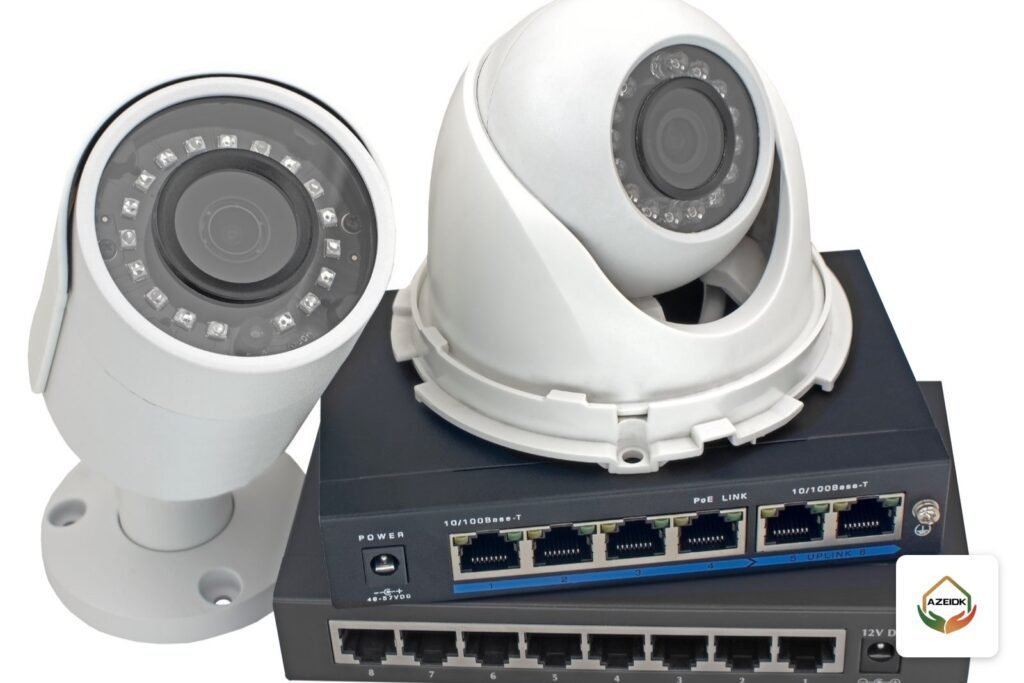
iVMS meaning in CCTV: iVMS is the name of Hikvision’s video management software family, best known as iVMS-4200, the PC client used to view cameras and recorders, play back footage and handle alarms. VMS stands for Video Management System. This guide explains, in plain terms, the words you meet in CCTV quotations and drawings: NVR, DVR, IPC, PTZ, CMS, PoE and the camera’s IP address, with examples from the security and surveillance systems AZEIDK supplies.
Key takeaways
- iVMS is Hikvision viewing and management software, not a device or a camera type.
- An NVR records IP cameras over the network; a DVR records analog and HD-over-coax cameras.
- IPC means IP camera (network camera); PTZ means a pan, tilt and zoom camera.
- A CMS manages several recorders or sites from one screen.
- PoE carries power and data on the same network cable, up to 100 m.
In this article
- iVMS meaning in CCTV: what is iVMS?
- CCTV terms at a glance
- What is the difference between an NVR and a DVR?
- What does IPC mean in CCTV?
- What does PTZ mean in CCTV?
- What is a CMS in CCTV?
- What is PoE and how much power does it deliver?
- CCTV IP address: how to find and change it
- Other terms you will see in a quotation
- Frequently asked questions
- Conclusion
iVMS meaning in CCTV: what is iVMS?
iVMS is the name Hikvision uses for its video management software. Most people mean iVMS-4200, which Hikvision’s datasheet describes as a client software application for Hikvision video surveillance, free to download and use. With it you add recorders and cameras by IP address or through Hik-Connect, watch live view, play back and export recordings, control PTZ cameras and receive alarms.
A VMS in general is any software that brings cameras and recorders into one interface. iVMS-4200 suits a shop, an office, a villa or a small number of devices. Once a project has several sites or a large camera count, it usually moves to a central platform, which is what CMS refers to below.
CCTV terms at a glance
| Term | Full name | What it means in practice |
|---|---|---|
| iVMS | Hikvision video management software name | PC software to view cameras and recordings |
| VMS | Video Management System | Any software that manages cameras and recorders |
| NVR | Network Video Recorder | Records IP cameras over the network |
| DVR | Digital Video Recorder | Records analog and HD cameras on coaxial cable |
| IPC | IP Camera | Network camera that sends video as data |
| PTZ | Pan-Tilt-Zoom | Moving camera: pan, tilt and optical zoom |
| CMS | Central Management System | Central control of several recorders or branches |
| PoE | Power over Ethernet | Power and data on one network cable |
| SADP | Search Active Devices Protocol | Hikvision tool to find devices on the network and change their address |
What is the difference between an NVR and a DVR?
An NVR receives video from IP cameras over the network, whether the cameras plug into PoE ports on the recorder or into a separate switch. One example AZEIDK supplies is the Hikvision DS-7608NXI-K1/B 8-channel NVR.
A DVR works with analog and HD cameras connected by coaxial cable, each camera on its own cable back to the recorder. The choice follows the cameras and cabling on site; see IP vs analog CCTV for a full comparison. Hard drive size and retention are a separate calculation, covered in CCTV storage and bandwidth calculation for NVR systems.
What does IPC mean in CCTV?
IPC is short for IP camera, also called a network camera. It compresses the image inside the camera and sends it as data over the network cable to an NVR or VMS. That is why Dahua network camera models start with IPC, for example the Dahua IPC-HFW2531T-ZS IP bullet camera. Hikvision calls them network cameras, and their model numbers usually start with DS-2CD.
Every IP camera has its own network address, resolution and compression settings and user permissions, so an IP system needs network planning, not just camera placement.
What does PTZ mean in CCTV?
PTZ stands for Pan-Tilt-Zoom: horizontal rotation (pan), up and down movement (tilt) and optical zoom. PTZ cameras watch yards, car parks, fences and wide gates, controlled by an operator from the software or running preset tours.
A PTZ camera does not replace fixed cameras: while it looks one way, it does not record the other. A typical design pairs fixed cameras for constant coverage with a PTZ for tracking and zoom. One example is the Hikvision DS-2SF8C442MXG-ELW/26 PTZ camera.
What is a CMS in CCTV?
CMS stands for Central Management System: software or a platform that brings several recorders or branches into one control room, with user permissions, alarms and maps. Unlike a simple client, a CMS is built to scale and to serve several operators.
Hikvision, for example, describes HikCentral Professional as its centralized video management system that brings together video surveillance and access control. The right platform depends on camera count, number of sites and how they connect, which is part of AZEIDK’s programming and systems integration service.
What is PoE and how much power does it deliver?
PoE (Power over Ethernet) powers the camera through the same network cable, so there is no adapter next to each camera. Power levels are set by IEEE standards, as summarised by chipmaker Microchip:
| Standard | Power from the switch | Minimum power at the device |
|---|---|---|
| IEEE 802.3af (Type 1) | 15 W | 12.95 W |
| IEEE 802.3at (Type 2) | 30 W | 25.5 W |
| IEEE 802.3bt (Type 3) | 60 W | 51 W |
| IEEE 802.3bt (Type 4) | 90 W | 71 W |
Standard network cable length is 100 m. PTZ cameras and cameras with heaters draw more than fixed cameras, so check each camera’s consumption on its datasheet and the switch’s total PoE budget, for example on a Hikvision DS-3E1309P-EI PoE switch. The full calculation is in PoE switch power budget for CCTV.
CCTV IP address: how to find and change it
Every IP camera and recorder needs an address inside the site network so the recorder and software can reach it. According to Hikvision’s SADP user manual, a device takes the default IP 192.168.1.64 after activation. SADP searches for active devices on the subnet, shows their addresses and lets you change basic network settings. For Dahua devices, check the model’s quick start guide for its default address and search tool.
Practical rules on site:
- Give each camera its own fixed address; several cameras left on the same default address will conflict.
- Keep cameras and recorder in the same subnet, or on a dedicated camera network where needed.
- Set a strong password at activation and record all addresses in the handover file.
- Update firmware only from the manufacturer’s own source.
Other terms you will see in a quotation
ONVIF: ONVIF is an open industry forum that provides standardized interfaces so IP security products from different makers can work together, such as one brand’s camera on another brand’s recorder. Confirm actual compatibility on the datasheets before mixing brands.
Hik-Connect: Hikvision’s service and app for remote viewing from a phone.
Channels: the number of cameras a recorder can take, for example an 8-channel unit.
For facilities in Saudi Arabia, review the legal duties in the security surveillance cameras law and facility obligations, and the installation steps in the CCTV installation guide.
Frequently asked questions
What is the iVMS meaning in CCTV?
iVMS is the name of Hikvision’s video management software, best known as iVMS-4200 for PC. It shows cameras and recorders, plays back footage and receives alarms.
Does iVMS-4200 work without a recorder?
It can add IP cameras directly by IP address for viewing, but continuous recording in a facility is normally done on an NVR or a dedicated recording platform.
What is the PTZ meaning in CCTV?
Pan-Tilt-Zoom: a camera that rotates, tilts and zooms optically, used for wide areas alongside fixed cameras.
What is the difference between an IPC and an NVR?
The IPC is the network camera itself; the NVR is the recorder that receives its video over the network and stores it on hard drives.
What is a CMS in CCTV?
A central management system that brings several recorders or branches into one interface with permissions and alarms, suited to large projects and control rooms.
How do I find a CCTV camera’s IP address?
Use the manufacturer’s search tool, such as SADP for Hikvision, which lists device addresses on the network. Per the SADP manual, the Hikvision default after activation is 192.168.1.64.
Conclusion
Once these terms are clear, a quotation is easier to check: iVMS is software, NVR and DVR are recorders, IPC and PTZ are camera types, CMS is central management, PoE powers the cameras, and each device needs its own IP address. What then decides a sound design is camera count and positions, retention period and the state of the site network.
Planning a CCTV system for your facility? AZEIDK designs, supplies and installs Hikvision and Dahua cameras and recorders, and programs the network and software. Talk to the AZEIDK team
Related guides
- Ansul R-102 or American Fire Control for Kitchen Fire Suppression: A Practical Comparison for Restaurants in Saudi Arabia
- Bakery Safety Requirements in Saudi Arabia: Gas, Tannour, Hood and Kitchen Extinguisher
- Integrated Fire and Life Safety Systems Testing Before Handover: Elevators, HVAC, Smoke Control and Doors Under NFPA 4
- WATEX UL-Listed Foam Bladder Tanks: Capacities, Specifications, Ratio Controllers and Sizing