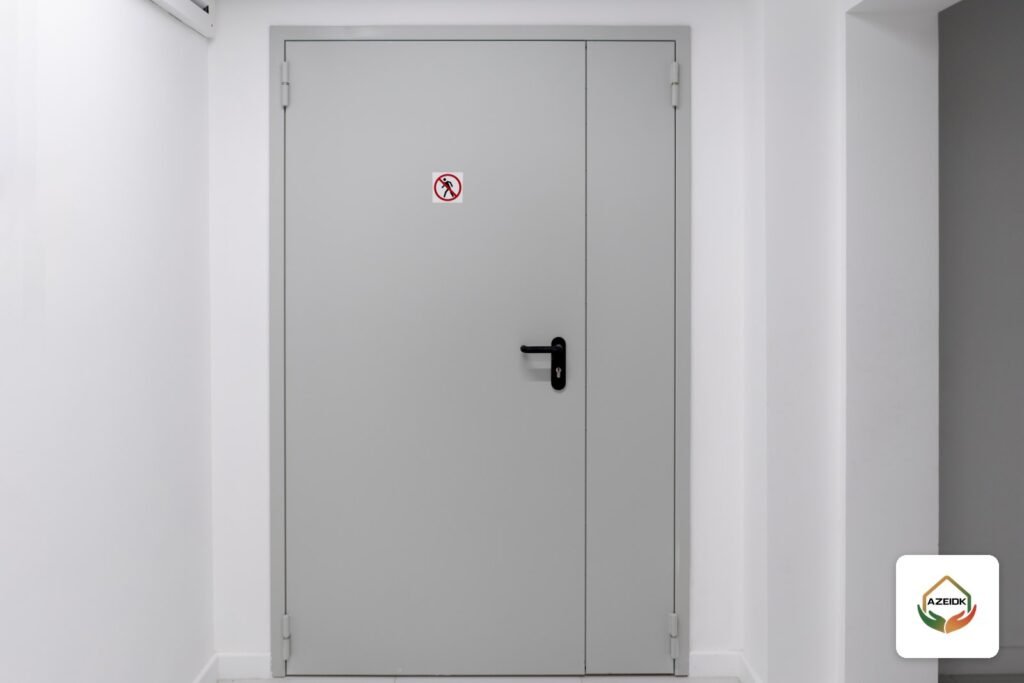
The price of fire-rated doors in Saudi Arabia is set by the whole assembly, not the leaf alone: the required fire rating (60, 90 or 120 minutes), size and number of leaves, any vision panel, the hardware (closer, panic bar, hinges, latch, seals), the frame, installation, and the documents proving the door is tested. Two quotes for the same number of doors can differ widely when these items differ.
Below we take each cost factor in turn and show how to write an RFQ that makes offers comparable. AZEIDK supplies, installs and inspects Falcon Gold metal fire doors as part of its fire-rated doors and emergency exit solutions. We do not quote SAR figures here, because a sound price is built from your project’s actual door schedule.
Key takeaways
- Pricing is built line by line from the door schedule.
- The supplier does not choose the rating. It comes from the rating of the wall shown on the approved drawings.
- Glazing in a fire door must be tested with that door. NFPA 80 limits glazing in 3-hour doors to 100 sq in per leaf.
- A door that will carry a panic bar must be ordered that way from the factory, because NFPA 80 requires a specific label on it.
- The cheapest quote is often incomplete: no hardware, installation or documents.
In this article
- What drives the price of a fire door?
- Is a 120-minute fire door more expensive than a 60-minute one?
- How do size and number of leaves affect the price of fire-rated doors?
- Vision panels: why glazing adds cost
- Is the panic bar included in the fire door price?
- The frame and the wall type
- How do you verify a fire door’s approval?
- Installation, inspection and maintenance: costs after purchase
- How to write an RFQ that makes quotes comparable
- Common mistakes that raise fire door costs
- Frequently asked questions
- Conclusion
What drives the price of a fire door?
A fire door is tested in a furnace as an assembly: leaf, frame, hinges, latch and closer, and sometimes glazing and a panic device. The common test standards for door assemblies are UL 10B, UL 10C (positive pressure) and NFPA 252, and all of them require the hardware to keep the door closed during the test. In practice every item on the door is part of the rating, so the price moves with every choice: rating, size and leaves, glazing, hardware, frame, documents and installation. Door components and site acceptance are covered in detail in Fire-Rated Doors: How to Order and Accept Them on Saudi Projects.
Is a 120-minute fire door more expensive than a 60-minute one?
Usually, yes. A longer rating needs an assembly tested for longer, typically with a core, frame and hardware to match, and fewer glazing and size options. The more useful question is which rating you actually need.
The rating follows the wall or room the door sits in, as shown on the consultant’s approved drawings. The Saudi Fire Protection Code (SBC 801) sets minimum requirements to protect life and property from fire hazards, and the 2024 edition of the Saudi Building Code has been mandatory since 30 June 2025, as explained in our SBC 801 practical guide. Ordering 120 minutes where 60 is enough wastes money. Ordering 60 where more is required means a rejected door and a replacement.
| Factor | When it raises cost | What to check before ordering |
|---|---|---|
| Fire rating | Longer ratings (90 and 120 minutes) versus 60 | The rating stated for each door in the approved door schedule |
| Number of leaves | Double or leaf-and-a-half doors | Required clear egress width and closing sequence |
| Size | Large or non-standard sizes | That the size does not exceed the largest tested size on the certificate |
| Vision panel | Any glazing, and larger areas | That glass type and area are within what was tested with the door |
| Panic bar | Adding one, especially on double doors | That it is fire exit hardware intended for fire doors |
| Door closer | Heavy-duty closers or closers with hold-open magnets | That it suits the leaf weight and size |
| Frame | Wide frames or frames for special wall types | Wall type and thickness on site |
| Installation | Height, difficult access, work in an occupied building | That the quote includes installation and inspection afterwards |
How do size and number of leaves affect the price of fire-rated doors?
A double door needs a wider frame, hinges and a closer on each leaf, usually a coordinator so the leaves close in the right order, and possibly two panic bars. It is priced on what goes into it, not as twice a single door.
Size affects the amount of steel and core, and the test limits: a door made bigger than its largest tested size falls outside its certificate. Egress width, leaf count and swing direction are covered in Emergency Exit Doors in Saudi Arabia.
Vision panels: why glazing adds cost
Fire window and glazing assemblies are tested to standards such as UL 9 and NFPA 257, and in a door the glass type and area must match what was tested with that door. NFPA 80 sets clear limits:
- 3-hour doors: glazing no more than 100 sq in (0.065 m²) per leaf.
- Lower ratings: the maximum area tested.
- A single exposed light no larger than 1,296 sq in (0.84 m²), with no dimension over 54 in (1.37 m), unless tested larger.
- Each glazing unit carries a label that stays visible after installation, unless the door listing permits otherwise.
A vision panel means a cut-out, a glazing frame and fire-rated glass, all of which add cost, and replacing broken fire-rated glass with ordinary glass voids the rating. State in the RFQ whether a panel is needed and its size, so the supplier neither adds it by default nor drops it to cut the price.
Is the panic bar included in the fire door price?
Not always. The Falcon Gold fire-rated steel doors page lists hinges, escape handles, locks and installation materials as optional accessories chosen to suit the site, so the base price may exclude them. Ask for each as a separate line.
NFPA 80 requires a door prepared for fire exit hardware to carry a label stating it is to be equipped with fire exit hardware, which means the preparation happens at the factory. Decide before manufacture which doors need a panic bar, because drilling for one on site can take the door outside its certificate.
Other hardware that changes the price
- Door closer: a fire door must close by itself, so the closer is essential, sized to leaf weight and width.
- Hinges: number and type follow leaf weight and the door’s certificate.
- Latch or lock: the door must stay shut under fire pressure, so the latch is part of the rating.
- Seals: close the leaf-to-frame gap and must match what was tested.
- Electric locks and hold-open magnets: add an electrical item and an interface with the fire alarm system. See Access Controller Wiring and Fire Alarm Lock Release.
The frame and the wall type
The frame is chosen for the wall type (blockwork, concrete or drywall) and thickness. A mismatched frame needs site modifications that cost money and put the rating at risk, so ask suppliers to state frame type, size and fixing for each wall type.
How do you verify a fire door’s approval?
Part of the price pays for proof that the door is tested. Ask for these documents with every quote:
- The datasheet or material submittal for the offered model. The Falcon Gold door page on our site provides a “Material Submittal for Fire Rated Door Falcon Gold” file.
- A certificate or test report covering the model, size, rating and hardware required, naming the test standard.
- Labels on the leaf and frame that match the certificate, and a label on each glazing unit.
- The manufacturer’s installation instructions, because installation is part of how the assembly performs.
Logos in a general catalogue prove nothing: the certificate must cover this model, size and hardware. Reading certificates and European classifications is covered in our fire-rated doors guide, and the door schedule and specification can be checked before ordering through our drawings and specifications review service.
Installation, inspection and maintenance: costs after purchase
A good fire door fitted with wrong gaps or an out-of-plumb frame will not self-close and latch, and will fail inspection. Our solution page lists a general post-installation check: full self-closing without obstruction, latch engagement, escape handle working from the exit side, a clear egress path on both sides, and label data matching the approved door schedule.
After handover, NFPA 80 (2025 edition) sets a programme of periodic inspection and testing for fire door assemblies, and AZEIDK inspects doors periodically under maintenance contracts. Budget for it, and make any later component replacement follow the manufacturer’s instructions and the assembly certificate. Fitting is carried out under our installation service.
How to write an RFQ that makes quotes comparable
Send every supplier the same door schedule, each line stating:
- Door number and location (stair, corridor, electrical room, exit).
- Required rating from the approved drawings.
- Clear width and height, number of leaves and swing direction.
- Vision panel: yes or no, and size.
- Hardware item by item: hinges, closer, latch or lock, panic bar, seals, coordinator.
- Wall type and thickness.
- Whether the price includes installation, post-installation inspection and documents.
This exposes the real differences between offers, especially on a commercial building with dozens of doors; see what we provide for the sector on malls and commercial buildings.
Common mistakes that raise fire door costs
- Ordering one rating for every door instead of following the approved door schedule.
- Drilling for a panic bar or card reader on site after delivery.
- Making a door larger than its largest tested size to avoid a wall change.
- Replacing a broken vision panel with ordinary glass.
- Painting over or removing labels during finishing, so approval cannot be shown at inspection.
Frequently asked questions
How much does a fire-rated door cost in Saudi Arabia?
There is no single price. It depends on rating, size, leaves, glazing, hardware and installation, and is priced from the door schedule.
What determines the price of a fire door?
Mainly rating, size and leaf count, vision panel, hardware, frame, documents and installation.
Is a 120-minute door more expensive than a 60-minute door?
Usually, because it needs an assembly tested for longer. The rating comes from the approved drawings, so do not order more than required.
What is the difference between a 1-hour and a 2-hour fire door?
How long the door resisted fire in the test: 60 versus 120 minutes. It is chosen to match the rating of the wall it sits in.
Is the panic bar included in the price?
Not necessarily. The Falcon Gold door page lists escape handles as an optional accessory chosen for the site, so ask for it as a separate line.
How do I verify a fire door’s approval?
Ask for the datasheet and a certificate or test report covering the model, size and hardware, and check that the labels on the leaf and frame match it.
Can a fire door be left open?
Not with wedges, since it only works when closed. If it must stay open, the usual solution is a magnetic hold-open released by the fire alarm, subject to the consultant’s approval.
Conclusion
Fire door pricing follows specific decisions: a rating from the drawings, a size within test limits, tested glazing, fire-door hardware, documents that prove it, and correct installation. Put these in one schedule and quotes become comparable, with less risk of rejection at Civil Defense inspection. For the rest of the Falcon Gold range in Saudi Arabia, see Falcon Gold in Saudi Arabia.
Have a door schedule and need a clear price? Send the schedule and drawings from anywhere in the Kingdom for an itemised quote on Falcon Gold doors with hardware and installation. Talk to the AZEIDK team
Related guides
- Intercom for Villas and Apartment Buildings in Saudi Arabia: Audio, Video, IP and Mobile App (Hikvision and Dahua)
- Victaulic in Saudi Arabia: Fire Sprinklers by AZEIDK
- Integrated Fire and Life Safety Systems Testing Before Handover: Elevators, HVAC, Smoke Control and Doors Under NFPA 4
- Fire Pump UL and FM Approval: How to Check the Certificate and Model Before You Buy