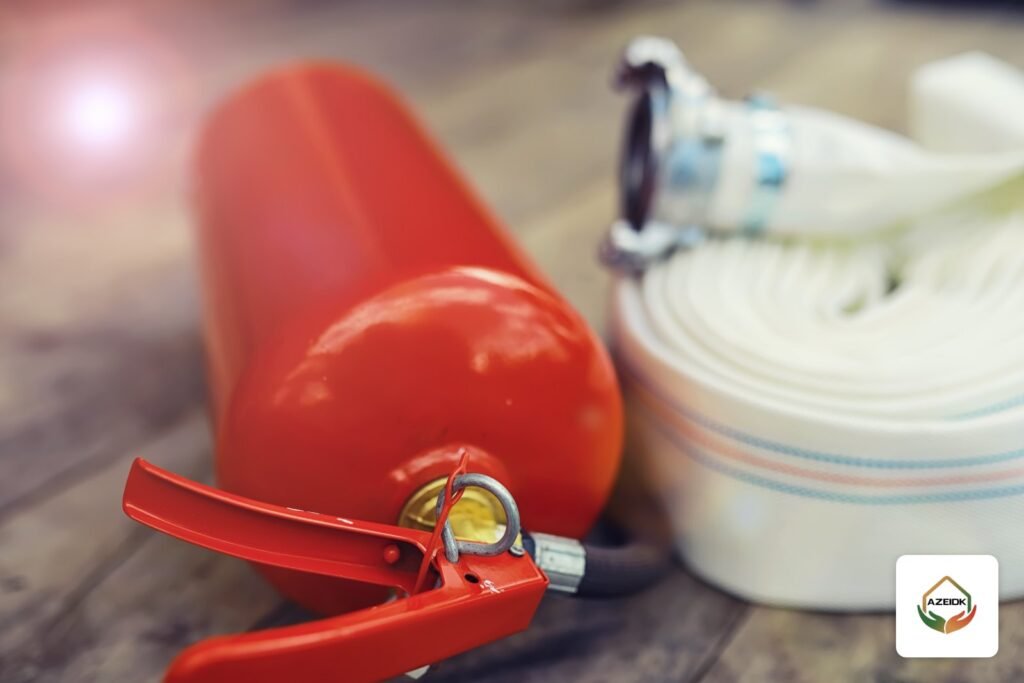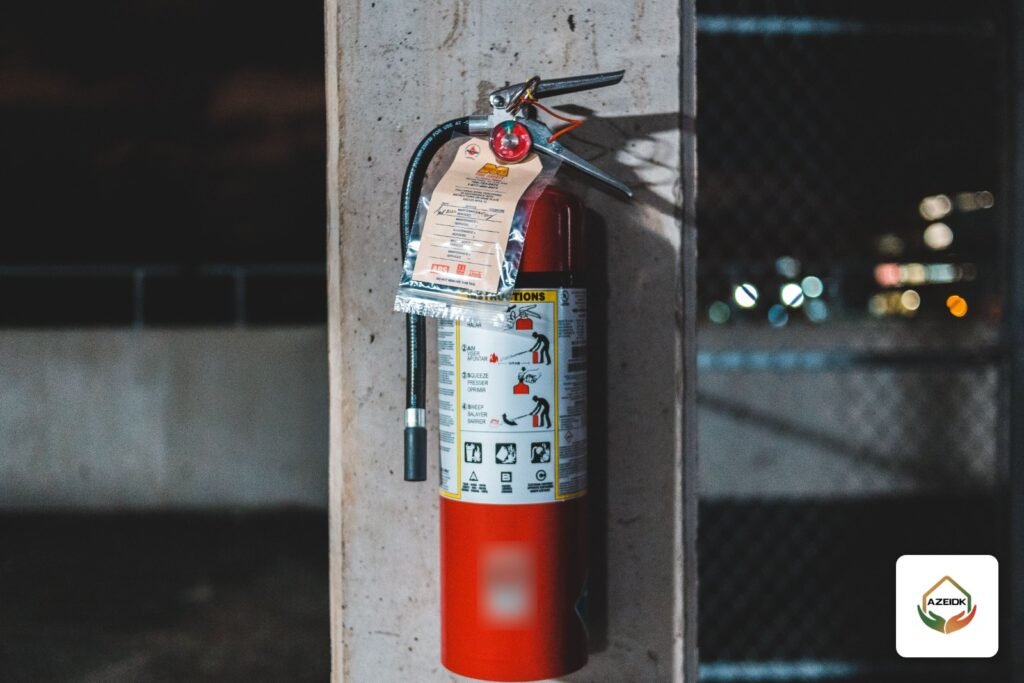
Every extinguisher carries two sources of information. The fire extinguisher label (the manufacturer’s nameplate on the cylinder) tells you what the unit is: its class, capacity, agent, operating pressure and temperature range. The inspection tag or maintenance tag that the technician attaches after each service tells you its condition: when it was checked, who checked it, and when it was last recharged or pressure tested.
This article reads both, field by field, using NFPA 10 (2026 edition) and the labelling rules in SASO’s Technical Regulation for Fire Control Materials and Equipment. For new units with clear labels and documented data, see the fire extinguishers AZEIDK supplies. AZEIDK’s own maintenance team inspects existing units and updates their tags under its preventive and periodic maintenance contracts.
Key takeaways
- NFPA 10 requires every extinguisher to show the listing organization, the extinguisher type, its classification and the performance and fire test standards it meets.
- A number before the class letter applies only to Class A and Class B. Class C, D and K carry no number.
- The annual maintenance tag shows the month and year, the technician’s name and the service company’s name and address. On its own it does not prove when the unit was recharged.
- The recharge date is on the verification-of-service collar around the cylinder neck. The hydrostatic test date is on a punched label or stamped into the metal.
- A monthly inspection record needs only the month, year and the inspector’s initials, and at least the last 12 monthly records must be kept.
In this article
- Label vs inspection tag: what is the difference?
- How to read a fire extinguisher label, field by field
- Inspection and maintenance tags: what must be on them?
- How do I know when an extinguisher was last refilled?
- How to read the hydrostatic test date
- What do Saudi regulations require on extinguisher labels?
- Common mistakes when reading labels and tags
- Frequently asked questions
- Summary
Label vs inspection tag: what is the difference?
Mixing them up causes many inspection findings. The label is part of the product and does not change for the life of the unit. The inspection tag (maintenance tag) is a service record renewed at every visit.
| Item | Extinguisher label (nameplate) | Inspection and maintenance tag |
|---|---|---|
| Applied by | The manufacturer | The service technician or the person assigned to monthly inspection |
| What it proves | Identity, capability and operating method of the unit | The last inspection and maintenance, and who did them |
| Does it change? | No. If damaged or illegible it is cleaned or replaced | Yes, at every inspection or service |
| Location | Front of the cylinder, with operating instructions facing out | Hung from the neck or handle, or applied on the side |
How to read a fire extinguisher label, field by field
Listing data and standards
NFPA 10 requires extinguishers to be listed and labeled, and each unit must be marked with four things: the listing and labeling organization, the product category showing the extinguisher type, its classification, and the performance and fire test standards it meets or exceeds. A logo with no standard or model behind it is not enough: ask for the datasheet and the model certificate.
Class and rating
The classification is a letter that shows the class of fire. In the US system, only Class A and B carry a number before the letter; a higher number means more capacity in the test. So “2-A:10-B:C” reads as: a rating of 2 on ordinary combustibles, a rating of 10 on flammable liquids, and an agent that does not conduct electricity.
On extinguishers built to EN 3, the rating appears on the instruction label in a form such as 13A, 34B or 15F, the number reflecting the test fire size. London Fire Brigade guidance says to choose by rating, not size, citing a 2.5 kg CO2 unit rated 34B. The body is red, with a colour zone of up to 5% of the body surface identifying the agent. For a detailed comparison of the two systems, see UL Listed fire extinguisher ratings: 2-A:10-B:C vs EN 3.
Agent and capacity
The label states the agent (ABC powder, CO2, foam or wet chemical) and the nominal charge in kg or litres. NFPA 10 also requires a label, tag or stencil with the agent’s name as on its Safety Data Sheet (SDS), the HMIS identification, hazardous materials above 1%, each chemical above 5%, the agent’s hazards, and the manufacturer’s or service agency’s name, address and phone number.
Operating pressure and temperature range
Compare the label with the datasheet. For example, the product page for the Falcon Gold 6 kg dry powder extinguisher (FDP6) lists ABC powder at 70%, an operating pressure of 15 bar, a test pressure of 30 bar and an operating temperature range of -30 to +60 °C. Any difference from the approved submittal should be recorded before handover. The printed pressure is also the reference for the extinguisher pressure gauge.
Operating instructions and manufacture date
Operating instructions must stay legible and face outward, and the technician checks this at annual maintenance under NFPA 10. Where the manufacture date sits depends on the maker. Kidde, for example, says it may be a two- or four-digit number stamped into the bottom of the cylinder, or printed on the body. The inspection table in the NFPA 10 annexes includes checking the hydrostatic test date or date of manufacture.
Inspection and maintenance tags: what must be on them?
One extinguisher can carry five different records:
| Record | Data required by NFPA 10 | When it is updated |
|---|---|---|
| Monthly inspection record | Month and year, and the inspector’s initials, on a tag, checklist or electronic log | At intervals not exceeding 31 days, and at least once per calendar month |
| Annual maintenance tag | Month and year, the person who did the work, and the service agency’s name and address, securely attached | At least yearly, at hydrostatic test, or when a deficiency is found |
| 6-year internal examination label | Month and year, the person and the agency name, on a weatherproof label of at least 51 × 89 mm | Every 6 years for stored-pressure units that have a 12-year hydrostatic test |
| Verification-of-service collar | Month and year, and the agency name | After every internal examination or recharge that required removing the valve |
| Hydrostatic test label or stamp | Month and year punched, test pressure, tester’s name or initials and agency name; on high-pressure cylinders, a stamp in the metal | Every 5 or 12 years, depending on the extinguisher type |
HMIS, 6-year and hydrostatic test labels must not be placed on the front of the extinguisher. The exception is the original manufacturer’s label and labels that relate to operation or fire classification.
How do I know when an extinguisher was last refilled?
The answer is not on the annual maintenance tag, which proves a service visit, not a recharge. To find the recharge date:
- Look for the verification-of-service collar around the cylinder neck, under the valve. NFPA 10 requires one after every internal examination or recharge that required valve removal. It cannot come off without removing the valve, and shows the month, year and agency name.
- If there is no collar, check the type. Cartridge-operated units are exempt, and so are new water, foam and wet chemical units charged in the field.
- Check the site’s maintenance file.
- CO2 units have no gauge. Their charge is confirmed by weighing against the weights on the label.
The reference intervals in the NFPA 10 tables are: internal examination every 6 years and hydrostatic test every 12 years for stored-pressure dry chemical units with mild steel, aluminium or brazed brass shells, and for halogenated agent units. Stored-pressure water, CO2 and wet chemical units take both every 5 years, while foam units have an internal examination every 3 years and a hydrostatic test every 5 years. Non-rechargeable units need neither, but NFPA 10 requires them to be removed from service no more than 12 years after the date of manufacture. The recharge process itself is covered in our article on fire extinguisher maintenance and refilling.
How to read the hydrostatic test date
- Low-pressure cylinders (most powder, foam and water units): a label of at least 51 × 89 mm, applied without heat, that self-destructs if someone tries to remove it. The month and year are punched with a hand punch, not written by pen.
- High-pressure cylinders such as CO2: a stamp in the metal with the retester’s identification number and the month and year, located on the shoulder, top, head, neck or foot ring.
A handwritten test date on an ordinary sticker, or a label that peels off in one piece, does not match what NFPA 10 describes; ask the test facility.
What do Saudi regulations require on extinguisher labels?
The SASO Technical Regulation for Fire Control Materials and Equipment covers fire extinguishing equipment. Labels must include warnings and usage instructions, written clearly and irremovably, and all marked information must be valid and verified. The regulation treats missing or incomplete product data or labels, and missing or improperly fixed conformity labels, as non-compliance. Its annex lists SASO GSO ISO 7165 for portable extinguishers and ISO 11602-2 for their inspection and maintenance.
NFPA 10 is a technical reference; the Saudi Fire Code SBC 801 and Civil Defense requirements decide what applies to each building.
Common mistakes when reading labels and tags
- Treating a new maintenance tag as proof of a recent recharge.
- Reading the monthly inspection date as the annual maintenance date.
- Sticking tags or test labels over the operating instructions.
- Buying a unit with no rating on it, or a label with no listing organization and no standard.
- Leaving a faded or peeling label in place after sun exposure, although the NFPA 10 annexes call for an illegible nameplate to be cleaned or replaced.
- A tag with no service company name and address.
Frequently asked questions
How do I know when my fire extinguisher was refilled?
Check the verification-of-service collar on the cylinder neck: it shows the month and year of the last recharge or internal examination. The annual tag alone does not prove a recharge.
What is written on an extinguisher maintenance tag?
Under NFPA 10: month and year, the technician’s name, and the service agency’s name and address, securely attached.
Who signs the monthly inspection tag?
The person who did the inspection. The month, year and their initials are enough, on a tag, a checklist or an electronic log.
What do 2-A:10-B:C and 13A 34B mean on the label?
The first is a US rating: numbers before A and B show test capacity; C means a non-conductive agent. The second is an EN 3 rating by test fire size.
Is there an expiry date on the extinguisher label?
Rechargeable units follow internal examination and hydrostatic test intervals. Non-rechargeable units must be removed from service no more than 12 years after the date of manufacture under NFPA 10.
What should I do if the label is illegible?
Clean the nameplate or replace it with the manufacturer’s label. If the unit cannot be identified, take it out of service and replace it.
Summary
The label tells you whether the extinguisher suits the hazard. The tag tells you whether it is ready now. Read the label first, then the monthly record and annual tag, then the collar and hydrostatic test date. Any missing field needs a question before the inspector asks it.
Extinguisher tags missing or unclear? AZEIDK’s maintenance team inspects extinguishers and updates their records under a periodic maintenance contract, and supplies new units with full documentation. Talk to the AZEIDK team
To buy an extinguisher or book its maintenance, see AZEIDK fire extinguishers.
Related guides
- 4K CCTV Cameras (8 MP): When Higher Resolution Pays Off, and the NVR, Hard Drive and Monitor It Needs
- Food Factory Fire Protection and Security: Fryers, Cold Rooms and Stores
- ZKTeco Fingerprint Device Guide: Enrol Staff, Set the Clock, Download Logs
- Special Fire Suppression Brands in the Saudi Market: Clean Agent, Aerosol and Kitchen