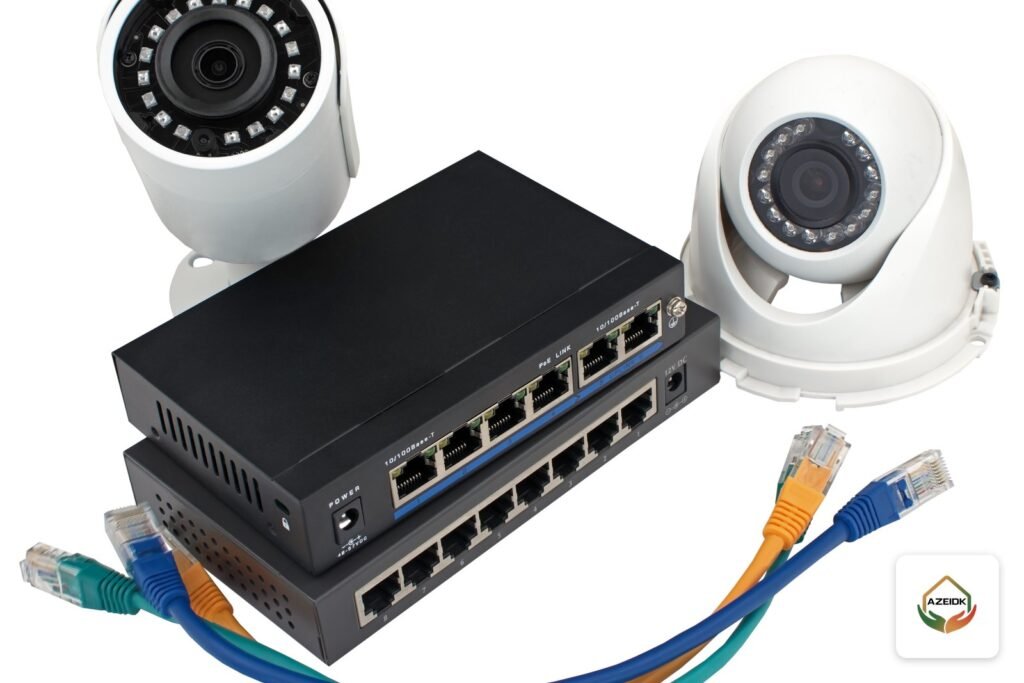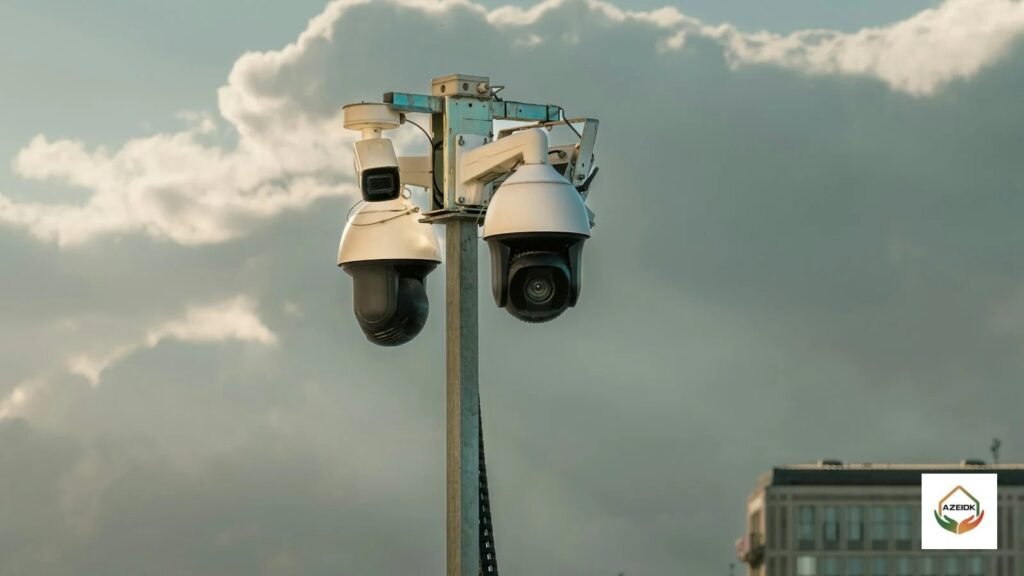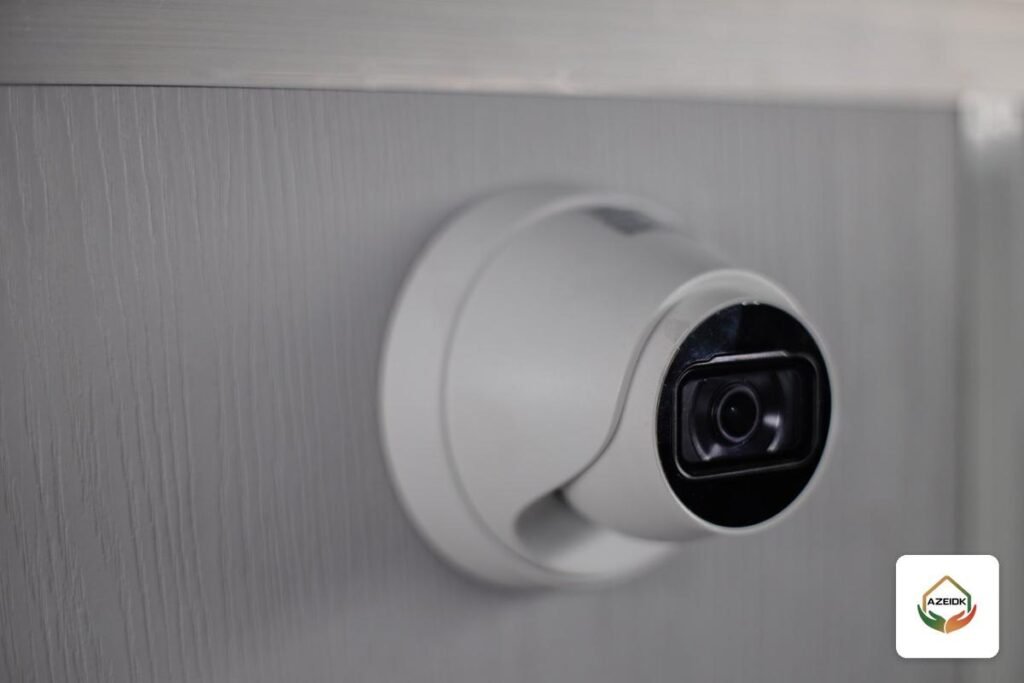
4K CCTV cameras (8 MP, 3840 × 2160 pixels) have twice the horizontal pixels of a 2 MP camera with the same lens, so faces and number plates stay readable at a greater distance. They are worth the extra cost only when the site needs that detail at range, and when the recorder, hard drive and monitor are sized to match.
Below: the calculation that shows when higher resolution is justified, then the NVR, storage and monitor it needs, using models AZEIDK supplies in Saudi Arabia.
Key takeaways
- With the same lens and field of view, an 8 MP camera doubles the pixel density on target compared with a 2 MP camera.
- Higher resolution pays off at entrances, gates and yards where faces or plates must be identified at a distance. It adds little in a short corridor or small room.
- The Hikvision DS-7608NXI-K1(B) NVR accepts 80 Mbps in total and decodes only two 8 MP channels at the same time (with smart analytics off).
- Storage grows with bitrate, not megapixels alone, and H.265 compression reduces it.
- A 4K CCTV monitor helps when four or more cameras are viewed together, and it needs a 4K HDMI output on the recorder.
In this article
- What is the real difference between 4K CCTV cameras and 2 MP or 4 MP cameras?
- When is an 8 MP camera worth it, and when is it not?
- 4K camera models available from AZEIDK
- Choosing an NVR for 4K cameras: bandwidth and decoding
- How much hard drive space do 4K cameras need?
- CCTV monitor: do you need a 4K screen?
- Network and power for 4K cameras
- Common mistakes when upgrading to 4K cameras
- Frequently asked questions
- Summary
What is the real difference between 4K CCTV cameras and 2 MP or 4 MP cameras?
The practical measure is pixel density on target: how many pixels cover one metre of the scene at the distance that matters (px/m). The higher it is, the clearer the face or number plate.
A quick estimate from datasheet figures: work out the scene width at the target distance (scene width = 2 × distance × tan(half the horizontal field of view)), then divide the horizontal pixel count by that width. The table applies this to four cameras from the AZEIDK range. Use the results for a first comparison only, as they ignore lens distortion and the target’s position in the frame.
| Camera (lens) | Resolution / horizontal FOV | At 5 m | At 10 m | At 20 m |
|---|---|---|---|---|
| Hikvision DS-2CD2123G2-I(S) dome (2.8 mm) | 2 MP, 1920 px / 107° | approx. 142 px/m | approx. 71 px/m | approx. 36 px/m |
| Hikvision DS-2CD2T46G2-2I/4I bullet (4 mm) | 4 MP, 2688 px / 83° | approx. 304 px/m | approx. 152 px/m | approx. 76 px/m |
| Hikvision DS-2CD2087G2-L(U) ColorVu bullet (2.8 mm) | 8 MP, 3840 px / 102° | approx. 311 px/m | approx. 155 px/m | approx. 78 px/m |
| Bosch FLEXIDOME indoor 5100i IR (widest setting) | 8 MP, 3840 px / 105° | approx. 295 px/m | approx. 147 px/m | approx. 74 px/m |
To read these numbers: IEC 62676-4 (2025 edition) defines operational categories in pixels per metre, including Perceive at 125 px/m and Characterize at 250 px/m, as summarised in an Axis Communications white paper. On the same calculation, a 2 MP camera with a 2.8 mm lens holds 125 px/m only up to about 5.7 m, while the DS-2CD2087G2 holds the same density to about 12 m. One 4K camera covers roughly twice the distance at the same level of detail.
When is an 8 MP camera worth it, and when is it not?
Where higher resolution earns its place
- Main entrances, reception desks and car park entrances: Article 2 of the implementing regulations of the Saudi Security Surveillance Cameras Law requires these locations to be covered at a range that allows identification, and a wide entrance needs more pixels to hold that level. See our guide to the Security Surveillance Cameras Law and facility obligations.
- Gates, warehouse yards and open car parks: one 4K camera with a wide lens can replace two lower-resolution cameras covering the same width.
- Areas reviewed with digital zoom: such as cash counters, where a 4K recording keeps more detail.
Where 2 MP or 4 MP is enough
- Short corridors and small rooms.
- Very dark locations, if the choice is between a 4K camera with a small sensor and a 4 MP camera designed for low light. On the same sensor size, more pixels means each pixel is smaller and collects less light. Compare sensor size and aperture in the datasheet: the DS-2CD2087G2 has a 1/1.2″ sensor and an F1.0 lens, while the Bosch NDV-5704-AL sensor is 1/2.8″.
- Projects whose budget cannot cover a recorder and storage upgrade as well.
4K camera models available from AZEIDK
The models below are listed on the AZEIDK Saudi website, with specifications taken from product pages based on the manufacturers’ official datasheets. Supply, installation and programming are part of AZEIDK’s security and surveillance systems scope.
| Model | Type | Key specifications | Typical use |
|---|---|---|---|
| Hikvision DS-2CD2087G2-L(U) | ColorVu network bullet | 3840 × 2160, 1/1.2″ sensor, F1.0 lens, white light up to 40 m, 130 dB WDR, PoE (802.3af) max 7.5 W, IP67 | Entrances and outdoor areas needing colour at night |
| Hikvision DS-2CD2T87G2-L | ColorVu network bullet | 8 MP (4K), 130 dB WDR, H.265+ | Building perimeters and car parks |
| Bosch FLEXIDOME indoor 5100i IR (NDV-5704-AL) | Indoor dome | 3840 × 2160, 3.2–10.5 mm lens, 40 m IR, IP54 and IK10 | Large lobbies and corridors, banks and offices |
| Dahua DH-SD8A840-HNF-PA | PTZ | 3840 × 2160, 40× optical zoom, 500 m IR, 36 VDC or Hi-PoE power | Industrial sites and long perimeters |
| Dahua IPC-PT2849DC1-SW-PV | Outdoor Wi-Fi pan-tilt | 3840 × 2160, Wi-Fi 6 (2.4 GHz), microSD up to 512 GB, IP66 | Villas and shops without network cabling |
| EZVIZ C8c 4K | Outdoor Wi-Fi smart home camera | 3840 × 2160, 350° pan and 80° tilt, 20 m colour night vision, IP65 | Homes and small shops |
The difference between the last two and the rest: Wi-Fi cameras usually record to a microSD card or through the app, while professional network cameras work with an NVR, network cabling (Cat6) and PoE power.
Choosing an NVR for 4K cameras: bandwidth and decoding
Three datasheet figures decide whether a recorder suits 4K cameras:
- Maximum recording resolution: the Hikvision DS-7608NXI-K1(B) records IP cameras up to 12 MP, so 8 MP is within its range.
- Incoming bandwidth: 80 Mbps for all cameras combined. If each of eight 4K cameras is set to 10 Mbps, the total is exactly 80 Mbps, the limit with no margin.
- Decoding capacity: with smart analytics off, it is 1 channel at 12 MP, 2 channels at 8 MP, 4 channels at 4 MP or 8 channels at 1080p. So the recorder cannot display more than two 4K main streams at once. General practice (not a datasheet statement) is to run multi-camera views on sub streams.
For larger projects, the Bosch DIVAR IP all-in-one 4000 records up to 32 IP cameras (BVMS Lite, 250 Mbps recording bandwidth, two internal drives). Channel count and PoE port selection are covered in detail in our CCTV recorder selection guide.
How much hard drive space do 4K cameras need?
Recording size depends on the bitrate set in each camera, which depends on resolution, frame rate, compression (H.265 or H.264) and scene movement. There is no fixed figure for an 8 MP camera; take it from the actual camera settings. The example below uses assumed bitrates, not datasheet values (bitrate × 86,400 s ÷ 8, with 10 TB taken as 10,000 GB before formatting):
| Assumption | Per camera per day | 8 cameras per day | Retention on a 10 TB drive |
|---|---|---|---|
| Continuous recording at 8 Mbps per camera | approx. 86 GB | approx. 691 GB | approx. 14 days |
| Continuous recording at 4 Mbps per camera | approx. 43 GB | approx. 346 GB | approx. 29 days |
The key point: the DS-7608NXI-K1(B) has one SATA bay for a drive of up to 10 TB. If the required retention is longer than one drive allows with eight 4K cameras, the options are a lower bitrate, motion or event recording, or a recorder with more drive bays. Retention itself is set in the security conditions document approved with the regulations. The full method is in our CCTV storage and bandwidth calculation guide.
CCTV monitor: do you need a 4K screen?
The DS-7608NXI-K1(B) has an HDMI output at 4K (3840 × 2160) and 30 Hz, plus a VGA output at 1920 × 1080. The Bosch DIVAR IP all-in-one 4000 has a DisplayPort 1.2 output and an HDMI 2.0 output at 4K and 60 Hz, and an HDMI 1.4 output at 4K and 30 Hz.
Screen pixels per camera in a split view:
| Split view | Full HD monitor (1920 × 1080) | 4K monitor (3840 × 2160) |
|---|---|---|
| 1 camera | 1920 × 1080 | 3840 × 2160 |
| 4 cameras | 960 × 540 | 1920 × 1080 |
| 9 cameras | 640 × 360 | 1280 × 720 |
| 16 cameras | 480 × 270 | 960 × 540 |
If an operator watches four or more cameras together, a 4K monitor gives each tile much higher resolution. For occasional playback, a Full HD monitor is enough. When buying, check for an HDMI input that supports 3840 × 2160, an HDMI cable suited to the run length, and a monitor designed for continuous operation if it runs all day.
Network and power for 4K cameras
- PoE power: the DS-2CD2087G2-L(U) runs on PoE (802.3af) at a maximum of 7.5 W, and the /8P version of the NVR has eight PoE ports with a total of 75 W or less. The Dahua SD8A840 needs 36 VDC or Hi-PoE, so it cannot be powered from standard NVR ports.
- Remote viewing: the DS-7608NXI-K1(B) network port is 10/100 Mbps. Several users opening 4K main streams can saturate it, so general practice is to set remote viewing to the sub stream.
Common mistakes when upgrading to 4K cameras
- Connecting 4K cameras to an older recorder limited to 4 MP, which will not record them at full resolution or will not accept them.
- Counting channels and ignoring incoming bandwidth, so total streams exceed the recorder’s limit.
- Buying the same drive capacity that served 2 MP cameras, so retention falls short.
- Connecting a 4K monitor to the VGA output of a recorder such as the DS-7608NXI-K1(B), which is limited to 1920 × 1080.
- Choosing 4K for a dark location without comparing sensor size and low-light performance.
- Relying on the 4K label alone without calculating pixel density.
Frequently asked questions
Are 4K and 8 MP the same thing in CCTV?
For the cameras in this article, yes. 3840 × 2160 equals about 8.3 million pixels, which is why it is sold as 8 MP or 4K.
Is the best CCTV camera always the highest resolution?
Not always. The best camera delivers the pixel density you need at the furthest important point, performs in the site’s lighting, and fits what the recorder and storage can handle.
Will a standard NVR work with 4K CCTV cameras?
Only if its maximum recording resolution is 8 MP or higher and its incoming bandwidth covers all streams. The DS-7608NXI-K1(B), for example, records up to 12 MP with 80 Mbps incoming bandwidth.
How many terabytes do eight 4K cameras need?
It depends on bitrate and retention. At an assumed 8 Mbps (not a datasheet value) with continuous recording, a 10 TB drive lasts about two weeks. An exact figure starts from the cameras’ actual settings.
What monitor suits a 4K CCTV system?
A 3840 × 2160 monitor with an HDMI input that supports that resolution, connected to the recorder’s 4K HDMI output, preferably rated for continuous operation in a control room.
Summary
4K CCTV cameras are the right choice when the calculation shows the site needs a pixel density that 2 MP or 4 MP cameras cannot reach, provided the recorder, storage and monitor are sized to match.
Planning to upgrade entrance or car park cameras to 4K? Send us the layout and the required retention period, and we will propose cameras, recorder, storage and monitor with pixel density and storage calculations. Talk to the AZEIDK team
Related guides
- Sprinkler Head Types: K-Factor, Temperature Rating and Response
- Best CCTV Cameras in Saudi Arabia: Hikvision, Dahua, Bosch and EZVIZ Compared by Use
- Intrusion Alarm Systems: Components, Design and Integration
- Fire Hose Cabinet Maintenance: Monthly and Annual Checks of Hose, Reel, Valve and Glazing, and What the Technician Records