A CCTV power supply converts building mains into the low DC voltage a camera runs on, usually 12 V DC for analog cameras and for many IP cameras. There are three ways to do it: a separate adapter at each camera, a central power supply box feeding several cameras, or PoE from the switch or recorder over the network cable itself. The right choice depends on camera type, camera count and cable length, and the sizing always starts from the datasheet. This guide compares the options, shows how to size the amps, explains voltage drop on long runs and how to estimate power consumption, as part of how we approach security and surveillance system supply and installation.
Key takeaways
- Every camera needs a power source: a 12 V adapter near it, a central box, or PoE over the network cable.
- Amps equal watts divided by volts, using the maximum figure from the datasheet.
- The Hikvision DS-2CD2123G2-IS, for example, runs on 12 V DC ±25% at up to 6 W, or on 802.3af PoE at up to 7.5 W.
- On long 12 V runs the voltage drops, and the calculation uses the full out-and-back wire length.
- To keep recording through a power cut, put the switch and recorder on a UPS, or use a power box with battery backup.
In this article
- What is a CCTV power supply, and what are the options?
- 12V CCTV power supply: when an adapter is enough and how to pick one
- Central CCTV power supply box
- PoE: running cameras without an adapter
- How to size the amps for a CCTV power supply
- Voltage drop on long cable runs
- CCTV power consumption
- What happens to cameras during a power cut?
- Common power mistakes
- Frequently asked questions
- Summary
What is a CCTV power supply, and what are the options?
A camera does not run on mains directly. It needs a low DC voltage specified by the manufacturer, delivered in one of three ways:
| Option | How it works | Suits | Watch for |
|---|---|---|---|
| Individual CCTV camera adapter | A small plug-in adapter near the camera, needing a mains socket at that location | Homes and shops with a few cameras close to sockets | Each adapter is a separate failure point and is hard to reach above a false ceiling |
| Central CCTV power supply box | An enclosure with a 12 V supply and several outputs, each protected by a fuse or a self-resetting PTC | Medium and large HD analog systems | Total current, current per output and distance from the box to each camera |
| PoE from a switch or recorder | Power and data on one network cable | IP cameras in commercial buildings | No adapter or socket at the camera, but the switch power budget must cover all cameras |
Start with the camera type. Analog cameras do not use PoE, so they need an adapter or a central box, unless the coax system supports power over coax (PoC) at both recorder and camera, which we cover in our article on upgrading an old CCTV system. Most IP cameras accept either 12 V or PoE.
12V CCTV power supply: when an adapter is enough and how to pick one
A single adapter is the simplest option when there are only a few cameras and each has a socket nearby. Two examples from the cameras AZEIDK lists: the analog Hikvision DS-2CE76K0T-LMFS runs on 12 V DC ±25% at a maximum of 2.9 W, less than a quarter of an amp. The Hikvision DS-2CD2123G2-IS IP camera datasheet gives 12 V DC ±25%, 0.5 A, max 6 W.
Check four things on the adapter:
- Voltage: the same voltage and type (DC) as the camera. An adapter above the permitted tolerance can damage it.
- Current: the rated amps should equal or exceed the camera’s maximum. A larger amp rating does no harm, since the camera draws only what it needs.
- CCTV power connector and polarity: the DS-2CD2123G2-IS datasheet specifies a 5.5 mm coaxial power plug with reverse polarity protection. Confirm centre-positive wiring as the manufacturer requires before connecting.
- Location: an indoor adapter should not sit exposed to sun and rain outside; use a suitable enclosure or a covered space.
The CCTV socket is part of the design too. Fixing a mains outlet position near each camera before finishes is far easier than running temporary extensions afterwards. The mains circuit, sockets, breakers and earthing are work for a qualified electrician under the electrical code approved for the building; the CCTV technician handles the low-voltage side only. For the technical regulations that apply to cameras and recorders in Saudi Arabia, see our guide to the CCTV certificate of conformity.
Central CCTV power supply box
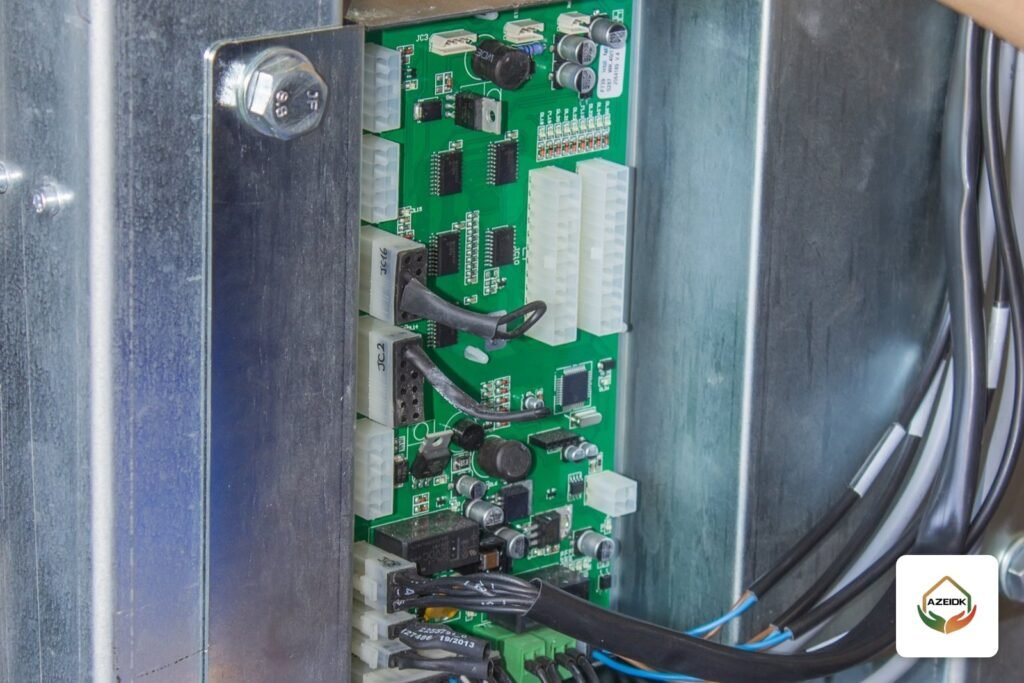
As the number of analog cameras grows, a central power supply box in the equipment room or next to the rack is the usual choice. Manufacturer datasheets for these boxes describe multiple outputs, each with its own fuse or self-resetting PTC, LEDs for input and output power, and on some models a charger for a standby battery that takes over when mains fails.
The practical benefit: a short on one camera cable trips only that output instead of killing every camera, and the technician finds all the power in one place. Power reaches each camera on a two-core cable, often a coax with an attached power pair, as explained in our CCTV camera cable article.
PoE: running cameras without an adapter
In IP systems, power travels with data over the network cable from a PoE switch or a recorder with PoE ports, so the camera needs no adapter or socket. The IEEE 802.3 standards set the power levels:
| Standard | Power at the switch port | Power available at the camera |
|---|---|---|
| 802.3af (PoE) | 15.4 W | 12.95 W |
| 802.3at (PoE+) | 30 W | 25.5 W |
| 802.3bt Type 3 | 60 W | 51 W |
| 802.3bt Type 4 | 90 W | 71.3 W |
The DS-2CD2123G2-IS draws up to 7.5 W on 802.3af Class 3 PoE. The Hikvision DS-3E1309P-EI switch supports 802.3af and 802.3at with a 110 W total PoE budget and up to 30 W per port. Not every camera fits that range: the DS-2SF8C442MXG-ELW26 PTZ runs on 36 V DC at up to 60 W or on Hi-PoE, beyond what an 802.3at port supplies, so it needs the power source the manufacturer specifies.
Switch power budgets and port counts are covered in detail in PoE switches for CCTV, so we do not repeat them here.
How to size the amps for a CCTV power supply
- List each camera’s voltage and maximum wattage from the datasheet, not the typical figure.
- Work out the current per camera: amps = watts ÷ volts.
- Add up the current of all cameras on the same adapter or box.
- Add a design margin and choose a supply rated at or above the result.
- For a central box, also check each camera’s current is below the rating of the protected output it uses.
Example 1 (IP cameras on 12 V): eight DS-2CD2123G2-IS cameras at 6 W ÷ 12 V = 0.5 A each, 4 A in total. With a 25% margin assumed for this example, you need at least 5 A.
Example 2 (analog cameras): eight DS-2CE76K0T-LMFS cameras at 2.9 W each total 23.2 W ÷ 12 V ≈ 1.93 A. With the same margin, about 2.4 A, so pick a supply rated above that.
The recorder normally sits outside this calculation because it has its own adapter. The Hikvision DS-E04HQHI-B DVR, for example, takes 12 V DC, 1 A.
Voltage drop on long cable runs
At 12 V, any resistance in the wire eats into the voltage before it reaches the camera. A power supply manufacturer’s guide notes that a paired run counts both the feed and return conductors: 100 m between box and camera means 200 m of wire. The rule:
Voltage drop = camera current × out-and-back wire resistance, with resistance per metre taken from the cable datasheet for its conductor size.
Illustration: with 4 ohms of loop resistance and a 0.5 A camera, the drop is 2 V and about 10 V reaches the camera. A camera rated 12 V ±25% works down to 9 V, but the margin is thin and any extra length or load pushes it out of range. Usual fixes:
- A heavier power conductor for distant cameras.
- A power supply closer to the remote group of cameras instead of one box in the equipment room.
- For IP cameras, PoE up to 100 m per port, or the extended-distance methods the switch maker documents.
CCTV power consumption
Daily consumption = watts × 24 hours. A camera with a 7.5 W maximum uses at worst 180 Wh, or 0.18 kWh, per day. Eight such cameras use up to 1.44 kWh per day. Add the recorder from its own datasheet: the DS-E04HQHI-B lists a maximum of 5.4 W with its storage, about 0.13 kWh per day.
These are upper bounds because they use maximum ratings. Their real use is sizing a UPS and its runtime, since total watts set the battery capacity you need.
What happens to cameras during a power cut?
If the adapter, switch or recorder loses power, recording stops. The usual answer is a UPS in the equipment room feeding both the PoE switch and the recorder, which keeps IP cameras running since they draw power from the switch. One example from AZEIDK’s range is the Legrand KEOR SPE 2200 VA (1980 W) UPS, a line-interactive unit for a 19-inch rack or tower installation. Analog cameras on individual adapters would each need backup, which is why a central box with battery support suits them better.
People also search for CCTV without a power supply. No camera runs without a power source, but battery and solar cameras exist for sites without mains, with recording limits set by the manufacturer; see solar and battery CCTV cameras.
Common power mistakes
- Sizing the supply by camera count instead of total amps from the datasheets.
- Ignoring cable length, so the camera works by day and drops out at night when infrared raises its draw.
- Mounting indoor adapters outdoors with no enclosure.
- Connecting a high-power PTZ to a PoE port that cannot cover it.
- Putting only the recorder on the UPS and forgetting the switch or power box, so it records nothing.
If you see video loss or repeated reboots, start with our guide to common CCTV camera faults; power is one of the first checks.
Frequently asked questions
How many amps does a CCTV power supply need?
Divide each camera’s maximum watts by its voltage, add up all cameras on the supply and add a margin. Eight 6 W cameras at 12 V need 4 A before margin.
Do PoE cameras need a power adapter?
Not at the camera. They take power from a PoE switch or a PoE recorder over the network cable, provided the switch budget covers all cameras.
Can CCTV work without a power supply?
Every camera needs a power source. For sites without mains there are battery and solar cameras, with recording limits stated in their datasheets.
How much electricity do CCTV cameras use?
Multiply watts by 24 hours. A 7.5 W camera uses up to 0.18 kWh per day, and eight cameras up to 1.44 kWh.
Can one adapter power several cameras?
Yes, if its amp rating exceeds the cameras’ total current plus margin. For medium systems a central box with a protected output per camera is better.
Why does a camera switch off only at night?
A weak supply or voltage drop on a long cable is a common cause, because infrared at night raises the camera’s draw. Measure the voltage at the camera at night and compare it with the datasheet tolerance.
Summary
Size a CCTV power supply by calculation: camera voltage and maximum watts from the datasheet, total amps plus margin, then cable length and voltage drop. Individual adapters suit small systems, a central box suits larger analog systems, and PoE is the simplest route for IP cameras. In every case, a UPS in the equipment room protects recording from power cuts.
Planning a new CCTV system or chasing cameras that keep dropping out? Send us the camera count, models and cable lengths, and our team will size the power as part of supply and installation. Contact the AZEIDK team
Related guides
- Sprinkler System Acceptance Tests After the Pressure Test: Flushing, Main Drain, Inspector’s Test and Waterflow Alarm Before Handover
- Fire Fighting Companies in Saudi Arabia: Comparing Riyadh, Jeddah, Dammam and Multi-City Firms
- Atrium Smoke Control in Malls to NFPA 92: Smoke Exhaust and Make-Up Air Calculation
- CCTV Supply and Installation Contract Template: Clauses to Include