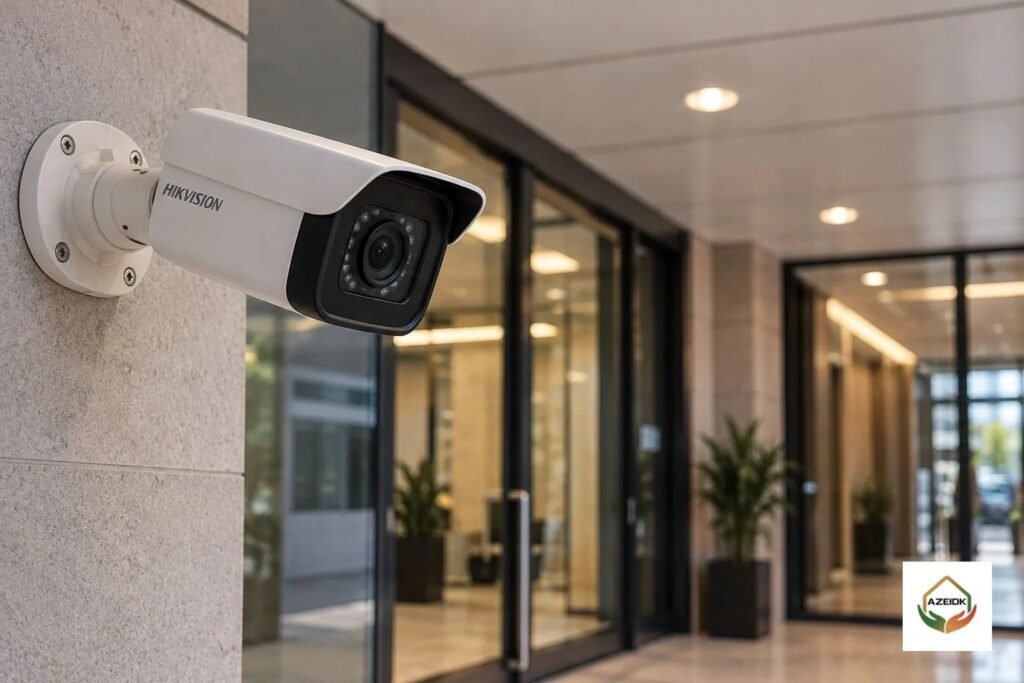
Consultants and procurement teams often ask for a CCTV certificate of conformity before they approve a camera submittal or accept a delivery. The supplier’s question is simple: which technical regulation covers the camera and the recorder on SABER? The answer is less simple. SASO has not issued a technical regulation named for CCTV cameras. The requirement follows the product’s classification and customs code on SABER, and one device can fall under more than one regulation.
This article sets out the candidate regulations for cameras and recorders (NVR and DVR), the difference between wired and Wi-Fi cameras, and what a buyer should ask the supplier for. Cameras and recorders are part of AZEIDK’s security and surveillance systems range in Saudi Arabia.
Short answer: CCTV cameras and recorders need a product certificate of conformity registered on SABER whenever their classification links them to a mandatory technical regulation, then a shipment certificate for every imported consignment. The candidate regulations are the Communications and IT Devices regulation (mainly for wireless cameras), the Electromagnetic Compatibility regulation, and the Restriction of Hazardous Substances regulation, whose guideline names video cameras and video recorders. The final check is the model’s customs code inside SABER.
Key takeaways
- There is no Saudi technical regulation named for CCTV cameras. The requirement comes from the model’s classification and HS code on SABER.
- The guideline to the hazardous substances regulation lists “video cameras, video recorders” under telecommunication and IT equipment.
- A Wi-Fi camera is a wireless device, so the Communications and IT Devices regulation, issued in coordination with CST, most likely applies. Confirm it in the model’s classification.
- A shipment certificate is issued per consignment. SASO’s service page lists a fee of SAR 350 and 1 to 2 working days.
- Ask for the SABER certificate of the exact model number, not a certificate for a series or a similar model.
In this article
- CCTV certificate of conformity: why there is no single regulation
- Candidate technical regulations for cameras and recorders
- How the requirement differs by device
- Product certificate and shipment certificate on SABER
- What to ask the supplier before you buy or approve
- Common mistakes with camera certificates
- CCTV cameras from AZEIDK
- Frequently asked questions
- Conclusion
CCTV certificate of conformity: why there is no single regulation
SABER works on a simple idea. Each product is registered under its customs code. The code links it to one or more technical regulations, and each regulation sets the type of conformity evidence required. Fire equipment has its own named regulation, as explained in our article on the SABER certificate of conformity for fire equipment. Cameras do not.
A camera is an electronic device that captures images and sends them over a network. A recorder is a dedicated computer for storage and viewing. These devices sit where the regulations for electrical and electronic equipment overlap with the regulations for communications devices.
Candidate technical regulations for cameras and recorders
From the official texts on the SASO website:
| Technical regulation | Official dates | Link to cameras and recorders | Conformity route |
|---|---|---|---|
| Restriction of Hazardous Substances in Electrical and Electronic Equipment | Published 09/07/2021; applied to telecom and IT equipment from 31/12/2022 per its guideline | The guideline lists “video cameras, video recorders” in Category 2 | Certificate of conformity from SASO or an accepted body; tests in ISO/IEC 17025 accredited labs |
| Electromagnetic Compatibility (EMC) | Approved 28/09/2023; published 17/11/2023 | Does not name cameras, but its annex covers HS 8471 (automatic data processing machines) and the multimedia emission standard SASO CISPR 32 | Supplier’s declaration with a technical file; radio and telecom terminal equipment is excluded |
| Communications and Information Technology Devices | Approved 28/12/2023; published 16/08/2024 | Does not name cameras or recorders, but covers data transmission devices in licence-exempt bands and wireless LAN devices | Certificate of conformity from an accepted body, type 1a (type approval) |
| Gulf Technical Regulation for Low Voltage Electrical Equipment | In force since 01/07/2016 | Scope is 50 to 1000 V AC and 75 to 1500 V DC; its text does not name cameras or recorders | Gulf conformity mark and declaration of conformity; an IECEE CB certificate is accepted, taking national differences into account |
Hazardous substances regulation: the closest by wording
Of these regulations, it is the only one whose official guideline names video cameras and video recorders. It sets limits for lead, mercury, cadmium, hexavalent chromium, PBB and PBDE. The guideline says its examples are indicative only.
Communications and IT Devices regulation: for Wi-Fi cameras
SASO issued it in coordination with the Communications, Space and Technology Commission (CST). Its standards include the safety standard SASO-IEC-62368-1 for audio/video and ICT equipment, and the standard for data communication equipment in licence-exempt bands. It requires wireless devices to show their supported frequency bands and maximum output power per band. Full detail is in our article on certificates of conformity for network and telecom devices on SABER.
Electromagnetic compatibility regulation
Its aim is that equipment does not cause interference that affects communications equipment, and that it tolerates interference in normal use. It relies on the supplier’s declaration with a technical file kept for ten years, and it treats products holding the Saudi Quality Mark as compliant.
How the requirement differs by device
Use this as a checklist, not a substitute for the SABER classification result:
| Device | What drives the requirement | What to check |
|---|---|---|
| Wired IP camera powered by PoE | The camera’s customs code; it is an electronic device on low DC voltage | SABER product certificate for the model and the test reports behind it |
| Wi-Fi camera for homes or shops | Being a wireless device, in addition to its customs code | Communications and IT Devices requirements; frequency bands and output power shown on the device |
| Analog HD camera with a DVR | The customs code of the camera and of the recorder, separately | A separate certificate for each model |
| NVR or DVR | Its customs classification, and whether it runs directly on 220 V or through an external adapter | Product certificate for the model, and conformity of the supplied adapter if there is one |
| PoE switch and network devices | Communications and IT Devices regulation | See the network devices article linked above |
A practical point: a device on low DC voltage, such as a 12 V camera or a PoE camera, sits below the lower limit of the low voltage regulation’s scope. A recorder plugged straight into 220 V mains sits inside it.
Product certificate and shipment certificate on SABER
Conformity on SABER has two stages, and one does not replace the other:
- Product Certificate of Conformity (PCoC): the local manufacturer or importer registers it on SABER for each model, and a SASO-accepted conformity assessment body chosen by the supplier reviews it. The service page asks for product registration, model numbers, and a technical file that suits the regulation and product type. It lists 5 to 6 working days.
- Shipment Certificate of Conformity (SCoC): the importer issues it for each consignment from outside the Kingdom, after the product is registered and a product certificate or self-declaration is in place. SASO’s service page lists a fee of SAR 350 and 1 to 2 working days.
The service page does not list a product certificate cost; it depends on the conformity assessment body, the number of models and the tests. Each model number needs its own registration.
What to ask the supplier before you buy or approve
- The SABER product certificate number, matched character by character with the model number on the camera label.
- The shipment certificate for the consignment the delivered units came from, if imported.
- The test reports behind the certificate: safety, EMC, radio testing for Wi-Fi cameras, and a hazardous substances report from an accredited lab.
- Arabic labelling on the device and its box. The EMC and Communications and IT Devices regulations require supplier details, trademark, country of origin and warnings in Arabic.
- Frequency bands and output power marked on Wi-Fi cameras.
A certificate does not prove the camera suits your site. It proves the model meets the rules on safety, interference and substances. Resolution, viewing range and footage retention are governed by other requirements, including those in our article on the security surveillance cameras law.
Common mistakes with camera certificates
- Submitting a certificate for a whole series or a similar model instead of the model in the BOQ.
- Relying on CE or FCC alone. Those are for other markets and do not replace SABER registration.
- Treating a Wi-Fi camera like a wired one. It is a wireless device with extra requirements.
- Forgetting the recorder and the power adapter and checking only the cameras.
- Mixing up rules: the SABER circular requiring the supplier’s name and CR number on products from 1 October 2026 named ten regulations, and the electronics and telecom regulations are not among them. See our news item on the supplier’s name and CR number on products.
CCTV cameras from AZEIDK
In Saudi Arabia, AZEIDK supplies cameras and recorders from Hikvision, Dahua and EZVIZ. AZEIDK holds the Saudi Local Content certificate and ISO 9001, ISO 14001 and ISO 45001 certificates, with a scope that covers the design, supply, installation and maintenance of CCTV and access control systems.
Frequently asked questions
Do CCTV cameras need a SABER certificate?
Yes, when SABER links their customs code to a mandatory technical regulation. That is the usual case, since the hazardous substances guideline names video cameras and video recorders. The final check is the model’s classification result on SABER.
What is the SABER platform?
An online platform run by SASO where suppliers register products and their certificates of conformity, and importers issue a shipment certificate for each consignment before clearance.
What is the difference between a PCoC and an SCoC?
The PCoC covers a model and is issued by an accepted conformity assessment body. The SCoC covers one shipment and is issued by the importer once the product certificate or self-declaration is registered.
Is a shipment certificate needed for every camera shipment?
Yes for imported products. SASO’s service issues the shipment certificate per consignment, with a listed fee of SAR 350 and 1 to 2 working days.
How much does a SABER certificate cost and how long does it take?
The shipment certificate fee is SAR 350. The product certificate cost is set by the conformity assessment body based on models and tests, and the service page lists 5 to 6 working days for registration.
Do Wi-Fi cameras need CST requirements?
A Wi-Fi camera is a wireless device. The Communications and IT Devices regulation covers data transmission devices in licence-exempt bands and requires wireless devices to show their frequency bands and output power.
How do I find my camera’s HS code on SABER?
From the customs tariff and SABER’s code search, with help from your customs broker or conformity assessment body. The code decides the regulation, so a wrong code changes the whole requirement.
Does the Saudi Quality Mark replace the certificate of conformity?
The EMC regulation treats products holding the Saudi Quality Mark as compliant with it. For the other regulations, check the text for each product before relying on the mark alone.
Conclusion
A CCTV certificate of conformity is not one fixed certificate for every device: the model’s customs code on SABER decides the requirement. Ask for the exact model’s certificate, the shipment certificate and the test reports before approving supply.
Reviewing a camera supply offer or a BOQ? Send us the model numbers and we will go through the documents available for each model we supply from Hikvision, Dahua and EZVIZ. Talk to the AZEIDK team
Related guides
- Foam Fire Suppression for Saudi Industrial Facilities: Types and Applications
- Fire Hose Cabinet Price in Saudi Arabia: What Drives the Cost, From Material, Doors and Mounting to Reel and Valve
- How to Choose a Fire Fighting System: A Project Decision Guide
- Hotel CCTV System in Saudi Arabia: Where Cameras Go, Retention and the Security Room