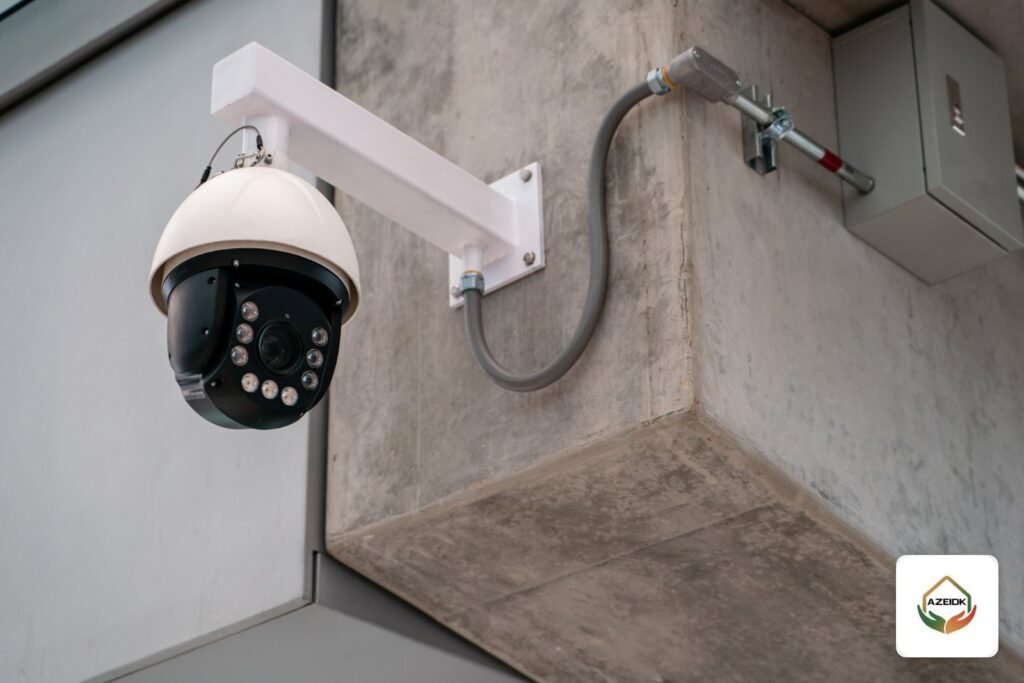
A long range CCTV camera is one that still delivers useful detail far from the mounting point, and that comes from optical zoom: a lens whose focal length actually changes, not a digital crop of the image. To cover a distant gate, a long fence line or a large car park you have three options: a fixed camera with a varifocal lens, the same camera with a motorized varifocal lens that is adjusted remotely, or a PTZ camera. This article explains how to choose between them by calculation, how to read DORI distances and IR range in a datasheet, and which models are available through AZEIDK security and surveillance solutions.
Key Takeaways
- Optical zoom changes the focal length and adds real detail; digital zoom only enlarges pixels that already exist.
- A varifocal lens is set once to the required scene and then records that same view all the time.
- A PTZ camera suits sites with an operator following events live. It does not replace fixed cameras on critical points.
- Recognition distance comes from pixel density on the target (pixels per metre), not from megapixels alone.
- The IR range in a datasheet is how far the illuminator reaches, not the distance at which you can recognise a person or a plate.
In this article
- What makes a long range CCTV camera?
- Fixed, varifocal, motorized varifocal and PTZ: what is the difference?
- How do you calculate recognition distance? DORI in numbers
- Motorized varifocal cameras available from AZEIDK
- When do you need a PTZ instead of a fixed long range camera?
- IR range is not night-time recognition distance
- Installation mistakes that waste a long zoom on Saudi sites
- Frequently Asked Questions
- Conclusion
What makes a long range CCTV camera?
“Strong zoom” in camera marketing can mean different things. Optical zoom happens inside the lens: as the focal length in millimetres increases, the field of view narrows, the sensor’s pixels are spread over a smaller part of the scene, and distant detail becomes clear. Digital zoom crops part of the picture and enlarges it. It adds no new information, so it cannot read a number plate that the lens never resolved.
When comparing two cameras, look at the focal length range (for example 2.7–13.5 mm or 8–32 mm) and the horizontal field of view at full zoom, not at the digital zoom figure. Fixed 2.8, 4 and 6 mm lenses are covered in our article on CCTV field of view and DORI calculation; this article focuses on longer distances.
Fixed, varifocal, motorized varifocal and PTZ: what is the difference?
| Type | How zoom is set | Best for | Watch out for |
|---|---|---|---|
| Fixed lens | No optical zoom | Entrances, corridors, short distances | Distance is limited by the chosen lens angle |
| Manual varifocal | By hand during installation | A distant scene that does not change | Any later change needs a technician at the camera |
| Motorized varifocal | Remotely from software or browser, with autofocus | Gates, fences and car parks where fine adjustment after installation matters | Still a fixed camera: one view, recorded continuously |
| PTZ | Pan, tilt and large optical zoom during operation | Wide yards and live operator tracking | When it turns to one point, the rest of the scene is not recorded |
On most projects, a fixed camera with a motorized varifocal lens is the practical answer for medium and long distances. It records the same view all day, and the technician can set zoom and focus from the control room during commissioning without a lift.
How do you calculate recognition distance? DORI in numbers
DORI splits what you need from the image into four levels: Detection, Observation, Recognition and Identification. Manufacturer guidance based on IEC EN 62676-4:2015 gives these pixel densities across the scene width: 25 pixels per metre for detection, 62 for observation, 125 for recognition and 250 for identification.
The calculation is simple. Scene width at the target distance = 2 × distance × tan(half the horizontal field of view). Pixel density = horizontal pixels ÷ scene width. A rough, hypothetical example for a 4 MP camera 2560 pixels wide with an 8–32 mm lens and a 15.1° horizontal field of view at full zoom: to reach 125 pixels per metre the scene must be no wider than about 20.5 m, which happens at roughly 77 m. At the wide end of the same lens (42.5°), recognition distance drops to about 26 m. This is a theoretical estimate to guide selection; the final reference is the DORI table in the datasheet and a test on site.
Some manufacturers publish a DORI table. Dahua’s datasheet for the IPC-HFW2531T-ZS-S2 series (2.7–13.5 mm motorized lens) gives:
| Lens position | Detect | Observe | Recognise | Identify |
|---|---|---|---|---|
| Wide, 2.7 mm | 64 m | 25.6 m | 12.8 m | 6.4 m |
| Tele, 13.5 mm | 220 m | 88 m | 44 m | 22 m |
The two rows show what a varifocal lens buys you: the same camera gives about three and a half times the recognition distance at full zoom, in exchange for a narrower scene.
Motorized varifocal cameras available from AZEIDK
| Model | Sensor and resolution | Lens | Horizontal FOV | IR range |
|---|---|---|---|---|
| Dahua IPC-HFW2531T-ZS-27135-S2 | 1/2.7″, 5 MP | 2.7–13.5 mm motorized, F1.5 | 100° to 26° | Up to 60 m |
| Hikvision iDS-2CD7A46G0/S-IZHSY | 1/1.8″, 4 MP | 2.8–12 mm or 8–32 mm | 114.5° to 41.8°, or 42.5° to 15.1° | Up to 50 m, or up to 100 m |
The Dahua camera fits gates, external walkways and medium car parks, and runs on PoE (802.3af) or 12 VDC. The Hikvision DeepinView model comes with two lens options; the 8–32 mm version is the better fit for longer distances such as perimeter fences and truck entrances, Dahua values come from the manufacturer datasheet and the AZEIDK product page; Hikvision values come from the AZEIDK product page. Check the datasheet of the supplied version before approving the design. More models are listed under CCTV cameras and recorders.
When do you need a PTZ instead of a fixed long range camera?
A fixed varifocal camera answers one question precisely: what happened at this gate or this section of fence? A PTZ answers a different one: where did that person or vehicle go next? A PTZ is justified when:
- An operator watches events live from a control room, or auto-tracking and saved tours are configured.
- The area is very wide and open, such as outdoor storage yards and large car parks.
- The required distance is beyond what fixed-camera lenses deliver; professional PTZ cameras reach 40x optical zoom or more.
Examples in the AZEIDK catalogue, per the product pages: the Dahua SD8A840-HNF-PA with 40x optical zoom, a 5.6–223 mm lens and IR up to 500 m, and the Hikvision DS-2SF8C442MXG-ELW/26, which pairs a panoramic camera with a 42x PTZ module (6–252 mm). The working rule: a PTZ is added on top of fixed cameras, not instead of them. Tracking, Hi-PoE power and mounting are covered in PTZ cameras from Dahua and Hikvision.
IR range is not night-time recognition distance
“Up to 100 m” or “up to 500 m” in a datasheet describes how far the infrared illumination reaches under test conditions. It does not mean you will recognise a face or read a plate at that distance. At night, recognition distance still follows the same pixel-density calculation, plus target reflectance, dust and humidity. Existing lighting, such as car park lamp posts, changes the result a great deal.
That is why every long-distance view should be tested at night before handover. If the distance is long and lighting is poor, the answer may be additional external lighting or splitting the distance between two cameras. For ColorVu, Starlight and IR technologies, see our guide to night vision CCTV cameras.
Installation mistakes that waste a long zoom on Saudi sites
- An unstable pole: the narrower the field of view, the more any wind-driven pole movement is magnified, so the image shakes at full zoom. Pole and bracket must suit the camera weight and mounting height.
- Heat shimmer: on summer afternoons, hot air over asphalt and open yards distorts the image, and long lenses show it clearly. Do not rely on maximum zoom alone for very long distances.
- Dust on the front glass: a thin layer reduces sharpness and reflects IR at night, so cleaning the window belongs in routine maintenance of outdoor cameras.
- Focusing in daylight only: recheck focus at night after installation; a motorized lens makes this easy from software.
- Ignoring the cable route: cameras far from the equipment room need planning for distance and power, and may need fibre or a wireless link.
Most of these show up during a technical site inspection before supply, when real distances are measured and mounting height and pole positions are fixed. For heat and dust protection, see the outdoor CCTV camera guide.
Frequently Asked Questions
What is the best long range CCTV camera?
There is no single best camera for every site. Start with the distance and the level of detail you need, then choose a fixed varifocal camera for a fixed view, or a PTZ when an operator tracks events live.
What is the difference between optical and digital zoom in CCTV?
Optical zoom changes the lens focal length and adds real detail. Digital zoom only enlarges the existing image, so it cannot reveal detail the sensor never captured.
What does varifocal mean on a CCTV camera?
A lens whose focal length can be adjusted within a range such as 2.7–13.5 mm. Adjustment is either manual at installation or motorized and remote.
How far can a long range CCTV camera see?
It depends on the level of detail. Dahua’s IPC-HFW2531T-ZS-S2 datasheet, for example, gives 220 m for detection but 44 m for recognition at full zoom, so the answer varies widely with what you need to see.
Is a PTZ better than a fixed camera for long distances?
It offers more optical zoom, but when it points at one spot the rest of the scene is not recorded. Use it alongside fixed cameras, not instead of them.
Does a 100 m IR range mean I can recognise people at 100 m at night?
No. That is the illumination range under test conditions. Recognition distance follows pixel density on the target and site conditions, and should be proven with a night test.
Conclusion
Choosing a long range CCTV camera starts with distance and required detail, which then translate into focal length, field of view and pixel density. For a fixed distant view, a motorized varifocal camera is usually enough; for wide yards, add a PTZ on top. Do not rely on IR range alone, and ask for a night test at handover.
Need to cover a distant gate or a long fence line? Send us the layout, the distances and what you need to see at each point, and our team will propose the right lens and camera for each position. Contact the AZEIDK team
Related guides
- Wheeled Fire Extinguisher (50 kg Unit): When You Need One Instead of a Portable, 25 to 150 kg Sizes, Hose Length and Placement
- Smoke Detector Types: Optical, Ionisation or Multisensor, and Which Model for Each Room
- Fire Safety in Clinics and Small Medical Centres in Saudi Arabia
- Hospital Fire Alarm Systems: Staged Horizontal Evacuation, Silent Staff Alarms and Zoned Voice Messages