A cold store fire behaves differently from a fire in an ordinary dry warehouse for two reasons. Walls and ceilings are built from insulated sandwich panels with a plastic foam core that can carry fire inside the panel, out of sight. And the cold, humid rooms make detectors and extinguishers work outside the conditions most of them were designed for. A dry warehouse design cannot simply be copied into a cold store or packhouse.
This article covers temperature zoning, detector choice per zone, extinguishers for low temperatures and yard hydrants, based on what AZEIDK Egypt supplies under fire detection and alarm systems: the TANDA TX7130 beam detector and Context Plus panels and detectors, together with PYRAMID extinguishers and AFC FW-9000 hydrants.
Key takeaways
- The main fire load in a cold store is the plastic insulation (polyurethane and polystyrene panels), cardboard, plastic crates and pallets, not the fruit itself.
- Split the site into zones: freezer rooms, chill rooms, sorting and packing hall, loading dock, electrical rooms and the outside yard. Each zone needs its own choices.
- Standard smoke detectors are not installed below 0 °C unless listed for it, and the TX7130 has a minimum operating temperature that must be checked in the official TANDA datasheet; it is not installed in freezer rooms.
- EN 3-7 requires powder and CO2 extinguishers to work down to -20 °C or lower, while water-based units without antifreeze are limited to +5 °C.
- Yard hydrants are the main tool for civil protection crews against a panel fire, so place them near the docks and on the fire truck route.
In this article
- Why a cold store fire is different from a dry warehouse fire
- Split the site into temperature zones before choosing any device
- Detection at low temperature and high humidity
- Choosing extinguishers when the temperature drops
- Fire hydrants in the cold store yard
- The regulatory framework in Egypt
- Common mistakes in cold store fire protection
- Frequently asked questions
- Conclusion
Why a cold store fire is different from a dry warehouse fire
Most cold stores and packhouses in Egypt, in places such as Sadat City, 10th of Ramadan and along the Nubaria road, use a steel frame with sandwich panels. The panel core is usually polyurethane (PU), polyisocyanurate (PIR) or polystyrene (EPS) between two steel skins. FM Global covers these panels in Data Sheet 1-57 (Plastics in Construction) and cold storage in Data Sheet 8-29 (Refrigerated Storage).
Fire can enter the panel core at a joint, cable penetration or device fixed to the panel, then travel inside while the steel face looks intact. Add cardboard, plastic crates, timber pallets and packaging film, often stacked high in closed rooms.
Ignition sources are mostly electrical: evaporator panels, defrost heaters, lighting, forklift battery charging and improvised connections in the packing hall. The refrigeration machine room and the refrigerant have their own requirements and are outside the scope of this article.
Split the site into temperature zones before choosing any device
Start with a schedule of temperature and humidity for each space, because detector and extinguisher choices follow from it. The table is a starting point; the designer adjusts it to actual project temperatures and each device’s datasheet.
| Zone | Conditions | Detection | Extinguishers |
|---|---|---|---|
| Freezer rooms | Below 0 °C | Only devices rated for that temperature, per datasheet | Outside the door, in the corridor or anteroom |
| Fruit and vegetable chill rooms | Around 0 °C and above, high humidity | Beam detector if temperature and humidity are within datasheet limits | Powder at the entrance, after checking the label temperature range |
| Sorting and packing hall | Ambient or air-conditioned | Beam detector for high roofs, point detectors for low ceilings | ABC powder, AFFF foam where needed |
| Loading dock and anteroom | Temperature swings, condensation at doors | Careful siting away from direct cold airflow | Powder, wheeled powder for large areas |
| Electrical and battery charging rooms | Dry, normal temperature | Point smoke or heat detectors | CO2 for electrical panels |
| Outside yard | Open air | Not applicable | Wet barrel hydrants and wheeled powder |
Detection at low temperature and high humidity
NFPA 72 says that smoke detectors, unless designed and listed for the expected conditions, are not installed where the temperature is below 0 °C or above 38 °C, relative humidity is above 93%, or air velocity is above 1.5 m/s. Freezer rooms fall outside these limits on temperature, and chill rooms can fall outside them on humidity and evaporator airflow.
What this means for the devices available in Egypt
- Context Plus Series 65A conventional detectors: the catalogue operating range is about 0 to 38 °C. They belong in the packing hall, electrical rooms and offices, not inside cold rooms.
- TANDA TX7130 beam detector: covers 8 to 100 m depending on the number of reflectors and works at up to 95% RH non-condensing. Its natural place is the packing hall and high loading docks. In a chill room, install it only after comparing the lowest room temperature with the minimum operating temperature in the official TANDA datasheet, and confirming that no condensation forms on the lens or reflector. It is not installed inside freezer rooms.
- Freezer rooms: the designer selects a device whose datasheet clearly rates it for that temperature, usually heat detection. Detection in a freezer may be slower, because heat takes longer to reach the detector’s threshold.
Condensation and frost are the detector’s enemy
Opening a door lets warm humid air in, which condenses on cold surfaces, sometimes as frost. On a beam detector this means a weaker signal or a fault; on a point detector it can mean a false alarm. Keep devices away from door openings and evaporator outlets, and mount the beam detector and reflector on rigid structure that does not move as panels expand and contract. The TX7130 automatically compensates for gradual signal loss from dust or slight movement, but it cannot deal with a layer of dew or ice. Spacing and mounting height are covered in beam detector spacing in warehouses and high halls, and the device itself in TANDA TX7130 beam detector.
Choosing extinguishers when the temperature drops
The European standard EN 3-7 requires the manufacturer to declare an operating temperature range for each extinguisher and tests it at both limits. The upper limit is 60 °C or higher for all extinguishers. The lower limit is -20 °C, -30 °C or lower for non-water-based units such as powder and CO2, while a water-based unit without antifreeze is limited to +5 °C.
- PYRAMID ABC powder (1, 3, 6, 9 and 12 kg, to EN3 and Egyptian standard ES 8442/2021): the main choice for cold room entrances and the packing hall. Check the temperature range on the label against the space.
- PYRAMID CO2 (2 to 30 kg): for electrical panels and evaporator control panels, with no residue on equipment.
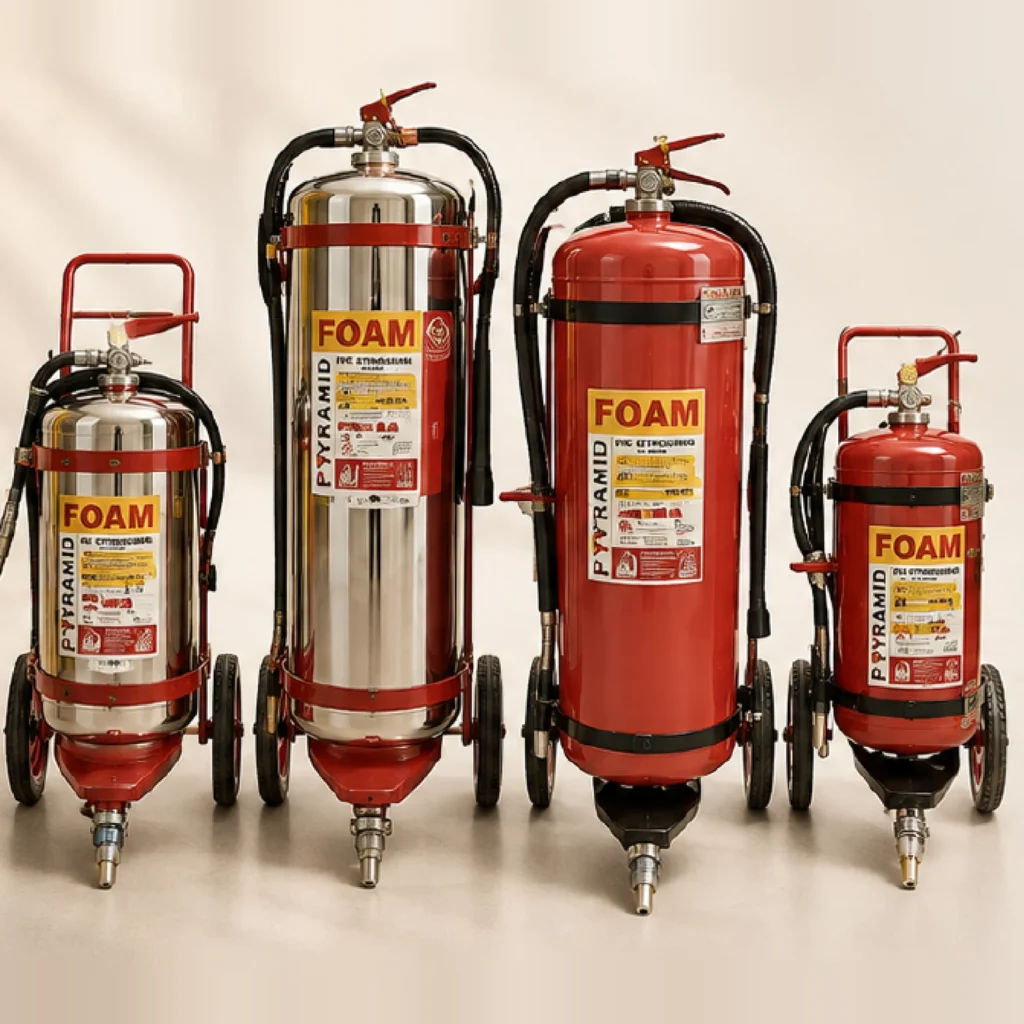
- PYRAMID AFFF foam (6 and 9 L, wheeled 25 and 45 L): a water-based unit, so place it in warm areas only unless its datasheet states a lower range.
- Wheeled powder 25 and 50 kg: for loading docks, the yard and forklift parking.
Practical rule: do not hang extinguishers inside a freezer room. Put them outside the door in a warm, visible spot. For quantities and layout, see fire extinguishers.
Fire hydrants in the cold store yard
Once fire reaches the panel core, crews fight it mostly from outside, so yard hydrants are a core part of cold store protection. The American Fire Control FW-9000 is a wet barrel hydrant with a 4.5 inch pumper nozzle for fire trucks and two 2.5 inch hose outlets, 250 psi working pressure and a 6 inch flanged inlet. Its datasheet operating temperature is 0 to 80 °C, which suits open yards in Egypt.
- Space hydrants around the building so hoses reach every elevation, especially the loading docks where cardboard and pallets collect.
- Keep a clear fire truck route, never blocked by parked trucks or empty crates.
- Fit an isolation valve on each hydrant branch so it can be serviced without shutting the network.
- Do not run water-filled pipes into freezer rooms. Put hose cabinets, such as Falcon Gold cabinets, in the packing hall and warm corridors.
Installation and testing are covered in AFC FW-9000 fire hydrants. For the dry stores on the same site, such as cardboard and packaging stores, see warehouse fire protection.
The regulatory framework in Egypt
Egyptian Building Law No. 119 of 2008 and its executive regulations require the permit applicant to apply fire protection requirements according to the Egyptian code. The current edition is the Egyptian Code for the Design and Implementation of Fire Protection for Buildings, 2026 edition (Ministerial Decree No. 355 of 2026). The General Directorate of Civil Protection (Ministry of Interior) reviews drawings and systems and inspects before occupancy. NFPA 72, EN 3-7 and FM Global data sheets are technical design references, not legal requirements in Egypt, although some insurers ask for them.
Common mistakes in cold store fire protection
- Installing standard smoke detectors inside freezer rooms, then living with faults and false alarms.
- Fixing the beam detector or reflector directly to sandwich panels, so alignment drifts as panels move.
- Hanging foam or water extinguishers inside cold rooms without checking the temperature range.
- Running cables and lighting through panels without sealing the openings, giving fire a path into the core.
- Storing empty cardboard and pallets on the dock against the facade and in front of hydrants.
- Leaving the forklift charging area in the packing hall without detection or a nearby extinguisher.
Frequently asked questions
What usually causes a cold store fire?
Common sources are electrical: evaporator panels, defrost heaters, lighting and forklift battery charging. Fire spreads quickly because of insulated panels, cardboard and pallets.
Can a standard smoke detector be used in a chill room?
Under NFPA 72, smoke detectors are not installed below 0 °C or above 93% RH unless listed for those conditions. Check the datasheet for each room.
Does the TANDA TX7130 beam detector work in freezer rooms?
It is not installed inside freezer rooms. It belongs in packing halls and high docks; for a chill room, the designer compares the room temperature with the minimum operating temperature in the official TANDA datasheet, with non-condensing humidity.
Which fire extinguisher is best for a fruit cold store?
ABC powder at cold room entrances and in the packing hall, and CO2 for electrical panels, after checking the temperature range on the label.
Can a fire extinguisher freeze?
Under EN 3-7, water or foam units without antifreeze are limited to +5 °C, while powder and CO2 units work down to -20 °C or lower.
Where should fire hydrants go at a packhouse?
Around the building so hoses reach every elevation, especially the docks, with a clear fire truck route and an isolation valve on each branch.
Conclusion
Cold store protection starts with a temperature and humidity schedule for every space, then detectors and extinguishers that actually work in those conditions according to their datasheets, and yard hydrants that let crews fight a panel fire from outside. Daily housekeeping and sealed cable penetrations keep the design valid.
Building a new cold store or reviewing an existing packhouse? Send us the layout and room temperatures, and the AZEIDK Egypt team will review detection, extinguishers and hydrants for each zone. Talk to the AZEIDK Egypt team
Related guides
- Electric, Diesel and Jockey Fire Pumps: Why One Set Combines All Three
- Fire Alarm Elevator Interface: Lift Recall, AHU Shutdown, Door Release and Gas Shut-off with Context Plus Outputs
- Fire Hose Cabinet Locations: Spacing, 30 m Hose Reach and Mounting Height by Stairs and Exits with the Falcon Gold FG-1001S
- Fire Extinguisher for a Pharmacy in Egypt: Type, Detection and GAHAR CPS.14