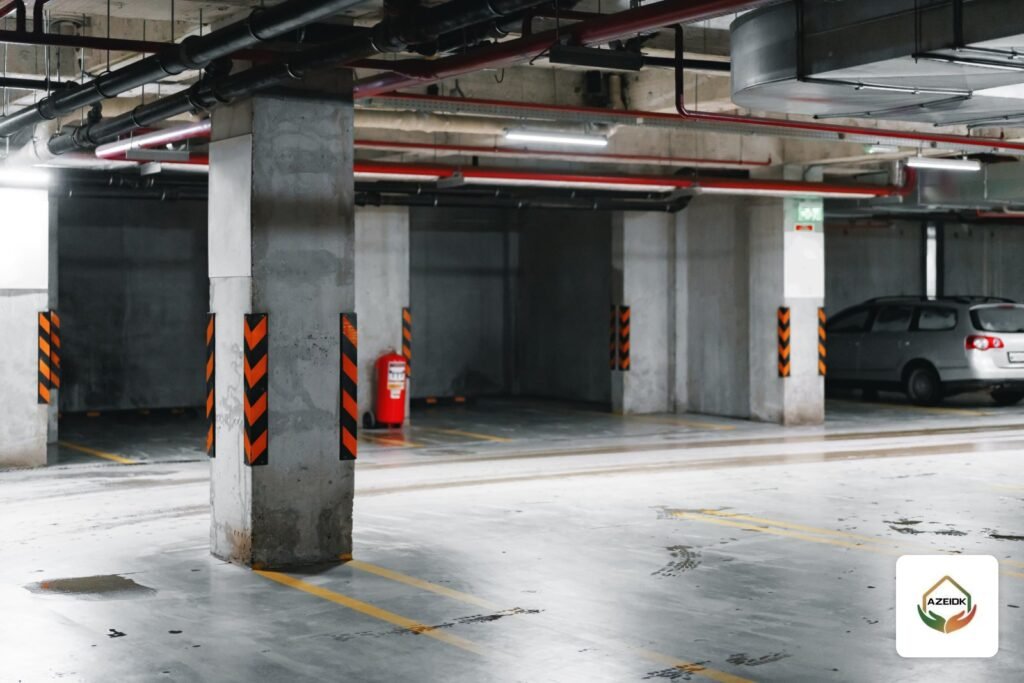
An underground car park is a closed, low-ceilinged space that firefighters struggle to enter once smoke fills it. Good underground car park fire protection therefore relies on a system that works before civil protection arrives: sprinklers, an alarm valve, early detection, and extinguishers and hose reels within reach.
This guide covers basement car parks under malls, office towers and residential buildings in New Cairo, the New Administrative Capital and Downtown, and maps each part of the system to the right product within AZEIDK GROUP firefighting solutions in Egypt. General sprinkler design basics are covered in Automatic Sprinkler Systems in Egypt.
Key takeaways
- The binding reference is the Egyptian fire protection code, 2026 edition (Decree No. 355 of 2026), complemented by the Egyptian garages code issued by Decree No. 139 of 2024.
- A wet pipe system is the usual choice in a basement, with an alarm valve such as the AFC ACV-300 for each sprinkler zone and a supervised OS&Y valve upstream.
- The 2022 edition of NFPA 13 moved car parking from Ordinary Hazard Group 1 to Ordinary Hazard Group 2 (OH2).
- Exhaust fumes cause false alarms on smoke detectors, so heat detectors such as the Context Plus Series 65A 55000-139IMC are usually chosen for parking areas.
- At ramps and exits, place PYRAMID 6 kg powder extinguishers and a 50 kg wheeled unit, with Falcon Gold hose reel cabinets next to the stairs.
In this article
- The Egyptian references: the 2026 fire code and the garages code
- Why a basement car park is a special case
- Underground car park fire protection with sprinklers: hazard class and layout
- ACV-300 alarm valve and OS&Y valves for each sprinkler zone
- Heat detectors instead of smoke detectors in the basement
- Extinguishers and hose reel cabinets at ramps and exits
- Where each component goes
- Common mistakes in car park protection
- Frequently asked questions
- Conclusion
The Egyptian references: the 2026 fire code and the garages code
The binding document for fire system design is the Egyptian Code for the Design and Implementation of Fire Protection for Buildings, 2026 edition (Ministerial Decree No. 355 of 2026). Its second part covers mechanical firefighting systems and its third part detection and alarm. The General Directorate of Civil Protection (Ministry of Interior) reviews the drawings and inspects the system before occupancy, under Egyptian Building Law No. 119 of 2008 and its executive regulations.
Car parks also have their own code, issued by Minister of Housing Decree No. 139 of 2024 as the “Egyptian Code for Safety Requirements for Multi-Purpose Facilities, Part One: Garages”. Egyptian press reports say it sets minimum requirements for standalone and attached garages, open or enclosed, above or below ground, for new buildings permitted after it took effect, and that the fire protection code sets the fire requirements for garage buildings.
NFPA 13 and NFPA 88A are technical references the designer uses for details the Egyptian code does not set, or where project documents call for them. They are not legally mandatory in Egypt. Check clause numbers in the official Egyptian editions adopted for your project.
Why a basement car park is a special case
- Fire load of modern cars: plastic parts, plastic fuel tanks and batteries let a fire in one car spread to the next. According to the NFSA, this is why NFPA 13 (2022) raised the hazard class of car parking and NFPA 88A (2023) requires sprinklers in all new parking structures.
- Difficult access: firefighters go down the ramp or stairs against rising smoke, so the first minutes belong to the automatic system.
- A harsh operating environment: exhaust, dust and humidity affect detector choice, while deep beams and crossing services affect sprinkler layout.
Underground car park fire protection with sprinklers: hazard class and layout
A wet pipe system is the normal solution in Egyptian basements, since there is no freezing risk that would call for a dry system. The car park is usually split into sprinkler zones by level or area, each with an alarm valve and a flow switch that tell the fire alarm panel where the fire is.
On projects designed to NFPA 13, car parking is treated as Ordinary Hazard Group 2 (OH2) from the 2022 edition. Since the 2022 edition, NFPA 13 uses a single design point per hazard class for new systems instead of the density/area curve. In practice, OH2 means:
| Item | Typical NFPA 13 value for OH2 | Car park note |
|---|---|---|
| Design density | 0.20 gpm/ft² (about 8.1 mm/min) | Over a 1,500 ft² (about 139 m²) design area |
| Maximum area per sprinkler | 130 ft² (about 12.1 m²) | Often less in practice because of beams and slab bays |
| Maximum spacing between sprinklers | 15 ft (about 4.6 m) | Check around columns and wide ventilation ducts |
| Sprinkler type | Usually upright in an exposed basement ceiling | Protect from impact by tall vehicles near ramps |
These values are a technical reference, not an Egyptian requirement; the governing values are those set by the Egyptian code and the project documents. On the drawing, check wide exhaust ducts that block the spray, sprinklers near the vehicle path on ramps, and clear driving height.
ACV-300 alarm valve and OS&Y valves for each sprinkler zone
A wet alarm check valve is installed in the valve room at the start of each sprinkler zone. AZEIDK GROUP supplies the American Fire Control ACV-300. According to its datasheet it comes in sizes from 2 to 12 inches with a maximum working pressure of 300 psi (21 bar), and its retard chamber prevents false alarms caused by pressure surges. When a sprinkler opens, system pressure drops, the clapper lifts and water reaches the water motor gong and pressure switch to signal flow. Trim and installation details are in AFC ACV-300 Wet Alarm Check Valve.
Upstream of the alarm valve sits an AFC OS&Y gate valve. Its rising stem shows whether it is open or closed, and a tamper switch sends a supervisory signal to the alarm panel if it is closed. A zone valve shut for maintenance and forgotten leaves a whole level unprotected.
Place the valve room near a stair so firefighters reach it without crossing the parking floor.
Heat detectors instead of smoke detectors in the basement
An optical smoke detector sees exhaust particles and dust the way it sees smoke. Repeated false alarms at peak hours often end with the zone disabled. That is why heat detectors are usually chosen for parking areas, while smoke detectors stay in electrical rooms, pump rooms and enclosed corridors attached to the car park.
From Context Plus, AZEIDK GROUP supplies the Series 65A conventional heat detectors in Egypt:
| Model | Type | Rating | Suggested use in a car park |
|---|---|---|---|
| 55000-139IMC | Fixed temperature with rate of rise | 135°F (about 57°C), Ordinary class | Parking areas in a ventilated or conditioned basement |
| 55000-145IMC | Fixed temperature with rate of rise | 200°F (about 93°C), Intermediate class | Areas that get hot in summer, after checking operating limits |
Both models run on 9 to 33 V DC. The datasheet ambient range is 0 to about 38°C, a figure to compare against the actual summer basement temperature before approval. A comparison of detector types by space is in Smoke and Heat Detectors: Choosing the Right Detector.
Each zone’s flow and tamper switches also connect to monitor modules, so sprinkler flow and a closed valve show as separate signals.
Extinguishers and hose reel cabinets at ramps and exits
The driver or attendant usually sees a car fire first, so first-aid equipment goes on traffic routes, not in corners:
- PYRAMID 6 kg powder extinguishers: stored-pressure ABC powder, conforming to EN3 and Egyptian standard ES 8442/2021, hung by columns along driving aisles and at stair doors.
- PYRAMID 50 kg wheeled powder extinguisher: conforming to EN 1866 and ES 1494, placed at the foot of the ramp and at the entrance to each level, where it can be wheeled to a burning car on level ground.
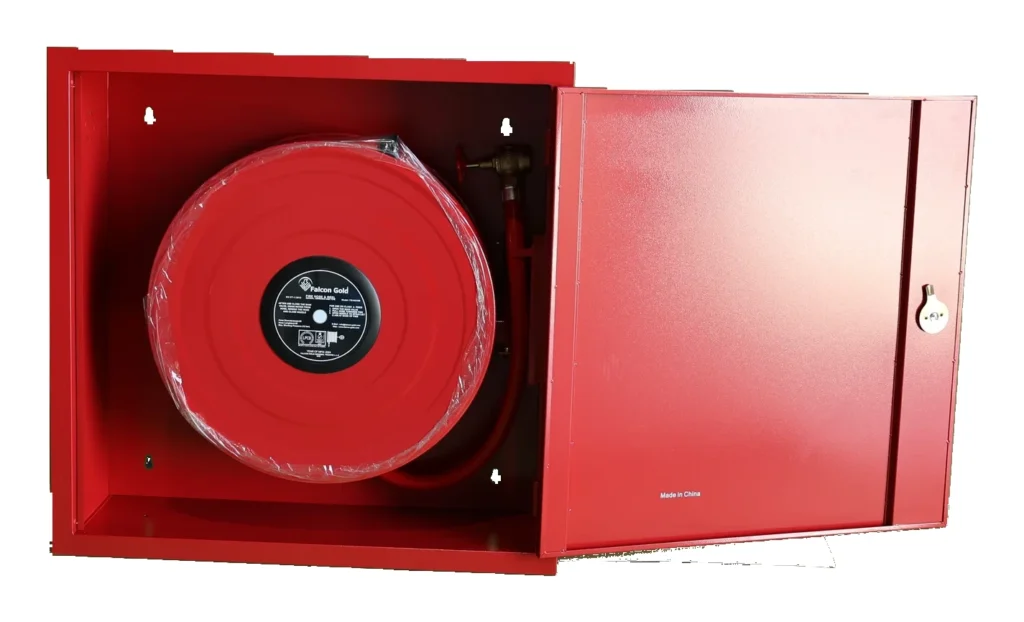
- Falcon Gold hose reel cabinets: such as the single-door FG-1001S, manufactured locally in Egypt with genuine Falcon Gold components, installed next to stair exits so the reel reaches the farthest car in its area.
For extinguisher sizes and specifications see the PYRAMID page.
Where each component goes
| Location | Usual protection | Product from AZEIDK GROUP Egypt |
|---|---|---|
| Parking areas | Wet pipe sprinklers and heat detectors | Context Plus 55000-139IMC or 55000-145IMC |
| Valve room | Wet alarm valve and supervised gate valve per zone | AFC ACV-300 and AFC OS&Y valves |
| Ramps and level entrances | Wheeled and portable extinguishers | PYRAMID 50 kg wheeled and 6 kg powder |
| Stair exits | Hose reel cabinet | Falcon Gold FG-1001S |
| Electrical and pump rooms | Smoke detector and an extinguisher suited to electrical risk | Context Plus detectors and PYRAMID extinguishers |
Common mistakes in car park protection
- Installing smoke detectors in parking areas, then disabling them a month later because of false alarms.
- Designing the network to the old OH1 classification on a project whose documents call for a recent edition of NFPA 13.
- Leaving wide exhaust ducts without sprinklers beneath them.
- A zone valve with no tamper switch, or a tamper switch not wired to the panel.
- A valve room deep inside the car park, far from the stairs and hard to reach through smoke.
- Low sprinklers at the ramp entrance that tall vehicles hit.
Frequently asked questions
Are sprinklers mandatory in underground car parks in Egypt?
Fire requirements for garages are set by the Egyptian fire protection code, 2026 edition, which the garages code issued by Decree No. 139 of 2024 refers to. Check the clause that applies to your car park’s size and type in the official edition with your designer and civil protection.
What is the Egyptian garages code called?
The “Egyptian Code for Safety Requirements for Multi-Purpose Facilities, Part One: Garages”, issued by Minister of Housing Decree No. 139 of 2024.
Why heat detectors rather than smoke detectors in a car park?
Exhaust fumes and dust cause false alarms on optical smoke detectors. Smoke detectors remain suitable for attached electrical and pump rooms.
How many alarm valves does a car park need?
One per sprinkler zone, and zones are usually set by level and area. If a three-level car park has one zone per level, it needs three alarm valves, each with a supervised OS&Y valve upstream.
What is the NFPA 13 hazard class for a car park?
The 2022 edition moved car parking from Ordinary Hazard Group 1 to Group 2 (OH2). This is a technical reference that applies where project documents adopt it.
Where should a wheeled extinguisher go in a car park?
On level ground at the foot of the ramp and at the entrance to each level, so it can be wheeled easily to any parking bay.
Conclusion
An underground car park needs a system that works before anyone arrives: wet sprinklers designed to the right hazard class, an alarm valve and supervised gate valve for each zone, heat detectors that ignore exhaust, and extinguishers and hose reels on the traffic routes.
Designing or building a basement car park? Send us the floor plans and number of levels, and we will put together the valves, detectors and extinguishers list with a datasheet for each. Talk to the AZEIDK GROUP Egypt team