


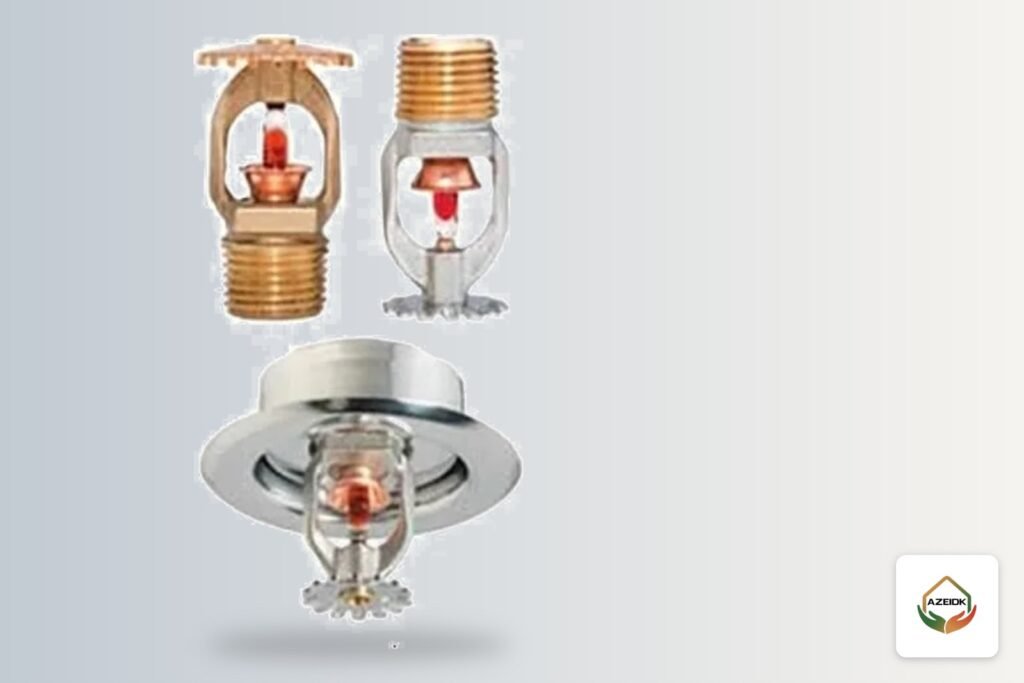
A sprinkler system waits for years without operating, then has to work within a minute without error. That is why sprinkler system maintenance is not optional: a valve closed by mistake, a painted sprinkler head, or goods stacked to the ceiling can each make the whole system useless.
This guide explains the inspection, testing and maintenance programme for wet sprinkler systems in Egyptian buildings, from visual checks of sprinkler heads to the main drain test, water motor gong and flow switch tests, with reference intervals from NFPA 25, and how it applies to the alarm stations and valves from American Fire Control that AZEIDK Egypt supplies as part of its fire fighting systems.
Key takeaways
- Under NFPA 25 (2017 edition, reference values), sprinkler heads, pipework and hangers get a visual inspection once a year, together with the spare sprinkler stock.
- Control valves are inspected weekly if not locked or supervised, monthly if locked, and quarterly if electrically supervised (2026 edition).
- The main drain test is annual, vane or pressure type flow switches are tested semiannually, and mechanical water motor gongs quarterly.
- Standard sprinklers are replaced or sample tested at 50 years and fast response sprinklers at 20 years, then every 10 years.
- Keep at least 18 in (about 457 mm) between storage and sprinkler deflectors, never paint a sprinkler, and hang nothing from the pipes.
In this article
Why does a sprinkler system need a maintenance programme?
A sprinkler head works thermally and individually: only the head whose surroundings reach its operating temperature opens. So every head must be intact and exposed to heat, and water must be behind it at the required pressure. Any weak link in that chain, from pump to valve to head, removes protection where it is needed.
Egyptian buildings see many changes after handover: a tenant installs a new suspended ceiling, a warehouse raises its stacking height, or a finishing contractor paints pipes and heads the same colour. Routine maintenance is what finds these changes before a fire does.
The binding reference in Egypt is the 2026 Egyptian fire code, whose second part covers mechanical firefighting systems, together with civil protection requirements. NFPA 25 is used as the technical reference for inspection and testing, along with the valve and sprinkler manufacturers’ instructions.
Wet sprinkler system maintenance schedule
The intervals below come from the NIFSAB guide based on NFPA 25 (2017 edition), with control valve intervals from the 2026 edition as presented by QRFS. Each project follows the edition and programme agreed for it.
| Item | Reference interval | What is inspected or tested |
|---|---|---|
| Sprinkler heads | Annual (visual) | Leaks, corrosion, paint, damage, orientation, obstructions |
| Spare sprinklers | Annual | Enough stock of each type, with the right wrench |
| Pipes, fittings and hangers | Annual | Leaks, corrosion, external loads, secure fixing |
| Gauges | Inspect quarterly; test or replace every 5 years | Normal system pressure reading |
| Control valves | Weekly, monthly or quarterly by securing method; full operation annually | Open position, lock or supervision, free movement |
| Waterflow alarm devices | Inspect quarterly | Device intact and undamaged |
| Flow switch (vane or pressure) | Test semiannually | Signal reaches the fire alarm panel |
| Water motor gong | Test quarterly | Gong sounds when the test valve is opened |
| Main drain test | Annual | Static and residual pressure compared with earlier readings |
| Fire department connection (Siamese) | Quarterly | Caps, threads, access, no leaks |
| Internal pipe inspection | Every 5 years | Deposits, obstructions, internal corrosion |
Inspecting sprinkler heads: what the technician looks for
The technician walks the area and looks at the heads from the floor, looking for paint, heavy dust or grease, leaks or rust, a glass bulb that has lost its liquid, or a bent or broken head. Obstructions are checked too: storage closer than 18 in (about 457 mm) to the deflector, new ductwork or lighting in front of a head, or items hung from the pipes.
Warehouses in particular change their storage after handover: higher racking, plastic goods instead of cardboard, or stacks close to the ceiling. Each such change is recorded in the visit report and raised with the owner, because the system was designed for a specific hazard that may no longer be the current one.
A painted sprinkler is not cleaned or reused. It is replaced with one of the same type, temperature rating and K-factor. That is why a stock of spare sprinklers is kept in an on-site cabinet with the right wrench for each type, so an area is not left unprotected for days waiting for delivery.
Alarm station, main drain and water motor gong
At the base of each riser sits the alarm station: a control valve, a wet alarm check valve such as the AFC ACV-300, gauges, the main drain valve and a flow switch. Per its datasheet the ACV-300 is installed vertically only with flow upwards, and works with a retard chamber that delays the alarm by 5 to 60 seconds per the manufacturer’s manual to avoid false alarms from pressure surges. Details are in AFC ACV-300 wet alarm valves.
In the main drain test, record static pressure, open the drain fully and record residual pressure while flowing, then close it and note how long pressure takes to recover. What matters is the comparison with earlier readings: a clear drop in residual pressure can mean a partly closed valve in the supply, a blockage or a problem with the water source.
The alarm test is done by opening the inspector’s test valve or test line, checking that the water motor gong sounds and that the flow switch signal reaches the alarm panel. How flow and tamper switches connect to the panel is covered in connecting sprinklers to the fire alarm.
Common mistakes
- Closing a control valve for alterations and forgetting to reopen it, one of the best-known causes of sprinkler failure.
- Painting heads with the ceiling during finishing, or bagging them and never removing the bags.
- Replacing a damaged head with one of a different temperature rating or K-factor.
- Raising storage height in a warehouse without reviewing the sprinkler design.
- Running the main drain test without comparing the result with earlier readings.
- Leaving the fire department (Siamese) connection without caps or blocked by cars or fences.
Sprinkler maintenance with AZEIDK Egypt
As part of its maintenance and technical support services, AZEIDK Egypt carries out sprinkler inspection and testing visits and supplies American Fire Control valves, such as OS&Y gate valves and ACV-300 alarm valves, when they need replacing, with a written report of readings and findings. Whether the system is in a warehouse in 10th of Ramadan City or a hotel in Hurghada, the programme starts with a survey of alarm stations, valves and protected areas. Components and system types are covered in automatic sprinkler systems in Egypt.
Frequently asked questions
How often should a sprinkler system be maintained?
Under NFPA 25 (2017 edition): an annual visual inspection of heads and pipework, routine checks of valves and gauges, an annual main drain test, and quarterly or semiannual alarm device tests depending on type.
Can a painted sprinkler be cleaned?
No. A painted sprinkler is replaced with a new one of the same type, temperature rating and K-factor.
When should old sprinkler heads be replaced?
Under NFPA 25 (2017 edition), standard sprinklers are replaced or sample tested at 50 years and fast response sprinklers at 20 years, then every 10 years. Any damaged, painted or leaking head is replaced immediately.
What does the main drain test show?
It compares static and residual pressure with earlier readings, revealing partly closed valves, blockages and water supply problems.
How much clearance is needed between goods and sprinklers?
NFPA 25 gives at least 18 in (about 457 mm) between storage and the sprinkler deflector, with few exceptions. High-piled storage may need a special design.
Is NFPA 25 mandatory in Egypt?
The binding reference is the 2026 Egyptian fire code and civil protection requirements. NFPA 25 is used as the technical reference for inspection and testing.
Conclusion
Sprinkler maintenance comes down to three questions on every visit: are the valves open, are the heads intact and exposed, and does water still arrive at the same pressure as before? Documented answers in a written record turn pipes in the ceiling into protection you can rely on.
Has your sprinkler system not been tested since handover? Send us the number of alarm stations and protected areas, and we will propose a suitable inspection and testing programme. Talk to the AZEIDK Egypt team
Related guides
- Fire Safety in Nurseries and Kindergartens in Egypt: Detectors, Extinguishers, Evacuation
- Fire Pump for Residential Towers in Egypt: Estimating Flow and Pressure and Choosing a 3PUMP Set
- Fire Water Tanks: Capacity, Types and Design Basics
- Fire Hose Maintenance in Egypt: Hose Cabinets, Reels, Valves, Leaks and Hose Replacement





