


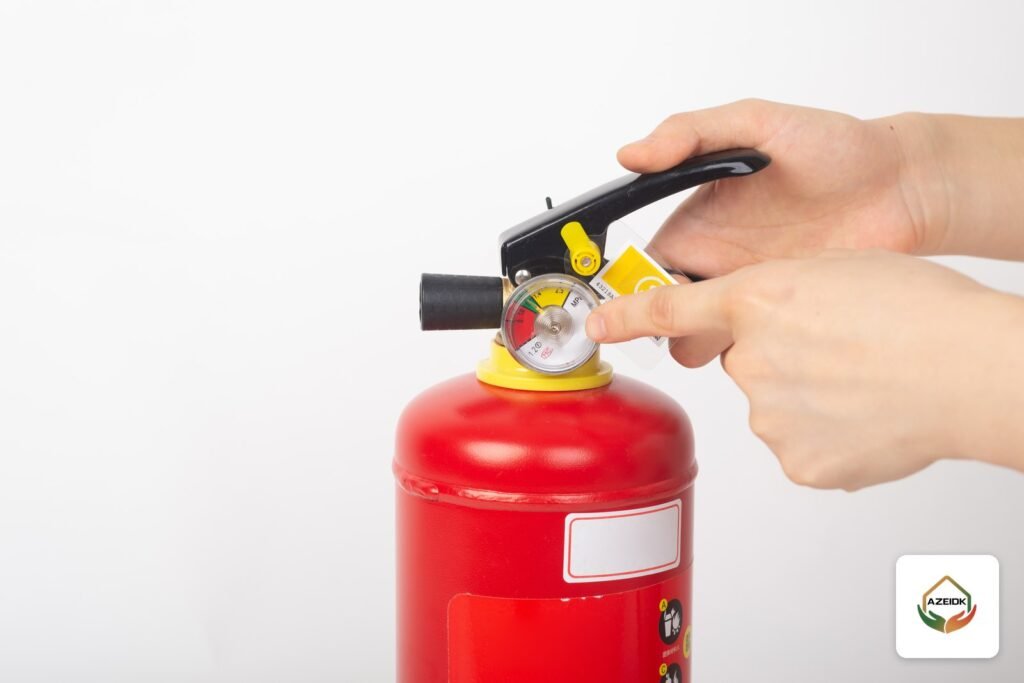
Many shop, office and warehouse owners in Egypt ask the same question: which size should I buy? The usual answer is a 6 kg dry powder extinguisher, but it does not fit everywhere. Capacity sets the fire size the unit can handle, its weight, how it discharges and where it belongs.
This article covers the five PYRAMID stored-pressure powder sizes (1, 3, 6, 9 and 12 kg) as listed on the AZEIDK Egypt datasheet: the fire rating of each, where each fits, and where powder should not be used. AZEIDK supplies these units as part of its fire extinguisher solutions, and the full range is on the PYRAMID brand page.
Key takeaways
- PYRAMID portable powder extinguishers are stored-pressure units with nitrogen as the propellant, in 1, 3, 6, 9 and 12 kg, for Class A, B and C fires.
- The datasheet gives a fire rating for each size, from 5A–21B for the 1 kg unit to 43A–183B for the 12 kg unit.
- The 1 and 3 kg units discharge through a nozzle on the valve head. The 6, 9 and 12 kg units have a hose with a nozzle at the end.
- The extinguishers conform to EN3 and Egyptian Standard ES 8442/2021, the powder conforms to EN 615 and ES 4833, and the units are approved by the Egyptian Organization for Standardization and Quality (EOS) and carry the Egyptian Quality Mark.
- Powder leaves residue that is hard to remove. Do not choose it to protect delicate electronics or cooking oil fires.
In this article
- What the datasheet says about PYRAMID powder extinguishers
- How to read a fire rating such as 21A–113B
- The 6 kg dry powder extinguisher: why it is chosen so often
- Choosing the size by type of space
- Where powder falls short: residue, electronics and kitchens
- The legal and technical references in Egypt
- Common mistakes when buying a powder extinguisher
- Frequently asked questions
- Conclusion
What the datasheet says about PYRAMID powder extinguishers
In a stored-pressure unit the propellant sits in the same cylinder as the powder: pull the pin, squeeze the handle and it discharges. The datasheet describes the units as locally made in Egypt. Data shared by all five sizes:
- Pressure: working pressure 17.5 bar, test pressure 35 bar, burst pressure 70 bar or more.
- Propellant: nitrogen.
- Extinguishing agent: ABC-E dry chemical powder.
- Operating temperature range: −20 °C to +70 °C.
- Cylinder: steel to Egyptian Standard ES 1110, surface treated and electrostatically coated with red polyester.
- Valve: nickel-chrome plated brass, with a pressure gauge showing internal pressure and a safety valve that releases pressure above the permitted limit.
- Fittings: an electrically insulating, rust-proof plastic base, a steel wall bracket, and manufacturer data and operating instructions printed on the body in non-erasable print.
- Warranty: two years against manufacturing defects, per the datasheet.
At delivery, check the label, confirm the gauge needle is in the operating zone, and check the pin and tamper seal.
How to read a fire rating such as 21A–113B
As Firesafe.org.uk explains the European system, the rating is a number and a letter. The letter is the fire class: A for solids such as wood, paper and fabric; B for flammable liquids such as petrol, diesel and solvents. The number is the size of the test fire the unit put out under standard conditions; higher means larger. Class C (gas) carries no number.
EN3 extinguishers are tested to Part 7 of the standard (EN 3-7). This rating has a different format from the UL rating used in the NFPA 10 tables (for example 2-A:10-B:C), so do not compare the two sets of numbers directly. When Egyptian code distribution requirements or NFPA 10 tables are applied to a project, the designer decides how the European rating on the unit is treated.
| Size | Fire rating (datasheet) | Discharge | Typical locations |
|---|---|---|---|
| 1 kg | 5A – 21B | Nozzle on valve head | Private cars; an extra unit next to a panel or appliance in a small space |
| 3 kg | 13A – 55B | Nozzle on valve head | Light vans and minibuses; kiosks and very small shops |
| 6 kg | 21A – 113B | Hose with nozzle | Shops, offices, building corridors and stairs, clinics |
| 9 kg | 27A – 144B | Hose with nozzle | Workshops, medium warehouses, showrooms |
| 12 kg | 43A – 183B | Hose with nozzle | Large warehouses, loading areas, near generators, flammable liquid storage |
“Typical locations” is practical guidance, not a requirement. Final numbers and sizes come from a hazard assessment and travel distances.
The 6 kg dry powder extinguisher: why it is chosen so often
The 6 kg unit pairs a 21A–113B rating that covers typical early-stage fires in shops, offices and corridors with a weight most people can lift and move with quickly. It is also the smallest PYRAMID size with a hose. The hose lets you aim the powder at the base of the flames while holding the cylinder steady in the other hand.
Popular does not mean enough. A warehouse full of cardboard or liquids may need 9 or 12 kg units, or more of them. In a server room, powder is the wrong choice altogether, as explained below. For quantity, spacing and mounting height, see How many fire extinguishers do you need?
Choosing the size by type of space
Cars
A car extinguisher must sit in a bracket that stops it moving. A 1 kg unit is usual for private cars, 3 kg for larger vehicles. The datasheet operating range tops out at +70 °C, so do not keep the unit where it can get hotter than that, such as near the engine or exhaust.
Shops and offices
In a shop or office, a 6 kg powder unit near the entrance or on the exit route is the usual starting point. Where there are computers, servers or medical equipment, add a CO2 extinguisher next to them rather than relying on powder alone. For the PYRAMID options, see PYRAMID CO2 extinguishers.
Warehouses and workshops
These spaces carry a higher fire load: cardboard, pallets, plastics, sometimes oils and solvents. Here the 9 and 12 kg sizes, with higher Class B ratings, earn their place. A heavier unit needs someone able to carry it; with few or untrained staff on shift, more 6 kg units can be easier to use than a few 12 kg ones.
When to go beyond 12 kg
For large hazards in open areas, such as storage yards, fuel stations or unloading zones, adding more portable units is not the answer. That is the job of PYRAMID wheeled powder extinguishers in 25 and 50 kg, which conform to EN 1866 and Egyptian Standard ES 1494. Selection is covered in Wheeled fire extinguishers.
Where powder falls short: residue, electronics and kitchens
ABC powder works fast on solids, liquids and gases, but it has limits buyers should know:
- Residue: the powder sticks to surfaces after discharge and must be cleaned up after any use. The Fire Equipment Manufacturers’ Association (FEMA), in a paper based on NFPA 10 (2018 edition), notes that dry chemical residue often cannot be removed completely and immediately, and that ABC powder can cause corrosion at high temperature or high relative humidity.
- Delicate electronics: according to the same source, NFPA 10 says dry chemical extinguishers shall not be installed to protect delicate electronic equipment, and that types listed and labeled for Class C hazards, such as CO2, should be selected instead. Powder can still put out an electrical fire; the problem is that it may ruin the equipment it is protecting.
- Confined spaces: the UK Fire Protection Association (FPA) warns that a powder cloud reduces visibility and affects the user’s breathing, more so in small enclosed spaces, which can hinder escape.
- Cooking oil: cooking oil and fat fires are a separate class (Class K in NFPA 10, Class F in European standards), and, as Amerex reports from NFPA 10, the standard requires Class K extinguishers for them. A powder unit is not adequate protection for a restaurant fryer.
The legal and technical references in Egypt
The binding reference in Egypt is the Egyptian Code for the Design and Implementation of Fire Protection for Buildings, 2026 edition (Ministerial Decree No. 355 of 2026), together with what the General Directorate of Civil Protection (Ministry of Interior) accepts at drawing review and inspection. NFPA 10 (2026 edition) is used as a technical reference for selecting, distributing and inspecting extinguishers. It is not a stand-alone legal requirement in Egypt.
Product conformity (EN3, ES 8442/2021, EN 615, ES 4833, EOS approval and the Egyptian Quality Mark) shows in the product documents. Ask for the datasheet with the quotation and match it against the label.
Common mistakes when buying a powder extinguisher
- Buying a 6 kg dry powder extinguisher for every space without looking at the type and size of the hazard.
- Hanging only a powder unit in a server room or next to delicate electronics.
- Relying on powder to protect a fryer or oil cooker in a commercial kitchen.
- Choosing a 12 kg unit for a space where staff cannot carry it easily.
- Leaving the car extinguisher in a closed boot in the sun or near the engine, outside the datasheet operating temperature range.
- Accepting a unit without checking the rating, size and standard printed on the label, and the gauge reading.
- Not recharging a unit after a short partial discharge because it still “feels full”.
Frequently asked questions
Is a 6 kg powder extinguisher enough for a small shop?
It is the usual starting point, but the final number and size depend on the goods, floor area and travel distance. Add a CO2 unit for delicate electronics.
What is the difference between the PYRAMID 1 kg and 3 kg units?
Both use a nozzle on the valve head with no hose. The rating rises from 5A–21B (1 kg) to 13A–55B (3 kg), a clearly larger test fire.
Can a powder extinguisher be used on an electrical fire?
The datasheet describes the powder as ABC-E type. Isolate the power first if you can. For protecting delicate electronic equipment, NFPA 10 says powder units shall not be installed (per the FEMA paper) because its residue can damage the equipment; CO2 is preferred.
What gas is inside a PYRAMID powder extinguisher?
The propellant is nitrogen, stored with the powder in the cylinder at a working pressure of 17.5 bar per the datasheet. The pressure shows on the gauge fitted to the valve head.
Is a powder extinguisher suitable for a home or commercial kitchen?
Cooking oil fires are a separate class, and NFPA 10 requires Class K extinguishers for them. Powder is not the right protection for fryers and cooking appliances in restaurants.
Conclusion
The five PYRAMID sizes are not interchangeable. Start with the hazard, pick the size whose rating covers it and that staff can carry, and rule out powder where it does more harm than good, such as delicate electronics and cooking oil. Then check the datasheet and label at delivery.
Need extinguishers for a shop, office or warehouse? Tell us the type of space, its area and what is stored there, and we will recommend PYRAMID sizes and quantities with the datasheets. Talk to the AZEIDK Egypt team
Related guides
- Clean Agent Fire Suppression in Egypt for Server Rooms
- How to Choose a Fire Fighting Company in Egypt: Technical Questions Before You Sign
- Food Court Kitchen Fire Suppression in Egyptian Malls: Per-Unit Systems, Alarm Link and Gas Shutoff
- Fire Triangle and Fire Classes A, B, C, D and K: Choosing the Right Extinguisher





