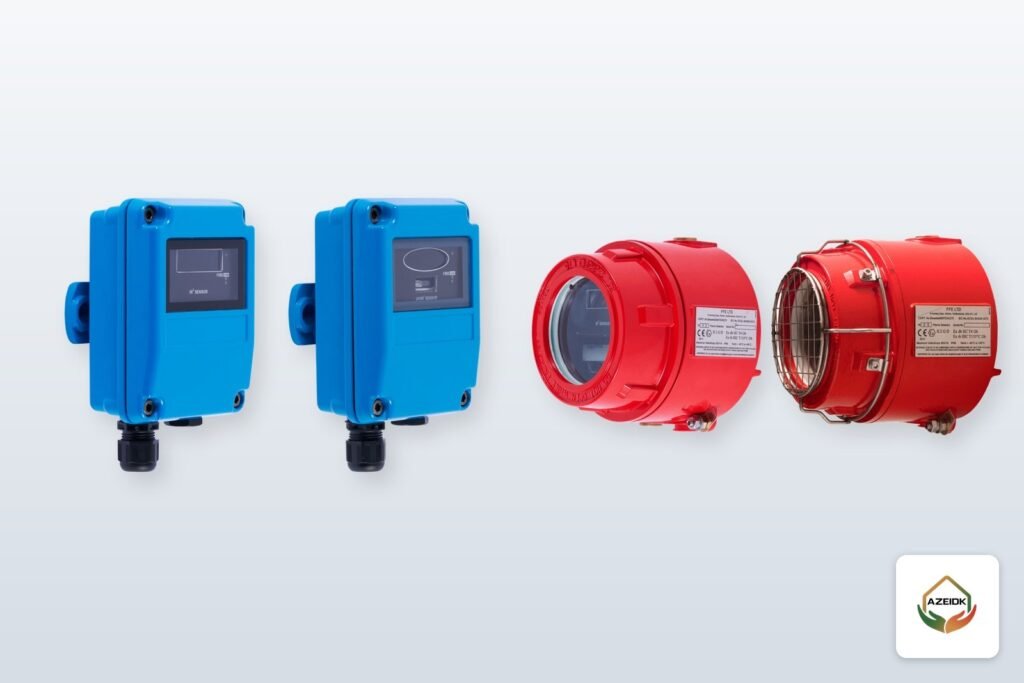
Choosing the right Talentum flame detector starts with two questions: is the site a classified hazardous area that needs a flameproof housing, and will the detector work indoors or on an open site exposed to sunlight and arc welding? The Talentum 16000 series by FFE, UK, covers three detection technologies (IR2, IR3 and UV/IR2), each in a standard blue version and a red flameproof Ex d version. This guide sorts the six models by site. Every figure comes from the official datasheets attached to the product pages.
AZEIDK supplies Talentum detectors as part of its fire alarm systems work in Saudi Arabia. For a general explanation of UV, IR and IR3 detection, see Flame Detectors in Industrial Facilities.
Quick answer
- Engine room or enclosed plant with no hazardous classification: Talentum IR2, model 16581.
- Indoor or outdoor site with hydrocarbon fuel and possible lens contamination: Talentum IR3, model 16589.
- Site with arc welding, lightning or strong sun reflections: Talentum UV/IR2, model 16591.
- Classified hazardous area on an oil or gas site: the flameproof IR3 Ex d 16519, UV/IR2 Ex d 16521, or IR2 Ex d 16511 for indoor areas.
What the six Talentum models have in common
All Talentum 16000 detectors respond to flickering, low frequency (1 to 15 Hz) radiation from flames and detect hydrocarbon fires with 4.3 µm emissions through to invisible hydrogen flames. At high sensitivity (EN 54-10 Class 1) they detect a 0.1 m² n-heptane fire at 25 m, and at low sensitivity (Class 3) at 12 m. The field of view is a 90° minimum cone, supply is 14 to 30 V DC, outputs are selectable relay or 4-20 mA, and each unit has built-in automatic and manual test.
IR2, IR3 or UV/IR2: the detection difference
| Model | Sensors | Location per datasheet | Strength |
|---|---|---|---|
| IR2 (16581) | Two infrared sensors | Indoor | Filters and signal processing reject flickering sunlight |
| IR3 (16589) | Three infrared sensors | Indoor and outdoor | Works with oil, dust, vapour or ice on the lens |
| UV/IR2 (16591) | One UV and two IR sensors | Indoor and outdoor | Alarms only on simultaneous UV and IR, so sunlight, arc welding and lightning are rejected |
As a working rule, IR3 suits most liquid fuel sites such as loading racks and tank farms, while UV/IR2 is preferred where there is welding, high voltage equipment or generators. The IR2 datasheet specifies indoor areas only.
When do you need the flameproof Ex d version?
Refineries, gas plants and petrochemical sites have classified areas where a flammable mixture may be present, and any electrical device there must be certified for that use. The Talentum Ex d versions have a red, copper free aluminium housing rated IP66 and weigh 2.3 kg:
- IR3 Ex d, model 16519: EN 54-10, LPCB, ATEX and IECEx, indoor and outdoor.
- IR2 Ex d, model 16511: EN 54-10, LPCB, ATEX and IECEx, indoor areas.
- UV/IR2 Ex d, model 16521: EN 54-10, VdS, LPCB and ATEX, indoor and outdoor.
Note that on the Ex d versions the viewing angle must not exceed ±20° to meet EN 54-10, against ±30° on the standard versions, which affects how many detectors a design needs. For combining flame and gas detection, see Fire and Gas Systems in Industrial Facilities.
Aircraft hangars and fuel stores
The datasheets list aircraft hangars among the applications of IR3 and UV/IR2, where the detector triggers the alarm or foam system when spilled jet fuel ignites. Hangar requirements are covered in NFPA 409 Aircraft Hangar Fire Protection. In warehouses storing flammable liquids, the IR3 is a practical choice because it tolerates dust on the lens.
Accessories and testing
Official accessories are available for all models: adjustable mounting bracket 07127-00, stainless steel weather shield (12545-00 for standard units, 07279-00 for Ex d), an air purge kit, and the Talentum Test Torch 1800-101 for field testing.
FAQ
Do Talentum detectors work with a conventional fire alarm panel?
Yes. The relay output wires into a conventional panel zone, and the 4-20 mA output can feed a control system. Wiring details are in the datasheet and user guide.
What is the difference between the EN and FM versions?
Some models have an FM version ending in -20, such as 16589-20, rated -20 to +60 °C, while the EN version is rated -10 to +55 °C.
How do I request a quotation for Talentum detectors?
Send the layout, area classification and fuel type through the contact page, or browse all models on the Talentum brand page.
Related guides
- Context Plus vs FG Fire Alarm Panels: Conventional, Addressable, Approvals and When to Choose Each
- Factory Fire Extinguishers in Saudi Arabia: Type and Size for Production Halls, Stores, Electrical Rooms and Fuel Areas
- Fire Protection and Safety Companies in Jeddah: A Practical Selection Guide
- Voice Evacuation Commissioning: PA Zoning, Wiring and STI Testing