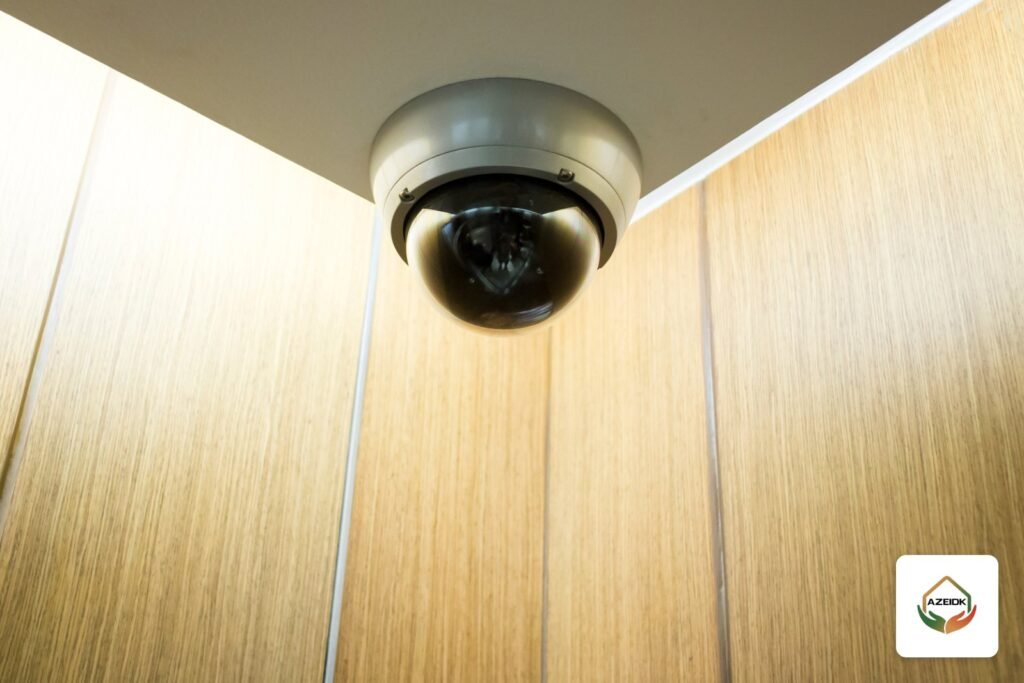
Designing CCTV for entertainment centers and indoor play parks is different from shops and offices. The space is open and large, movement never stops, children wander between attractions away from their parents, and there are payment counters, entry gates, emergency exits and parking. The system serves two goals: day-to-day security and compliance with the Saudi Security Surveillance Cameras Law and its Implementing Regulations.
This article covers where cameras go in an entertainment center, where they are prohibited, how recordings are kept and who may see them, and what to check in a quotation. AZEIDK supplies and installs Hikvision and Dahua cameras and recorders as part of Security and Surveillance Systems.
Key points
- Facilities covered by the Law on the Use of Security Surveillance Cameras include public and private entertainment facilities and event and festival venues (Article 2 of the Law).
- The Implementing Regulations (Umm Al-Qura, 9 June 2023) list camera locations, including entrances, reception desks, corridors, emergency exits, assembly points, parking, service areas and stairs.
- Cameras are prohibited in privacy areas such as restrooms and changing rooms.
- Audio recording may not be enabled without the competent directorate’s approval.
- When a security incident is reported, recordings are kept until the investigation ends or for the period in the specification document, whichever is longer, and released only on official request.
In this article
- Does the surveillance cameras law apply to entertainment centers?
- Where to place CCTV for entertainment centers
- Where cameras are prohibited
- Retention and access to recordings
- Choosing cameras and resolution for open spaces
- The monitoring room and the lost child procedure
- Quotation, handover and maintenance
- Frequently asked questions
- Summary
Does the surveillance cameras law apply to entertainment centers?
The Law on the Use of Security Surveillance Cameras was published in Umm Al-Qura on 7 October 2022. Article 2 lists the covered facilities, including public and private entertainment facilities, event and festival venues and cultural facilities, among others. The Implementing Regulations were then published in Umm Al-Qura on 9 June 2023, setting camera locations and rules for operation and retention.
For an entertainment center owner, cameras are therefore not decoration but a regulated system with specifications, locations and records. Article 12 of the Law sets the fines, including SAR 500 per camera or device not meeting the technical specifications, SAR 5,000 for failing to keep recordings, SAR 10,000 for installing cameras in privacy areas, and SAR 20,000 for unlawfully transferring or publishing recordings.
Where to place CCTV for entertainment centers
Article 2 of the Implementing Regulations lists the general installation locations. Applied to a family entertainment center, they look like this:
| Location | Purpose | Design note |
|---|---|---|
| Entry gates and ticket desk | Identify people entering and leaving | Camera facing the entrance, not the back of heads; allow for backlight from glass doors |
| Payment and card top-up counters | Cash handling oversight | Overhead view of drawer and screen without capturing card numbers |
| Play halls and children’s areas | Overall view and quick location of a lost child | Wide-angle cameras from above covering aisles between attractions |
| Corridors, stairs, escalators | Crowding and incidents | Cover the top and bottom of each stair |
| Emergency exits and assembly points | Exits kept clear; evacuation monitored | One camera per exit showing the door from inside |
| Parking and vehicle entrances | Accidents and theft | Cameras suited to night lighting; plate capture at entrances if required |
| Electrical, HVAC rooms and stores | Prevent unauthorized entry | Camera at the door rather than inside hazardous rooms unless required |
Where cameras are prohibited
Article 6 of the Law prohibits cameras in privacy areas, including restrooms, changing rooms, salons and women’s clubs. In entertainment centers, pay particular attention to:
- Restrooms, baby changing rooms and nursing rooms.
- Changing rooms in water play or trampoline areas where present.
The Regulations require privacy masking of private areas in certain cases, such as PTZ cameras and cameras whose view extends beyond the property boundary. Audio recording may not be enabled without the directorate’s approval, so built-in microphones are disabled during programming. See CCTV cameras with audio and when audio recording is allowed.
Retention and access to recordings
Under Article 6 of the Regulations, when a security incident is reported the person in charge signs an undertaking to keep recordings until the investigation ends or for the period set in the specification document, whichever is longer. Recordings are released only on an official request from Ministry of Interior enforcement authorities. Access to system equipment is limited to authorized persons, with entry and exit logged.
In practice, NVR storage is calculated from camera count, resolution, bitrate and the required retention period, not from the cheapest disk available. The recorder sits in a locked room, and viewing rights are limited to security staff and management. A common mistake is a staff member sending a clip to a parent by phone in good faith; the Regulations govern exactly that and it exposes the facility to a violation.
Choosing cameras and resolution for open spaces
Play halls are large and full of coloured lighting and screens. The need is facial detail at entrances and overall coverage inside, so the system is planned on two levels: higher-resolution cameras with suitable lenses at gates and counters, and wide-angle cameras in the halls. Resolution and lens choice are covered in 5MP CCTV cameras and the CCTV camera types guide. Centers inside malls coordinate with the mall control room, as described in CCTV for malls and retail centers.
Watch the lighting too. Glass entrances create strong daytime backlight, so wide dynamic range (WDR) cameras keep faces from turning black. Some attractions such as laser tag and VR run in dim or coloured light and need cameras with good low-light performance, tested at night before acceptance, not only in daylight.
The monitoring room and the lost child procedure
Cameras alone do not find a lost child; an organised monitoring room and a clear procedure do. Keep gate and exit cameras on the main screens at all times, because the first question is whether the child has left the center. Then review hall cameras in sequence from where the child was last seen.
- Name cameras in the recorder by real location (Gate 1, North kids’ hall) rather than random numbers.
- Set the recorder clock accurately, since searches depend on time.
- Train security staff in fast search and playback on the recorder software.
- Link the procedure to the gates: gate staff get the child’s description immediately.
Paging speakers can be added to call parents, such as the Hikvision IP horn speaker in outdoor areas, bearing in mind that fire evacuation messages follow the building’s approved alarm system.
Quotation, handover and maintenance
- Ask for a camera layout on the floor plan with each camera’s field of view, not just a total count.
- Ask for the storage calculation and the resulting retention period.
- Confirm models match the technical specifications in the tender document.
- Have passwords and user rights handed over in the facility’s name, not the technician’s.
- CCTV and low current maintenance is a separate contract from fire systems maintenance; see CCTV maintenance.
Frequently asked questions
How long must entertainment center CCTV recordings be kept?
For the period set in the specification document, and when a security incident is reported, until the investigation ends or that period, whichever is longer. Storage is sized on that basis.
Can a camera be installed in restrooms or changing rooms?
No. These are privacy areas where installation is prohibited.
Should audio be enabled in play hall cameras?
No, unless the competent directorate approves, because the Regulations prohibit enabling audio recording without approval.
Can a parent be given a clip of the footage?
Recordings are released only on official request from Ministry of Interior enforcement authorities, so the parent is directed to the official procedure.
Does a fire maintenance contract cover the cameras?
No. CCTV and low current maintenance is a separate contract from fire and safety systems.
Summary
A good surveillance system in an entertainment center covers entrances, counters, children’s halls, exits and parking, stays out of privacy areas, keeps recordings for the regulated period under the regulated controls, and is maintained under its own contract. For other sector solutions, see Entertainment and Event Halls, and for fire safety in enclosed venues see cinema and entertainment venue fire safety.
Fitting out an entertainment center or play park? Send the floor plan with gate and counter positions, and we will prepare the camera layout, storage sizing and a supply and installation offer. Contact the AZEIDK team
Related guides
- Fire Extinguishers in Jeddah: Where to Buy and How to Choose a Supply and Maintenance Company
- Fire Suppression Gases: CO2, FM-200, Novec 1230 and Inert Gases Compared
- Emergency and Exit Lighting Guide for Saudi Arabia: Duration, IP65 and Choosing the Right Emergency Light (KHIND, Alrouf, LIFECO)
- Aruba vs Huawei Access Points for Business: Cloud Management, Licensing and Series