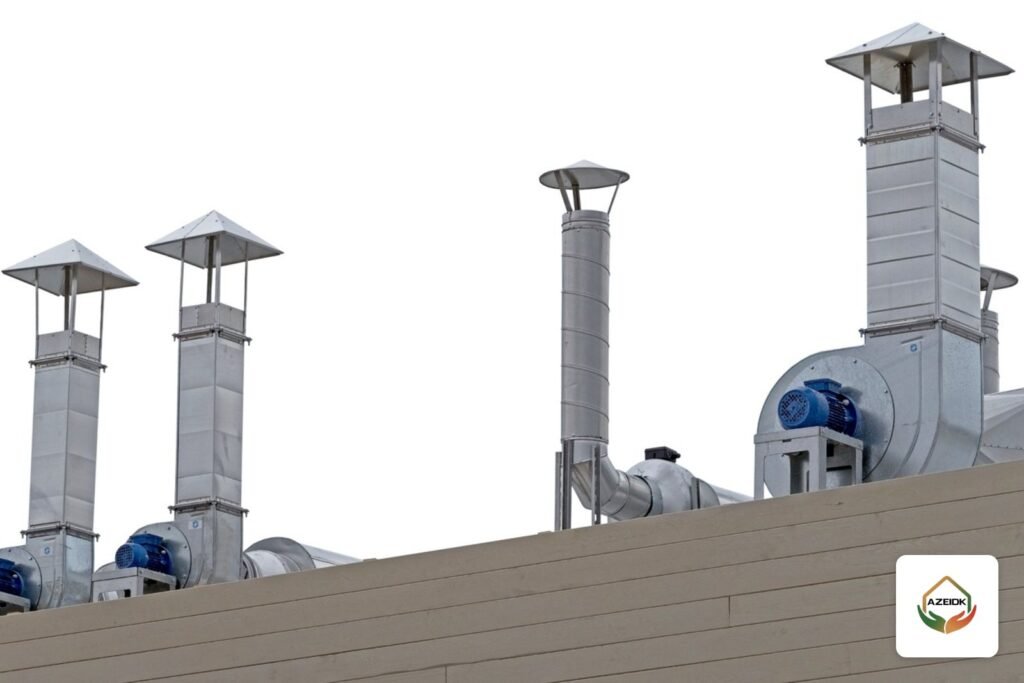
Smoke exhaust fans are fans built to keep running while they extract hot smoke for a set time, and that ability is expressed as a temperature and time class such as F300 (300 °C for 60 minutes) or F400 (400 °C for 90 or 120 minutes) under the European standard EN 12101-3. Selection starts from the approved smoke control study, then the fan type, then the temperature class, then how the fan is powered and started from the fire alarm panel. This guide walks owners, contractors and consultants through those steps, as part of AZEIDK’s smoke extraction and emergency ventilation systems.
Key takeaways
- EN 12101-3 classes combine temperature and minimum running time: F200 (200 °C, 120 min), F300 (300 °C, 60 min), F400 (400 °C, 90 or 120 min), F600 (600 °C, 60 min), F842 (842 °C, 30 min).
- “300 °C for two hours”, seen in some specifications, is not a standard EN 12101-3 class, so ask for a test certificate that covers that exact condition.
- The International Fire Code requires exhaust fan components to be rated and certified by the manufacturer for the probable temperature rise.
- The number and capacity of fans come from the approved design study for each project, not from a general table.
- The fan is part of a system: fire-resistant power supply, start from the fire alarm panel per the cause and effect matrix, and testing at handover.
In this article
- How are smoke exhaust fans different from normal ventilation fans?
- Smoke exhaust fan temperature and time ratings: how to read them
- Types of smoke exhaust fans: axial, centrifugal or jet?
- How to select the right smoke exhaust fan
- Power supply and fire alarm interface
- Common supply and installation mistakes
- Testing at handover and maintenance
- Frequently asked questions
- Conclusion
How are smoke exhaust fans different from normal ventilation fans?
A normal ventilation fan moves air at room temperature. A smoke exhaust fan works at the worst moment: the smoke it extracts may be hundreds of degrees hot, and it must keep running for the whole time assumed in the design study, until people are out and Civil Defense arrives. That changes the motor design, insulation, bearings and motor cooling, and it changes the test itself: the fan is run inside a furnace at a set temperature for a set time.
The International Fire Code (IFC), Section 909.10, says smoke control equipment, including fans, must be suitable for its intended use and for the probable exposure temperatures shown by the rational analysis. Section 909.10.1 adds that exhaust fan components must be rated and certified by the manufacturer for the probable temperature rise. The text quoted here is from the Massachusetts code, which is based on the international code. The Saudi Fire Code SBC 801 is based on the IFC, so check the matching clause in the edition on your permit.
Smoke exhaust fan temperature and time ratings: how to read them
EN 12101-3 is the reference most fan catalogues use. Each fan gets a class starting with F and the temperature, together with the minimum time it must run at that temperature:
| Class | Temperature | Minimum running time | Practical note |
|---|---|---|---|
| F200 | 200 °C | 120 min | Lowest temperature in the table with a long duration; chosen when the study shows low smoke temperature at the fan |
| F300 | 300 °C | 60 min | Common in specifications; note the duration is one hour |
| F400-90 | 400 °C | 90 min | Where the study expects higher temperatures |
| F400-120 | 400 °C | 120 min | Same temperature, longer duration |
| F600 | 600 °C | 60 min | Special cases set by the design study |
| F842 | 842 °C | 30 min | Special cases set by the design study |
The values are taken from Colt’s EN 12101-3 leaflet. The design engineer sets the temperature and time from the design fire and the fan’s distance from it, not the supplier.
What if the specification asks for “300 °C for two hours”?
This requirement appears in some regional specifications, but it is not an EN 12101-3 class, because F300 is rated for 60 minutes. Some manufacturers test outside the standard classes; Witt & Sohn, for example, lists a special 300 °C for 120 minutes test alongside the standard classes. The right approach is to ask the manufacturer for the test certificate itself and confirm it covers the proposed model, size and motor, rather than relying on a catalogue line.
Types of smoke exhaust fans: axial, centrifugal or jet?
Axial fans
They move air in a straight line along the fan axis and are fitted in ductwork or on the roof. They are compact for the airflow they deliver and suit systems with moderate duct resistance.
Centrifugal fans
They draw air in at the centre and discharge it at an angle. They develop higher pressure, so they are often chosen for long ducts with many bends. In some designs the motor sits outside the smoke path, which reduces its heat exposure.
Jet fans
Hung below the ceiling in car parks, they do not exhaust smoke outside by themselves. They push it horizontally toward the main extract points and work with main exhaust fans; they are also used for daily ventilation of vehicle fumes. See our article on car park fire protection.
| Type | Typical use | Strength | What to check |
|---|---|---|---|
| Axial | In-duct or roof | Compact for a large airflow | Temperature rating of a motor sitting in the smoke path |
| Centrifugal | Long ducts, high resistance | Higher pressure | Space, weight and supports |
| Jet | Car parks | Moves smoke without long ducts | Coordination with main exhaust fans and the smoke movement study |
How to select the right smoke exhaust fan
- Start from the design study: extract volume, required pressure, expected temperature at the fan and required time. As AZEIDK’s solution page states, fan capacities, numbers and extract rates come from the approved design study for each project.
- Choose the type: axial, centrifugal or jet, based on ductwork and available space.
- Choose the temperature class: not lower than the temperature and time in the study, backed by a test certificate for the model.
- Check the motor and drive: IFC Section 909.10.5 requires belt-driven fans to have 1.5 times the belts needed for the design duty, with a minimum of two, motors not run beyond nameplate rating, and a minimum service factor of 1.15.
- Ask for the documents: datasheet, fan curve with the duty point, temperature test certificate, installation and maintenance manual.
Power supply and fire alarm interface
A rated fan is useless if it loses power in the first minutes of a fire. It is normally fed from a standby power source as the code requires, through fire-resistant cables that keep circuit integrity for the required time. We explain circuit integrity in fire alarm cables and circuit integrity; the same principle applies to fan supplies, although the cable type differs.
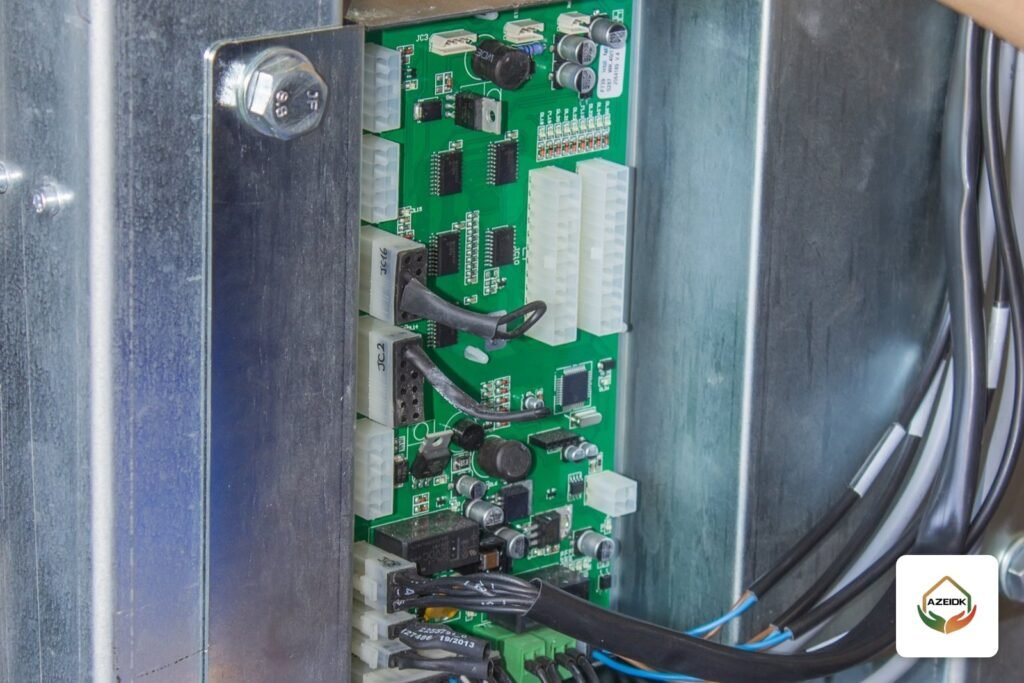
The start command comes from the fire alarm panel. On an alarm in a given zone, the panel sends a command through a control module or relay to the fan starter and receives back a signal confirming the fan is running. All of this is written in advance in the cause and effect matrix: which detector starts which fan, which fans stop and which keep running. Programming and testing this interface is part of our programming and systems integration service.
Common supply and installation mistakes
- Test certificate for a different size or motor: the class belongs to the tested model and motor and does not transfer automatically.
- Reading F300 as two hours: it is 60 minutes, and the consultant will notice.
- Fan fed by a standard cable: the fan stops when its cable burns before it does.
- No run confirmation signal: the panel sends the command but cannot tell if the fan responded.
- No maintenance access: belts and bearings become hard to inspect later.
Testing at handover and maintenance
Before handover the sequence from detector to fan is tested and airflow is measured against the study, as part of our testing, commissioning and handover service. After commissioning, fans need routine checks of motor, belts, bearings and the interface signals with the fire alarm panel.
Frequently asked questions
What does F300 mean on a smoke exhaust fan?
The fan was tested to EN 12101-3 to run at 300 °C for at least 60 minutes.
Is F400 always better than F300?
Not necessarily. The required class is the one set by the design study. A higher class adds cost without benefit if the study does not need it.
What is the difference between smoke exhaust fans and stair pressurisation fans?
Exhaust fans extract smoke from the affected space. Pressurisation fans push clean air into the stairwell to keep smoke out. Each has its own design and test.
Can car park ventilation fans also be used for smoke extraction?
In many projects, yes, provided the fans themselves are temperature-rated for smoke and are powered and controlled as the smoke control study requires.
Who decides the number and capacity of smoke exhaust fans?
The design engineer, through the approved smoke control study for each project, which the authority then reviews.
What documents does the consultant need to approve a fan?
The datasheet, fan curve with duty point, temperature test certificate for the model and motor, and the installation and maintenance manual.
Conclusion
Selecting smoke exhaust fans starts with the study and ends with the test. Read the temperature class as temperature and time together, ask for a test certificate that matches the model and motor, and confirm the fire-resistant supply, the fire alarm interface and the run confirmation signal. These are the details the consultant and Civil Defense review before handover.
Have a smoke control study and need fans supplied and installed? Send the study and drawings, and our team will review the temperature class, fan types and fire alarm interface. Talk to the AZEIDK team
See the fire alarm panels and systems AZEIDK supplies.
Related guides
- Kitchen Suppression Installation in Saudi Arabia: Survey, Nozzles, Detection and Gas Shut-Off
- NFPA 101 Life Safety Code: What It Covers, How It Relates to SBC 801, and When Projects Require It
- Worker Accommodation Safety Requirements: Balady and Civil Defense Rules for Collective Housing in Saudi Arabia
- Fingerprint Attendance Device Price in Saudi Arabia: What Drives the Cost (Fingerprint or Face, Headcount, Software, Installation) and How to Compare Quotes