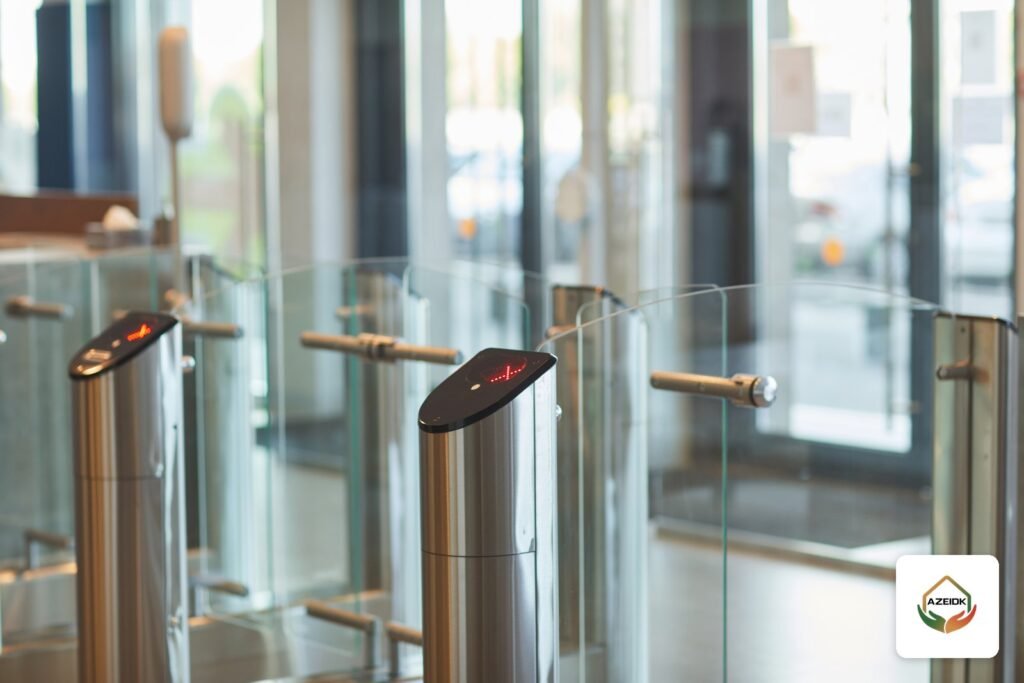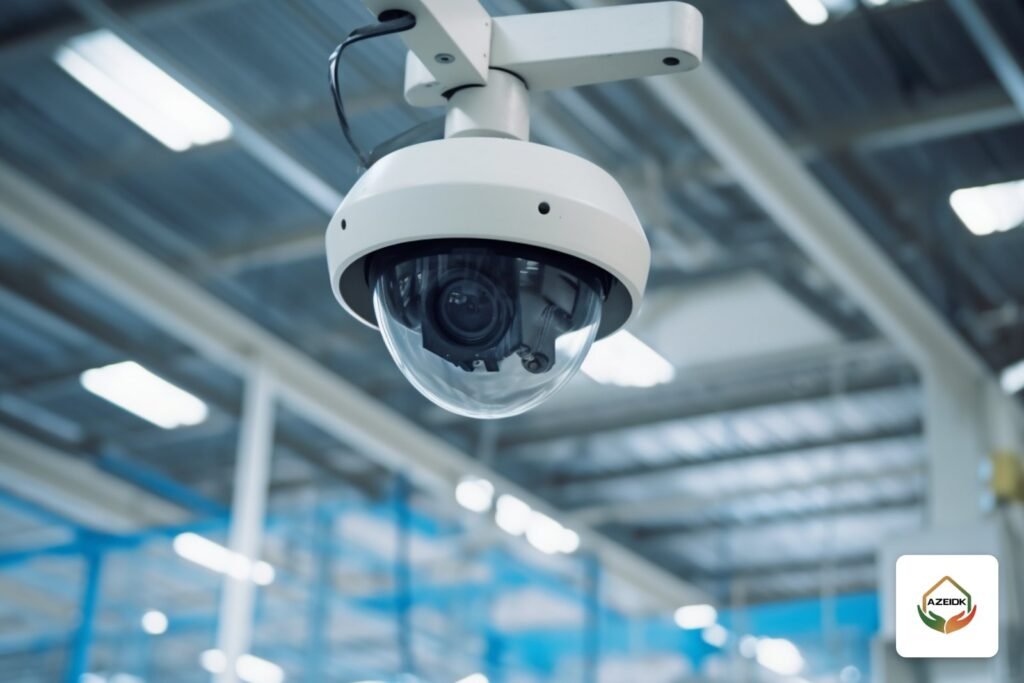
CCTV for auto workshops is not installed for the same reason as cameras in a shop. In a workshop a customer’s car stays in your custody for days, expensive parts move between the store and the bays, and a customer may return a week later saying a scratch appeared while the car was with you. Clear recording at reception and handback settles that argument, and proper coverage of bays, stores and the gate protects the business from theft and misuse.
For camera types, resolution, night vision and storage, see our CCTV cameras guide for Saudi Arabia.
This guide shows where cameras go in a service centre, which specifications matter at each point, how storage is sized and what to avoid. It is part of AZEIDK’s security and surveillance systems for the car showrooms and workshops sector.
Key points
- The most important point is the reception and handback lane, where the car’s condition and plate are recorded on arrival and exit.
- Bays need wide, high-mounted cameras; the parts store and key cabinet need close coverage.
- An ANPR camera at the gate logs every vehicle without manual effort.
- The Saudi Law on the Use of Security Surveillance Cameras lists places where cameras are prohibited, including toilets and changing rooms.
- CCTV maintenance is a separate contract from fire system maintenance.
In this article
- CCTV for auto workshops: where do the cameras go?
- Reception: the point that settles disputes
- The gate and number plate recognition
- Bays and stores: how they differ from the showroom
- Available cameras and brands
- How long should recordings be kept?
- Places where cameras are prohibited
- Linking with intrusion alarms
- Maintenance: a separate contract
- Network, power and recorder location
- Common workshop CCTV mistakes
- Frequently asked questions
- Summary
CCTV for auto workshops: where do the cameras go?
| Point | Purpose | What matters |
|---|---|---|
| Reception and handback lane | Record bodywork, plate and arrival time | High resolution, good lighting, view of both sides |
| Entry and exit gate | Log number plates automatically | Dedicated ANPR camera at the right height and angle |
| Service bays | Oversee work and prevent tampering | Wide angle, high mounting, dust resistance |
| Parts store | Stop parts leaving without issue | Door and issue window in clear detail |
| Key cabinet and cashier | Protect keys and cash | Close view showing hands and screen |
| Overnight yard | Protect cars left overnight | Night vision; one panoramic camera may replace several |
| Customer lounge | General security | Away from toilets and any private area |
Reception: the point that settles disputes
Most disputes come down to one question: was the scratch there before the car came in? Design the reception lane so the car stops in a fixed spot in front of at least two cameras covering both sides and the front, with enough lighting at night. Keep the recorder clock accurately synchronised with the job card system so the clip can be found fast. Our article on retrieving CCTV footage covers search and export.
The gate and number plate recognition
Large service centres see dozens of cars in and out each day. An ANPR camera at the gate records each plate and time, so every exit can be matched to an invoice. Integrated entrance units combine camera and recognition in one device, such as the one covered in our article on the Hikvision DS-TMC407 licence plate recognition camera. Reading success depends more on height, angle and distance to the plate than on resolution alone.
Bays and stores: how they differ from the showroom
A showroom is clean, well lit and has a tidy ceiling; a bay has a high roof, lifts, dust and exhaust. So:
- Mount cameras above the lift travel and raised vehicles so the view is not blocked.
- Choose dust and water resistant housings for wash areas and yards.
- Check lighting: strong floodlights behind a car darken the image, and wide dynamic range helps.
- In large yards, panoramic and multi-lens cameras can replace several fixed cameras.
These needs differ from the showroom covered in our car showroom security and fire protection article.
Available cameras and brands
AZEIDK supplies cameras and recorders from Hikvision, Dahua and EZVIZ. Multi-bay workshops usually use an IP system with PoE switches and a network video recorder (NVR); a small single-branch workshop may need only a limited camera kit. The choice depends on distances, number of points and whether an owner with several branches needs remote viewing.
How long should recordings be kept?
The Saudi Law on the Use of Security Surveillance Cameras (Article 4) requires covered establishments to keep recordings for the period set in the specification document, and prohibits any alteration of a recording once an incident has been reported, until the investigation ends. Check the retention period for your activity in the specification document and the executive regulation. Technically, days, camera count, resolution and bit rate set the disk capacity; see our NVR storage and bandwidth calculation. For a workshop, retention should at least cover the period in which a customer might come back with a complaint.
Places where cameras are prohibited
The law lists places where cameras may not be installed, including toilets and changing rooms. In a workshop this means technicians’ changing rooms and customer toilets are excluded, and corridor cameras are aimed so they do not look inside. The law also requires covered premises to display one or more visible signs stating that security cameras are in use; the regulation sets their specifications, number and placement.
Linking with intrusion alarms
After closing, the workshop is full of customer cars and parts. Linking cameras to motion and door sensors lets the owner see an event on the phone as it happens rather than finding it in the morning. AZEIDK supplies intrusion alarm systems from Hikvision and Ajax.
Maintenance: a separate contract
Cameras working on handover day may stop months later because of a failed disk or a dust-covered lens. A periodic maintenance contract for CCTV and low current systems is recommended, separate from the fire and alarm maintenance contract. Our article on the CCTV maintenance SLA explains what goes into it.
Network, power and recorder location
Most workshop CCTV faults come from the infrastructure, not the camera. Cables laid across the bay floor are crushed by wheels and lifts, so they run in conduit or raised trays away from traffic. Switches and recorders need a clean, air-conditioned space away from bay dust and oil, ideally a locked room with a UPS that keeps them running through short power cuts.
In large centres the camera network is separated from the office and accounts network, default passwords are changed on every device, and firmware is updated only from the manufacturer’s own sources. These simple steps prevent camera compromise and outside access to recordings. AZEIDK carries out this work under its installation and implementation service.
Common workshop CCTV mistakes
- One high camera at reception that cannot see both sides of the car.
- A gate camera at too sharp an angle to read plates.
- A recorder inside the bay, failing from dust and heat.
- Retention so short it expires before the customer complains.
- Ignoring time drift between the recorder and the job card system.
Frequently asked questions
How many cameras does a car workshop need?
It depends on bays, entrances and stores. A practical minimum: reception, gate, each bay, the parts store, the cashier and the yard.
Can CCTV prove a car’s condition at drop-off?
It helps a lot when resolution and lighting are adequate, the car stops in a fixed spot in front of the camera, and the time matches the job card.
Can a camera be placed in the staff changing room?
No. The Law on the Use of Security Surveillance Cameras prohibits cameras in changing rooms and toilets.
Does a small workshop need an ANPR camera?
Not always. It is most useful where many cars pass daily; a small workshop may manage with a good camera at the gate.
Does fire system maintenance include CCTV maintenance?
No. CCTV and low current maintenance is a separate contract from fire and alarm maintenance.
Summary
In a workshop, CCTV settles disputes and protects what is in your custody before it is a general security tool. Start with reception, the gate and the store, then the bays and yard, size storage for the period you really need, respect prohibited areas and keep a maintenance contract that keeps the system running.
Related reading: TP-Link CCTV Cameras, Hikvision DVR 4 Channel and H.265 and H.265+ Video Compression in CCTV.
Fitting out a workshop or service centre? Send us the site plan and the number of bays and entrances, and we will propose camera positions, recorder and storage. Contact the AZEIDK team
Related guides
- UTP vs FTP Cable: Unshielded vs Shielded Network Cable (STP, S/FTP) and When You Need Each
- Fire Door Rating by Location: 20, 60 or 90 Minutes for Stairs, Corridors and Service Rooms in Saudi Arabia
- Standpipe Systems (NFPA 14): Classes, Wet and Dry Risers and Testing
- Hotel Fire Maintenance Contract: Servicing Without Disturbing Guests, Room Schedules, Kitchens and the Safety Log