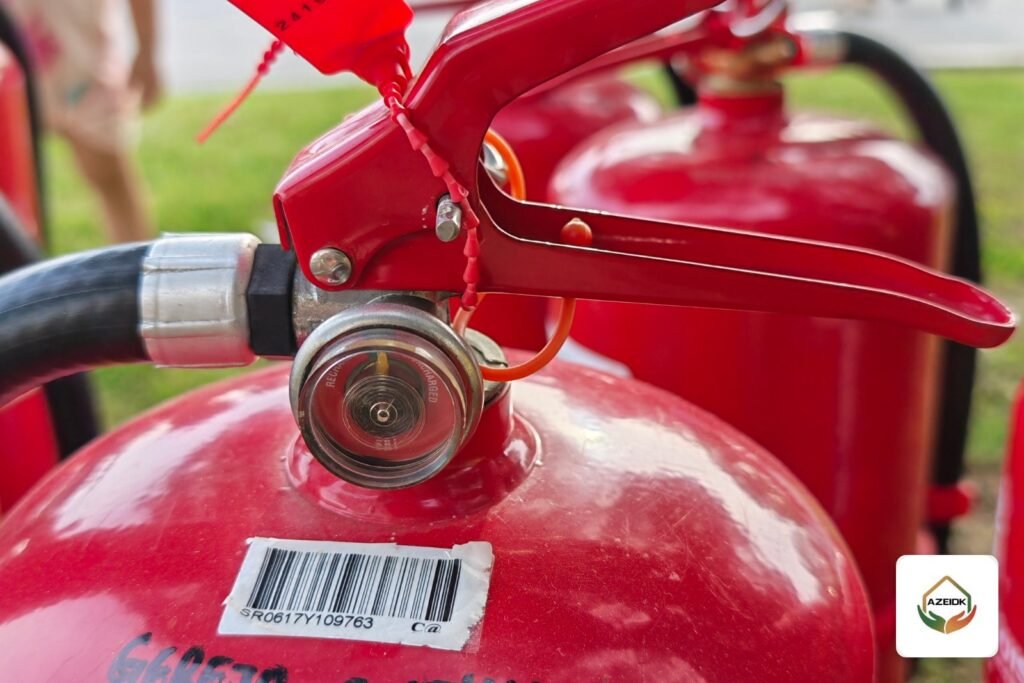
A fire extinguisher tamper seal is the thin plastic tie that runs through the ring of the safety pin and holds it in the valve. The pin stops the lever being squeezed by accident; the seal is designed to break as soon as the pin is pulled, leaving visible evidence that the unit may have been used. If you find the seal broken or missing, do not rely on the extinguisher until a technician has checked it, even if the gauge is in the green and the tag is recent. AZEIDK inspects and recharges extinguishers with its own team as part of its preventive and periodic maintenance service.
Key takeaways
- The pin prevents accidental discharge; the seal shows that the pin has been pulled. They are two parts with two different jobs.
- A missing or broken seal can be evidence that the extinguisher has been used, according to the NFPA 10 annex.
- At annual maintenance the seal is broken deliberately by operating the pin, and a new listed tamper seal is fitted once maintenance is complete.
- Seals on non-rechargeable units are not removed, and a non-rechargeable unit found without its seal comes out of service.
- An intact seal does not prove the unit is charged, and a broken seal is never fixed by fitting a new one without an inspection.
In this article
- Safety pin vs tamper seal: what is the difference?
- Why is the safety pin designed the way it is?
- Fire extinguisher tamper seals: what a broken seal means at inspection
- Seal and inspection tag: which one do you trust?
- When are the tamper seal and safety pin replaced?
- Can I fit a new seal myself?
- The seal on CO2 and other gauge-less extinguishers
- Common mistakes with the pin and seal
- Frequently asked questions
- Conclusion
Safety pin vs tamper seal: what is the difference?
The two parts sit side by side on top of the extinguisher, so they are often confused. The table sets out the difference:
| Part | Purpose | What is checked | When it is replaced |
|---|---|---|---|
| Safety pin (ring pin) | Passes through the valve and blocks the lever | Present, straight, pulls out freely, ring facing the front | When bent, hard to remove or corroded |
| Tamper seal (pin tie) | Breaks when the pin is pulled, revealing use or tampering | Present and unbroken | After every maintenance or recharge, fitted by the technician |
In the Amerex parts book the pin is a stainless steel ring pin, and the seal is listed as a “Lock Wire Seal” that appears on nearly every valve assembly. Amerex operating instructions for its dry chemical units describe the first step as holding the extinguisher upright, then twisting and pulling the ring pin, snapping the plastic lock wire seal. In other words, the seal is meant to break by hand, without tools.
Falcon Gold dry powder units, for example the 6 kg dry powder extinguisher, have a nickel-plated valve with a rigid handle and safety pin. For the Arabic and English names of the other parts, see our fire extinguisher glossary.
Why is the safety pin designed the way it is?
The historical annex of NFPA 10 explains that one revision of the UL listing standards set a maximum force of 30 lb (133 N) to remove a safety pin, after tests with novice users found that some could not pull the pin to operate the extinguisher. The same revision required the pin to be visible from the front unless the operating instructions said otherwise.
That is why a missing pin should never be replaced with a nail, wire or bolt. The replacement comes from the manufacturer’s parts, and Amerex states that only factory replacement parts are approved for its extinguishers. How to operate the unit once the pin is out is covered in our guide on how to use a fire extinguisher (PASS).
Fire extinguisher tamper seals: what a broken seal means at inspection
The NFPA 10 annex states that a missing safety seal or tamper indicator can be evidence that the extinguisher has been used. University of Nebraska-Lincoln safety guidance goes further: if the seal around the pin is broken, the extinguisher is considered not acceptable for use and is sent for servicing regardless of the date on the inspection tag, because it may not be fully charged whatever the gauge shows.
| What you find | Likely meaning | Action |
|---|---|---|
| Seal intact, pin in place | The pin has not been pulled since the last service | Complete the check: gauge or weight, tag, cylinder |
| Seal broken, pin in place | The pin was pulled and put back; the lever may have been squeezed | Take the unit out of service, put a replacement in its place and have it inspected |
| Seal and pin both missing | Use or tampering, and the unit can be discharged by accident | Remove from service immediately |
| Non-rechargeable unit without a seal | Its charge cannot be confirmed | Remove from service and replace |
At monthly inspection, NFPA 10 places the check for broken or missing safety seals and tamper indicators among the additional items for extinguishers exposed to particular conditions, such as frequent fires, severe hazards, likely mechanical damage, abnormal temperatures or corrosive atmospheres. It takes a second, so it is worth adding to every monthly round.
Seal and inspection tag: which one do you trust?
The inspection tag tells you when the extinguisher was last serviced and by whom. The seal tells you that nobody has pulled the pin since that service. They complement each other: a recent tag with a broken seal means the unit may have been used after servicing, while an intact seal with an overdue tag means the unit has not been used but is late for maintenance. What goes on the tag and how to read it is explained in our fire extinguisher maintenance and recharging guide.
When are the tamper seal and safety pin replaced?
- Annual maintenance: NFPA 10 requires the tamper seal of a rechargeable extinguisher to be removed by operating the pull pin or locking device, and its annex calls for the pin to be removed to verify that it works and to check it for damage or corrosion. A new listed tamper seal is fitted once maintenance is complete.
- After recharging: Amerex instructions call for installing the tamper seal, recording the recharge date and attaching a new tag, with the ring pin installed so the ring faces the front of the extinguisher.
- When a seal is found broken: Amerex calls for a new tamper seal and for the service data to be recorded on the inspection tag, after the unit has been checked, not instead of checking it.
- The pin: checked for freedom of movement, and replaced if bent or if removal appears difficult.
NFPA 10 guidance also warns to use proper safety seals, because other types such as meter seals could fail to break at the prescribed force, leaving the user unable to pull the pin in a fire.
Can I fit a new seal myself?
The seal is not cosmetic. Its value lies in being fitted after documented maintenance. If a facility owner fits one on an extinguisher whose pin has been pulled, it hides the only evidence of use, and the unit may stay on the wall undercharged. The right route is to inform your maintenance provider, put a replacement of at least equal rating in place as NFPA 10 requires, and wait for the technician to inspect the unit, recharge it if needed, seal it and record the work on the tag. Workshop steps and how to accept the unit back are in our guide to fire extinguisher refilling in Saudi Arabia.
The seal on CO2 and other gauge-less extinguishers
A CO2 extinguisher has no pressure gauge, so the seal becomes its clearest visual indicator. University of Nebraska-Lincoln guidance notes that on CO2 units, which have no gauge, the inspector looks at the integrity of the plastic tie around the pin. The seal alone is not enough, though: NFPA 10 requires the fullness of self-expelling units such as CO2 to be confirmed by weighing or hefting, and at maintenance they are weighed against the weight on the nameplate.
Common mistakes with the pin and seal
- Putting the pin back after testing or briefly using the unit, and hanging it up again without a recharge.
- Fitting whatever seal is to hand after a discharge to hide it before an inspection.
- Replacing a lost pin with a nail or wire that was never meant for the extinguisher.
- Trusting a recent tag without looking at the seal, or the other way round.
- Fitting a seal that does not break easily, so the user cannot pull the pin when it matters.
Frequently asked questions
What is the purpose of a fire extinguisher tamper seal?
It shows whether the safety pin has been pulled. An intact seal means the pin has not been pulled since the last service; a broken one may mean the unit has been used.
The seal is broken but the gauge is in the green. Can I use it?
Do not rely on it. Part of the charge may be gone, and safety guidance treats it as not acceptable until it is inspected, whatever the gauge and tag show.
Are pin ties and car seals the same as a tamper seal?
They are names people search for the plastic tie that holds the extinguisher pin. What matters is that it is a seal intended for extinguishers, breaks when the pin is pulled and is fitted by the technician after servicing.
Who fits the new seal?
The maintenance technician, after completing maintenance or recharging, and the work is recorded on the tag. The user should not fit one on a unit whose pin has been pulled.
What should I do if the safety pin is missing?
Take the unit out of service, put a replacement in its place and ask your maintenance provider to inspect it and fit a manufacturer’s pin and a new seal.
Is the seal replaced every year?
Yes on rechargeable units, because annual maintenance includes operating the pin, and a new seal is fitted when it is finished.
Conclusion
The tamper seal and safety pin are small parts that answer two different questions: is the extinguisher protected against accidental discharge, and has it been used since its last service? A broken or missing seal is reason enough to take the unit out of service and have it checked, and a new seal is fitted by the technician after maintenance, not before. On CO2 units, which have no gauge, the seal matters even more, alongside regular weighing.
Found extinguishers with broken seals or missing pins? Send us the number, types and location, and our maintenance team will arrange inspection, recharging and tag records. Talk to the AZEIDK team
To buy an extinguisher or book its maintenance, see AZEIDK fire extinguishers.
Related guides
- Forgot CCTV Password? Recover a Hikvision or Dahua Recorder the Official Way
- LUYUAN Ductile Iron Grooved Fittings: Rigid and Flexible Couplings, Elbows and Tees for Sprinkler Systems
- Emergency Exit Doors in Saudi Arabia: Fire-Rated or Not, Swing, Width, Panic Bars and Inspection
- FM200 Recharge After Discharge: Steps, Cylinder Checks and Return to Service