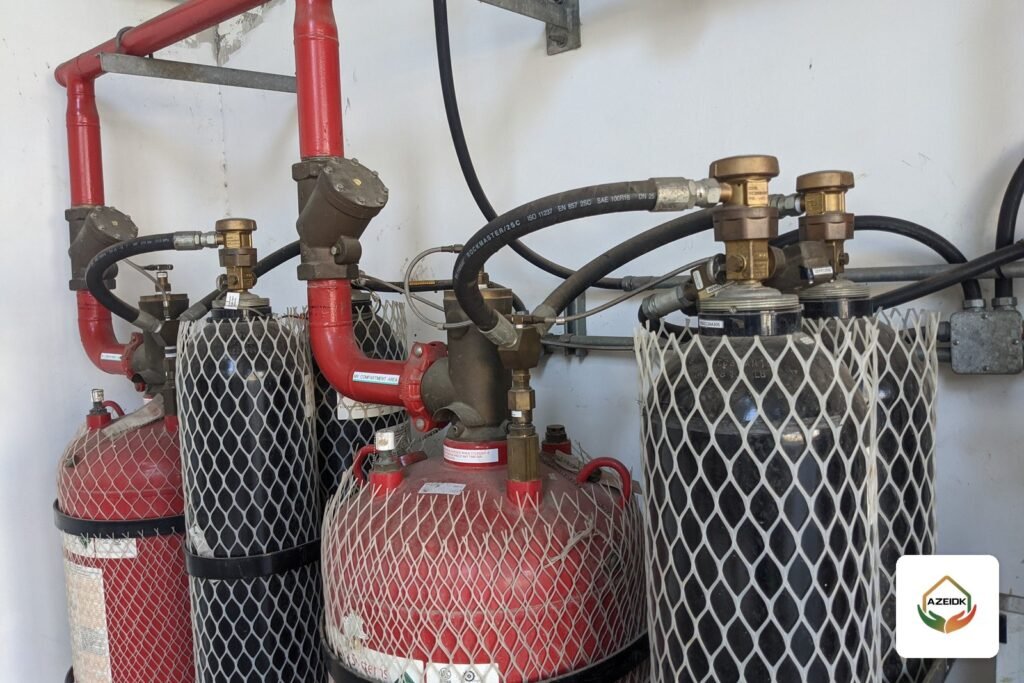
FM200 recharge after a discharge is more than refilling a cylinder and putting it back. Whether the system fired on a real fire or a false release, the room stays unprotected until the cylinders are refilled and pressurised, each valve and actuator is serviced, the control panel is reset, and the enclosure is confirmed able to hold the agent.
AZEIDK handles this work for gas suppression systems under its corrective maintenance and technical support service.
Short answer: After an FM-200 discharge, secure the room and find out why the system fired. The empty cylinders are then removed and sent to a manufacturer-recognised fill facility, where valve parts are renewed, the agent is filled by weight and the cylinder is pressurised with nitrogen, or they are swapped for charged cylinders. The system is re-armed only after piping, detection, actuators and the control panel are checked and the work is recorded.
Key takeaways
- The room is unprotected from the moment of discharge, so keep the outage short and arrange temporary cover.
- Find the cause before recharging, or the same false release can happen again.
- Check the cylinder’s last test date. Summaries of NFPA 2001 (2015 edition) say DOT or similar cylinders are retested before recharging if more than 5 years have passed since the last test.
- Fill by weight to the nameplate quantity, then pressurise with nitrogen to the manufacturer’s charging pressure.
In this article
- What should you do right after an FM200 discharge?
- Finding the cause before recharging
- FM200 recharge, step by step
- When does a cylinder need a hydrostatic test before refilling?
- Checking the piping and the room before return to service
- How is the system returned to service and documented?
- What drives FM-200 recharge cost, and what should a quotation include?
- FM-200 systems and parts from AZEIDK
- Frequently asked questions
- Conclusion
What should you do right after an FM200 discharge?
Keep the room closed to everyone except safety staff. In a real fire, HFC-227ea breaks down in the flame, and laboratory studies have measured hydrogen fluoride (HF) among the decomposition products, so ventilate the room per the site plan before entry.
- Record the discharge time and photograph the panel display and event log before any reset.
- Tell facility management the room has no automatic protection, and arrange temporary cover such as extinguishers suitable for electrical equipment and regular room checks.
- Leave the panel and actuators untouched until a technician who knows the installed model arrives, so the cause can still be traced.
Finding the cause before recharging
A false discharge can come from a dirty or faulty detector, a manual release pressed by mistake, a release circuit fault, or work that raised dust or heat. The technician usually reviews:
- The panel event log: which detector or zone gave the first and second alarm, and whether a manual button triggered the release.
- The alarm sequence, countdown, and hold and abort buttons. For how this works on the Context Plus EP203 panel, see our gas suppression release sequence article.
- Detector condition and surroundings, plus the release circuit and solenoid.
FM200 recharge, step by step
The binding detail is in the manual for the installed model. For the American Fire Control FM-200 system AZEIDK supplies, the product information lists three steps after a discharge: isolate the discharged cylinders, refill or replace them, then fully recommission the system.
- Isolate the release: disable the release circuit at the panel, remove solenoids and actuators from the valve heads and fit their safety pins, so no undischarged cylinder can fire during the work.
- Remove the cylinders: disconnect discharge and actuation hoses, and fit anti-recoil caps on the valve outlets before moving any cylinder.
- Check the test date: read the last hydrostatic test date on the cylinder and decide whether a retest is due before filling (see the next section).
- Send it to a manufacturer-recognised fill facility: the Janus Fire Systems manual, for example, states that recharge must be done at a Janus-recognised facility to maintain the system’s FM Approval.
- Renew valve parts: each manufacturer specifies the parts to replace. The Fike HFC-227ea manual lists the friction ring, disc assembly, O-ring and fill-port valve core as items that must be replaced before a discharged container is recharged.
- Fill by weight: fill to the agent quantity on the nameplate and in the design calculation, and record the weight.
- Pressurise with nitrogen: charge with dry nitrogen to the specified pressure. The AFC-227 fill pressure is 24.8 bar (about 360 psi) at 21°C. Context Plus clean agent cylinders are super-pressurised to 360 psi (24 bar) or 500 psi (34 bar) depending on the model, so never assume one pressure for every system.
- Leak check and tag: record fill date, weight, pressure and technician on the tag.
- Reinstall: secure the cylinder in its bracket, connect the discharge hoses, then remove the anti-recoil caps. Leave the actuators off until the piping and panel checks are complete.
The alternative is to exchange the empty cylinder for a charged one of the same model, size and approval. These manufacturer details are examples; follow the manual for the AFC or Context Plus model actually installed.
When does a cylinder need a hydrostatic test before refilling?
The answer depends on the NFPA 2001 edition adopted for the project, the cylinder’s construction standard and the manufacturer’s instructions. The first four rows below come from Koorsen’s published summary of the 2015 edition, so confirm them against the edition in your approved specification:
| Situation | Requirement | Source |
|---|---|---|
| DOT or similar design cylinder, more than 5 years since last test and inspection | Retested before recharging | NFPA 2001 (2015), per Koorsen |
| Halocarbon (e.g. FM-200) cylinder in the case above | A complete visual inspection as described in 49 CFR suffices | NFPA 2001 (2015), per Koorsen |
| Cylinder in continuous service, not discharged | Complete external visual inspection every 5 years | NFPA 2001 (2015), per Koorsen |
| Cylinder that may be damaged (fire, impact, corrosion) | Additional strength tests | NFPA 2001 (2015), per Koorsen |
| Containers built to European rules (ADR / TPED) | Fike: retest if more than 10 years since the last test, per ADR instruction P200 | Fike manual |
The AFC product information gives a hydrostatic test pressure of 137.9 bar (about 2,000 psi) for its FM-200 cylinders.
Checking the piping and the room before return to service
Before arming, check everything the discharge affected:
- Piping and nozzles: nozzles clear and aimed; pipes and supports not shifted by the discharge.
- Flexible hoses: inspect them and replace any hose that shows a defect. The same 2015-edition summary calls for hydrostatic testing of hoses at least every 5 years at 1.5 times container pressure for one minute.
- Manifold and check valves: on multi-cylinder systems, check the manifold check valves and the discharge pressure switch. See FM-200 system components from Context Plus.
- Room integrity: if doors were forced, openings added or the room changed since the last test, repeat the room integrity test to confirm the agent will hold the design concentration for the design time.
- Detection and control: test detectors, manual release, hold and abort buttons, and the linked ventilation shutdown, without discharging agent.
- Actuators: reset them with the manufacturer’s tool before fitting them to the valves.
Fike’s instructions make arming the last step, after the electrical and control system has been checked and shows no trouble or ground faults.
How is the system returned to service and documented?
The usual order: install the cylinders, test the panel and detection without release, fit the reset actuators, enable the release circuit once the panel shows no faults, then hand over in writing.
In Saudi Arabia the Saudi Fire Protection Code SBC 801 applies (the 2024 edition of the Saudi Building Code has been mandatory since 30 June 2025), and facilities deal with the General Directorate of Civil Defense and the Salamah platform for licensing. NFPA 2001 is a technical reference adopted by the designer, with the edition set in the approved specifications. Keep a file with:
- The cause report and corrective action.
- A fill report for each cylinder and any retest result.
- The post-recharge system test report and any parts replaced.
File them with the fire safety log book and maintenance records for inspection or licence renewal.
What drives FM-200 recharge cost, and what should a quotation include?
There is no fixed price. The main cost drivers are the number of cylinders and agent quantity in each, any retest or visual inspection due, the valve and actuator parts the manufacturer requires, refilling versus exchanging for charged cylinders, and any faults found while investigating the cause.
A clear quotation states the agent weight per cylinder, the fill facility, replaced parts with part numbers, whether retesting is included, the post-recharge test, the documents handed over and the expected outage time. For routine checks between discharges, such as semiannual weighing, see FM-200 system maintenance.
FM-200 systems and parts from AZEIDK
Under its special fire suppression systems, AZEIDK supplies the American Fire Control FM-200 system in AFC-227 and AFC-P227 configurations, UL listed and FM approved per the manufacturer, together with Context Plus components such as clean agent cylinders and the CP60020 liquid level indicator, which checks agent quantity without removing the cylinder. Replacement parts are checked against the installed model’s datasheet before supply.
Frequently asked questions
What should you do after an FM200 system discharges?
Keep the room closed and ventilate it before entry, record the panel status without resetting it, arrange temporary cover, and call a qualified technician to find the cause.
Can an FM200 cylinder be recharged?
Yes. Refillable cylinders are filled at a manufacturer-recognised facility after the specified valve parts are renewed, or exchanged for charged cylinders of the same model.
When is a cylinder hydrostatically tested?
Summaries of NFPA 2001 (2015 edition) say a DOT or similar cylinder is retested before recharging if more than 5 years have passed since its last test, and that a complete visual inspection suffices for halocarbon cylinders. European containers follow their manufacturer’s instructions; confirm the edition adopted for your project.
How is the system returned to service?
Install the charged cylinders, test detectors, panel and release circuits without discharge, fit the reset actuators, enable the release and hand the system over in writing.
How often are FM200 cylinders checked and weighed?
Agent quantity and pressure are checked every six months. Under NFPA 2001, a halocarbon container that loses more than 5% of its agent or more than 10% of its pressure (adjusted for temperature) is refilled or replaced.
Does FM200 damage electronic equipment?
The agent is non-conductive and leaves no residue. After a real fire, decomposition and combustion products can affect equipment, so check it before restarting.
Is FM200 approved by Saudi Civil Defense?
Acceptance applies to the system and model within the project’s approved drawings, not to the agent in general. Check the model’s UL or FM certificates and the Civil Defense requirements for each project; our Civil Defense approval support service can help.
How much does FM200 recharge cost?
It depends on cylinder count and agent quantity, any retest, the parts replaced and the faults behind the discharge. Ask for an itemised quotation.
Conclusion
FM200 recharge starts with one question: why did the system fire? Then come filling at a manufacturer-recognised facility with renewed valve parts, a check of the cylinder test date, and checks of piping, detection and actuators before arming. Deciding in advance who will do the work shortens the time the room stays unprotected.
Has your FM-200 system discharged, or do you want a post-discharge plan ready? Send us the system model, number of cylinders and last test date, and we will set out the recovery steps and documents with you. Contact the AZEIDK team
Related guides
- Kitchen Suppression Recharge After Discharge: Cleanup and Reset Before Reopening
- Battery Smoke Alarm or Panel Fire Alarm System? When a Standalone Alarm Is Enough (with SD-425 and RadioLINK Rules)
- ISO 45001 Certification: Occupational Health and Safety Guide
- Fire-Rated Doors: How to Order and Accept Them on Saudi Projects (Ratings, Components and Checklist)