How to use a fire extinguisher comes down to four movements known as PASS: pull the safety pin, aim the nozzle at the base of the flames, squeeze the handle, and sweep from side to side until the flames are out. The movements alone are not enough. Before them comes a quick decision on whether the fire is small enough to fight, and after them you watch the area so it does not reignite. The technique also changes slightly between dry powder, CO2, foam, water and clean agent units.
This guide sets out the steps as OSHA guidance and manufacturer manuals describe them, the practical differences between extinguisher types, and the mistakes we see repeated on site. Choosing and placing extinguishers is part of designing a building’s fire fighting systems and is covered in separate articles linked below.
Key takeaways
- A portable extinguisher is for a fire in its first stage only: flames no higher than your head, confined to the item that caught fire, and a safe exit behind you.
- Raise the alarm and call Civil Defense first: 911 in Makkah, Madinah, Riyadh and the Eastern Province, 998 elsewhere in the Kingdom.
- PASS: Pull, Aim, Squeeze, Sweep. Start from the distance printed on the extinguisher label.
- Hold a CO2 horn by its grip only, never use water on cooking oil or live electrical equipment, and never spray foam straight into a burning liquid.
- Any extinguisher that has been discharged, even for a second, goes for recharging before it returns to its bracket.
In this article
- Before you pick it up: fight or leave?
- Fire extinguisher parts you should know beforehand
- How to use a fire extinguisher step by step (PASS)
- Fire extinguisher types and their use: what changes in technique?
- Technique by extinguisher type
- After the fire is out: what to do with the extinguisher
- Common mistakes when using an extinguisher
- Falcon Gold extinguishers at AZEIDK: examples
- Frequently asked questions
- Summary
Before you pick it up: fight or leave?
The US Occupational Safety and Health Administration (OSHA) states in its emergency planning guidance that portable extinguishers are meant for incipient-stage fires. Its conditions are clear: flames no taller than a person’s head, fire confined to the material that ignited first (a waste bin, for example), heat and smoke not affecting visibility or breathing, and an open escape route behind you.
OSHA also lists situations where you should evacuate without trying, including:
- Fire spread over more than 60 square feet (about 5.6 m²).
- Heat that stops you getting within 10 to 15 feet (about 3 to 4.5 m), or forces you to crawl.
- Smoke filling the room quickly and cutting visibility.
- Fire hidden behind a wall or ceiling, or out of reach from a standing position.
- Fire that could block your way out.
Before any attempt, operate the nearest manual call point and call emergency services. Saudi Civil Defense, as reported by Okaz on 17 September 2026, advises 911 in Makkah, Madinah, Riyadh and the Eastern Province, and 998 in the rest of the Kingdom. OSHA’s rule is simple: if you have the slightest doubt about your ability to fight the fire, evacuate immediately.
Fire extinguisher parts you should know beforehand
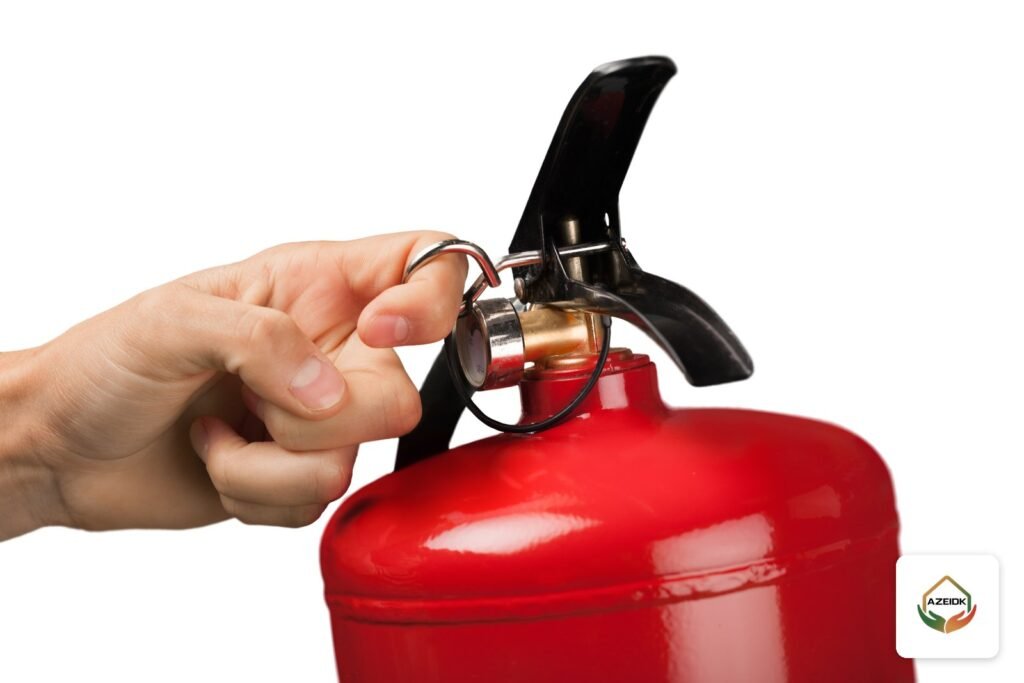
- Safety pin and plastic tamper seal: prevents accidental discharge. Pulling the pin breaks the seal, and an intact seal is your sign the unit has not been used.
- Carrying handle and lever: hold the lower handle and squeeze the upper lever to discharge. On most models, releasing it stops the flow.
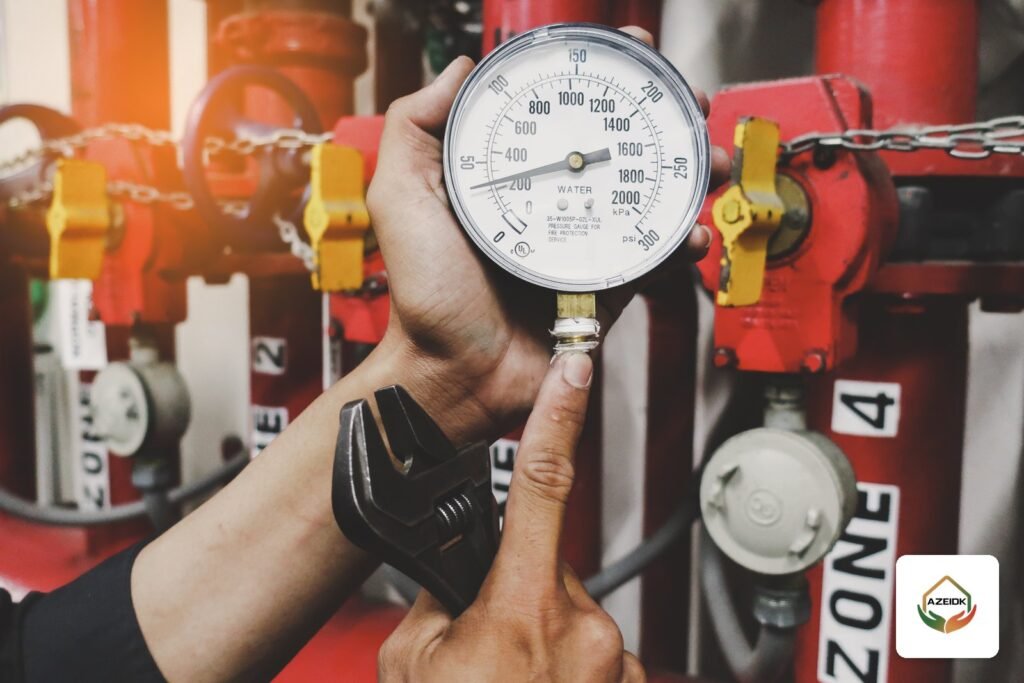
- Pressure gauge: fitted on stored-pressure units such as powder, foam and water. A needle in the green zone means usable pressure. OSHA describes CO2 units as having a hard horn and no pressure gauge, and the Amerex CO2 manual says to check them by weighing and comparing with the weight on the nameplate.
- Hose and nozzle, or horn on CO2 units: where the agent comes out. On a CO2 extinguisher, hold the horn by its insulated grip only.
- Nameplate (label): shows the agent, the fire classes it is rated for, the starting distance and pictogram operating instructions.
How to use a fire extinguisher step by step (PASS)
OSHA and manufacturer manuals describe nearly the same sequence. In order:
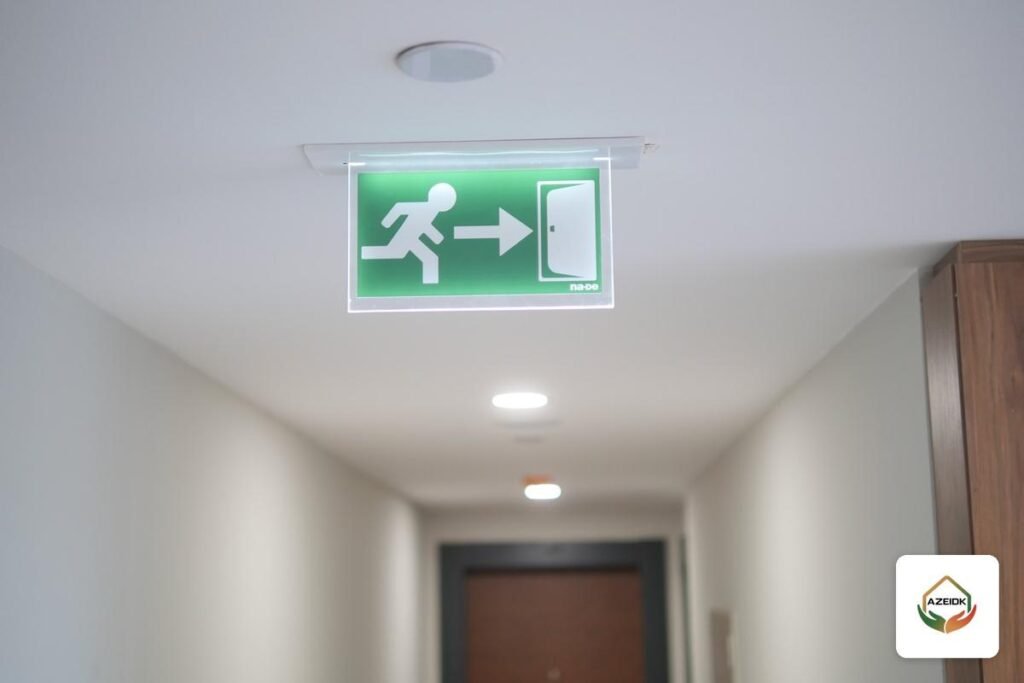
- Identify your exit first. Keep the exit behind you and never let fire or smoke get between you and the door.
- Check the extinguisher suits the fire. Look at the classes on the label (A for ordinary solids, B for liquids, C or the electrical symbol, K or F for cooking oils).
- P: Pull the pin. Hold the unit upright, twist the ring and pull it to break the seal.
- A: Aim low. Point the nozzle at the base of the flames nearest you, not at the flames above. The fuel is at the base.
- S: Squeeze the lever. Squeeze steadily with the unit upright. Most hand portables empty in seconds, so do not waste the first burst into the air.
- S: Sweep. Sweep side to side across the base of the fire and past both edges, moving closer slowly as the flames retreat.
- Back away and watch. Once the flames are out, step back and watch the area. If it reignites, aim, squeeze and sweep again. If the extinguisher empties and the fire is still burning, leave immediately.
How far away should you start?
The correct distance is the one printed on your extinguisher’s nameplate, because it varies by type and size. As an illustration only: Amerex’s manual for hand portable dry chemical units says to start at least 8 feet (about 2.4 m) back, and its CO2 manual gives about 8 feet for small sizes and 10 feet (about 3 m) for 10 to 20 lb units, with a discharge range of roughly 3 to 8 feet. Too far wastes agent. Too close scatters burning material.
Fire extinguisher types and their use: what changes in technique?
PASS applies to every type, but the details differ. The table below sums up what matters to the user. For how each type works and how to choose it, see our guide to fire extinguisher types and brands.
| Extinguisher type | Application | Watch for | Do not use on |
|---|---|---|---|
| Dry powder (ABC or BC) | At the nearest base of the flames, working the fire away from you | Poor visibility, reignition, ventilating after use | Anything the label excludes, and commercial fryer oils where a Class K unit is needed |
| Carbon dioxide (CO2) | From relatively close range, at the base of the flames | Very cold horn, oxygen depletion in small rooms | Wood and paper fires as the only measure, since they may reignite |
| Foam (AFFF) | Onto a nearby surface so the foam flows over the liquid | Not splashing burning liquid, covering the whole surface | Live electrical equipment unless the label allows it |
| Water | At the base of the burning solid material | Isolating power first | Flammable liquids, live electrical equipment, cooking oils |
| Clean agent (FM-200 and similar) | At the base of the flames or the fire source inside a panel | Minimum room size on the label, ventilation | Anything the label excludes |
| Wet chemical (Class K) | After the hood system has operated, applied gently onto the oil surface | Isolating power to the appliance | Non-cooking fires unless the label allows |
Technique by extinguisher type
Dry powder extinguisher
Dry powder is the most common type in homes, shops and warehouses. The Amerex manual says to start at least 8 feet back, aim at the base of the fire nearest you and work the fire away from you while watching for flashback, then move closer without scattering burning material. Powder cuts visibility quickly in closed rooms, so the manufacturer calls for evacuating and ventilating the area after use. ABC versus BC, and where powder is not allowed, are covered in our dry powder extinguisher guide.
CO2 extinguisher
The key warning: hold the horn by its grip only. The Amerex manual says touching the horn or discharge tube can cause cold burns, and OSHA warns against touching the horn for the same reason. CO2 displaces oxygen, so staying in a small unventilated room after discharge can lead to loss of consciousness. On solid-material fires CO2 leaves no blanket, so keep watching after the flames go out. Use in electrical rooms is explained in our CO2 extinguisher guide.
Foam extinguisher
On a liquid fire, do not spray foam into the middle of the pool. A strong jet splashes burning fuel. Direct it at a wall or surface in front of or behind the spill so the foam flows gently over the liquid and covers all of it. Amerex stresses this gentle application especially on polar solvents such as alcohols, which also need a foam listed for that use. On solids, aim at the base of the fire as usual.
Water extinguisher
OSHA notes that water extinguishers are designed for Class A fires only, that water on flammable liquids can spread the fire, and that water conducts electricity, so power must be isolated first. Manufacturer manuals also warn against using water on cooking oils.
Clean agent extinguisher
Clean agent units suit fires in panels and sensitive equipment because they leave no residue. Some manufacturers’ manuals for halocarbon units say not to use them in spaces smaller than the size shown on the nameplate, and to ventilate afterwards. When a portable unit is enough and when you need a fixed system is covered in our FM-200 extinguisher article.
Kitchen extinguisher (Class K)
According to the NFPA 10 text quoted by Amerex, where a hazard is protected by an automatic fire protection system such as a kitchen hood system, a placard must be placed near the extinguisher stating that the system shall be actuated before the extinguisher is used. The Class K unit therefore backs up the hood system. OSHA warns that water or CO2 on a deep fryer can cause a violent reaction and that many Class K agents conduct electricity, so power to the appliance is shut off first.
After the fire is out: what to do with the extinguisher
- Stay near the scene and watch for reignition, then brief the Civil Defense crew on arrival.
- Clear and ventilate the area. Smoke, combustion products and the agent itself can be harmful.
- Do not return the extinguisher to its bracket even after one second of use. Amerex manuals call for recharging immediately after any use, with the agent named on the nameplate only. What happens in the workshop and how to accept the unit back is covered in our fire extinguisher refilling guide.
- Put a serviceable replacement in the same place until the original returns.
AZEIDK services extinguishers with its own technical team as part of its preventive and periodic maintenance contracts.
Common mistakes when using an extinguisher
- Fighting the fire before raising the alarm and calling emergency services.
- Standing with the fire between you and the exit.
- Aiming at the top of the flames instead of the base.
- Starting too close and scattering burning material, especially on liquid fires.
- Holding a CO2 horn anywhere other than its grip.
- Using water on cooking oil or an energised electrical panel.
- Turning your back as soon as the flames die down and leaving without watching.
- Putting a partly used extinguisher back because the gauge needle still looks fine.
- No practice beforehand. In the United States, OSHA requires employers to train staff on extinguisher use at hire and annually, which is good practice for any facility.
Falcon Gold extinguishers at AZEIDK: examples
In its fire extinguisher range, AZEIDK supplies units from Falcon Gold, including the Dry Powder Fire Extinguisher 6 kg, the CO2 Fire Extinguisher 6 kg, the Foam Fire Extinguisher 25 L and the Gas Fire Extinguisher 6 kg. When training staff, refer to each model’s label and datasheet, because operating instructions and starting distance differ between types and sizes.
Frequently asked questions
What are the steps to use a fire extinguisher, in short?
Raise the alarm and call emergency services, keep the exit behind you, then apply PASS: pull the pin, aim at the base, squeeze the lever and sweep side to side. Afterwards, watch the area.
How long does an extinguisher discharge?
A matter of seconds for most hand portables, depending on model and size. That is why you start at the right distance and send the first burst straight at the base.
Can I use a powder extinguisher on an electrical panel?
A powder unit rated for electrical fires can be used, but it leaves residue on equipment. For panels and sensitive equipment a CO2 or clean agent unit is preferred, with power isolated where possible.
Why must I not touch the CO2 horn?
The gas discharges at a very low temperature, so touching the horn or discharge tube can cause cold burns. Hold it by the insulated grip only.
I used the extinguisher briefly. Can it go back on the wall?
No. Manufacturer manuals require recharging immediately after any use, because pressure can leak away and leave the unit useless at the next fire.
When should I leave instead of fighting the fire?
When flames are above head height, smoke is filling the room, heat stops you approaching, the fire could block your exit, or the extinguisher is empty and the fire is still burning.
Summary
Using a fire extinguisher is simple on paper. The hard part is acting correctly in the first seconds: alarm and call, exit behind you, the right extinguisher for the fire, then PASS from the distance on the label. The differences between types are small but decisive: the grip on a CO2 horn, foam that flows rather than being sprayed into the liquid, and water kept away from electricity and oil. After every use, however short, the extinguisher goes for recharging.
Want to be sure your building’s extinguishers match its hazards and are ready to use? AZEIDK reviews types, sizes and the condition of each unit and arranges refilling and maintenance. Contact the AZEIDK team
Related guides
- Falcon Gold Fire Extinguishers: Types, Sizes and Placement
- Fire Extinguisher Maintenance and Recharging: Monthly, Annual and Hydrostatic Testing
- Fire Protection Companies in Jazan (Safety and Fire Fighting Companies), Khamis Mushait and Abha: How to Choose a Company That Serves the South
- CCTV and Security System Maintenance: Periodic Checks and Contract Scope