The home safety tools every house should have are a small ABC dry powder fire extinguisher, a smoke alarm in the hallway outside the bedrooms, a stocked first aid box, and a rechargeable emergency light, plus a list of emergency numbers and an escape plan the whole family knows. Together they cover the first minutes of an incident before Civil Defense or an ambulance arrives.
It is close to the list Saudi Arabia’s General Directorate of Civil Defense promoted in its home campaign «سلامتك بمنزلك غايتنا» (Your Safety at Home Is Our Goal): a smoke detector, a fire extinguisher, a first aid kit, an evacuation plan, and care with electricity and gas. This article turns those items into one household checklist and points you to the detailed guide for each. AZEIDK supplies extinguishers and safety equipment through its fire fighting systems and extinguishers offering and its branches across the Kingdom.
Key takeaways
- The baseline for every home: an extinguisher, a smoke alarm, a first aid box, an emergency light and the emergency numbers.
- A small ABC powder extinguisher near the kitchen door and one in the main hallway suits most apartments. Type and size are covered in the extinguisher guides.
- The U.S. Fire Administration (USFA) recommends a smoke alarm inside and outside every bedroom and on every level, tested monthly.
- A first aid box has no fixed contents. Stock it for your family and check expiry dates regularly.
- Saudi emergency numbers: 998 Civil Defense, 997 ambulance, 911 unified security operations.
In this article
- Which home safety tools should every house have? The core list
- Home fire extinguisher: the short version
- Smoke alarm: the tool that warns you while you sleep
- First aid box: what to put in it
- Rechargeable emergency light for power cuts
- Home safety and security: habits that support the tools
- Household safety checklist
- Common mistakes when equipping a home
- Frequently asked questions
- Summary
Which home safety tools should every house have? The core list
The items below are the practical minimum for an apartment or villa. The table shows what each one does, where it goes, how to check it, and the matching product available from AZEIDK.
| Item | Purpose | Suggested location | Check | AZEIDK example |
|---|---|---|---|---|
| Home fire extinguisher (ABC powder) | Put out a small fire at its start | Outside the kitchen door, and in the main hallway | Monthly look at the gauge and seal | Falcon Gold 1 kg powder extinguisher |
| Smoke alarm (standalone) | Wake sleeping occupants when smoke starts | Hallway ceiling outside bedrooms, and inside bedrooms | Press the test button monthly | SD-425 standalone smoke alarm |
| First aid box | First response to minor cuts and burns | A known spot out of small children’s reach | Restock and check expiry after each use | Falcon Gold H-323 box |
| Rechargeable emergency light | Light the way during a power cut or in smoke | Plugged in, in the hallway or near the exit door | Unplug it and confirm it lights | KHIND EM 2004 GT |
| Emergency numbers and escape plan | Fast calls and an orderly exit | On the fridge or by the landline | A simple family drill twice a year | No product needed |
Home fire extinguisher: the short version
The extinguisher is what people ask about most, so we keep it short here and leave the detail to the dedicated guides. For general home use, ABC dry powder is the usual choice because it covers ordinary combustibles such as fabric and wood, flammable liquids and gases. AZEIDK publishes the data for the Falcon Gold 1 kg powder extinguisher (model FDP1): 70% ABC powder, fire classes A, B, C and E, 5 m discharge range, 6 second discharge time, wall bracket mounting. Larger homes and villas can use the Falcon Gold 6 kg powder extinguisher.
Three points are enough for this checklist:
- Mount it outside the kitchen near the door, not behind the cooker, so you can reach it without walking toward the fire.
- Discharge time is very short. A home extinguisher is for a fire that has just started. If it grows, get out and call Civil Defense on 998.
- An oil fire in a pan needs different handling, explained in our kitchen fire extinguisher guide.
To choose type and size, see fire extinguisher types and brands available in Saudi Arabia. For checks and refilling, see fire extinguisher maintenance and recharging.
Smoke alarm: the tool that warns you while you sleep
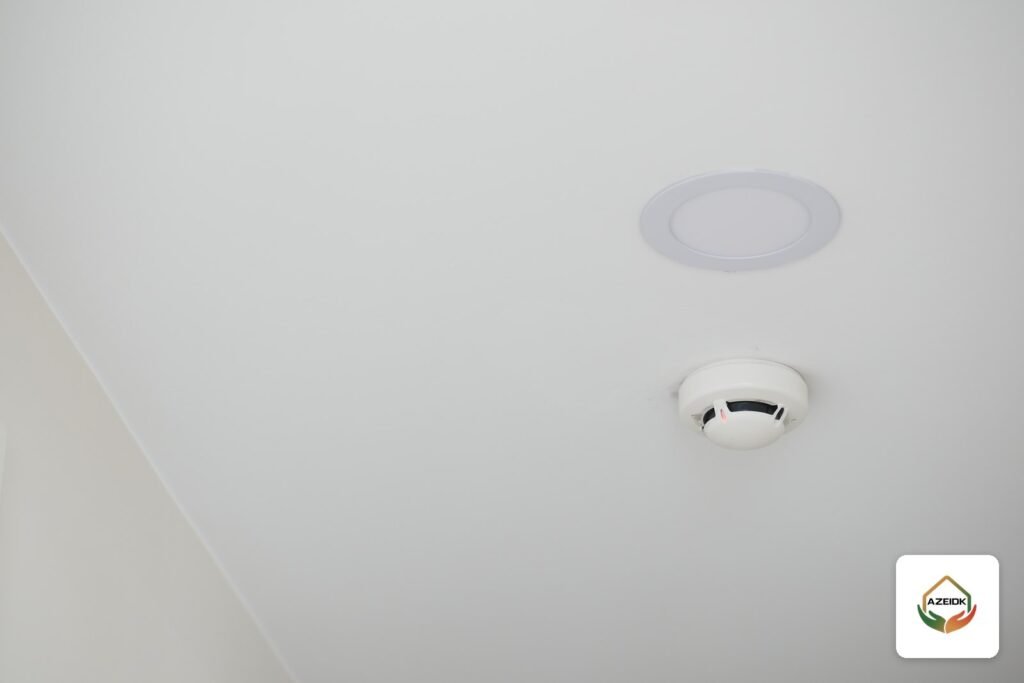
An extinguisher is useless if you learn about the fire too late. Night-time fires are the most dangerous because smoke comes before flame, and a sleeping person does not smell it. That makes the smoke alarm the first priority.
USFA guidance for homes is simple: an alarm inside and outside each bedroom and on every level, on the ceiling or high on a wall per the manufacturer, tested monthly, and the whole unit replaced 10 years after its manufacture date. Never remove the alarm or its battery because of cooking nuisance alarms; move it further from the kitchen instead.
AZEIDK offers the FG SD-425 standalone photoelectric smoke alarm, which runs on a 9V battery with an approximate one-year life and sounds at no less than 85 dB at 3 m, according to its product page. When a standalone alarm is enough, when a panel system is required, and how wireless interlinking works are covered in Battery smoke alarm or panel fire alarm system?
First aid box: what to put in it
Cuts and minor kitchen burns happen at home far more often than fires, and an organised first aid box saves time hunting for a plaster or gauze. AZEIDK supplies three wall-mounted Falcon Gold sizes with a clear front and a lock or latch: the small H-323, which suits apartments; the medium H-324 for villas and residential compounds; and the large H-325 for bigger sites. The product pages state that each box is supplied empty or stocked on request and has no fixed contents list.
Suggested basic contents for a home first aid box
Mayo Clinic’s first aid kit guide suggests a set that includes:
- Sterile gauze, adhesive dressings in several sizes, an elastic bandage and medical tape.
- Antiseptic solution and saline for cleaning wounds.
- Scissors, tweezers, safety pins and disposable gloves.
- Instant cold packs and a triangular bandage for a sling.
- A thermometer, a suitable pain reliever, and aloe gel for minor burns.
- A small torch with spare batteries and a sheet of emergency numbers.
Personal and children’s medicines should be decided with a doctor or pharmacist. The same guidance says to keep the kit easy to reach but away from small children, check expiry dates and replace what has been used.
Rechargeable emergency light for power cuts
A power cut at night with smoke in the hallway makes it hard to find the door. A portable emergency light stays plugged in, keeps its battery charged, switches on when power fails, and can be unclipped and carried.
One option from AZEIDK’s range is the KHIND EM 2004 GT. Its page lists a 3.7 V 2.2 Ah lithium-ion battery, up to 6 hours on low and 3 hours on high, a maximum of 250 lumens, IP65 protection and a 24 hour charge time. To compare emergency lights and their run times, see the emergency and exit lighting guide.
Home safety and security: habits that support the tools
Tools do little if the causes of fire stay in place. These habits reduce the chance you will ever need them.
Electricity and chargers
- Do not run high-load appliances such as a water heater, iron and space heater from one extension strip.
- Unplug chargers once charging is complete, and do not charge a phone under a pillow or on the bed.
Gas and cooking
- Close the gas cylinder valve after cooking, as Civil Defense advises.
- Do not leave the hob unattended. If oil catches fire in a small pan, leave the pan where it is, slide the lid over it, turn off the heat and never use water, per USFA guidance.
Charcoal and wood in winter
Civil Defense warns against lighting charcoal or wood in enclosed spaces. It advises lighting them outdoors, opening windows and doors when bringing them inside, and making sure they are fully out before sleeping.
Escape plan and emergency numbers
Agree on two ways out of each room where possible and a meeting point outside. USFA’s rule is to get out first, call from outside, and never go back in. Keep the numbers to hand: 998 Civil Defense, 997 ambulance, 911 unified security operations.
Household safety checklist
Print this list, keep it by the first aid box and go through it on the first day of each month.
| Item | Monthly | Yearly or as needed |
|---|---|---|
| Fire extinguisher | Gauge in the green, seal intact, no rust or damage | Service by a qualified provider per the manufacturer |
| Smoke alarm | Press the test button | Replace the 9V battery; replace the unit 10 years after manufacture |
| First aid box | Restock anything used | Check expiry dates on all contents |
| Emergency light | Unplug it and confirm it lights | Compare actual run time with the datasheet |
| Emergency numbers and escape plan | Confirm the list is in place | Family exit drill |
Common mistakes when equipping a home
- Extinguisher behind the cooker: in a fire you cannot reach it. Keep it near the exit door.
- Removing the smoke alarm battery: because of cooking alarms. Move the alarm away from the kitchen instead.
- A first aid box nobody checks: expired or used items never replaced.
- Relying on a phone as a torch: the battery may be low, and the phone is needed to call for help.
- Water on an oil fire: it makes the flames flare. Cover the pan and turn off the heat.
- Buying an extinguisher without learning to use it: read the printed instructions with the family on the day you buy it.
Frequently asked questions
Which safety tools should every home have?
An ABC powder fire extinguisher, a smoke alarm, a first aid box and a rechargeable emergency light, plus the emergency numbers and an agreed escape plan.
What is the best home fire extinguisher?
For general use, ABC powder suits most homes because it covers ordinary combustibles, flammable liquids and gases. A 1 kg unit works near the kitchen; villas often choose a larger size.
Where should a smoke alarm go in an apartment?
On the ceiling of the hallway outside the bedrooms, inside each bedroom where possible, and on every level. Keep it away from the kitchen and bathroom to avoid nuisance alarms.
Do AZEIDK first aid boxes come stocked?
The Falcon Gold H-323, H-324 and H-325 boxes are supplied empty or stocked on request, and the contents list is agreed when you request a quotation.
What is the Civil Defense number in Saudi Arabia?
Civil Defense is 998, ambulance is 997 and the unified security operations centres are 911.
How often should home safety tools be checked?
A monthly look at the extinguisher, smoke alarm, emergency light and first aid box is enough, with extinguisher servicing and a new alarm battery yearly or per the manufacturer.
Summary
Home safety tools are few and inexpensive compared with what they protect: an extinguisher within easy reach, a smoke alarm above the bedroom hallway, an organised first aid box and a plugged-in emergency light. What makes them work is the monthly check and making sure everyone at home knows where they are and how to use them.
Want to equip your home in one visit? Drop in at the nearest AZEIDK branch or send us your list. Contact the AZEIDK team
Related guides
- Mini CCTV Cameras: Small Cube and Pan-Tilt Cameras from EZVIZ and Hikvision, Wi-Fi or SD Card, and What Saudi Law Allows
- Forgot CCTV Password? Recover a Hikvision or Dahua Recorder the Official Way
- Evacuation Plans for Facilities in Saudi Arabia: Preparing a Fire Evacuation Plan and Evacuation Plan Board for Civil Defense
- Manual Call Points and Audible and Visual Notification Appliances in Fire Alarm Systems