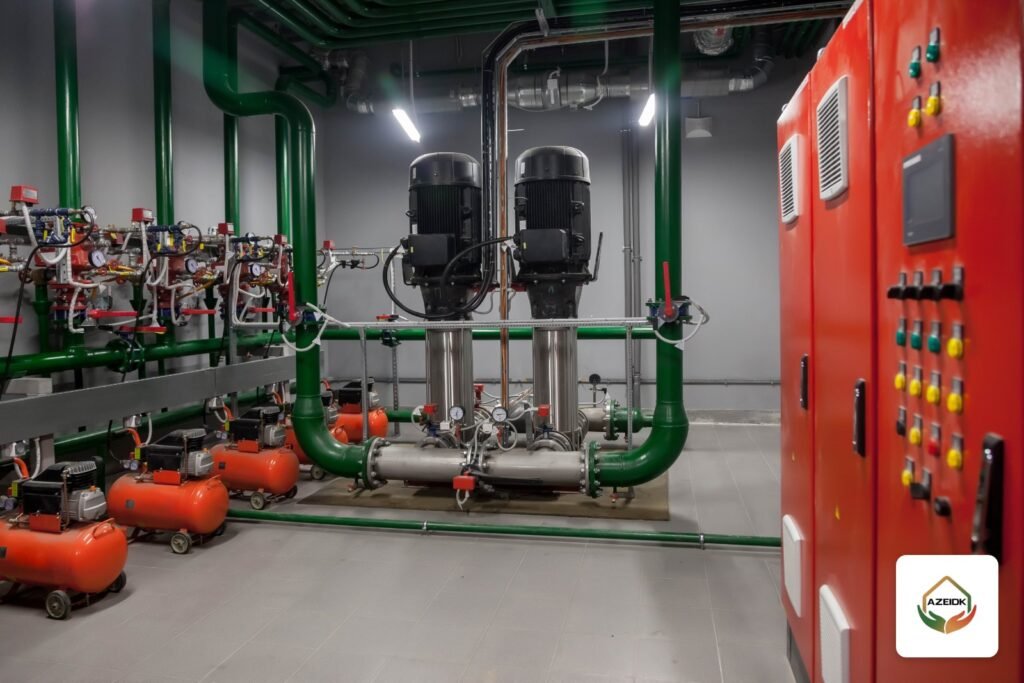
A diesel fire pump line in the BOQ covers far more than a pump. It means a package: an engine listed for fire pump service, a fuel tank, two battery units with chargers, a diesel controller, a cooling circuit, an exhaust line and a properly ventilated room. A missing item rarely shows up at purchase. It shows up at handover.
Below, each component in turn: what NFPA 20 asks of it, what to check in the submittal, and when diesel is the right choice. See also the fire pumps category.
The short answer: a diesel fire pump is a fire pump driven by a diesel engine listed for fire service, so it runs without relying on utility power. NFPA 20 requires a fuel tank sized for at least 12 hours of running plus 5% for expansion and 5% for sump, two battery units, a listed controller, and cooling, exhaust and ventilation to the engine maker’s instructions. It is usually chosen where power is unreliable, or as the permitted alternative to a second power source for an electric fire pump.
Key takeaways
- The diesel driver must be listed for fire pump service. The recognised test standards are UL 1247 and FM 1333.
- Since the 2022 edition of NFPA 20, the fuel tank is sized on the engine’s consumption rate for 12 hours, plus 5% expansion and 5% sump.
- Every diesel fire pump needs two battery units, and the controller alternates between them on each start attempt.
- Nameplate engine power must be derated for ambient temperature and altitude, which matters in a Saudi summer.
- Fire pumps fall under the SASO technical regulation for fire-fighting equipment, so they need a certificate of conformity through SABER.
In this article
- Diesel fire pump components: what are you actually buying?
- The engine: listing and derating for Saudi heat
- Diesel fuel tank: capacity, connections and alarms
- Batteries and chargers
- The diesel fire pump controller
- Cooling, exhaust and room ventilation
- When should you choose a diesel fire pump?
- Diesel fire pumps from AZEIDK
- Common mistakes when buying diesel fire pumps
- Frequently asked questions
- Summary
Diesel fire pump components: what are you actually buying?
The pump itself is the same as on an electric set. The difference is the engine and what serves it. The technical offer should list:
| Component | Function | What to check in the submittal |
|---|---|---|
| Diesel engine (driver) | Drives the pump on demand | Fire service listing, derated power, speed matched to the pump |
| Diesel fuel tank | Stores running fuel | Calculated capacity, level gauge, secondary containment, vents |
| Two battery units and chargers | Crank the engine | Battery capacity to the engine maker, a charger for each unit |
| Diesel fire pump controller | Automatic starting and alarms | Fire service listing, crank cycles, remote alarm contacts |
| Cooling circuit | Removes engine heat | Heat exchanger or radiator, strainers, pressure regulator, drain line |
| Exhaust and silencer | Discharges combustion gases | Back pressure calculated within the engine limit, insulation and route |
| Room ventilation and heating | Combustion and cooling air | Air openings, maximum air temperature at the engine intake |
For the general comparison, see electric vs diesel fire pumps.
The engine: listing and derating for Saudi heat
NFPA 20 requires the engine to be listed for fire pump service, under UL 1247 (diesel engines for driving stationary fire pumps) and FM Approvals Class 1333, revised in April 2022. Check the engine model in the official directory, not a catalogue logo.
Derating
Nameplate power is based on 25°C (77°F) ambient and 91 m (300 ft) above sea level. Above that baseline NFPA 20 (sections 11.2.2.4 and 11.2.2.5, as quoted in fire pump engine data from Cummins and NAFFCO) requires a reduction:
- 3% for every 305 m (1,000 ft) above 91 m.
- 1% for every 5.6°C (10°F) above 25°C.
Example: a room designed for 45°C is 20°C (about 36°F) above baseline, so power drops about 3.6%, plus any altitude derating. Compare the power left after both reductions with the maximum power the pump draws on its curve, as stated by the pump maker, and ask the supplier to show that check in the submittal.
Diesel fuel tank: capacity, connections and alarms
The 2022 edition of NFPA 20 changed how the tank is sized. Minimum capacity is now the engine’s fuel consumption at rated power multiplied by 12 hours, plus 5% for expansion and 5% for sump. Consumption comes from the engine datasheet: fuel supply minus fuel return at full load. According to PHC News, the 2025 edition left this rule unchanged.
Earlier editions used 1 gallon per hp plus the same allowances, so a 150 hp engine needed 165 gallons, about 625 litres. Check which method the submittal uses, and that the consumption figure comes from the engine’s own datasheet.
What to check on the tank
- A low fuel alarm, usually set at two thirds of tank capacity.
- Low fuel and interstitial leak signals (for double-wall tanks) sent through the pump controller to the fire alarm panel.
- Secondary containment under a single-wall tank, or a raised door sill that holds its full volume.
- Normal and emergency vents that terminate outside the building, at least 1.5 m (5 ft) from any building opening.
- Fuel type and grade per the engine datasheet.
Stored fuel degrades, so NFPA 25 includes requirements for monitoring and testing fuel quality; see diesel fire pump engine maintenance.
Batteries and chargers
The engine is cranked by an electric starter fed from batteries. Two independent battery units are required, as FM’s standard for diesel fire pump controllers states. Each unit can start the engine on its own, and each has a charger, either separate or a dual-output charger in the controller.
System voltage (12 or 24 V) and battery capacity are set by the engine maker; the official 3PUMP datasheets, for example, state 12 V for the diesel engine. Check that charger capacity suits the selected batteries.
The diesel fire pump controller
A diesel controller carries no motor power. It manages start attempts and monitors the engine and batteries, and, as ASPE summarises, must be listed for fire pump service, factory assembled and tested. The usual approval standards are UL 218 and FM Class 1321/1323. The datasheet of the Metron FD2, a UL listed and FM approved controller, shows these functions:
- Six 15-second crank periods separated by five 15-second rests, switching battery units on each attempt.
- A fail-to-start alarm after the six attempts.
- Overspeed shutdown with alarm.
- Alarms for low oil pressure, high coolant temperature and loss of battery charger output.
- A weekly program clock for the automatic test run, and dry contacts for remote signals to the fire alarm panel.
Many models come in NEMA 2 as standard, with 3R, 4, 4X and 12 options; specify the rating for hot, dusty or humid rooms. See also fire pump controllers.
Cooling, exhaust and room ventilation
Cooling
A heat exchanger is the common method: water from the pump discharge, taken ahead of the check valve, passes strainers, a pressure regulator and a solenoid valve, then goes to an open drain. A radiator keeps its heat in the room and needs far more ventilation. A jacket water heater keeps the engine ready to start.
Exhaust
Pipe diameter, length and number of bends are calculated so back pressure stays within the engine maker’s limit. Fit a silencer and a flexible connector, and insulate the pipe near people or combustibles.
Room temperature and combustion air
According to PHC News, citing the 2019 edition of NFPA 20, the room is kept at no less than 4°C (40°F) when idle, a value typically based on an engine block heater, and combustion air at the air cleaner inlet must not exceed 49°C (120°F) at full load. Confirm both limits against the engine maker’s instructions and the edition adopted for the project. In Saudi Arabia the upper limit is the challenge, so size air openings for the worst summer case. For full room requirements, see fire pump rooms in Saudi Arabia.
When should you choose a diesel fire pump?
The designer chooses the driver per SBC 801, Civil Defense requirements and the specification, with NFPA 20 as technical reference. Diesel typically appears when:
- Utility power is unreliable, or no emergency generator can handle the electric pump’s starting load.
- An alternate power source is needed for the electric pump, and NFPA 20 accepts a standby diesel pump instead.
- Industrial or remote sites, or an owner or insurer who wants a pump independent of electricity.
- The specification calls for a full set: electric main pump, diesel standby pump and jockey pump to hold pressure.
Diesel fire pumps from AZEIDK
In Saudi Arabia AZEIDK supplies 3PUMP fire pump packages (electric main, diesel standby and jockey) in four models documented by datasheet. They are Non-Listed, meaning not UL listed or FM approved, and listed versions are available on request. The documented diesel engines are:
| Duty point | Pump model | Diesel engine | Power |
|---|---|---|---|
| 500 GPM at 8 bar | 3P 4×3-10.2 | POWER 4102 | 84 HP |
| 750 GPM at 9 bar | 3P 5×4-10.2 | POWER 4105BZ | 108 HP |
| 1000 GPM at 10 bar | 3P 5×4-10.2L | POWER 6102BZQ | 150 HP |
| 1500 GPM at 10 bar | 3P 6×5-12.4 | POWER 6120Ti | 240 HP |
Where listing is required, WATEX pumps (UL listed, some models FM approved) and UL-listed Jack Pump pumps are available, with engine, tank and controller defined per project. AZEIDK holds the Saudi Local Content certificate and ISO 9001, ISO 14001 and ISO 45001 certificates.
Common mistakes when buying diesel fire pumps
- A quote for a “diesel pump” with no tank, batteries or silencer.
- Selecting the engine on nameplate power without temperature and altitude derating.
- Tank vents ending inside the room or next to a window or door.
- Diesel controller alarms (fail to start, low fuel, battery failure) not wired to the fire alarm panel.
- An unlisted engine or controller on a project whose specification requires listing.
Frequently asked questions
What is the difference between electric, diesel and jockey fire pumps?
Electric and diesel pumps are main pumps; only the driver differs. A jockey pump is small: it holds system pressure against minor leaks and is not a firefighting supply.
Does Saudi Civil Defense require a standby diesel pump?
No blanket rule applies. It depends on power reliability, SBC 801, the authority and the specification. NFPA 20 accepts a standby diesel pump in place of a second power source.
Must a diesel fire pump be UL or FM?
NFPA 20 requires a listed engine and controller, and many specifications want the whole package listed. Verify the model in the UL or FM directory.
How often is a diesel fire pump run and tested?
NFPA 25 calls for a weekly no-flow run of at least 30 minutes and an annual flow test at 0%, 100% and 150% of rated flow, alongside the engine maker’s instructions.
What does a diesel fire pump cost in Saudi Arabia?
No fixed price. It depends on flow, pressure, listing, engine power, tank size, controller and the scope of installation and testing.
Do fire pumps need a SABER certificate of conformity?
Yes. The SASO technical regulation for fire-fighting equipment and materials covers fire pumps, so they need a certificate of conformity through the SABER platform before supply.
Summary
A diesel fire pump is a system of at least seven components, each with a requirement in NFPA 20 or the engine maker’s instructions. Naming them in the specification and checking tank sizing, derating and alarms in the submittal prevents most handover comments.
Specifying a diesel fire pump for your project? Send us the required flow, pressure and listing requirements, and we will propose a suitable package with datasheets and the full diesel scope. Talk to the AZEIDK team
Related guides
- Fire Pump Faults and Troubleshooting: Failure to Start, Short Cycling, Low Pressure and Controller Alarms
- Manual Call Points and Audible and Visual Notification Appliances in Fire Alarm Systems
- Fire Extinguisher Selection Guide for Facilities in Saudi Arabia
- CCTV Cameras Without Internet: How Offline Recording Works and When You Need a Connection