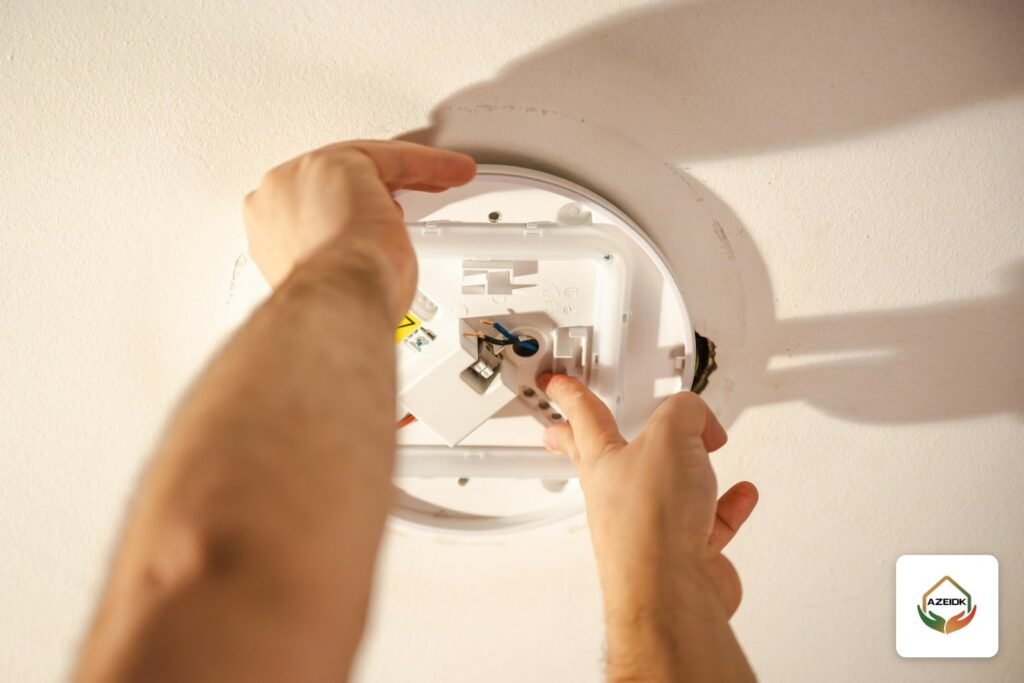
A smoke detector base is the ceiling-mounted part that holds the detector and terminates the circuit wiring. There are four types: a standard mounting base, an isolator base that cuts off a short circuit on the loop, a sounder base that adds an audible alarm under the detector, and a relay base that gives a contact to switch other equipment. The system type and the room decide which one you need.
This guide explains when to use each type, using the Context Plus models listed on AZEIDK’s fire alarm systems page and the figures given in each model’s datasheet, so the BOQ and submittal match the detectors and panel.
Key takeaways
- An XPERT addressable base does not take a 65A or 65E conventional detector, and the reverse is also true.
- The 45681-210IMC is the default base for XPERT Card addressable detectors; the 45681-200IMC is the standard base for 65A and 65E conventional detectors.
- The 45681-284IMC isolator base isolates the shorted section of the loop. The catalogue allows up to 20 devices between isolating bases, provided their total switch-on surge current does not exceed 20mA.
- A sounder base puts the audible alarm at the detector position: addressable models such as the CON431A/CX/W give 96dB(A) at 1 m, and the CP850BSW serves conventional systems.
- The 45681-245 relay base is for 65A and 65E conventional detectors. On addressable systems, plant control is normally done through input/output modules.
In this article
- What does a smoke detector base do?
- Types of smoke detector base, with Context Plus models
- Smoke detector base comparison
- How to choose the right smoke detector base for each point
- Smoke detector with sounder base: conventional or addressable?
- Common supply and installation mistakes
- Frequently asked questions
- Conclusion
What does a smoke detector base do?
The detector is a removable head. The base is fixed to the ceiling or a back box, the circuit wires terminate on it, and the detector twists into it. It can be removed for cleaning without touching the wiring.
On a Context Plus addressable system the address is carried on the XPERT card fitted in the base, not in the detector, as covered in our Context Plus addressable smoke detector article. The base sets how the point is addressed and what extra function sits there: isolation, sound, light or a relay contact.
Types of smoke detector base, with Context Plus models
1. Standard mounting base
Models listed by AZEIDK:
- 45681-210IMC intelligent mounting base: accepts Context Plus XPERT Card smoke and heat detectors. The catalogue lists four double terminals (L1 line negative in/out, L2 line positive in/out, +R and -R for a remote LED) and one isolated terminal for earth or screen continuity, with cable up to 2.5mm. The detector fits one way only and can be locked with a grub screw using a 1.5mm hex driver. An XPERT card is supplied with every base.
- 45681-210IMU: the common base for Context UL-Plus detectors, UL listed according to the product page, supplied with an XPERT card and a locking feature against unauthorised removal.
- 45681-200IMC: the standard base for 65A and 65E conventional smoke and heat detectors. It has no electronics to damage during installation, all versions lock, and detectors plug in without force. It works with the BF318 remote LED.
2. Isolator base
The 45681-284IMC isolating base combines a detector base and a short-circuit isolator. When it sees a short circuit or abnormally low impedance it isolates the negative supply in the direction of the fault, lights its yellow LED, keeps its own detector working, and restores the section automatically once the fault clears. Full details are in our loop isolator article.
3. Sounder base
A sounder base turns the detection point into an alarm point. It is most useful in closed rooms where the corridor sounder may not reach the required level, such as hotel and residential bedrooms. Addressable models listed by AZEIDK:
- CON431A/CX/W: 96dB(A) at 1 m, third-party certified to EN 54-3 (sounders) and EN 54-17 (isolators) per the datasheet, with an onboard short-circuit isolator and group addressing so several devices can operate together. Alarm current 5mA at 24V DC, quiescent current 550µA, 112mm diameter and 46mm deep (base only), IP21C. It works with DIL Switch and XPERT Card detectors and can stand alone with the BF330CTLIDW cap.
- CON456A/CX/W: the same base with a beacon giving C-3-8 light coverage, also certified to EN 54-23 for visual alarm devices. Alarm current 14mA at 24V DC with the VAD lit and the sounder at maximum.
- 45681-702IMC: integrated base sounder with a short-circuit isolator, loop powered, two tone ranges, synchronised Alert and Evacuate tones, individual and group addressing, acoustic self-test, and compliance with EN 54-3 (2001). For XPERT Card detectors only, or stand-alone with the 45681-292 cap.
- 45681-277: addressable sounder with an integral XPERT detector base, two tones, two volume ranges (55–75dB(A) and 75–91dB(A)), built-in isolator, 17–28V DC polarity sensitive.
- 45681-276: indoor ancillary base sounder, 85dB(A) at 1 m, 3mA, with no address of its own. It responds to the detector fitted on it.
Where a spoken message is needed instead of a tone, voice base sounders such as the CON454A/CX/W and CON457A/CX/W have their own article in the AZEIDK media center.
For conventional systems, the FirePlus CP850BSW is a low-profile 24V DC base sounder with 32 tones plus a selectable override tone, 93.8dB(A) at 1 m on Tone 1 high setting at 12mA, IP21C, and LPCB approval to EN 54-3 per the catalogue. It accepts most leading detector bases above it, per the catalogue. It runs on a sounder circuit, so include it in that circuit’s voltage drop calculation.
4. Relay base
A relay base changes a contact when its detector alarms. In the Context Plus range listed by AZEIDK, the 45681-245 is the standard relay base for 65A and 65E conventional detectors. The available catalogue does not state the contact rating, so ask the supplier for it before connecting any load.
AZEIDK does not list an XPERT relay base for addressable systems. Plant control is normally done by programmed input/output modules. The Ei128R and Ei128RBU relay bases are for 230V AC domestic alarms, and their product page notes they are not designed to be a critical component of a BS 5839-1 system, so they are not a substitute for a base on a panel-based system.
Smoke detector base comparison
| Type | Context Plus model | System | Extra function | Datasheet figure |
|---|---|---|---|---|
| Standard base | 45681-210IMC | Addressable (XPERT Card) | Remote LED terminals | Cable up to 2.5mm |
| Standard base, UL | 45681-210IMU | Addressable (UL-Plus) | Anti-removal lock | UL listed per product page |
| Conventional base | 45681-200IMC | Conventional (65A/65E) | None | No electronic parts |
| Isolator base | 45681-284IMC | Addressable | Short-circuit isolation | Up to 20 devices between isolators (20mA) |
| Sounder base | CON431A/CX/W | Addressable | Sounder and isolator | 96dB(A), 5mA alarm |
| Sounder beacon base | CON456A/CX/W | Addressable | Sounder, VAD and isolator | C-3-8, 14mA alarm |
| Integrated base sounder | 45681-702IMC / 45681-277 | Addressable (XPERT) | Sounder and isolator | EN 54-3 / up to 91dB(A) |
| Ancillary base sounder | 45681-276 | Addressable (XPERT) | Sounder, no address | 85dB(A), 3mA |
| Conventional base sounder | CP850BSW | Conventional | Sounder | 93.8dB(A), 12mA |
| Relay base | 45681-245 | Conventional (65A/65E) | Relay contact | Contact rating not stated |
How to choose the right smoke detector base for each point
- Fix the system and detector series first. XPERT addressable detectors need XPERT bases, UL-Plus detectors use the 45681-210IMU, and 65A/65E conventional detectors use the 45681-200IMC or 45681-245. Mixing series in the BOQ can get this submittal line rejected.
- Will the corridor sounder be heard in this room? If not certain, as in bedrooms with closed doors, a sounder base solves it without an extra wall sounder. The designer sets the required sound level.
- Is a visual alarm required? Use a sounder beacon base such as the CON456A/CX/W and check C-3-8 coverage against the room.
- Where are the isolation boundaries? Many addressable sounder bases have a built-in isolator; elsewhere use the 45681-284IMC. Check the isolator layout across the whole loop before the drawing is approved.
- Does the detector need to switch a local device? On conventional systems use the 45681-245 relay base; on addressable systems use a programmed output module.
- Add up the loads. Each addressable sounder base adds alarm current to the loop (5mA for the CON431A and 14mA for the CON456A per the datasheet), and the panel and battery calculations must cover all devices sounding together.
Smoke detector with sounder base: conventional or addressable?
On a conventional system the detector sits on the detection zone, while the CP850BSW sounder base runs on a separate sounder circuit from the panel, so every detector with a sounder needs two extra cores. They all sound together, and the panel cannot tell which one is sounding.
On an addressable system the sounder base runs from the same loop and has its own address (except the 45681-276 ancillary sounder), so it can be programmed per room or per group and the panel sees its status. Addressable suits buildings with many rooms, such as hotels and hospitals; conventional still suits small single-zone sites.
Common supply and installation mistakes
- Standard bases in the BOQ while the drawings show sounder bases in bedrooms.
- Fitting sounder bases without adding their current to the loop or checking the maximum number of devices between isolators.
- Connecting a load to a relay base without confirming it against the rated contact current.
- Omitting the remote LED for detectors hidden above ceilings or in locked rooms.
- Reversing polarity on polarity-sensitive bases such as the isolator base and the 45681-277.
Frequently asked questions
What is a smoke detector base?
It is the ceiling-mounted part where the circuit wiring terminates and the detector is fitted. Depending on type, it can add isolation, sound, light or a relay contact.
Can a conventional detector go on an addressable base?
No. Each detector series has its own bases in the catalogue: 65A and 65E conventional detectors use the 45681-200IMC or 45681-245, and XPERT detectors use XPERT bases.
Why use a smoke detector with a sounder base?
The alarm sounds from the detector position, so it reaches closed rooms without a separate wall sounder and there are fewer devices on the ceiling.
What is the difference between an isolator base and a sounder base with an isolator?
The 45681-284IMC adds isolation only. Bases such as the CON431A/CX/W and 45681-702IMC combine a sounder and a short-circuit isolator in one device.
Do I need a relay base on an addressable system?
Usually not. The addressable panel switches plant through programmed output modules; the 45681-245 relay base listed is for conventional detectors.
Conclusion
Start from the detector series and panel type, then ask for each point whether it needs local sound or light and whether it is an isolation boundary. Then add up the loads and write the correct model number in the BOQ.
Preparing a fire alarm BOQ? Send us the drawings and the panel type, and we will set the right Context Plus base for each point with the datasheets for your submittal. Talk to the AZEIDK team
Related guides
- Salamah Certificate in Saudi Arabia: What It Is, Who Needs It, Documents and Validity
- Fire Alarm Cause and Effect Matrix: How to Build, Program and Test It
- Hikvision vs Dahua NVR: Channels, PoE, Disk and App
- Fire Extinguishers in Khamis Mushait and Abha: Choosing Units for Shops, Rest Houses and Workshops