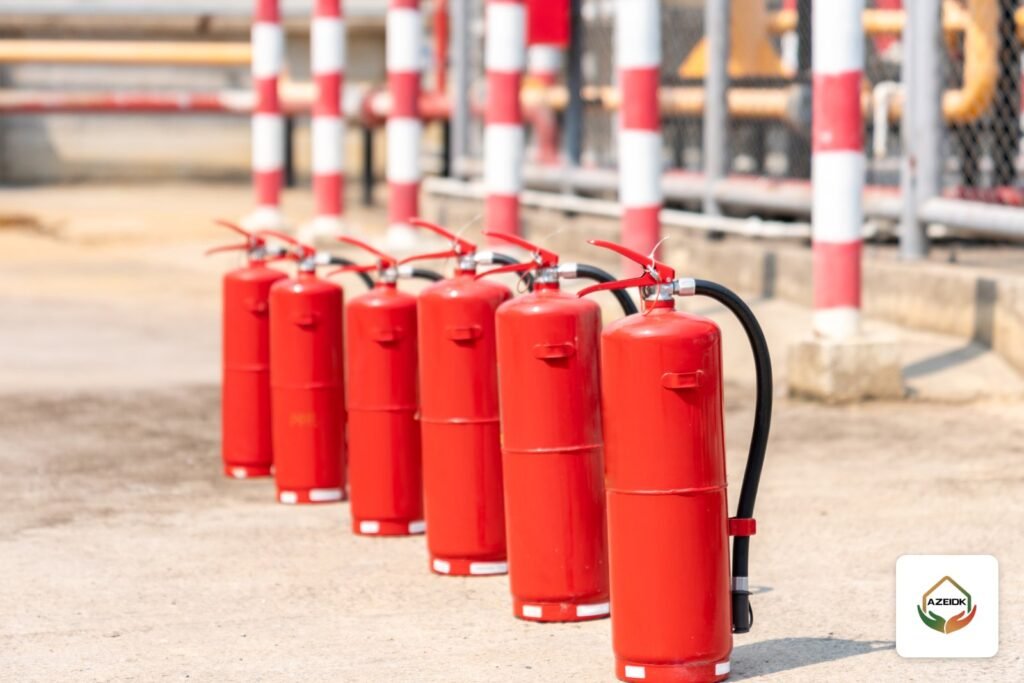
The SASO technical regulation for fire-fighting equipment and materials (Technical Regulation for Fire Control Materials and Equipment) is the document that decides which fire-fighting products need a certificate of conformity before they enter the Saudi market, which standards they are measured against, and who carries the legal responsibility. Few suppliers have read the regulation itself.
This article reads it from the supplier’s and contractor’s side, and links it to technical supply of fire equipment on real projects.
Key takeaways
The regulation covers fire extinguishing equipment and devices, fire pumps, extinguishing media, and their parts and accessories. Fire alarm systems are excluded. A covered product cannot be placed on the market without a certificate of conformity issued under conformity assessment model Type 3, followed by a shipment certificate for each consignment through the SABER platform.
- Annex 1 lists 29 reference standards for extinguishers, fire pumps, hose systems and extinguishing media, and the supplier must apply the latest edition of each.
- A product holding the Saudi Quality Mark, or an equivalent, is considered compliant with the regulation.
- The HS code is what links a product to the regulation in SABER. The current approved list is the one published on the platform.
- The supplier carries legal responsibility for conformity, and violations are handled under the Anti-Commercial Fraud Law.
In this article
- What is the SASO technical regulation for fire-fighting equipment and materials?
- Covered products and HS codes
- What does the regulation exclude?
- Reference standards in Annex 1
- Supplier obligations in the regulation
- Conformity route: Type 3
- What goes into the technical file
- Violations and penalties
- What it means for suppliers, contractors and consultants
- Common mistakes
- Frequently asked questions
- Conclusion
What is the SASO technical regulation for fire-fighting equipment and materials?
A technical regulation is mandatory; a standard stays voluntary unless a regulation refers to it. This one sets the essential safety requirements for fire-fighting equipment and the conformity steps before market placement. Only the Arabic text is legally authentic.
| Stage | Hijri date | Gregorian date |
|---|---|---|
| Approved by the SASO Board (Decision No. 172) | 28/12/1440 | 29/08/2019 |
| Published in Umm Al-Qura (Official Gazette) | 04/03/1441 | 01/11/2019 |
| Enforced at ports and factories | 08/09/1441 | 01/05/2020 |
| Enforced in the market | 14/03/1442 | 31/10/2020 |
Suppliers had six months from publication to comply, and non-conforming products could not be traded after one year. Both periods ended in 2020; later updates to the product list or HS codes are published on SABER.
Covered products and HS codes
Article 2 covers four groups: extinguishing equipment and devices, fire pumps, extinguishing media, and their parts and accessories. SASO’s guide gives non-exhaustive examples:
- Devices: portable fire extinguishers, fire pumps, CO2 cylinders for extinguishers, fixed fire extinguishing systems and extinguishing agents.
- Accessories: fire hoses, hydrant inlets and outlets, couplings, elbows and fittings, and cabinets for extinguishers or hose reels (fire hose cabinets).
The guide maps them to tariff headings; the current approved list is the one on SABER:
| Product | Tariff heading (first four digits) |
|---|---|
| Preparations and charges for fire extinguishers | 3813 |
| Vulcanized rubber fire hoses | 4009 |
| Cabinets for fire extinguishers or hoses | 7308 |
| Hydrant plates and plugs and fire alarm posts (cast iron or steel) | 7325 |
| Fire pumps | 8413 |
| Hydrant inlets and outlets | 8481 |
Coverage starts from the correct full HS code, not from the product name on the invoice.
What does the regulation exclude?
The two official SASO sources agree that fire alarm systems are excluded, but word the rest differently. Article 2/2 in the English translation published by SASO excludes “fire alarm and firefighting systems” from the scope and applies the Saudi Fire Protection Code to them. The SASO guide lists only fire alarm systems as excluded products and includes “fixed fire extinguishing systems” among its examples of covered products. Only the Arabic text of the regulation is legally authentic, so check how any fixed extinguishing package is classified on SABER by its HS code. Either way, system design, installation and acceptance are reviewed by the consultant and Civil Defense under the code, while covered supplied products (extinguisher, pump, hose, agent) fall under the regulation.
The guide adds general exclusions: equipment designed for industrial processes inside industrial facilities, equipment used temporarily for laboratory research, and exhibition products not offered for sale.
Excluding fire alarm system products from this regulation is not a general exemption: another regulation may apply by HS code, checked on SABER.
Reference standards in Annex 1
Annex 1 lists 29 standards used to assess conformity, and requires the latest edition of each. Grouped by product family as published:
| Product family | Reference standards | What they cover |
|---|---|---|
| Portable extinguishers | SASO 63, SASO 81, SASO 124, SASO 125, SASO 64, SASO GSO ISO 7165 | CO2, dry powder, foam and halocarbon portable extinguishers, test methods, performance and construction |
| Wheeled extinguishers | SASO 419, SASO 420, SASO 418, SASO GSO ISO 11601 | Mobile CO2 and dry powder extinguishers, test methods, performance and construction |
| CO2 cartridges | SASO 37, SASO 38 | Steel CO2 cartridges for extinguishers and their test methods |
| Extinguisher inspection and maintenance | SASO GSO ISO 11602-2 | Inspection and maintenance of portable and wheeled extinguishers |
| Fire pumps | SASO NFPA 20 | Installation of stationary pumps for fire protection |
| Hose systems | SASO GSO EN 671-1, SASO EN 671-2 | Hose reels with semi-rigid hose and hose systems with lay-flat hose |
| Extinguishing media | SASO ISO 5923, SASO ISO 1796, SASO 647, SASO ISO 7201-1 | CO2 as an extinguishing medium, liquid foam concentrates, dry chemical powder, halons |
| Gaseous system agents | Parts of SASO ISO 14520 (2, 5, 8, 10, 11, 12, 13, 14, 15) | Physical properties of agents including FK-5-1-12, IG-541, IG-55, IG-100 and IG-01 |
NFPA 20 is adopted here as a Saudi standard. That does not make every NFPA standard mandatory.
Supplier obligations in the regulation
The supplier is the manufacturer, a foreign manufacturer’s agent, the importer where there is no agent, or any supply-chain party that affects the product. Article 4 requires it to:
- Comply with the regulation and the Annex 1 standards.
- Prepare a risk analysis that is considered in design and manufacturing.
- Provide use, installation and maintenance information in a user manual.
- Provide technical documents, certificates and test reports on request.
- Not place any product on the market without a certificate of conformity.
Article 5 requires SI units and packaging with the recycling mark. Article 6 requires a clear, hard-to-remove label with warnings, instructions and verified information. For a recent requirement on supplier details on the product, see supplier name and CR number on products.
Conformity route: Type 3
Article 7 requires a certificate of conformity from a SASO-accepted conformity assessment body under model Type 3 of ISO/IEC 17067 (type approval plus production quality assurance):
- The body reviews the factory’s product safety management system (PSMS) and audits the factory with a team that includes at least one technical expert.
- PSMS approval is valid for three years, with periodic audits; the body may also make unannounced factory visits and test products where needed.
- The body issues the certificate of conformity while the approval is valid and records it on SABER.
Article 7/5 states that a product holding the Saudi Quality Mark, or an equivalent, is considered to meet the safety requirements. A shipment certificate is then registered for each consignment before shipping, with invoice data and quantities. SASO’s general certificate regulation sets validity at one year unless the technical regulation says otherwise. For the application steps in order, see SABER certificate of conformity for fire equipment.
What goes into the technical file
The SASO guide lists six documents for the technical file:
- The supplier’s declaration of conformity on the Annex 3 form, with a copy accompanying each product.
- A risk assessment document.
- A certificate of origin.
- Test reports against the reference standards.
- A list of the standards applied.
- A product information booklet where a label cannot be fixed to the product.
The supplier keeps these records for at least ten years after market placement. For how they fit with datasheets and submittals, read fire and security project certificates in Saudi Arabia.
Violations and penalties
Article 10 prohibits making, importing, selling or advertising a non-conforming product, including one with missing marks, improper certificates or an incomplete file. Authorities can order withdrawal, export or destruction at the violator’s cost, SASO can cancel the certificate, and penalties apply under the Anti-Commercial Fraud Law. Under Article 11/8, modifying a certified product cancels the certificate.
What it means for suppliers, contractors and consultants
| Party | What the text means in practice |
|---|---|
| Supplier or importer | Correct HS code, a complete technical file, a valid certificate of conformity for each model, and a shipment certificate for each consignment. |
| Contractor | Ask for the certificate of conformity of the model actually supplied, and match the model number on the label with the certificate and the datasheet before installation. |
| Consultant | Separate product conformity with the regulation from suitability for the design. Suitability is governed by the Saudi code and listing conditions such as UL and FM. |
A SABER certificate shows that a product may be placed on the market. It does not show that the product suits a particular hazard or working pressure. To compare the extinguishers available in the market by type and capacity, see fire extinguisher types and brands in Saudi Arabia.
Common mistakes
- Assuming a UL or FM certificate replaces the certificate of conformity. It does not.
- Using a nearby HS code that does not apply, so the shipment stops at the port.
- Using a certificate issued for another model from the same manufacturer.
- Modifying the product or its specification after certification without a new application.
- Working to an old edition of a reference standard when the annex requires the latest one.
Frequently asked questions
Do fire extinguishers and fire-fighting equipment need SABER certification?
Yes. Portable extinguishers, CO2 cylinders, fire pumps, hoses, hydrant outlets and their cabinets, and extinguishing media are covered by the regulation, and need a certificate of conformity through SABER plus a shipment certificate for each consignment.
Are fire alarm systems covered by the fire-fighting equipment regulation?
No. The SASO guide lists fire alarm systems as excluded products. Check on SABER which regulation may apply to an alarm product according to its HS code.
PCoC vs SCoC: what is the difference?
The product certificate (PCoC) confirms that a specific model conforms to the regulation and is issued after conformity assessment. The shipment certificate (SCoC) covers one consignment and is registered for each shipment with invoice and quantity data before shipping.
What is the SABER certificate validity?
SASO’s general regulation for certificates of conformity sets one year unless the relevant technical regulation sets another period. The expiry date appears on the certificate itself in SABER.
Does the Saudi Quality Mark replace the certificate of conformity?
A product holding the mark, or an equivalent, is considered compliant, but the supplier still enters the mark’s data in SABER so the certificate of conformity is issued directly after electronic verification. It shortens the route but does not remove registration.
How do I find the HS code for my product on SABER?
Start from the tariff heading in the SASO guide, such as 8413 for fire pumps and 4009 for hoses, then search SABER by code or product name to reach the full code and the regulation linked to it.
How much does a SABER certificate cost?
The regulation sets no price. The cost is the platform fee shown at the time of the request plus the conformity assessment body’s charges, which vary by product, body and audit scope.
Conclusion
The HS code decides coverage, Annex 1 the test standard, Type 3 means a factory audit, and Article 10 sets the cost of mistakes. Choosing the right model for the design remains a separate technical responsibility.
Preparing an order of extinguishers, pumps or fire hose cabinets for a project in Saudi Arabia? Send us the item list and we will review the models, datasheets and documents for each item. Talk to the AZEIDK team
Related guides
- EN 54 Fire Alarm Standard: Parts, CE Marking and Approvals
- General Contracting in Dammam and Khobar: How to Choose a Contractor for MEP and Fire Works
- Safety Signs in Saudi Arabia: Assembly Point, Emergency Exit, No Smoking and CCTV Surveillance Signs
- Fire Hose Cabinets: Types, Sizes and Components (Class I, II and III)