Solar panels are spreading across the roofs of factories, warehouses and commercial buildings, and the same question comes up at licensing: how do solar panels and fire safety fit together? Panels keep generating while the sun is on them, and they cover roof area that Civil Defense crews need for movement and ventilation. That is why the Saudi Fire Code SBC 801 has Section 1205 on solar photovoltaic systems, and the Saudi General Building Code SBC 201 covers them in Section 3111.
This article sets out what the official public-access text of both codes (2024 edition) says about pathways and roof access, rapid shutdown labels, panel listing and roof fire classification. AZEIDK supports owners on the fire safety side and the Civil Defense file through its Civil Defense approval support service; the electrical design and installation of the PV system remain with a licensed solar contractor.
Key takeaways
- PV systems are installed to SBC 201 (or SBC 1101 for dwellings), the electrical part to NFPA 70, and rooftop systems to SBC 801 Sections 1205.2 to 1205.4.3.
- Roof access, pathways and spacing are required, with pathways over areas able to carry firefighters and with minimal obstructions.
- Buildings with rapid shutdown systems carry permanent labels to Sections 1205.4.1 to 1205.4.3.
- Modules are listed and labelled to UL 1703 or UL 61730-1 and UL 61730-2, and rooftop systems need a fire classification to SBC 201 Section 1505.9.
In this article
Why solar panels and fire matter to Civil Defense
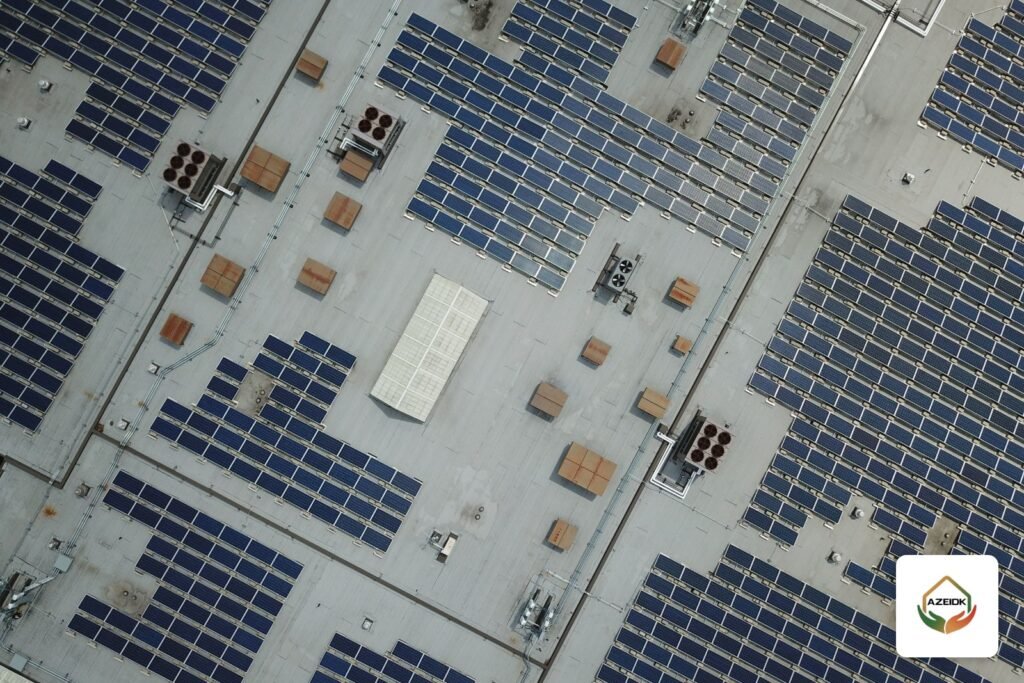
When a building with rooftop PV is on fire, crews need to reach the roof, move across it without stepping onto weak areas or tripping over equipment, and know that a generating system is present. Those are exactly the themes of Section 1205: access, pathways and labels. The code does not judge panel quality here; that is left to product listing and the electrical code.
The references: SBC 801 Section 1205 and SBC 201 Section 3111
| Topic | Section | Requirement |
|---|---|---|
| General installation | SBC 801, 1205.1 | To SBC 201 or SBC 1101; electrical part to NFPA 70 |
| Access and pathways | SBC 801, 1205.2 | Roof access, pathways and spacing per 1205.2.1 to 1205.3.3 |
| Buildings other than Group R-3 | SBC 801, 1205.3 | Access per 1205.3.1 to 1205.3.3 |
| Rapid shutdown | SBC 801, 1205.4 | Permanent labels per 1205.4.1 to 1205.4.3 |
| Ground-mounted systems | SBC 801, 1205.5 | Installed per the same section |
| Module and inverter listing | SBC 201, 3111.3.1 | UL 1703 or UL 61730-1 and UL 61730-2; inverters listed and labelled |
| Fire classification | SBC 201, 3111.3.2 | Rooftop systems per 1505.9; BIPV roof coverings per 1505.8 |
| Wind and roof load | SBC 201, 3111.1.1 and 3111.1.2 | Wind per 1609; roof live load per 1607.14.4 |
Pathways and roof access
SBC 801 Section 1205.2 requires roof access, pathways and spacing per Sections 1205.2.1 to 1205.3.3, and sets two clear conditions for where pathways go:
- Over areas capable of supporting firefighters accessing the roof.
- In areas with minimal obstructions such as vent pipes, conduit and mechanical equipment.
The section lists exceptions, and buildings other than Group R-3 (detached dwellings) follow the access rules in Section 1205.3. In practice, roof layout starts with the pathways and then fits panels around them, not the other way round. The public summary text does not give pathway widths and setbacks, so take them from the full edition or from Civil Defense at drawing approval.
Rapid shutdown and labels
Section 1205.4 requires buildings with rapid shutdown PV systems to carry permanent labels to Sections 1205.4.1 to 1205.4.3. The label tells crews that a generating system is on the building and how to deal with it. The electrical rapid shutdown requirements themselves follow NFPA 70, referenced by Section 1205.1.
Module listing and roof fire classification
SBC 201 Section 3111.3 requires PV systems to be designed and installed to that section, SBC 801, NFPA 70 and the manufacturer’s instructions. Section 3111.3.1 requires modules to be listed and labelled to UL 1703, or to UL 61730-1 and UL 61730-2, and inverters to be listed and labelled.
Because panels become part of the roof, Section 3111.3.2 requires a fire classification for rooftop systems per Section 1505.9, and for building-integrated PV (BIPV) used as roof covering per Section 1505.8, with BIPV installed to Section 1507. Supporting roof structures follow Section 1607.14.4 for loads and Section 1609 for wind, which matters on light metal warehouse roofs where the firefighter pathway must sit on structure that can carry it.
Ground-mounted systems and energy storage
Ground-mounted systems follow SBC 801 Section 1205.5 and Chapter 16. Batteries added for energy storage are a separate subject under electrical energy storage systems (ESS) in SBC 801 Chapter 12, and are not covered by the PV panel requirements alone.
Checklist before submission
- A roof plan showing pathways and access before panel layout.
- Confirmation that pathways sit over structure able to carry foot traffic, clear of vents and equipment.
- Listing certificates for modules (UL 1703 or UL 61730) and inverters.
- Fire classification for the roof assembly with panels.
- Rapid shutdown labels where required.
- Coordination with the building’s existing fire systems and the Civil Defense file.
See also NFPA 70, NFPA 70E and SBC 401, SBC 801 vs SBC 201 vs Civil Defense requirements and solar plant security cameras.
Frequently asked questions
Which code covers solar panels and fire in Saudi Arabia?
SBC 801 Section 1205, SBC 201 Section 3111, and NFPA 70 for the electrical part.
Do rooftop panels need pathways between them?
Yes. Section 1205.2 requires access, pathways and spacing over areas able to carry firefighters and with minimal obstructions.
What are rapid shutdown labels?
Permanent labels required by Section 1205.4 on buildings with rapid shutdown PV systems, to alert fire crews.
What listing do PV modules need?
SBC 201 Section 3111.3.1 requires listing and labelling to UL 1703 or UL 61730-1 and UL 61730-2.
Do these rules cover battery storage?
No. Electrical energy storage systems have their own section in SBC 801 Chapter 12.
Does AZEIDK install solar systems?
No. AZEIDK handles fire safety systems and the Civil Defense file; the PV system is the licensed solar contractor’s responsibility.
Adding solar panels to your roof? Contact AZEIDK to review the fire safety side and Civil Defense file before installation. Contact AZEIDK
Related guides
- Foam Fire Extinguisher (AFFF): Which Fires It Suits, Foam vs Dry Powder, and 6 to 12 Litre Sizes
- Access Gates and Barriers Cost: What Drives the Price (Type, Control and Installation)
- Saudi Civil Defense Requirements for Buildings and Facilities
- Mall Fire Extinguishers: Corridors, Shops, Food Courts, Plant Rooms and Car Parks