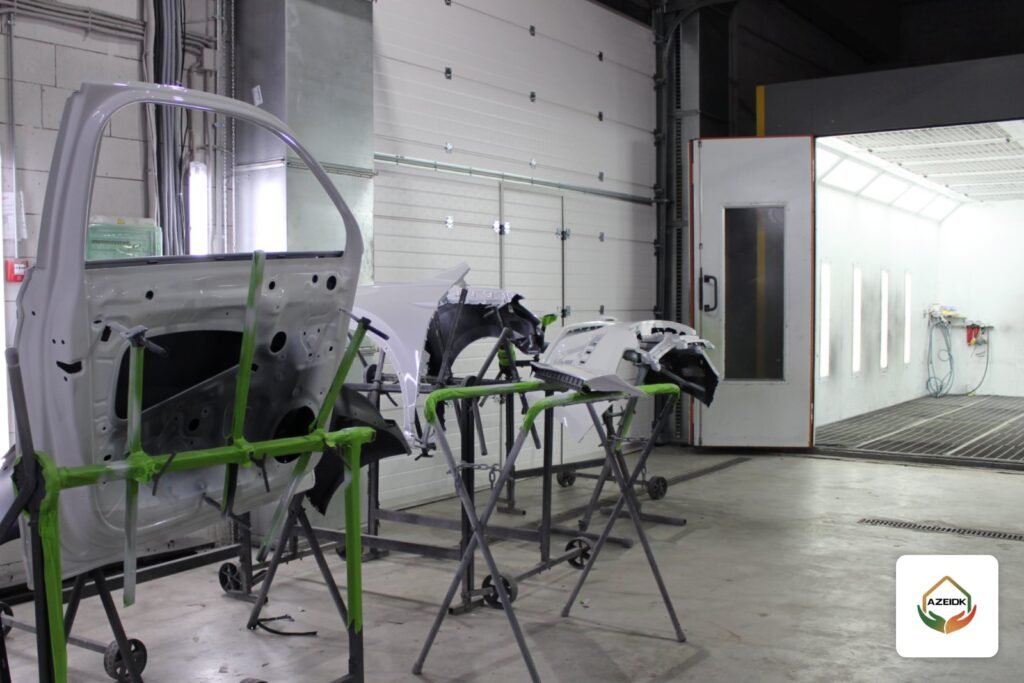
Paint booth fire suppression means the booth, its exhaust plenum and ductwork, the filters and the paint mixing room are all covered by an approved automatic fire protection system, with spraying interlocked to the ventilation and shut down when the system operates. The reference standard is NFPA 33 (current edition 2024), and the usual choices are automatic sprinklers or carbon dioxide (CO2). This article explains how to choose between them for a workshop or factory in Saudi Arabia, and what AZEIDK special fire suppression systems cover on this type of site.
Key takeaways
- NFPA 33 requires an approved automatic fire protection system for the spray area, extending to exhaust plenums, ductwork, filters and mixing rooms.
- The accepted systems are designed to NFPA 13, 16, 12, 17 or 2001, depending on the system type.
- Under the International Fire Code (IFC 2018), on which the Saudi Fire Code SBC 801 is based, spray equipment must be interlocked with the ventilation so spraying cannot start unless exhaust is running.
- CO2 leaves no residue, but its design concentration is lethal, so it needs a pre-discharge alarm, a time delay and a lockout valve.
- Sprinklers inside the spray area are protected from overspray with thin bags, and any head coated with paint is replaced.
In this article
- Why does a paint booth need its own fire protection?
- What does NFPA 33 require for paint booth fire suppression?
- Sprinklers or CO2? Comparing the suppression options
- When is CO2 dangerous to workers?
- Interlocks: spraying, ventilation and shutdown on fire
- Detection, alarm and extinguishers in the spray area
- Installation details that are often missed
- What AZEIDK provides for paint booth projects
- Frequently asked questions
- Conclusion
Why does a paint booth need its own fire protection?
A paint booth (spray booth) is built to hold a mixture of solvent vapour and paint mist in the air. A spark from a motor, static electricity or a nearby grinding tool can ignite that mixture, and fire spreads quickly into paint-loaded filters and then into the exhaust duct, which often runs above the ceiling or past storage areas.
That is why general building sprinklers are not enough. NFPA 33, Standard for Spray Application Using Flammable or Combustible Materials, treats the spray area as a separate hazard with its own rules on construction, ventilation, liquid storage and fire protection. The International Fire Code has a dedicated chapter, Flammable Finishes, which is Chapter 24 in the 2018 edition of SBC 801 according to the ICC study companion. Always check the edition of the Saudi code currently in force when you design.
What does NFPA 33 require for paint booth fire suppression?
Chapter 9 of NFPA 33 covers protection. Based on review checklists published by US fire authorities that enforce it, such as the Cobb County Fire Marshal, the core requirements are:
- An approved automatic fire protection system for the spray area, including exhaust plenums, exhaust ductwork, particulate filters, recirculation units and paint mixing rooms.
- Installation to the matching standard: NFPA 13 for sprinklers, NFPA 16 for foam-water sprinklers, NFPA 12 for carbon dioxide, NFPA 17 for dry chemical and NFPA 2001 for clean agents.
- Supervision of fire alarm and fire protection systems in line with NFPA 72.
- Exhaust and make-up air stay running during a fire alarm, unless the type of suppression system requires them to stop.
- Where sprinklers are used, design to Extra Hazard Group 2, controlled by a separate listed indicating valve operable from floor level.
Section numbers can move between editions, so we give the requirement and its source here, and the designer checks the numbers against the edition adopted for the project. For hazard classes and sprinkler system types, see wet, dry, pre-action and deluge sprinkler systems.
Sprinklers or CO2? Comparing the suppression options
The choice depends on booth size, whether an operator is inside during spraying, whether the fire water supply can take the extra demand, and how sensitive the painted product is to water. The table sums up the practical differences:
| Option | Reference standard | When it fits | Watch out for |
|---|---|---|---|
| Automatic sprinklers | NFPA 13 | Booths inside a sprinklered building where the water supply covers the added demand | Protecting heads from overspray, covering the duct and both sides of the filters, a separate control valve |
| CO2 total flooding | NFPA 12 | An enclosed booth that can be sealed, where water or residue on the parts is not acceptable | Lethal concentration: pre-discharge alarm, time delay, lockout valve and evacuation |
| CO2 local application | NFPA 12 | Protecting a defined hazard point, such as a partly open spray area | Careful nozzle positioning and discharge rate calculations; it does not protect the building |
| Dry chemical | NFPA 17 | An option the standards accept, made by specialist manufacturers | Leaves residue that must be cleaned; select from a listed manufacturer |
| Foam-water sprinklers | NFPA 16 | Where larger quantities of flammable liquids are present | Proportioning system design and foam concentrate storage |
For CO2 projects, AZEIDK supplies the SFFECO carbon dioxide (CO2) system. According to the product page, it is a UL listed high-pressure system designed to ANSI/NFPA 12, for total flooding or local application, with electric, pneumatic or mechanical actuation and an operating pressure of 58 bar (850 psi) at 21 °C.
When is CO2 dangerous to workers?
This point decides the matter in many workshops. In its review of CO2 risks, the US Environmental Protection Agency (EPA) notes that extinguishing concentrations start at 34% for materials such as methane, while concentrations above 17% can cause unconsciousness and death within one minute. In plain terms, a discharge with a painter inside the booth can kill.
NFPA 12 and related guidance therefore list these safeguards:
- Audible and visual pre-discharge alarm with a time delay long enough to get out.
- A lockout valve that prevents discharge during maintenance or when untrained people are present.
- Warning signs at entrances and a continuous alarm until the atmosphere is safe.
- Forced ventilation after discharge, because CO2 is heavier than air and collects in low areas.
- Operators and maintenance contractors who know the alarm signals and the evacuation route.
EPA also reports that most incidents it reviewed happened during maintenance or testing, not during a real fire. The maintenance procedure should state clearly that the system is locked out before anyone enters.
Interlocks: spraying, ventilation and shutdown on fire
Interlocks make the booth work as one system rather than separate devices. The International Fire Code (IFC 2018, as reproduced in the Seattle Fire Code 2018 based on it) sets three main requirements:
- Spray equipment is interlocked with the ventilation of the flammable vapour area, so spraying cannot run unless ventilation is on.
- On automated spray lines, discharge of the extinguishing system automatically stops spraying and workpiece conveyors.
- Make-up air and exhaust are not interlocked with the fire alarm to shut down, unless the type of extinguishing system requires ventilation to stop, in which case exhaust and make-up air shut down automatically.
The last point matters with CO2 in particular: fans running during discharge pull the gas out and drop the concentration, so shutdown is coordinated with the release panel. With sprinklers, ventilation keeps running. All of this goes into the cause and effect matrix before programming.
Detection, alarm and extinguishers in the spray area
The booth’s automatic suppression system usually operates on heat or flame detection, depending on the manufacturer’s design. For electrostatic spray equipment, the International Fire Code requires flame detection to stop spraying, stop conveyors into and out of the vapour area and shut down the coating supply. The suppression system is tied into the building’s fire alarm system so the alarm reaches the control room.
Detector selection in an area with flammable vapours is tied to the area’s electrical classification, so it is reviewed with the designer and against the detector datasheet. For the difference between fixed temperature and rate-of-rise heat detectors, see heat detector types and installation.
The code also requires portable fire extinguishers for spraying areas under the general extinguisher rules, with their locations shown on the plans submitted for review.
Installation details that are often missed
- Sprinkler bags: sprinklers inside the vapour area are covered with thin polyethylene or cellophane bags (0.003 in or less) or thin paper, and any head contaminated with overspray is replaced, not cleaned.
- Exhaust duct: protection extends into the exhaust duct and both sides of dry filters, not only inside the booth.
- Booth tightness with CO2: total flooding relies on holding the gas. Unclosable openings are added to the calculation or closed automatically.
- Water demand: with sprinklers, booth and duct protection is added to the network calculation and the capacity of the existing fire fighting system is checked.
- Maintenance: paint build-up on nozzles and detectors reduces performance, so cleaning and inspection go into the routine maintenance schedule.
What AZEIDK provides for paint booth projects
AZEIDK covers this type of protection as part of its work for industrial facilities: site survey, design through engineering design and calculations, supply of the SFFECO CO2 system, sprinklers and alarm components, installation and testing, support with the Civil Defense approval file, and routine maintenance after handover. The choice between sprinklers and CO2 is made after seeing the booth and how it is used, not from a catalogue.
Frequently asked questions
Does a paint booth need its own suppression system if the factory is already sprinklered?
Usually, yes. NFPA 33 requires automatic protection for the spray area itself, the exhaust duct and the filters, and ceiling sprinklers do not reach inside the duct or behind the filters.
Which standard covers paint booth fire protection?
NFPA 33, current edition 2024. It refers to NFPA 13, 12, 16, 17 or 2001 depending on the suppression system chosen.
Is a CO2 system safe in a booth where a painter works?
Not without safeguards. The CO2 design concentration is lethal, so a pre-discharge alarm, time delay, lockout valve and a briefed workforce are needed. If the operator stays inside the booth throughout, look at sprinklers first.
Must spraying stop when the suppression system operates?
On automated spray lines, the International Fire Code requires the discharge to stop spraying and conveyors automatically. In all cases, spraying is interlocked with ventilation so it only runs with the exhaust on.
Should sprinkler heads inside the booth be covered?
Yes, with thin polyethylene or cellophane bags no thicker than 0.003 in, or thin paper, replaced regularly. A head with paint build-up is replaced.
How much does paint booth fire protection cost?
There is no fixed figure. Cost depends on booth size and duct length, system type (sprinklers or CO2), the condition of the existing water supply, and the interlocks with alarm and ventilation.
Conclusion
Paint booth fire suppression is not one more sprinkler in the ceiling. It is a system that covers the booth, the exhaust and the filters, interlocks that tie spraying to ventilation, and a clear choice between water and CO2 based on whether people are inside and how tight the booth is. Start with a technical survey and a written operating matrix before buying any equipment.
Running a paint booth in a workshop or factory? The AZEIDK team can survey the site, propose the right protection and handle supply and installation. Talk to the AZEIDK team
Related guides
- Choosing a CCTV Company in Saudi Arabia: What to Ask For Before You Sign
- Upgrading an Old CCTV System: IP, HD over Coax (PoC/Turbo HD), and What to Keep or Replace
- NFPA 20: The Essential Requirements for Fire Pumps in Facilities
- Alcatel PBX in Saudi Arabia: OmniPCX, OXO Connect and OmniSwitch from Alcatel-Lucent Enterprise