Choosing a CCTV company in Saudi Arabia is not settled by the camera count on the quotation or by the final price. What protects the owner is what goes into the contract before signing: design documents, who carries the regulatory obligations, the limits of the warranty, how handover is accepted, and what happens after it.
Through its security and surveillance systems solution, AZEIDK supplies, installs, programs and maintains Hikvision, Dahua and EZVIZ cameras. Below is what you should ask any company for, including us.
The short answer: before contracting, ask the company for a coverage plan, a device schedule with exact models and a written storage calculation, plus a clear commitment to the Security Surveillance Cameras Use Law and its executive regulation. Then write the device warranty and the installation warranty into the contract separately, with measurable acceptance criteria and a maintenance agreement with a stated response time. A quotation that will not accept these terms in writing is not ready for comparison.
Key takeaways
- The facility is legally responsible for its cameras and recordings. The installer works on its behalf, so obligations belong in the contract, not in verbal understandings.
- The Security Surveillance Cameras Use Law (Royal Decree M/34 dated 7/3/1444H) bars anyone from manufacturing, importing, selling, installing, operating or maintaining these cameras as a business without the necessary approvals from the Ministry of Interior (Article 5).
- The executive regulation bars licensing bodies from issuing or renewing an activity licence without a certificate from Public Security confirming the installation requirements are met.
- The manufacturer’s warranty on a device and the company’s warranty on installation and programming are two different things, and the contract should state the length and scope of each.
- Acceptance means a test record for every camera against its purpose in the coverage plan, and the administrator passwords handed to the owner.
In this article
- Why choosing a CCTV company in Saudi Arabia starts with the contract, not the price
- Design stage: documents to ask for before signing
- Licences and legal obligations: who carries what?
- Warranty: separate the device warranty from the installation warranty
- Handover: acceptance criteria and the project file
- CCTV maintenance contract after handover
- Common contracting mistakes
- Frequently asked questions
- Conclusion
Why choosing a CCTV company in Saudi Arabia starts with the contract, not the price
Two quotations at the same price can differ in everything else: days of retention, resolution at the entrances, backup power, and who pays for the hard disk if it fails in month four.
The law makes the facility responsible for complying with the requirements and specifications document, keeping recordings and posting warning signs. If a violation comes from a camera the installer placed in a prohibited location or below specification, it is recorded against the facility first.
If you are still comparing several CCTV companies in your city, we published a detailed scorecard in our CCTV companies in Riyadh article that works for any city. This article starts once the shortlist is down to two or three firms.
Design stage: documents to ask for before signing
Do not sign for a number of cameras. Sign for a design. The minimum technical annex attached to the contract:
- Coverage plan: each camera’s location on the building plan, its direction and its purpose (general observation, recognition, face identification or plate reading).
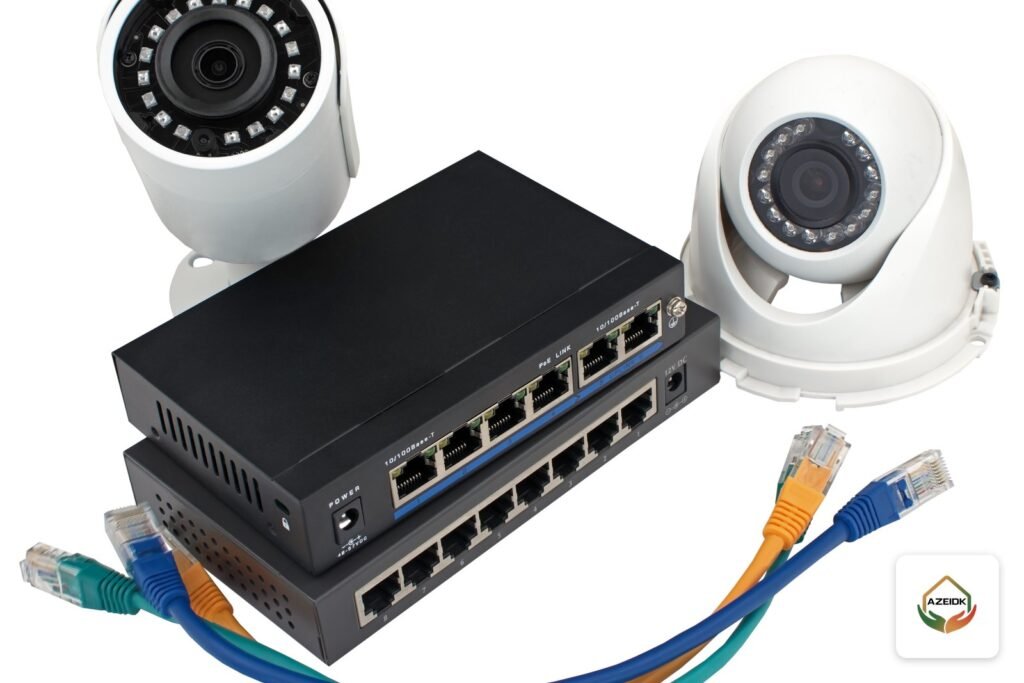
- Device schedule: brand and full model number for every camera, network video recorder (NVR) and switch, with datasheets. “Or equivalent” invites substitution.
- Storage calculation: number of cameras, bit rate, recording hours and required retention period, and the disk capacity that results. The method is in our storage and bandwidth calculation article.
- Network and power layout: cable routes, rack location, PoE power budget for the switches, and the UPS with its required runtime.
- Bill of quantities (BOQ): devices separated from cables, conduits, installation and programming.
A serious company builds these documents on a site survey. The installation steps themselves, from survey to handover, are covered in our CCTV installation guide.
Licences and legal obligations: who carries what?
The security surveillance camera law and its executive regulation (published in Umm Al-Qura on 20/11/1444H, 9 June 2023) place obligations on the facility, and some of them can only be met through the installer’s work. The table splits these obligations in practical terms and suggests contract wording. The full legal detail is in our article on the Security Surveillance Cameras Use Law.
| Obligation | Reference | What to ask the company for in the contract |
|---|---|---|
| Ministry of Interior approvals for the business of selling, installing, operating and maintaining the cameras | Law, Article 5 | Evidence that the company works under the required approval, and a statement accepting liability if it does not |
| Coverage of mandatory locations (facility entrances, emergency exit doors, car park entrances and exits, and others) | Regulation, Article 2 | A coverage plan that states the mandatory locations for your activity are covered |
| Certificate confirming installation requirements are met; without it the activity licence is not issued or renewed | Regulation, Article 4 | A commitment to prepare everything technically needed for the certificate, and to correct any finding at no extra cost |
| Keeping recordings for the period set in the requirements document | Law, Article 4; Regulation, Articles 6 and 10 | A storage calculation covering the full period, with a practical test at acceptance |
| No audio recording or thermal cameras without approval; privacy masking in defined cases | Regulation, Article 8 (paragraphs 3 to 5) | Audio disabled by default, privacy masks set where required, both recorded in the acceptance report |
| Warning signs at entrances and exits | Regulation, Article 8 (paragraph 6) | Who supplies and installs them within the scope of work |
To size the risk: Okaz and Ajel reported in October 2022 that the fines include SAR 500 per camera that does not meet the specifications, SAR 1,000 per camera not installed according to the requirements document, SAR 5,000 for failing to keep recordings, and SAR 20,000 for transferring, publishing or destroying recordings. Ajel added SAR 1,000 per breach of the warning sign requirement and SAR 10,000 for installing cameras in prohibited places. A single wrongly specified camera at an entrance can cost the facility more than the price gap between two quotations.
Many activities have extra requirements from their own licensing authority, so ask for a design based on your specific activity.
Warranty: separate the device warranty from the installation warranty
A common dispute after handover comes from the word “warranty” with no detail behind it. There are two different warranties.
Manufacturer’s warranty on devices
Issued by the manufacturer or its agent, it covers manufacturing defects in the camera, recorder and switch. Its length varies by brand, product line and the channel the device came through. Ask the contract to state each device category’s manufacturer warranty, a serial number list, and an authorised supply channel. Hard disks often carry a separate warranty, so ask about them by name.
The company’s warranty on installation and programming
This covers cabling quality, terminations, camera mounting, and recording and network settings. The company sets it, and the contract should state its length, its start (signed acceptance, not delivery) and who pays for labour and parts.
Add a replacement-time clause. Agree a maximum number of days a failed camera can stay down, or a temporary replacement.
Handover: acceptance criteria and the project file
“The cameras work” is not an acceptance criterion. Write into the contract that acceptance follows:
- A day and night image check of every camera against the purpose set in the coverage plan.
- Recording, search, playback and clip export tested, with available capacity confirmed against the required retention period.
- Default passwords changed, user accounts created with defined permissions, and time and date synchronised.
- Audio confirmed disabled and privacy masks set where required.
Then the project file is handed over: as-built drawings, the IP address schedule, datasheets, the signed test record, and the administrator password to the owner in a sealed envelope. The main recorder and app account should be in the facility’s name. More on this stage in our documentation and final handover service.
Tie payments to milestones: supply against matching models, signed acceptance, and a retention until the installation warranty ends.
CCTV maintenance contract after handover
The regulation requires the facility to report camera faults promptly through the Public Security electronic platform (Regulation, Article 3), so a fault is no longer an internal matter. A CCTV maintenance contract should define:
- The number of preventive visits per year and what each visit checks (image, recording, disk health, capacity, firmware).
- Response time to an emergency call in hours, and repair time.
- Which spare parts are included and which are charged separately.
- A written report after every visit, kept by the owner.
The periodic inspection is covered in detail in our CCTV and security systems maintenance article, and cameras can be added to annual maintenance contracts together with fire systems under one agreement.
Common contracting mistakes
- Accepting a quotation without models: a lower-grade device arrives and you have nothing to object with.
- Leaving retention without a number: storage is sized for fewer days than required, and the gap shows at the first request for footage.
- Merging both warranties into one line: you end up paying the technician because “the manufacturer warranty covers the device only”.
- Handover without passwords: the facility depends on the installer for every change.
- Paying in full before acceptance: there is no incentive left to close the snag list.
- Skipping maintenance: a hard disk stops recording for weeks and nobody notices.
What drives system price, and how to compare quotations line by line, is in our CCTV system cost article.
Frequently asked questions
Do I need a licence to install CCTV in a shop?
The executive regulation bars licensing bodies from issuing or renewing an activity licence without a certificate from Public Security confirming the camera installation requirements are met.
What is the fine for not installing CCTV cameras?
According to Okaz and Ajel, the fine is SAR 1,000 per camera not installed according to the requirements document, and SAR 500 per camera that does not meet the specifications.
How long must CCTV recordings be kept?
The period is set by the requirements and specifications document approved with the regulation. After an incident is reported, recordings are kept until the investigation ends or the set period expires, whichever is longer.
Do shops inside malls need external cameras?
No. The regulation exempts shops inside enclosed malls and offices inside office buildings from the external camera requirement.
Can CCTV cameras record audio?
Audio recording may not be enabled without approval from Public Security. Ask the installer to disable it by default and record this at acceptance.
Can cameras be installed in fitting rooms or restrooms?
No. The law prohibits installation in changing rooms, restrooms, medical examination rooms and other places, and Ajel reported a fine of SAR 10,000 per violation.
Hikvision or Dahua: which is better?
Each brand has several product lines, so choose the right model for each location rather than the name, and make sure the model is written into the contract. We compare them in our Hikvision vs Dahua article.
Conclusion
The right company is the one that accepts its obligations in writing: a design with models and a storage calculation, clear responsibility for the legal requirements, two separate warranties, acceptance against criteria, and maintenance with a response time. AZEIDK holds ISO 9001, ISO 14001 and ISO 45001 certificates with a scope that covers the design, supply, installation and maintenance of CCTV and access control, and you can ask for these same clauses in any quotation we send you.
Have a CCTV quotation and want its terms reviewed before signing? Send the site plan and type of activity, and we will prepare a design, supply and installation offer with models, a storage calculation, and written warranty and maintenance terms. Talk to the AZEIDK team
Related guides
- Clean Agent Fire Suppression for Equipment Rooms in Saudi Arabia
- CCTV Cameras for Hospitals and Medical Complexes: Emergency, Pharmacy, Entrances and Patient Privacy
- Fire Pump Flow Testing to NFPA 25 with a GVI Test Meter in Saudi Arabia
- 4K CCTV Cameras (8 MP): When Higher Resolution Pays Off, and the NVR, Hard Drive and Monitor It Needs