The NFPA 704 diamond, widely searched as the nfpa diamond, is the coloured diamond sign you see on warehouse doors and chemical tanks. In four coloured squares it sums up a material’s health hazard, flammability, instability and any special hazard such as water reactivity, rated from 0 to 4, so emergency responders can read it in seconds before they enter.
This article explains what each colour, number and symbol means, who assigns the ratings, where the sign goes in a facility, and how the same information feeds Civil Defense requirements and the choice of fire protection for a store. If your facility stores hazardous materials and is preparing for a licence or inspection, AZEIDK’s Civil Defense approval support starts by listing those requirements for your type of activity.
Key takeaways
- The diamond is part of NFPA 704, the standard for identifying the hazards of materials for emergency response. The latest edition is the 2027 edition.
- Blue for health on the left, red for flammability at the top, yellow for instability on the right, white for special hazards at the bottom.
- Ratings run from 0 (minimal) to 4 (severe), the opposite direction to GHS categories on a Safety Data Sheet.
- Only three symbols are authorised in the white quadrant: W, OX and SA.
- NFPA 704 does not itself require the sign. The requirement comes from the code or authority that adopts it.
In this article
- What is the nfpa diamond?
- NFPA meaning: the four colours and where each sits
- What do the numbers 0 to 4 mean?
- White quadrant symbols: W, OX and SA
- Who assigns NFPA 704 ratings to a material?
- Where should the NFPA hazard diamond go in a facility?
- Is the NFPA 704 diamond mandatory in Saudi Arabia?
- From the diamond to the right fire protection for the store
- Common mistakes with the diamond
- Frequently asked questions
- Summary
What is the nfpa diamond?
NFPA 704 is the National Fire Protection Association’s Standard System for the Identification of the Hazards of Materials for Emergency Response. According to NFPA’s own quick card, its purpose is to give responders basic hazard information in a fire or spill, to help those planning emergency response, and to inform workers about chemical hazards under normal use and foreseeable emergencies.
The diamond does not name the material or the quantity. It is a quick read of hazard severity at that location, so a firefighter outside can decide whether to enter, with what protective equipment, and whether water is safe to use. For that reason the standard covers acute, short-term health hazards only. Chronic hazards such as carcinogens are left to workplace hazard communication systems.
The 2027 edition of NFPA 704 was issued in 2026 and replaces the 2022 edition. Published changes include new definitions for battery energy storage systems and lithium-based batteries, and alignment of the 1A and 1B flammable gas categories with NFPA 1. For what is and is not binding in the Kingdom, see our guide to NFPA standards in Saudi Arabia.
NFPA meaning: the four colours and where each sits
The diamond is made of four smaller squares, each with a fixed colour and position:
| Colour | Position | Hazard | What goes in it |
|---|---|---|---|
| Blue | Left (9 o’clock) | Health | Rating 0 to 4 |
| Red | Top (12 o’clock) | Flammability | Rating 0 to 4 |
| Yellow | Right (3 o’clock) | Instability (shown as Reactivity on older signs) | Rating 0 to 4 |
| White | Bottom (6 o’clock) | Special hazards | W, OX or SA, or left blank |
Flammability and instability get separate numbers because a material can be hard to ignite yet decompose violently when heated, or the other way round.
What do the numbers 0 to 4 mean?
The number expresses hazard severity under emergency conditions: 0 is minimal and 4 is severe. The table gives a simplified practical meaning for each level. The detailed criteria are in the standard’s own tables.
| Rating | Health (blue) | Flammability (red) | Instability (yellow) |
|---|---|---|---|
| 4 | Very short exposure can be lethal | Gases or liquids that vaporise rapidly at normal conditions and burn readily (liquids with a flash point below about 23°C and a boiling point below about 38°C) | Readily capable of detonation or violent decomposition at normal temperature and pressure |
| 3 | Short exposure can cause serious or permanent injury | Liquids and solids that ignite under almost all ambient temperatures (flash point below about 38°C) | Capable of detonation with a strong ignition source or heating under confinement |
| 2 | Intense or continued exposure can cause temporary incapacity or injury | Must be moderately heated or exposed to high ambient temperature to ignite (flash point below about 93°C) | Undergoes violent chemical change at elevated temperature and pressure |
| 1 | Irritation or minor injury | Must be preheated considerably before ignition | Normally stable, may become unstable at elevated temperature and pressure |
| 0 | No significant health hazard under fire conditions | Will not burn under normal conditions | Stable even when exposed to fire |
Reading example: 3 in blue, 3 in red and 0 in yellow means a toxic material that calls for breathing apparatus for the entry team, ignites readily at normal summer temperatures, but is not prone to self-reaction.
White quadrant symbols: W, OX and SA
NFPA’s FAQ, prepared by its technical staff, states that only three symbols are authorised in the special hazards quadrant:
- W with a line through it: the material reacts unusually or violently with water. This is the single most important symbol for firefighters and for the system designer.
- OX: an oxidiser, which intensifies burning by supplying oxygen.
- SA: a simple asphyxiant gas that displaces oxygen, limited to nitrogen, helium, neon, argon, krypton and xenon.
Markings such as “COR” or “ACID” inside the white square are not part of the standard, because corrosive and acid hazards are already reflected in the blue health rating.
Who assigns NFPA 704 ratings to a material?
The standard sets criteria but does not give ready-made ratings for each chemical. NFPA’s FAQ says the evaluation should be done by a technically competent, experienced person, and the user remains responsible for the final rating.
The practical source is the material’s Safety Data Sheet (SDS): health from Section 11, flammability from Section 9, instability from Section 10, and special hazards from Sections 9, 10 and 11. NFPA warns against copying the hazard category numbers in Section 2 of the SDS into the diamond. GHS numbers categories from 1 (most severe) upwards, the reverse of NFPA 704, so a Category 1 on the SDS may correspond to a 4 on the diamond. Copying it across can mislead responders.
Where a room or area holds several materials, the standard offers more than one rating method. One is the composite rating, which shows the highest rating present for each colour instead of a separate diamond for every product. Agree the method with the authority.
Where should the NFPA hazard diamond go in a facility?
The standard does not fix a single location for every case. Placement is decided with the authority having jurisdiction. NFPA’s FAQ does give a practical minimum:
- On at least two exterior walls of the building or facility, visible from the access routes.
- At each access to a room or area where hazardous materials are stored.
- At each principal access to an exterior storage area.
The size of the sign depends on the distance from which the ratings must be legible, and the standard has a dedicated chapter on it. On site the rule is simple: responders must be able to read it from where they arrive, before they get close to the hazard.
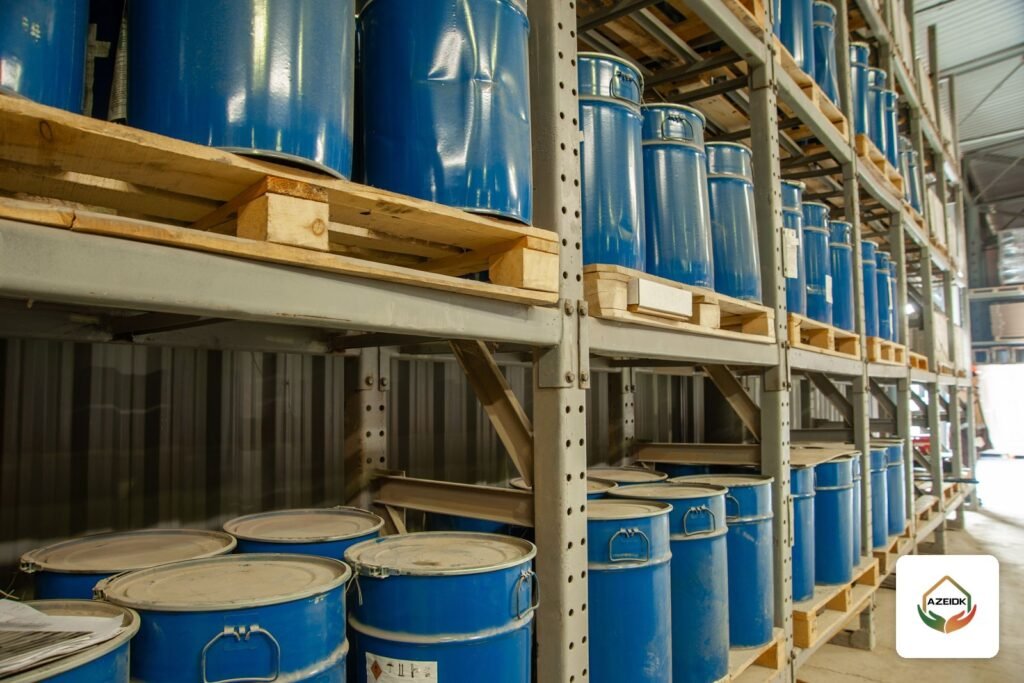
In Saudi warehouses and factories the diamond is typically needed at solvent and paint stores, compressed gas stores, cleaning chemical and chlorine rooms, and industrial chemical warehouses. See AZEIDK’s pages for warehouses and logistics and industrial facilities.
Is the NFPA 704 diamond mandatory in Saudi Arabia?
NFPA 704 does not mandate the sign by itself. NFPA’s FAQ states that the signs are required when another regulation, code or local authority requires them. In codes based on the International Fire Code (IFC) family, for example, the hazardous materials chapter refers to NFPA 704 for hazard identification signs on stationary containers, above-ground tanks and entrances to storage locations above permit quantities.
In the Kingdom, the Saudi Fire Code SBC 801 includes a hazardous materials chapter, and the General Directorate of Civil Defense applies its requirements during licensing and inspection. Whether your particular facility must display the diamond, at what size and where, depends on the materials, their quantities and the occupancy. Confirm it with your design consultant or directly with Civil Defense rather than assuming. For warehouse licensing in general, see Salamah licence for warehouses.
From the diamond to the right fire protection for the store
The diamond is more than a warning sign. It summarises what the fire protection designer needs to know about the store:
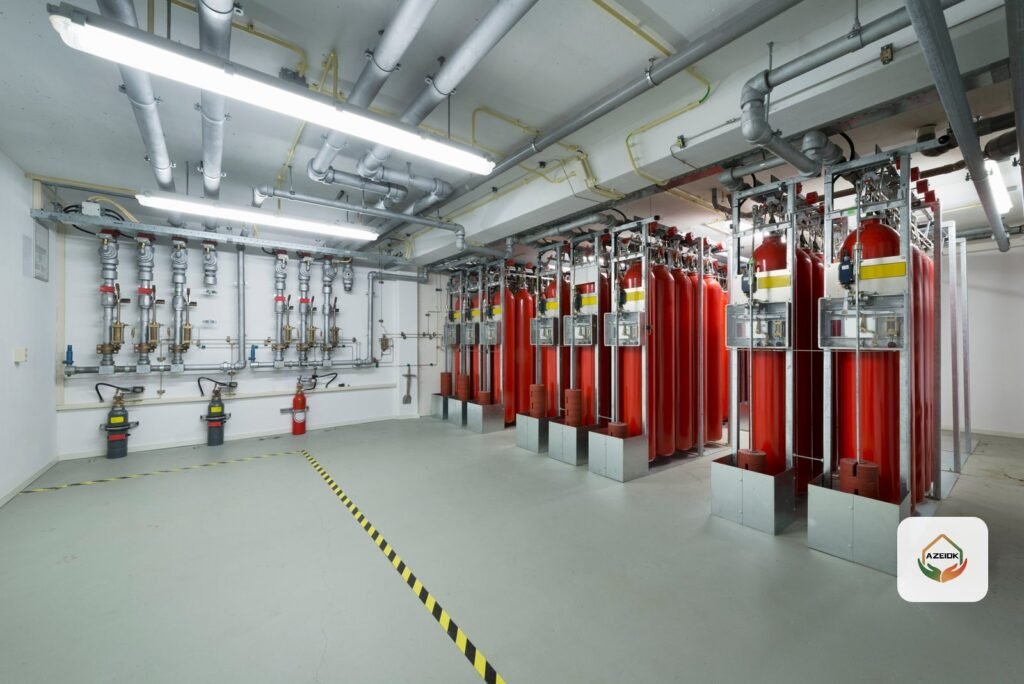
- Red 3 or 4: highly flammable liquids or gases. The store may need foam or a special hazard system rather than standard sprinklers alone.
- W symbol: water may make things worse, so choosing a water-based system here is an engineering decision to review carefully with the consultant.
- OX symbol: oxidisers call for separation from combustibles and can affect the choice of extinguishing agent.
- High blue rating: affects alarm design, ventilation and the evacuation plan, because manual firefighting entry becomes limited.
AZEIDK provides special fire suppression systems, including gas, clean agent, aerosol and foam systems for industrial areas and high-risk warehouses. The choice between them starts with the data on the stored materials, the same data the diamond is built on.
Common mistakes with the diamond
- Copying GHS category numbers from SDS Section 2 straight onto the diamond.
- Fixing an off-the-shelf “warehouse” diamond without assessing the materials actually stored.
- Not updating the sign after the stored materials or quantities change.
- Adding unauthorised symbols inside the white quadrant.
- Placing the diamond only inside the store, where responders cannot see it before entering.
- A sign too small to read from the actual approach distance.
Frequently asked questions
What does the nfpa diamond mean?
It is the hazard identification diamond from NFPA 704. Four colours show a material’s health, flammability, instability and special hazards, rated from 0 to 4 so responders can read them quickly.
Is 4 the most dangerous rating, or 1?
On the NFPA 704 diamond, 4 is the most severe and 0 the least. On GHS categories in a Safety Data Sheet, Category 1 is the most severe, which is why those numbers are not copied onto the diamond.
What does W mean in the white square?
It means the material reacts unusually or violently with water, so water should not be used on it without a technical assessment.
What is the latest edition of NFPA 704?
The latest is the 2027 edition, issued in 2026 to replace the 2022 edition.
Where should I put the hazard diamond in a warehouse?
At minimum on two exterior walls and at each access to a room or area storing hazardous materials, following any location and size requirements from the authority.
Does AZEIDK sell NFPA 704 signs?
No. AZEIDK does not sell these signs. Its role is Civil Defense requirements support for the facility and the design and supply of alarm and suppression systems suited to the stored materials.
Summary
The NFPA 704 diamond is a short language between a facility and its emergency responders: four colours, ratings from 0 to 4 and three special symbols. Its value lies in an accurate assessment, a location where it is seen before entry, and updates whenever the materials change. The data behind it is the same data the alarm and suppression designer needs to choose the right protection for the store.
Does your facility store hazardous materials ahead of a licence or inspection? Send us the material list, the Safety Data Sheets and the store layout, and we will help you map the Civil Defense requirements and select a suitable alarm and suppression system. Contact the AZEIDK team
Related guides
- Special Fire Suppression Brands in the Saudi Market: Clean Agent, Aerosol and Kitchen
- Fingerprint Attendance Device Price in Saudi Arabia: What Drives the Cost (Fingerprint or Face, Headcount, Software, Installation) and How to Compare Quotes
- Renewing a Salamah Civil Defense Licence in Saudi Arabia: Licence Types, Renewal Steps and Pre-Inspection Systems
- Attendance Software for Fingerprint Devices: ZKBio Time and Hikvision Software, Reports, Shifts and Payroll Export