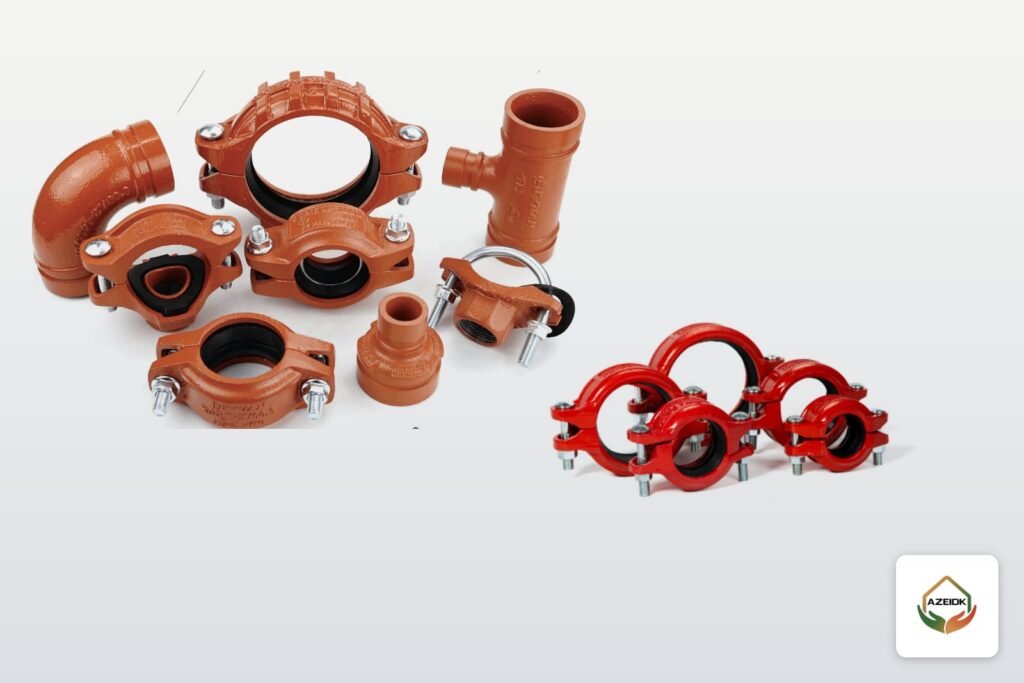
LUYUAN or Ding Liang grooved fittings? AZEIDK supplies both brands in Saudi Arabia, and each offers a full range of grooved fittings for fire networks: rigid and flexible couplings, elbows, tees and reducers, flange adapters, mechanical tees and caps. The difference lies in model naming and in what each catalogue shows for approvals, finishes and pressure data. This article compares them from the product pages on the AZEIDK site and explains when to choose each one.
Both brands are part of the fire fighting systems materials AZEIDK supplies; see the LUYUAN and Ding Liang (DL) brand pages.
Key takeaways
- LUYUAN: ductile iron, clearly numbered models (XGQT1 rigid, XGQT2 flexible, XGQT12 heavy duty flexible) and elbows at 90, 45, 22.5 and 11.25 degrees.
- Ding Liang: catalogue tables show rigid and flexible coupling sizes rated 300 PSI (about 20.7 bar) with FM and UL references.
- Approvals stated: LUYUAN says most products are listed or approved by UL, FM, CE, KC and LR; Ding Liang shows FM, UL, cULus and ISO 9001.
- Finish: LUYUAN galvanized or coated; Ding Liang painted, galvanized or epoxy powder-coated in red, grey or orange.
- With both brands, verify the approval of the exact model, size, pipe type and groove.
Range compared
| Part | LUYUAN | Ding Liang (DL) |
|---|---|---|
| Couplings | Rigid XGQT1, flexible XGQT2, reducing flexible XGQT5, angle pad rigid XGQT6, heavy duty flexible XGQT12, shouldered flexible | Rigid, flexible, standard and reducing, with heavy duty configurations in the range |
| Elbows | 90° XGQT01, 45° XGQT02, 22.5° XGQT16, 11.25° XGQT10 | 90° and 45°, plus other angles per the catalogue |
| Tees and crosses | Tee XGQT03, grooved reducing tee XGQT13, threaded XGQT13S, cross XGQT14, reducing cross XGQT15 | Equal, reducing, grooved and threaded-outlet tees; crosses and reducing crosses |
| Mechanical tees | Grooved outlet XGQT3, threaded outlet XGQT3S, U-bolt XGQT3U | Grooved outlet, threaded outlet or U-bolt |
| Reducers | Grooved concentric XGQT07, threaded XGQT07S, eccentric XGQT17 | Concentric, eccentric, grooved and threaded-outlet |
| Flanges | Grooved flange XGQT8 and adaptor flange XGQT08 | Flange adapters XGQT10 and XGQT10A Class 150 |
| Gasket | Per model | Grade E EPDM in the FM documentation for selected couplings |
Sources: the LUYUAN fittings and Ding Liang fittings pages. LUYUAN models are covered in detail in LUYUAN ductile iron grooved fittings.
Approvals and compatible pipe
LUYUAN states ISO 9001:2015, ISO 14001:2015 and ISO 45001:2018 certification, and that most products are listed or approved by UL, FM, CE, KC and LR, noting that not every model, size and finish carries the same approval. Ding Liang’s catalogue certification pages show FM Approved, UL Listed, cULus Listed and ISO 9001, and its approval tables refer to Schedule 40 cut-groove pipe, Schedule 10 rolled-groove pipe and thin-wall and light-wall pipe.
The practical rule for both brands: read the approval for the model, size, pipe type, groove type, pressure, gasket and finish together, not for the brand in general. Grooving and assembly are covered in grooved coupling installation.
When to choose LUYUAN or Ding Liang
- LUYUAN suits projects that need precise model numbers on drawings and BOQs, small-angle elbows such as 22.5 and 11.25 degrees to clear obstructions, or an eccentric reducer.
- Ding Liang suits specifications that ask for 300 PSI ratings documented in approval tables, an epoxy coating in a specific colour, or a Class 150 flange adapter.
- With either, do not mix one brand’s coupling with another brand’s groove or gasket without checking the installation instructions.
Common mistakes when supplying grooved fittings
- Using flexible couplings everywhere when the design needs rigid joints where movement must be restrained.
- Ordering without stating the pipe schedule (10 or 40) and groove type.
- Overlooking the finish needed for the installation environment, such as wet or exposed areas.
- Relying on an approval logo in the catalogue instead of an approval document for the model and size.
To connect grooved pipe to valves and pumps see the grooved flange adapter; for the pipe itself see fire pipe types; for small-bore joints see Hitachi vs JIANZHI threaded fittings.
Frequently asked questions
What is the difference between rigid and flexible couplings?
A rigid coupling restrains movement between the pipe ends; a flexible coupling allows angular deflection, expansion and contraction within the limits of the model.
What is the working pressure of Ding Liang couplings?
The catalogue tables show multiple rigid and flexible coupling sizes rated 300 PSI, about 2.07 MPa or 20.7 bar.
What are LUYUAN fittings made of?
Ductile iron, in galvanized or coated finish per the project.
Can both brands be used in one project?
Yes in different parts, provided each joint is complete from one brand and matches its installation instructions and approval.
Summary
LUYUAN is clearer on model numbering and elbow angles; Ding Liang is clearer on 300 PSI tables and coating options. Choose by the approval, finish and pipe type the specification requires, and check the document for each model.
Need grooved fittings for your project? Send the bill of quantities with sizes, pipe type, groove and finish, and the AZEIDK team will prepare the offer in LUYUAN or Ding Liang. Contact AZEIDK
Related guides
- Smoke Detector Base Types: Standard, Isolator, Sounder and Relay Bases with Context Plus Models
- Fire Extinguisher Pressure Gauge: Reading the Green and Red Zones, Pressure in Bar, and Why CO2 Has No Gauge
- Context Plus Fire Alarm Application Guide: Panel Selection, Programming, Commissioning and Maintenance
- Fire and Security Project Certificates in Saudi Arabia: SABER, UL/FM, LPCB and Local Content