No single brand of network switches fits every project in Saudi Arabia. The practical differences between Cisco, Huawei, Ruijie, TP-Link, Alcatel-Lucent Enterprise and UTEPO lie in the management model (unmanaged, smart, managed L2/L3, cloud), PoE budget, stacking, and the team that will run the network after handover.
This article compares the series AZEIDK supplies from these six brands, using facts from each manufacturer’s official datasheets, and maps them to common use cases. For our supply, installation and integration scope, see Network and Communication Systems.
Key takeaways
- Compare series, not logos: each brand has switches for small offices and others for enterprise networks.
- The management platform drives operating cost: a cloud dashboard (Meraki, Ruijie Cloud, Omada or the Huawei eKit app) or local web/CLI management.
- Size the switch’s total PoE budget, not just the per-port figure, especially with cameras and access points.
- Stacking and 10G-plus uplinks matter in multi-floor buildings and aggregation rooms.
- For outdoor cabinets and hot locations, fanless industrial switches offer a wider operating temperature range.
In this article
How do you compare network switch brands?
Before looking at the brand, settle five points. They rule some series out and keep others in:
- Management level: an unmanaged switch simply connects devices. A smart switch adds VLANs and basic settings. Managed L2/L2+ adds full layer-2 control and some static routing. L3 switches run routing protocols such as OSPF and BGP and suit aggregation and core roles.
- PoE: 802.3af/at (PoE+) delivers up to 30 W per port; some series support 802.3bt or UPOE+ for higher power. What matters most is the total PoE budget shared by all ports.
- Uplinks: gigabit SFP for small sites; 10G SFP+ or faster when floors connect back to a main room.
- Stacking: managing several switches in the same rack as one unit.
- Management platform: a cloud dashboard for multiple branches, an on-site controller, or device-by-device management.
Passive infrastructure (cabling, outlets and testing) is covered in our article on structured cabling and network systems, so we do not repeat it here.
What does each brand offer in switches and Wi-Fi?
The products available from each brand are listed on its AZEIDK page: Cisco, Huawei, Ruijie, TP-Link, Alcatel and UTEPO.
Cisco
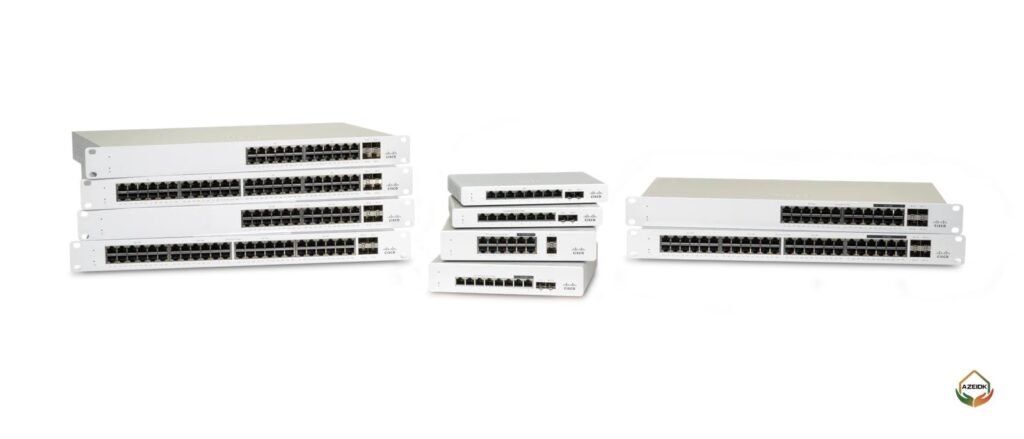
AZEIDK supplies four Cisco switch families. Catalyst 1200 is a smart managed range for small and mid-size sites, 8 to 48 ports, with PoE budgets from 67 W on the 8-port model to 375 W on the 48-port model. Catalyst 1300 is fully managed and stacks up to eight units, with PoE budgets up to 740 W and OSPF on 1300X models only. For enterprise networks there are Catalyst 9200 and Catalyst 9300; the 9300 reaches 90 W per port (UPOE+) and uplinks up to 100G depending on the family.
Meraki MS130 is managed entirely from the Meraki cloud dashboard, and per the official datasheet each switch needs an Enterprise or Advanced licence. On the Wi-Fi side, Catalyst 9166 (Wi-Fi 6E), the outdoor 9163E and Wireless 9176 (Wi-Fi 7) are available.
Huawei
eKit S310 is a managed range for SMEs with 24 or 48 ports, managed locally via web or from the cloud through the Huawei eKit app, with official datasheet PoE budgets of 380 W on the S310-48P4X and 846 W on the S310-48HP4X; other models differ. CloudEngine S5735-L-V2 is a gigabit enterprise access range that keeps PoE running while the switch reboots; XE models stack up to nine switches. For aggregation and core, CloudEngine S6730-H-V2 offers 10GE SFP+ ports, 40/100GE uplinks and a built-in WLAN controller for up to 1,000 access points. Access points include AirEngine Wi-Fi 6 and Wi-Fi 7 models, plus eKit models for smaller sites.
Ruijie
Ruijie’s Reyee line is built around cloud management via Ruijie Cloud and the Reyee app, which Ruijie advertises as free for life. RG-NBS3200 is managed L2+ with 24 or 48 PoE+ ports, four 10G SFP+ uplinks and a 370 W budget on PoE models. RG-ES228GS-P-V2 targets IP cameras: according to Ruijie it recognises connected IP cameras, supports PoE watchdog and keeps PoE running during switch restarts, with a 370 W budget. For enterprises, RG-S5310-E is an L3 access range with OSPF, BGP and stacking of up to eight units. Access points cover Wi-Fi 6 and Wi-Fi 7 for ceilings, walls and outdoors.
TP-Link (Omada)
The TP-Link switches supplied belong to the Omada SDN platform, which brings switches, access points and gateways under one central management. SG2210MP has eight PoE+ ports and a 150 W budget for small sites; SG3428MP has 24 PoE+ ports, a 384 W budget and L2/L2+ features. SG3428MP runs standalone (web, CLI) or with an Omada hardware, cloud-based or software controller. The OC200 or OC300 hardware controller removes the need for a dedicated management PC. Access points include the EAP670, EAP615-Wall and EAP650-Outdoor, all Wi-Fi 6.
Alcatel-Lucent Enterprise
OmniSwitch 6360 is a stackable gigabit access range (up to eight units as one virtual chassis), including small fanless models for installation near users, with PoE budgets up to 760 W on the larger models. OmniSwitch 6560 is an L3 access range with gigabit and multi-gigabit (2.5G/5G) ports and IEEE 802.3bt high-power PoE. For Wi-Fi, OmniAccess Stellar access points are available in indoor and outdoor Wi-Fi 6 and in Wi-Fi 7.
UTEPO
UTEPO focuses on PoE switches for surveillance and harsh environments. UTP3318S-PSB250-M0 is unmanaged with 16 PoE+ ports and a 230 W budget; DIP switches select default, QoS, CCTV or VLAN modes. Managed L2 models come in 8 and 24 ports, and the L3 UTP5628S-PSB-L3 has a 370 W budget, four 10G SFP+ uplinks and RIP, OSPF and BGP. UTP7308GE-POE is a fanless DIN-rail industrial switch rated for -40 to 75 °C. No UTEPO access points are among the products listed.
Network switch comparison by available series
| Brand | Switch series available | Management | Example PoE budgets (datasheet) | Wi-Fi access points available |
|---|---|---|---|---|
| Cisco | Catalyst 1200, 1300, 9200, 9300; Meraki MS130 | Smart, managed, stackable enterprise, and cloud (Meraki, licensed) | Catalyst 1300: up to 740 W. MS130-48P: 740 W | Wi-Fi 6E, Wi-Fi 7, outdoor |
| Huawei | eKit S310, CloudEngine S5735-L-V2, S6730-H-V2 | Local web or cloud via eKit app; enterprise L3 | eKit S310: 380 W (S310-48P4X), 846 W (S310-48HP4X) | Wi-Fi 6, Wi-Fi 7, outdoor |
| Ruijie | Reyee RG-NBS3200, RG-ES228GS-P-V2, RG-S5310-E | Cloud via Ruijie Cloud; enterprise L3 | NBS3200 and ES228GS: 370 W | Wi-Fi 6, Wi-Fi 7, outdoor |
| TP-Link | Omada SG2210MP, SG3428MP | Standalone or central via Omada SDN (hardware or cloud controller) | 150 W and 384 W | Wi-Fi 6 ceiling, wall, outdoor |
| Alcatel-Lucent Enterprise | OmniSwitch 6360, 6560 | Managed stackable; 6560 is L3 | OmniSwitch 6360: up to 760 W | Wi-Fi 6, Wi-Fi 7 |
| UTEPO | Unmanaged, managed L2 and L3, industrial DIN-rail | From DIP-switch unmanaged to L3 | UTP3318S: 230 W. UTP5628S: 370 W | None listed |
Figures are examples for specific models, not a performance ranking. Actual budgets vary within each series by model and power supply.
Which switch brand suits your project?
There is no fixed ranking; the choice follows the project and who will run the network. Common cases and the series whose features match them:
- Office, clinic or shop with few devices: a small smart switch with enough PoE for a few cameras and access points, such as TP-Link SG2210MP, Cisco Catalyst 1200 or Huawei eKit S310.
- Branch chain without IT staff at each site: cloud platforms reduce site visits, such as Meraki MS130, Ruijie Reyee or TP-Link Omada. Note that Meraki needs a valid licence for each device.
- Multi-floor office building or campus: stackable access switches with 10G uplinks, then an L3 aggregation switch in the main room, such as Cisco Catalyst 9200/9300, Huawei CloudEngine, Ruijie RG-S5310-E or Alcatel-Lucent OmniSwitch.
- IP CCTV network: total PoE budget and features such as PoE during reboot matter most, as in Ruijie RG-ES228GS-P-V2 and UTEPO switches. Power, port and distance sizing is covered in PoE switches for CCTV with Hikvision models.
- Outdoor cabinets, car parks and perimeters: a fanless industrial switch such as UTEPO UTP7308GE-POE, noting it runs on 48–57 V DC.
- Hotels and schools with wide Wi-Fi coverage: where possible, pick switches and access points from the same ecosystem so they are managed from one platform.
If the project also needs cameras and access control, see CCTV and access control brands in the Saudi market.
Should switches and Wi-Fi access points come from the same brand?
It is not a technical requirement: the switch connects and powers the access point over Ethernet and PoE regardless of brand. A single ecosystem does simplify operation: TP-Link Omada, Ruijie Reyee, Cisco Meraki and Huawei eKit show switches and access points in one dashboard, and the Huawei S6730-H-V2 has a built-in WLAN controller.
When mixing brands, check three things: that per-port PoE meets the access point’s needs (the Cisco Wireless 9176 datasheet lists 802.3bt up to 39 W for full performance, while the Huawei AirEngine 5776-26 runs on PoE+); that port speed matches the access point (the Wireless 9176 has a multigigabit port up to 10G, the AirEngine 5776-26 a 2.5GE port); and who will manage each platform.
Common mistakes when choosing network switches
- Specifying by brand only: writing “Cisco” or “Huawei” in the BOQ without series and model invites offers that cannot be compared.
- Sizing PoE by port count: 24 PoE+ ports do not mean 24 × 30 W. The total budget is the real limit.
- Ignoring licence and subscription costs: some cloud platforms need a time-limited licence per device; others are free according to the manufacturer. Ask before comparing prices.
- An unmanaged switch where systems must be separated: isolating cameras from the user network needs VLANs, which unmanaged switches offer only in limited, manufacturer-defined modes.
- Neglecting uplinks and growth: gigabit-only uplinks can become a bottleneck when a whole floor connects through them.
- Putting an office switch in an outdoor cabinet: the datasheet operating temperature range decides where a switch can go.
How to choose the installer and what to ask for in the offer is covered in network installation for offices in Saudi Arabia.
FAQ
What is the difference between managed and unmanaged switches?
An unmanaged switch connects devices with no configuration. A managed switch adds VLANs, port monitoring and traffic control; L3 switches also route between networks.
What is the best network switch brand in Saudi Arabia?
There is no single answer. The right choice depends on project size, management model, PoE needs and the operating team, and each brand has series for different levels.
Is cloud switch management free?
It depends on the manufacturer. Cisco Meraki requires a licence per switch, while Ruijie advertises Ruijie Cloud as free for life. Check each platform’s terms at purchase.
How much power does a PoE+ port deliver?
Up to 30 W per port under IEEE 802.3at, provided the combined load stays within the switch’s total budget.
Can AZEIDK supply models not listed on the site?
Yes, on request. Send the required specification or model and we will check availability with the official datasheet.
Conclusion
All six brands offer switches for different levels. The practical differences are the management platform and its licensing, PoE budget, stacking, uplinks and environmental rating. Start from the site’s needs and the operating team, then choose series and model from the official datasheet rather than naming a brand alone.
Comparing switch and Wi-Fi offers for your project? Send us your outlet and camera counts and preferred management model, and we will suggest suitable series from the brands we supply with datasheets, or ask for technical selection of systems and equipment. Contact the AZEIDK team
Related guides
- Addressable Fire Alarm System: How It Works, vs Conventional, and What to Compare Between Manufacturers
- Hikvision or Dahua? Comparing the CCTV Lines AZEIDK Offers in Saudi Arabia
- Fire Pipes: Types, Schedules, Grooved Joints and Delivery Inspection
- AFC NRS Gate Valve with Vertical Indicator Post (PIV): Protecting Underground Fire Main Valves and Reading Open/Shut Above Grade