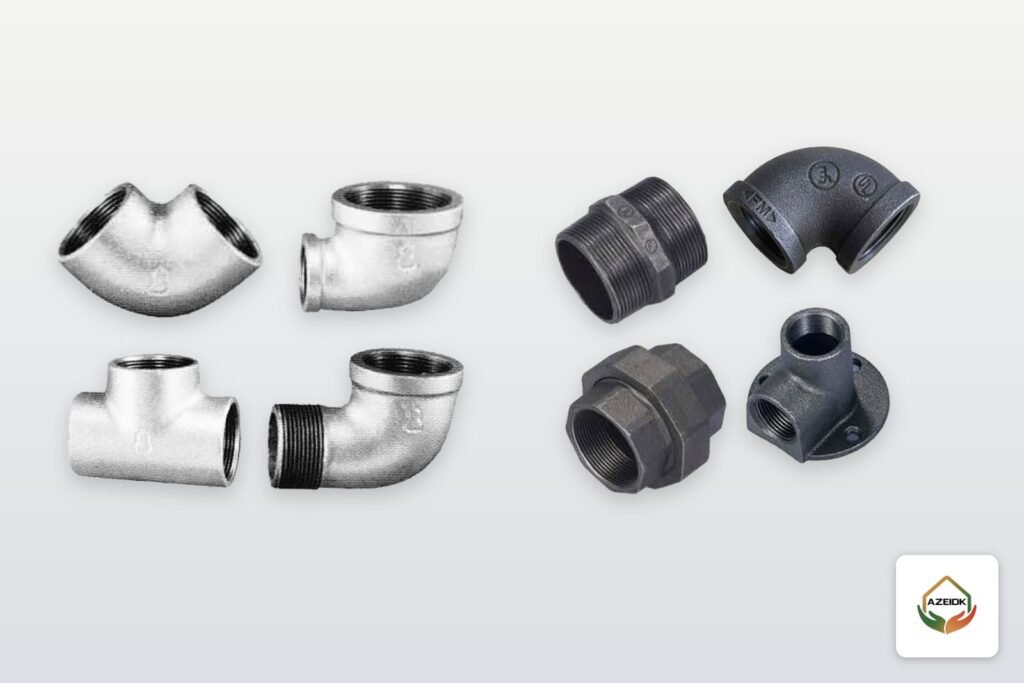
Threaded fittings for fire protection piping: Hitachi or JIANZHI? Malleable iron threaded fittings are the elbows, tees, sockets and nipples that join small-bore pipe in sprinkler branch lines and equipment connections. AZEIDK supplies two brands: Hitachi, under its Gourd Brand, and JIANZHI. This article compares them from the product pages on the AZEIDK site: material, thread standards, finish, pressure, approvals and when to choose each one.
Both brands are part of the fire fighting systems materials AZEIDK provides through its technical supply service.
Key takeaways
- Both brands use blackheart malleable iron, in black or galvanized finish.
- Hitachi: British, American or German threads to JIS B 2301, BS 21, ANSI B1.20.1 and DIN 2999.
- JIANZHI: threads to EN 10226 and ISO 7-1, dimensions to EN 10242 and ISO 49, sizes from 1/8 to 6 inches.
- Working pressure: JIANZHI up to 25 bar (363 PSI) from -20 to 120°C; Hitachi about 300 PSI for non-shock water below 120°C.
- The JIANZHI page lists UL and FM approvals, to be verified per fitting; the Hitachi page does not mention UL or FM approval.
Where threaded fittings are used in a fire network
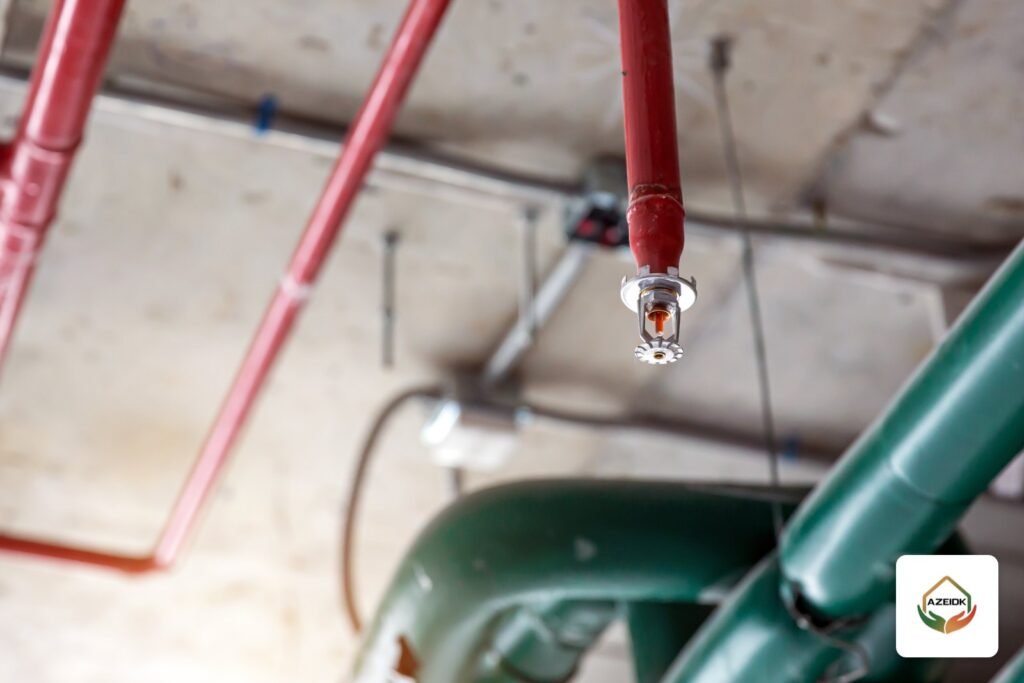
Threaded fittings are mostly used at small sizes: sprinkler branch lines and drops, gauge and switch connections, test and drain valves, and joints around equipment that has to be removed for maintenance. Larger mains are usually joined with grooved couplings; joining methods are compared in fire protection piping and fittings. For a threaded outlet on a grooved pipe there is the threaded-outlet mechanical tee.
Hitachi vs JIANZHI compared
| Item | Hitachi (Gourd Brand) | JIANZHI |
|---|---|---|
| Material | Blackheart malleable iron | Blackheart malleable iron to EN 1562 or ISO 5922; 350 MPa tensile strength, 10% elongation |
| Thread standards | British, American or German: JIS B 2301, BS 21, ANSI B1.20.1, DIN 2999; taper or parallel | EN 10226 and ISO 7-1 |
| Dimension standards | Catalogue tables | EN 10242 and ISO 49 |
| Finish | Black or hot-dip galvanized (dipped in zinc before threading) | Black, hot-dip galvanized (about 70 µm zinc) or electrogalvanized |
| Sizes | From 1/8 inch, up to 10 inches in selected data | 1/8 to 6 inches depending on fitting type |
| Pressure | About 300 PSI for non-shock water below 120°C, 200 PSI below 200°C, 150 PSI below 300°C | Up to 2.5 MPa (25 bar) from -20 to 120°C; about 2.0 MPa at 300°C |
| Approvals stated | No UL or FM approval mentioned on the page | UL, FM, ISO 9001, ISO 14001; verify per fitting and size |
Figures are from the Hitachi fittings and JIANZHI fittings pages. The final allowable pressure depends on fitting type, size, temperature and fluid.
Threads first: why the thread standard matters
The most costly mistake with threaded fittings is mixing thread standards. American NPT (ANSI B1.20.1) does not match British taper BSPT (ISO 7-1 or BS 21) even though the sizes look alike, and a mixed joint can feel tight yet leak under pressure. So the thread standard goes into the bill of quantities, matched to the project pipe and to the sprinkler and valve threads. Hitachi offers all three options; JIANZHI is listed with EN 10226 and ISO 7-1 threads.
When to choose Hitachi or JIANZHI
- Hitachi suits projects that need a specific thread standard (American, British or German) from one source, or special parts such as right- and left-hand thread sockets and ribbed sockets. See the Hitachi page.
- JIANZHI suits specifications that require UL Listed or FM Approved fittings, or a wide range including unions, bushings, nipples, caps and plugs in heavy, medium and light duty types. See the JIANZHI page.
Common mistakes
- Using black, ungalvanized fittings in a wet or exposed location without checking the specification.
- Ordering by size only, without the thread standard and type (taper or parallel).
- Assuming every part from a brand is approved, instead of checking the approval of the exact part and size.
- Over-tightening joints or using a thread sealant not suited to water networks.
For how fitting type affects cost without guide prices, see fire pipe cost factors; for grooved fittings, see LUYUAN vs Ding Liang grooved fittings.
Frequently asked questions
Malleable iron vs ductile iron fittings: what is the difference?
These threaded fittings are blackheart malleable iron, while grooved fittings are usually ductile iron, as with LUYUAN.
Are galvanized fittings better for fire networks?
Galvanizing improves corrosion resistance; the choice between black and galvanized follows the project specification and installation environment.
What is the maximum working pressure of JIANZHI fittings?
Up to 2.5 MPa (25 bar or 363 PSI) from -20 to 120°C per the catalogue.
Are Hitachi fittings UL listed?
The product page does not mention UL or FM approval, so ask for approval documents before ordering if the specification requires them.
Summary
Start with the thread standard, then the approval the specification requires, then the finish. JIANZHI comes with stated UL and FM approvals and a wider range of parts; Hitachi offers three thread standards from one brand.
Need threaded fittings for your project? Send the bill of quantities with sizes, thread standard, finish and required approval, and the AZEIDK team will prepare the offer in Hitachi or JIANZHI. Contact AZEIDK
Related guides
- Automatic Ceiling Fire Extinguishers and CO2 Extinguishers for Electrical and Server Rooms: SFFECO SFM and CD
- Fire Alarm False Alarms: Causes and How to Reduce Them
- Safety and Security Tools for Facilities and Shops in Saudi Arabia: The Essential List and When Each Is Required
- Fire Extinguisher Ball: Does It Replace a Portable Extinguisher Under Civil Defense Rules?