Warehouse smoke detectors in high-bay buildings are usually beam detectors rather than point (spot) detectors. Smoke can cool and stall before it reaches a high roof, and installing and testing dozens of point detectors above tall racking is slow and expensive. The final choice depends on ceiling height and shape, the length and width of the hall, the storage layout and the code the design follows. This guide compares the two options with documented figures and shows where each beam detector model in the AZEIDK fire alarm systems range fits.
Key takeaways
- The 2025 edition of NFPA 72 limits the prescriptive spacing method for spot smoke detectors to ceilings up to 12.2 m (40 ft). Above that, a performance-based design is required.
- General limits in BS 5839-1 (2017 edition): point smoke detectors up to 10.5 m, beam detectors up to 25 m, and up to 40 m under extra conditions.
- The BeamRay RFX70 reflective beam covers a 15 m wide strip (7.5 m each side) over 7 to 70 m, extendable to 160 m with extra reflector kits, according to the manufacturer’s guide.
- The beam needs a clear path 1 m in diameter along its full length. In warehouses with forklifts and tall racking, that is the main design challenge.
- Smoke detection does not replace sprinklers. The sprinkler system is designed separately for the commodity and storage height.
In this article
- Why warehouse smoke detection differs from an office
- Beam vs point warehouse smoke detectors: a direct comparison
- What ceiling height suits a beam smoke detector?
- How is beam detector coverage worked out?
- High-piled storage and racking: where does the beam go?
- Which beam detector model suits your warehouse?
- Common mistakes with warehouse smoke detectors
- What drives the cost of warehouse smoke detection?
- Frequently asked questions
- Conclusion
Why warehouse smoke detection differs from an office
An office ceiling sits around 3 m high and smoke reaches a point detector quickly. A warehouse is different for three practical reasons:
- Height and stratification: smoke cools as it rises and can stall under a hot, high roof before reaching the detectors. In a Saudi summer, the air under an uninsulated metal roof gets very hot, which makes this more likely.
- Floor area: an 80 m by 40 m hall needs a large number of point detectors, and every one of them needs periodic testing at height.
- Maintenance access: testing a point detector 12 m above a racking aisle means a personnel lift and a closed aisle. Beam detectors with a ground-level controller are tested from the floor.
That is why the AZEIDK warehouses and logistics page lists beam detection as a common choice for large open areas, while point detectors remain right for attached offices, electrical rooms and low-ceiling zones.
Beam vs point warehouse smoke detectors: a direct comparison
| Criterion | Point (spot) detector | Beam detector |
|---|---|---|
| Detection principle | Smoke enters a sensing chamber at one point | Smoke weakens an infrared beam along the distance between head and reflector |
| Height limit (BS 5839-1, general) | 10.5 m | 25 m, up to 40 m under conditions |
| Coverage | 7.5 m radius in BS 5839-1, or 9.1 m nominal spacing in NFPA 72 on a smooth ceiling | 15 m wide strip in the RFX70 guide, length set by the model’s range |
| Devices in a large hall | Many, each one a test point | A few heads and reflectors |
| Maintenance at height | A lift for every detector | Tested from floor level on models with a ground-level controller |
| Weak point | Late response under high ceilings | Needs a clear path and rigid mounting that does not move |
| European product standard | EN 54-7 | EN 54-12 |
The BS 5839-1 values are the 2017 edition’s general limits as summarised in Apollo’s guide; they may be exceeded over a limited part of the ceiling area. Check them in the text of the edition adopted for your project. For the other EN 54 parts, see our EN 54 standard guide.
What ceiling height suits a beam smoke detector?
Height is the first question in any high-bay warehouse. The designer works from three references:
- NFPA 72 (2025 edition): the prescriptive spacing method for spot smoke detectors stops at 12.2 m (40 ft); above that a performance-based design is required. Projected beam detectors are located according to the manufacturer’s published instructions.
- BS 5839-1: a general limit of 25 m for beam detectors, raised to 40 m with enhanced sensitivity and supplementary detection at a lower level, unless the risk of stratification is minimal.
- Manufacturer’s guide: the BeamRay RFX70 guide puts the head and reflector 0.3 to 0.6 m below a flat roof, at a maximum of 40 m above the floor.
In Saudi Arabia the Saudi Fire Protection Code SBC 801 applies; its 2024 edition has been mandatory since 30 June 2025, and the General Directorate of Civil Defense monitors it throughout a building’s life. The consultant names the detection standard in the specification, and its values are applied in full. Do not mix NFPA 72 and BS 5839-1 on the same project.
How is beam detector coverage worked out?
The RFX70 guide gives clear starting rules, to be checked against the adopted standard and the authority:
- Coverage width: 7.5 m on each side of the beam, a 15 m strip.
- Pitched roofs: a roof counts as flat unless the apex rises more than 0.6 m. Under a pitched roof, place the beam 0.3 to 0.6 m below the apex. Coverage width may be increased by 1% per degree of pitch; the guide’s example is 16.5 m at 10 degrees.
- Beam path: a clear 1 m diameter along the beam and at least 0.5 m from any protrusion.
- Short distances: below 20 m, fit the short-range mask supplied with the reflector.
A rough example: a 45 m wide hall with a flat roof needs at least three parallel beam lines (3 x 15 m). Line length sets the model. At 90 m, the standard RFX70 (up to 70 m) only works with the mid-range reflector kit, or a longer-range model is chosen. This is a starting point only; the final layout goes through engineering design and calculations to the adopted standard.
High-piled storage and racking: where does the beam go?
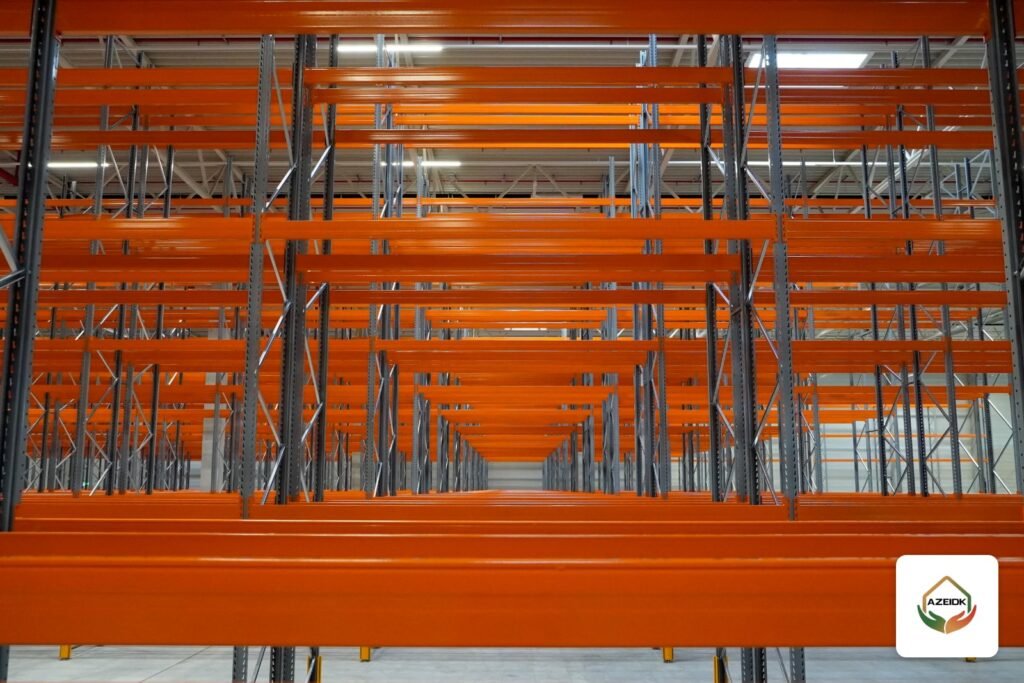
Tall racking changes the picture. The beam normally runs above the highest stored goods and below the roof, but daily operations can break the path:
- Forklifts and raised loads: a sudden total block is reported as a fault, not a fire. Repeated blocks fill the panel log with faults and wear down the operator’s trust in the system.
- Higher storage after handover: an extra rack level or goods stacked above the planned height can enter the beam path, so beam positions should be reviewed with every storage change.
- Structural movement: the guide calls for fixing the head to brickwork or main structural steel, not to thin outer cladding that moves as the sun heats it.
- Condensation: for warehouses open to the outside or exposed to fast temperature swings, the manufacturer offers an anti-fog kit for the reflector and lens.
- Direct sunlight: keep direct sun off the head’s lens, especially near roof lights and translucent panels.
Low-ceiling zones such as mezzanines and goods-in offices need their own point detectors. A beam under the main roof cannot see smoke trapped under a mezzanine deck.
Which beam detector model suits your warehouse?
AZEIDK supplies three Context Plus models, all reflective beams: transmitter and receiver share one head, and the far end is a reflector with no cabling.
| Model | Type | Range | Datasheet notes |
|---|---|---|---|
| BeamRay RFX70 | Conventional | 7 to 70 m, up to 160 m with reflector kits | Motorised auto-alignment, EN 54-12:2015, VdS approved |
| SA7100-100 | Addressable | Up to 100 m | Auto-aligning, automatic gain control, loop-powered with short-circuit isolator, ground-level controller, EN 54-12 and EN 54-17 certified |
| 55000-268 and 55000-273 | Addressable | 5 to 50 m, and 50 to 100 m | Loop-powered, built-in isolator, drift compensation, automatic reset |
Rule of thumb: with an addressable panel, choose an addressable beam so its address shows on the panel. Loop-powered detectors add to loop and battery loads, so see addressable loop design and fire alarm battery calculation.
Common mistakes with warehouse smoke detectors
- Fitting point detectors under a 14 m roof because they cost less to supply, then finding they are hard to test once the warehouse is running.
- Fixing a beam head or reflector to cladding panels, so it drifts out of alignment as the metal expands at midday and reports repeated faults.
- Laying out beams on an empty drawing without the racking heights and forklift routes.
- Forgetting mezzanines, internal offices and forklift charging rooms.
- Not moving detectors when the storage layout changes or racks are added.
- Using the RFX70 guide’s values for another model. Each model has its own limits in its own guide.
Many unwanted alarms in warehouses come from dust and vehicle exhaust; see false alarm causes. In very hot or dusty areas a heat detector may be the right choice, as covered in our heat detector guide.
What drives the cost of warehouse smoke detection?
There is no fixed price without drawings, but these factors move the cost:
- Hall area and width, which set the number of beam lines.
- The length of each line and any long-range reflector kits.
- Panel type: conventional or addressable.
- Working height and access equipment (personnel lift or scaffold) for installation and maintenance.
- The number of low-ceiling zones that need extra point detectors.
- The scope of periodic maintenance after handover.
Frequently asked questions
What is the best smoke detector type for a high-ceiling warehouse?
Open high-bay halls usually use beam detectors, because one unit covers a strip about 15 m wide and some models are tested from floor level. The final choice depends on height, the adopted standard and the storage layout.
Can a point smoke detector go on a 15 m ceiling?
The BS 5839-1 general limit for point smoke detectors is 10.5 m, and the NFPA 72 (2025) prescriptive spacing method stops at 12.2 m. Above that you need a performance-based design or another detection type such as beam.
How much area does a beam smoke detector cover?
In the RFX70 guide the beam covers 7.5 m each side, 15 m in total, over up to 70 m with the standard kit. A 70 m by 15 m strip is about 1,050 m² under a flat roof.
Why does a beam detector keep going into fault in a warehouse?
The usual causes are forklifts or goods blocking the path, a head fixed to cladding that moves with heat, condensation on the reflector, or direct sun on the lens.
Does a fire alarm system for a warehouse replace sprinklers?
No. The alarm detects and warns; sprinklers control or suppress the fire. Each has its own design, and the fire code and consultant set what is needed for the commodity and storage height.
What is the difference between a reflective and a projected beam smoke detector?
A projected (end-to-end) beam has the transmitter at one end and the receiver at the other, both wired. A reflective beam combines transmitter and receiver in one head with an unwired reflector opposite. All three models AZEIDK supplies are reflective.
Conclusion
Choosing warehouse smoke detectors starts with height and then the beam path. Under high roofs, beam detection is usually the practical answer, provided the heads are fixed to rigid structure, positions are planned against the racking and forklift routes, and low-ceiling zones get point detectors. Fix the adopted standard early, then pick the model that suits the panel type and hall length.
Planning smoke detection for a high-bay warehouse? Send the hall layout, roof height and racking plan, and the AZEIDK team will propose detector positions and the right model. Talk to the AZEIDK team