An FM-200 liquid level indicator is a manual device that measures the height of liquefied HFC-227ea inside a cylinder while it stays in place; the technician then converts the reading to weight using a chart from the manufacturer’s manual. Its main benefit is that large cylinders no longer have to be disconnected and lifted onto a scale at every periodic inspection. One example is the Context Plus CP60020 series for vertically mounted cylinders from 150 to 1,200 lb.
Key takeaways
- Liquid level indicators are used with liquefied agents such as HFC-227ea (FM-200), because the agent is stored as a liquid with a measurable level.
- The Context Plus CP60020 series suits vertical cylinders of 150/250, 375/560 and 1,200 lb.
- Readings are accurate from +40 °F to +90 °F (about 4 °C to 32 °C) and are converted to weight with the chart in the manufacturer’s Engineered Manual.
- US federal rule OSHA 1910.160 is one example of an inspection rule: weight and pressure of refillable containers checked at least semi-annually, with maintenance where weight loss exceeds 5% or pressure loss exceeds 10%.
- In Saudi Arabia inspection follows the NFPA 2001 edition adopted on the project and the manufacturer’s manual.
In this article
- What is a liquid level indicator on an FM-200 cylinder?
- Why does an FM-200 system need quantity checks?
- Weighing on a scale or a level indicator?
- Context Plus CP60020 series data
- Inspection steps with a liquid level indicator
- Common mistakes
- When is weighing still necessary?
- What should an FM-200 maintenance contract include?
- Frequently asked questions
- Conclusion
What is a liquid level indicator on an FM-200 cylinder?
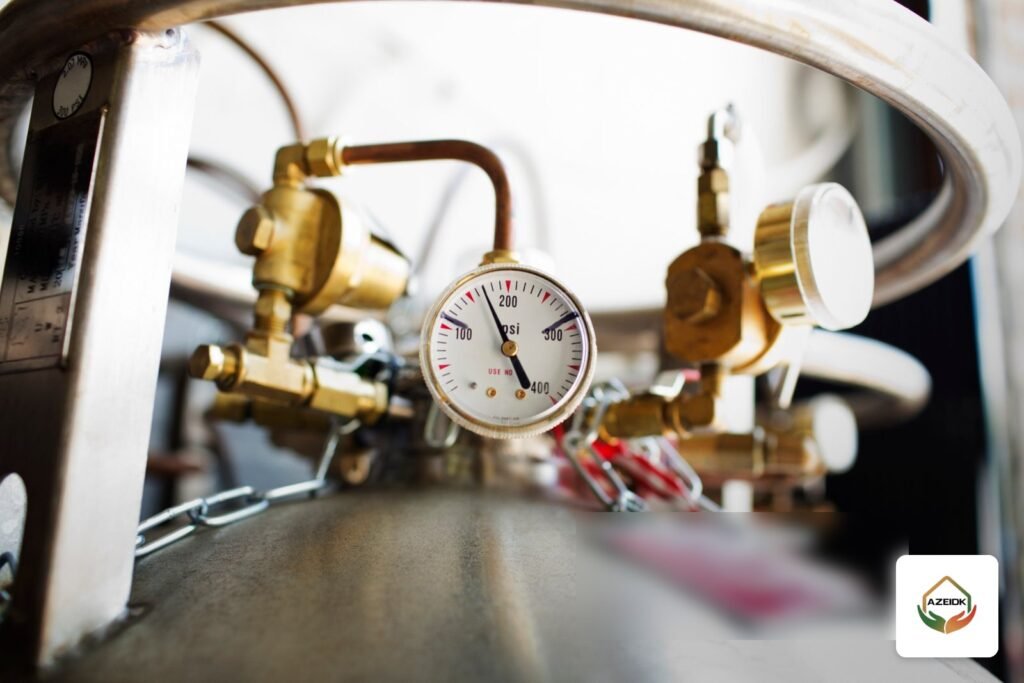
FM-200 (HFC-227ea) is stored in the cylinder as a liquid, superpressurised with nitrogen. On discharge it vaporises and fills the room. Because most of the charge is liquid, its quantity can be found from the liquid height in the cylinder, much as you read the water in a tank from its level.
The level indicator is fitted to the cylinder and lets the technician read that height manually. According to the AZEIDK product page, the Context Plus CP60020 series is “a simple, manually operated device for determining the clean agent liquid level” in vertically mounted cylinders, with the reading converted to weight using the chart in the Context Plus Engineered Manual.
Why does an FM-200 system need quantity checks?
The design calculates the agent quantity needed to reach the required concentration in the room. If agent leaks from the cylinder through the valve or fittings, the discharge may not reach extinguishing concentration. That is why standards and regulations call for periodic quantity and pressure checks.
This check matters most in server rooms, electrical rooms, archives and control rooms, which rely on the system alone in a fire, and where cylinders may sit for years without discharge. A slow leak does not show on a routine visit unless the quantity is actually measured and compared with the record.
One example is US federal regulation OSHA 1910.160 for fixed systems: it requires the weight and pressure of refillable containers to be checked at least semi-annually, and a container showing a loss in net content or weight of more than 5%, or a loss in pressure of more than 10%, is to be subjected to maintenance. On Saudi projects inspection follows the NFPA 2001 edition the consultant adopts and the manufacturer’s manual; see our NFPA 2001 clean agent guide.
Weighing on a scale or a level indicator?
| Comparison | Weighing on a scale | Liquid level indicator |
|---|---|---|
| Method | Disconnect the cylinder, weigh it and compare with the recorded weight | Read the liquid height in place and convert with the chart |
| Large cylinders | Difficult; needs lifting gear and disconnection of release connections | Practical; this is the main reason for the indicator |
| Temperature effect | Weight is not affected by temperature | Accurate within a set range (+40 °F to +90 °F for CP60020) |
| System out of service | Longer | Usually shorter |
| Suitable agents | All cylinders | Liquefied agents such as HFC-227ea, not inert gases |
Inert gases such as nitrogen and argon blends are stored as compressed gas, so they have no liquid level and are checked by pressure. The NFPA 2001 (2024 edition) Second Draft Report states that an inert gas container showing a pressure loss (adjusted for temperature) of more than 5% is to be refilled or replaced.
Context Plus CP60020 series data
| Item | Value per product page |
|---|---|
| Operation | Manual |
| Agent | HFC-227ea |
| Cylinder orientation | Vertical |
| Cylinder sizes | 150/250 lb, 375/560 lb, 1,200 lb |
| Accuracy range | +40 °F to +90 °F (about 4 °C to 32 °C) |
| Reading conversion | Chart in the Context Plus Engineered Manual |
| Use | Periodic inspection and maintenance of HFC-227ea cylinders |
The page gives no dimensions, weight or accessory-specific approval, so request the submittal and datasheet before material approval. The indicator is used on Context Plus HFC-227ea clean agent cylinders.
Inspection steps with a liquid level indicator
- Notify the building manager and put the extinguishing control panel into maintenance mode per the approved procedure, following the safety instructions in the manufacturer’s manual.
- Record the room or cylinder temperature and confirm it is within the accuracy range.
- Read the liquid level with the indicator per the manufacturer’s method.
- Convert the reading to weight using the chart for that cylinder size.
- Compare the calculated weight with the weight on the cylinder label and the filling record.
- Record the result in the fire safety log book and return the panel to normal.
- If the loss exceeds the limit in the adopted standard or the manufacturer’s manual, send the cylinder for refill or replacement.
Common mistakes
- Taking readings in a room outside the accuracy range, such as an unconditioned electrical room in summer.
- Using the chart for a different cylinder size.
- Relying on the pressure gauge alone on an FM-200 cylinder, although pressure reflects the nitrogen more than the liquid quantity.
- Not recording the original weight at handover, leaving nothing to compare against.
- Checking cylinders but ignoring room integrity, although room leakage loses agent after discharge. See room integrity testing.
When is weighing still necessary?
The level indicator is a periodic inspection tool, but in some cases the technician reverts to weighing or the manufacturer’s full procedure:
- After discharge or refill, to record the new weight.
- When the indicator shows a loss close to the limit, to confirm before deciding.
- When room temperature is outside the accuracy range and cannot be adjusted at inspection time.
- For cylinders that are not compatible with the indicator, or are mounted horizontally.
- When cylinders are relocated or their valves are replaced.
What should an FM-200 maintenance contract include?
Quantity checking is one item in system maintenance. When requesting a contract, make sure it states:
- The quantity check method for each cylinder (weighing or level indicator) and its frequency.
- A written record of calculated weight, original weight and the difference.
- Checks of the control panel, detectors, release and hold buttons.
- Checks of cylinder valves, solenoids and flexible hoses.
- Checks of nozzles, pipework and supports.
- Room integrity follow-up whenever walls, ceilings or openings are modified.
This contract falls under fire, safety and alarm maintenance, separate from the CCTV and low current contract.
Frequently asked questions
Does a level indicator replace weighing completely?
It is the manufacturer’s periodic inspection method for its cylinders. If a result is in doubt, or after discharge or refill, revert to weighing and the procedure in the manufacturer’s manual.
Does it work on Novec 1230 cylinders?
The CP60020 page names HFC-227ea only. For any other agent, refer to that system’s manufacturer.
How often should FM-200 quantity be checked?
Per the adopted NFPA 2001 edition and the manufacturer’s manual. One example is the US OSHA rule requiring checks at least semi-annually.
Why is the pressure gauge not enough on an FM-200 cylinder?
Pressure comes mainly from the nitrogen above the liquid. Pressure can stay acceptable while some liquid has been lost, so quantity is checked by weight or level indicator.
Can the indicator be fitted to existing cylinders?
It depends on the cylinder model, its valve and compatibility with the indicator. Our engineers review the existing cylinder data before supply.
Who reads the level indicator: the technician or the building manager?
The reading is part of a technical inspection by a qualified technician following the manufacturer’s manual, because converting to weight and deciding on refill needs system knowledge. The building manager keeps the report in the safety log.
Does the reading change if the cylinder is tilted?
Yes. The CP60020 series is for vertical cylinders, and any tilt changes the apparent liquid height. Make sure the cylinder is fixed upright in its bracket before reading.
Conclusion
A liquid level indicator makes FM-200 quantity checks on large cylinders faster and less disruptive, provided readings are taken within the right temperature range, with the right chart, and recorded. It is part of maintaining special fire suppression systems together with panel, valve and room integrity checks.
Have a Context Plus FM-200 system, or planning one? Contact the AZEIDK team to supply compatible CP60020 liquid level indicators, or to include agent quantity checks in your periodic maintenance contract. Talk to the AZEIDK team
Related guides
- Electric Fire Pump Maintenance: Weekly, Monthly and Annual Checks
- Construction Site CCTV in Saudi Arabia: Temporary Power and Links, Night Security and Progress Monitoring
- Fire Alarm System Installation in Saudi Arabia: Stages, Cabling and Pre-Approval Checks
- ISO Certificates for Companies and Contractors in Saudi Arabia: ISO 9001, 14001 and 45001 in Tenders