Container yard CCTV is a different job from warehouse CCTV: the area is open, stacked rows block the view, and distances run to hundreds of metres. The practical answer combines long-range PTZ cameras on high poles, fixed cameras along the fence, number plate recognition (ANPR) for trucks at the gates, and a fibre backbone back to the control room. On the fire side, the yard needs an external hydrant network that covers the stack aisles, plus protection for the electrical panels that feed reefer containers.
Key takeaways
- An open yard needs two layers: fixed cameras for the fence and gates, and long-range PTZ cameras to follow activity inside the aisles.
- Truck ANPR at the gate needs a lane design that suits truck height and plate position, checked against the datasheet before approval.
- Long runs between poles and the control room are usually solved with fibre; a wireless bridge covers points where cabling is impractical.
- External hydrant mains are typically designed to NFPA 24 as adopted by the consultant, and hydrants must stay reachable however the stacks change.
- Ports are among the sectors covered by the High Commission for Industrial Security (HCIS), so confirm the authority for your site before design starts.
In this article
- Why do container yards need a different CCTV design?
- How is container yard CCTV laid out?
- Truck ANPR at the gate: what makes it work?
- Network: how do distant cameras reach the control room?
- Fire protection in a container yard
- The reefer area: where is the risk?
- Who is the authority: Civil Defense or HCIS?
- Maintenance after handover
- Frequently asked questions
- Conclusion
Why do container yards need a different CCTV design?
In a closed warehouse you know where every rack is, lighting is constant, and the camera is a few metres from its target. In a container yard the scene changes daily: stacks rise and fall, aisles shift with crane movements, and night lighting is uneven. A fixed camera that covers an aisle today may face a wall of containers tomorrow.
So placing cameras on a drawing once is not enough. Good design starts with operational questions: where do trucks enter and leave, where do reefers stand, which fence line faces the public road, and who watches from the control room? The same questions apply to warehouse and logistics projects; the open yard adds distance.
How is container yard CCTV laid out?
| Area | Suggested camera type | Purpose |
|---|---|---|
| Outer fence | Fixed cameras in sequence with overlapping coverage | Detect anyone approaching or crossing the fence |
| Truck gates | ANPR camera plus an overview camera | Log plate number, in/out time and a truck image |
| Stack aisles | Long-range PTZ on high poles | Watch over the stacks and zoom in when needed |
| Reefer area | Fixed cameras on power points | Watch connections and electrical panels |
| Admin building and control room | Indoor cameras and access control | Protect the recorder and server room |
A PTZ such as the Dahua DH-SD8A840-HNF-PA illustrates this class: 8 MP (3840 × 2160), 40x optical zoom (5.6 to 223 mm), IR up to 500 m, IP67 and TVS 6000 V lightning protection, according to the product page on AZEIDK’s site. Real identification distance is shorter than IR range and depends on light, weather and what you need to see. Dust and heat in Saudi yards are another reason to choose a high protection rating and to schedule lens cleaning.
Fence cameras work at night too. To choose the right night technology (infrared or low-light colour), see our night vision CCTV guide.
Truck ANPR at the gate: what makes it work?
ANPR at the yard gate ties every entry and exit to a plate number, a time and a truck image. But a truck is not a car: the plate sits higher or lower, the trailer is long, and gate speed differs. Camera position, angle and lighting must be set for the truck lane specifically.
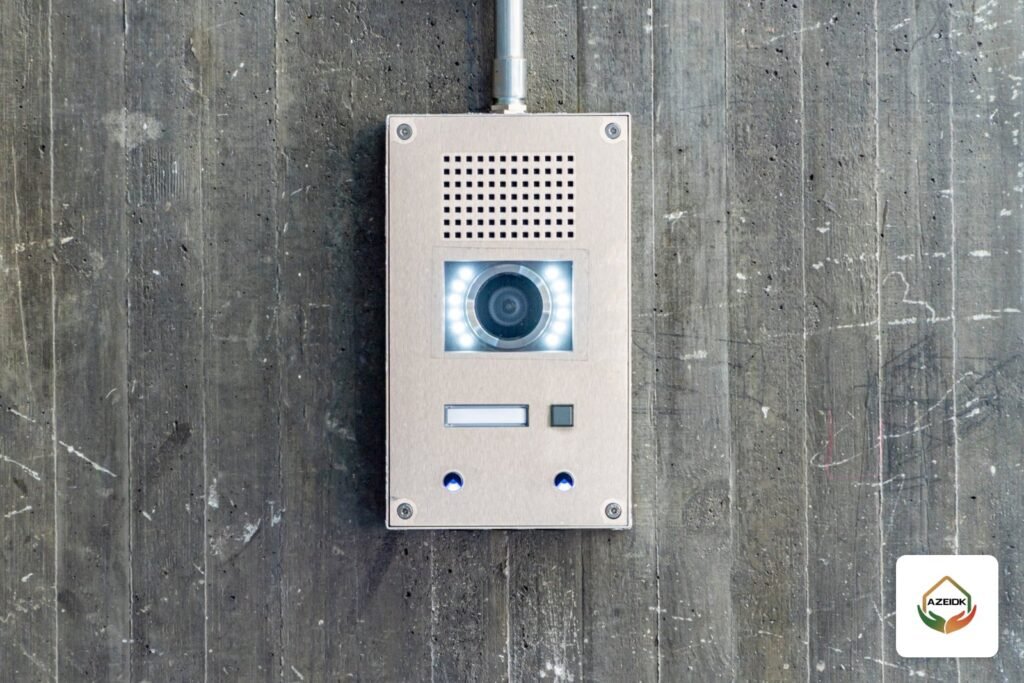
AZEIDK supplies the all-in-one Hikvision DS-TMC407-EH entrance and exit unit, which combines a 3 or 4 m barrier, a 4 MP ANPR camera and a supplement light, rated for -30 to 70 °C per the product page. It is designed mainly for car park entrances, and its page does not list the vehicle types it covers. We therefore review the datasheet against the actual truck lane before proposing it for a truck gate; at some gates a standalone ANPR camera with a separate barrier fits better.
Network: how do distant cameras reach the control room?
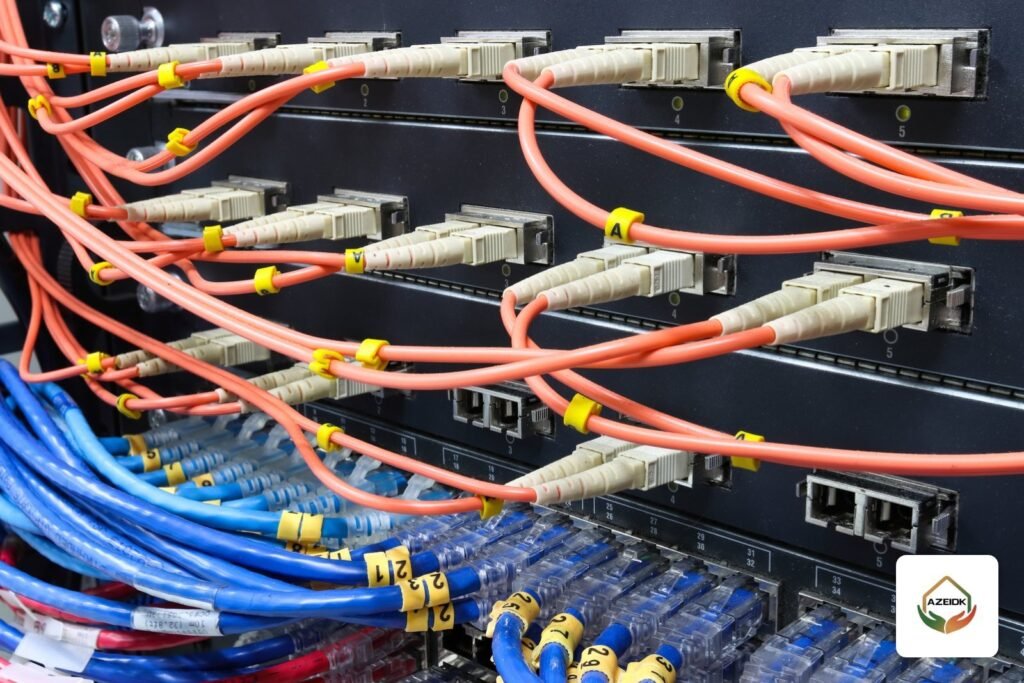
Standard copper network cable has a distance limit that does not suit a yard several hundred metres long. Yards therefore usually rely on a fibre backbone between pole-mounted cabinets and the control room, with short copper runs from each cabinet to nearby cameras. This is part of AZEIDK’s network and communication systems.
Where trenching is impractical, such as a temporary pole or a remote side gate, a point-to-point wireless bridge such as the Hikvision DS-3WF02C-5AC can be used, provided there is a clear line of sight that rising stacks will not cut. Then comes storage: dozens of high-resolution cameras need properly sized recorders and disks; see how to calculate NVR storage and bandwidth.
Fire protection in a container yard
A fire in an open yard is not a building fire: there is no ceiling for sprinklers, and crews reach a burning container from the aisles. The main defence is an external hydrant network fed by fire pumps, plus hoses and manual equipment at set points. Private fire service mains are typically designed to NFPA 24 (Standard for the Installation of Private Fire Service Mains and Their Appurtenances), as adopted by the consultant and required by the authority.
Practical points we check:
- Hydrants must stay reachable however the stacks are rearranged, so never place one where containers may be stacked in front of it.
- Protect hydrants from truck and crane impact with suitable barriers.
- Hose cabinets at buildings and workshops; see fire hose cabinet types and sizes.
- Wheeled extinguishers near the reefer area, workshops and any fuel point.
AZEIDK supplies hydrants and network valves from American Fire Control as part of its fire fighting systems, with design, supply, installation and testing.
The reefer area: where is the risk?
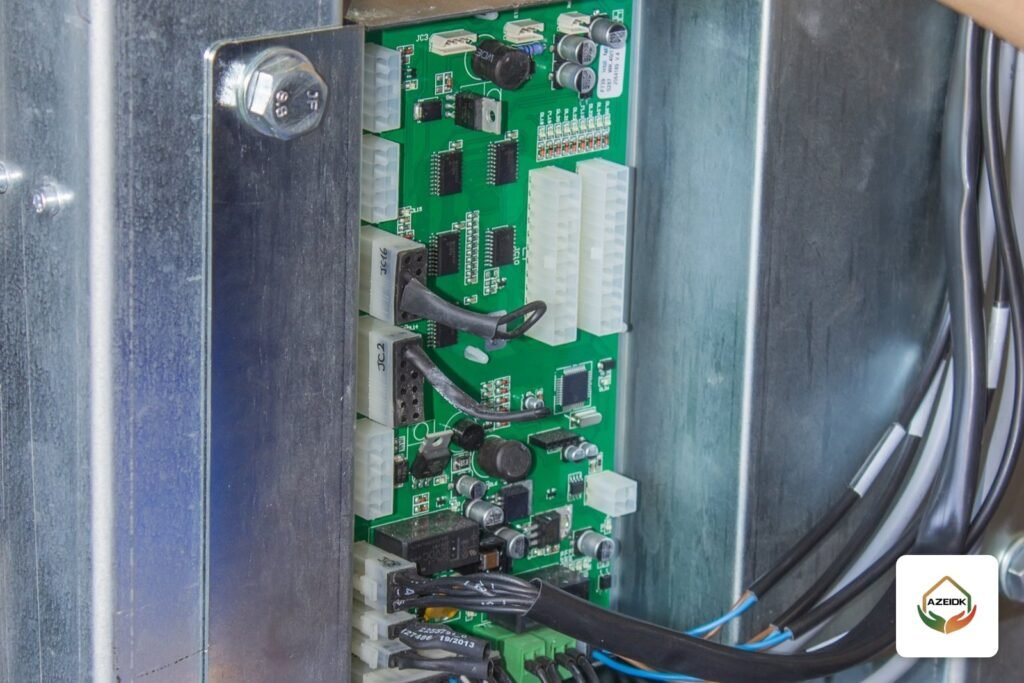
Reefer containers draw power around the clock through distribution boards and yard power points. The main risk is electrical: loose terminations, cables exposed to sun and movement, and heavily loaded panels. Protection starts with periodic inspection of connections, then a camera over the power points, then suitable extinguishers nearby. Distribution boards in closed enclosures can be protected with a condensed aerosol system such as FirePro, whose page lists electrical panels, distribution boards and equipment cabinets among its applications, after an engineering calculation for the enclosure volume.
Who is the authority: Civil Defense or HCIS?
Saudipedia states that the High Commission for Industrial Security oversees facilities in thirteen strategic sectors, including ports, railways, electricity and petrochemicals, and reviews security, safety and fire protection projects under its directives. Some yards and dry ports fall within these sectors; others are logistics facilities under Civil Defense and the municipality. Confirm this with the operator or consultant before design, because approval requirements differ. For Civil Defense sites, see our Civil Defense approval support.
Maintenance after handover
A yard is hard on equipment: dust, heat and vibration from cranes. CCTV and access control maintenance sit under one contract, and fire network, hydrant, pump and extinguisher maintenance under a separate one, each with its own inspection schedule. See our maintenance contracts.
Frequently asked questions
What range does a PTZ camera have in a container yard?
It depends on the model. The Dahua DH-SD8A840-HNF-PA page, for example, gives IR up to 500 m and 40x optical zoom, but real identification distance depends on light, weather and the target.
Are fixed cameras enough without PTZ?
For the fence and gates, usually yes. Aisles between stacks change daily, and a PTZ on a high pole gives flexibility fixed cameras cannot.
Does ANPR work with trucks?
Yes, if the lane is designed for it: camera position, height, angle and lighting set for the truck plate position and speed. Check the datasheet against the gate lane before approval.
When do I need fibre in the yard?
When the distance from a camera or network cabinet to the control room exceeds the copper cable limit, which is common in large yards.
Where should hydrants go in a container yard?
On a network that covers the stack aisles, at points that stay reachable however containers are rearranged, protected from vehicle impact, per the consultant’s approved design.
Does one maintenance contract cover CCTV and fire systems?
No. At AZEIDK, CCTV and access control are one contract, and fire and safety systems are a separate one.
Conclusion
Container yard CCTV works when fixed fence cameras, long-range PTZ cameras and truck ANPR run on a fibre network designed for distance. On the fire side, an external hydrant network that stays reachable as stacks move, and dedicated protection for reefer-area electrical panels.
Planning a container yard or dry port? Send us the site plan and gate locations, and our team will review the camera, network and fire protection layout. Talk to the AZEIDK team
See AZEIDK CCTV solutions: supply, installation and maintenance.
Related guides
- Central Kitchen Fire Safety: Hood Suppression, Gas Leak Detection and Gas Shut-Off
- On-Demand Fire Alarm Maintenance or an Annual Contract? When to Call a Technician
- Hazardous Materials Storage License from Civil Defense: Fire Detection and Suppression for Chemical Warehouses
- CCTV Camera Cable: Coax RG59 or Cat6, Maximum Distances, PoE and When You Need Fiber