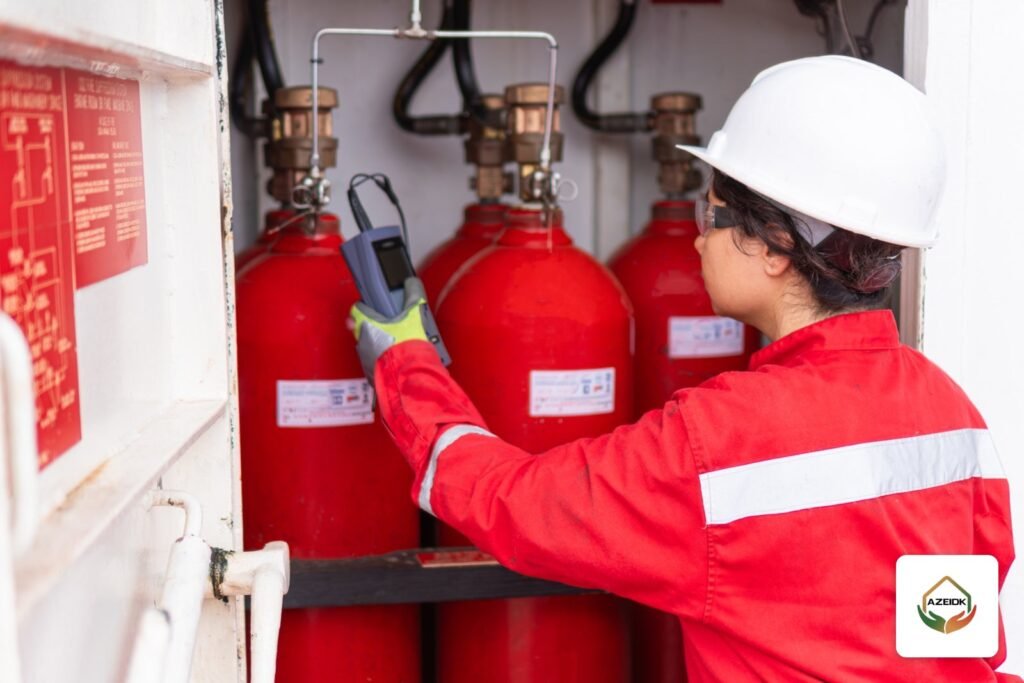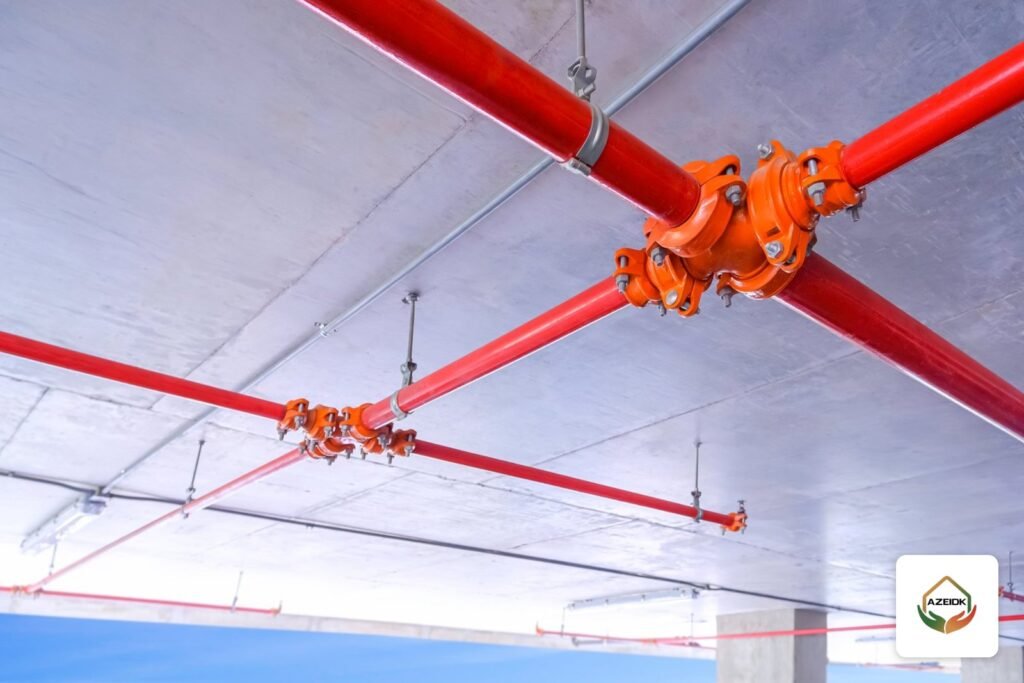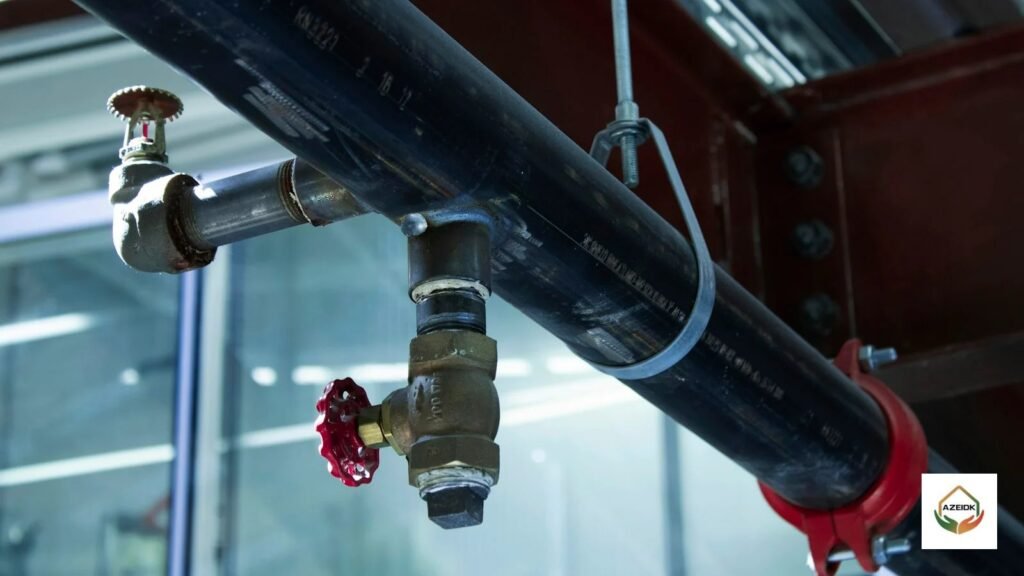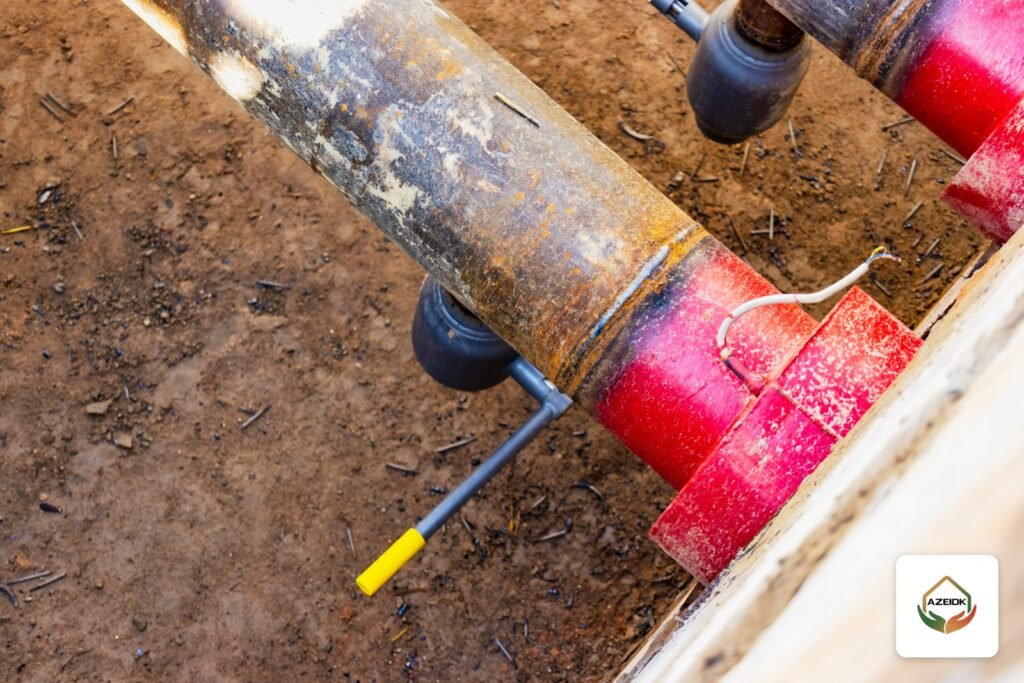
NFPA 24 is the NFPA standard for installing private fire service mains and their appurtenances: the on-site pipes that feed private hydrants, sprinkler systems and standpipe systems, most of them buried outside the building. The current edition is 2025. It covers acceptable pipe materials, valves, joint restraint, flushing and the hydrostatic test before handover.
Key takeaways
- Full title: Standard for the Installation of Private Fire Service Mains and Their Appurtenances. Current edition: NFPA 24-2025.
- It is the default standard for underground piping that supplies sprinkler systems, with specific exceptions for NFPA 13D and some NFPA 13R systems.
- Accepted materials include ductile iron, PVC and PE pressure pipe, copper and austenitic stainless steel, per the materials table in the standard.
- The usual hydrostatic test is 200 psi, or 50 psi above maximum system pressure, whichever is greater, and acceptance forms set the duration at 2 hours.
- In Saudi Arabia, NFPA 24 is a technical reference in the specification. The regulatory frame is the Saudi Fire Code SBC 801 and Civil Defense requirements.
In this article
- What is NFPA 24 and what does it cover?
- When does NFPA 24 apply to underground piping?
- Which pipe materials does NFPA 24 accept underground?
- Valves and indicator posts on the external fire main
- Joint restraint and burial: what to check before backfill
- Flushing and hydrostatic testing under NFPA 24
- NFPA 24 on Saudi projects
- Common mistakes on external fire mains
- Frequently asked questions
- Conclusion
What is NFPA 24 and what does it cover?
The ANSI webstore page for NFPA 24-2025 describes it as giving detailed requirements for installing private fire service mains and their appurtenances, which supply private hydrants and water-based fire protection systems, so that water is available in a fire emergency.
On site, this is the external fire ring main around buildings in factories, warehouses, residential compounds and hospitals: the line from the water source or fire pump room up to where it enters the building, including the hydrants and valves along it.
NFPA 24 works with other standards, each with its own boundary:
| Standard | What it covers | Link to NFPA 24 |
|---|---|---|
| NFPA 24 | Private fire service mains and appurtenances (mostly underground) | The external network itself |
| NFPA 13 | Sprinkler systems | Fed from the private main |
| NFPA 14 | Standpipe and hose systems | Fed from the same main |
| NFPA 20 | Stationary fire pumps | Pump water into the main |
| NFPA 25 | Inspection, testing and maintenance | Covers the private main and hydrants after handover |
For the connected systems, see our NFPA 14 standpipe guide, NFPA 20 fire pump guide and NFPA 25 inspection and maintenance guide.
When does NFPA 24 apply to underground piping?
An article by the National Fire Sprinkler Association (NFSA), published on 30 December 2025, explains that NFPA 24 is the default standard for underground piping supplying fire sprinkler systems. It names two cases where the plumbing code governs instead: the underground main for NFPA 13D systems, and the main for NFPA 13R systems when it is under 4 in. nominal diameter. Outside those exceptions, an underground pipe feeding a sprinkler system is treated as a private fire service main.
For combined fire and domestic lines, the same article notes that the NFPA 24 test pressure is usually higher than the plumbing code minimum, so the pipe often needs a higher pressure rating.
Which pipe materials does NFPA 24 accept underground?
NFSA refers to Table 10.1.1.1 of NFPA 24 (2022 edition) and states that ductile iron, PVC pressure pipe, PE pressure pipe, copper and austenitic stainless steel can meet NFPA 24. It adds that a fire-protection-specific listing is not required for underground piping when the material meets a standard that NFPA 24 recognizes.
On Saudi projects, the choice depends on practical factors: working and test pressure, soil type and salinity, traffic loads above the line, and how joints are restrained at changes in direction. The designer sets this in the specification, and each material datasheet is then reviewed in the submittal before supply.
Valves and indicator posts on the external fire main
The external main needs valves that isolate sections for maintenance without shutting down the whole site, and operators and firefighters need to see whether a valve is open or shut from above ground. That is why indicator posts are used with buried valves.
One example AZEIDK supplies is the AFC Model 5100 vertical indicator post. Its product page says it sits above buried NRS gate valves, including the AFC A-3100 NRS flanged gate valve, fits valve sizes from 4 to 12 in., and has a telescoping pipe and stem to match the valve depth, OPEN and SHUT indicator windows and a padlockable operating wrench. The page states it is UL Listed and FM Approved as shown in the catalogue.
To compare valve types on the network, see our fire protection valves and network components guide.
Joint restraint and burial: what to check before backfill
Water pressure inside a buried main pushes on joints at bends, tees and dead ends. Acceptance forms used with NFPA 24 therefore ask the contractor to confirm that joints needing anchorage were clamped, strapped or blocked (thrust blocks) in accordance with the standard.
Before backfilling, check on site that:
- Routing and pipe sizes match the approved shop drawings.
- Every change in direction and every dead end is restrained as designed.
- Valves and indicator posts are placed where the fire brigade can reach them.
- Joints stay exposed until the hydrostatic test is complete, where the specification asks for it.
Flushing and hydrostatic testing under NFPA 24
NFSA lists the underground acceptance tests as flushing, hydrostatic testing, leakage allowances, valve operation testing and forward-flow testing of backflow devices. The test pressure is typically 200 psi, or 50 psi above maximum system pressure, whichever is greater.
The Contractor’s Material and Test Certificate for Underground Piping forms used by US fire authorities set the duration at 2 hours: 200 psi (13.8 bar) for 2 hours, or 50 psi (3.4 bar) above static pressure in excess of 150 psi for 2 hours. The same forms give these minimum flushing rates, flowed until the water runs clear:
| Pipe size | Minimum flushing flow |
|---|---|
| 4 in. | 390 gpm (1476 L/min) |
| 6 in. | 880 gpm (3331 L/min) |
| 8 in. | 1560 gpm |
| 10 in. | 2440 gpm |
| 12 in. | 3520 gpm |
These figures are as printed on the acceptance forms. The final reference is the NFPA 24 edition named in your project specification. The allowable leakage formula has changed between editions, so take it from that same edition. For field practice, read our fire fighting hydrostatic pressure test article and see AZEIDK’s testing, commissioning and handover service.
NFPA 24 on Saudi projects
The regulatory frame is SBC 801 and Civil Defense requirements. In the International Fire Code (IFC), Section 507 on fire protection water supplies enforces NFPA 24 by reference, as NFSA notes, and consultants often name NFPA 24 for external networks, but it binds a project only when the specification or contract names it, or the authority asks for it.
Under fire fighting systems, AZEIDK designs external mains, supplies valves and indicator posts, and installs and tests them. The Civil Defense approval support team can prepare the facility file.
Common mistakes on external fire mains
- Backfilling before the hydrostatic test, then hunting for a leak underground.
- Skipping flushing at the full rate, so debris ends up in sprinklers and valves.
- A buried valve with no indicator post or no access, so nobody knows its position during a fire.
- Choosing pipe with a pressure rating below the test pressure.
- Missing thrust blocks or restraints at bends and tees.
Frequently asked questions
What is the NFPA 24 standard?
The NFPA standard for installing private fire service mains and appurtenances that feed private hydrants, sprinkler systems and standpipes. The current edition is 2025.
What is the difference between NFPA 24 and NFPA 13?
NFPA 13 covers the sprinkler system itself. NFPA 24 covers the private main that feeds it, which is mostly an underground line outside the building.
What is the test pressure for an underground fire main?
Usually 200 psi, or 50 psi above maximum system pressure, whichever is greater, and acceptance forms set the duration at 2 hours. Check the edition named for your project.
Is PVC or HDPE pipe acceptable underground?
NFSA states that PVC and PE pressure pipe can meet NFPA 24, provided the pipe complies with a standard NFPA 24 recognizes and has a suitable pressure rating.
Where can I find an NFPA 24 2019 PDF or a free copy?
Official copies are sold by NFPA. NFPA also lets registered users read its codes and standards online for free, as the International Association of Fire Chiefs (IAFC) explains. Use the edition named in your project specification.
Is NFPA 24 mandatory in Saudi Arabia?
The regulatory reference is SBC 801 and Civil Defense requirements. NFPA 24 binds a project when the specification or contract names it, or the authority asks for it.
Conclusion
NFPA 24 is the reference for the external network that feeds every water-based fire system on site. Choose the material and pressure rating carefully, restrain the joints, flush at the full rate, test hydrostatically before backfill and fit valves whose position can be seen from above ground.
Planning an external fire main or need an existing one tested? AZEIDK designs the network, supplies valves and indicator posts, and carries out flushing and testing with documented results. Talk to the AZEIDK team
Related guides
- Fire Pump UL and FM Approval: How to Check the Certificate and Model Before You Buy
- Wi-Fi CCTV Camera: How It Works, SD Card vs Cloud, Range Limits and When to Go Wired
- Fire Safety in Office and Administrative Buildings
- Fire Protection Companies in Jazan (Safety and Fire Fighting Companies), Khamis Mushait and Abha: How to Choose a Company That Serves the South