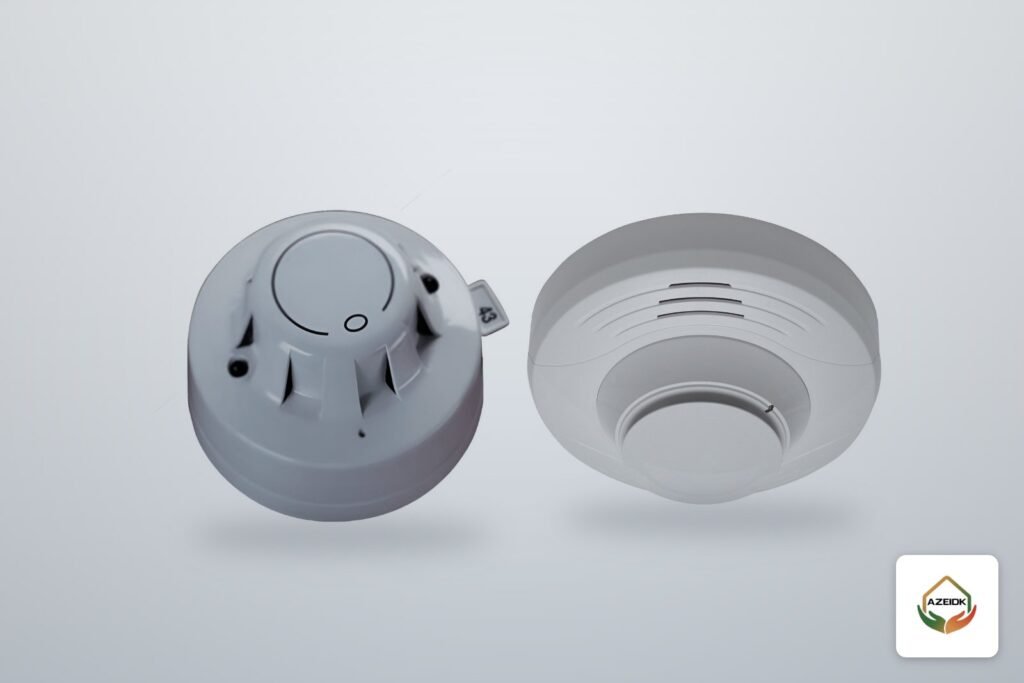
An addressable carbon monoxide detector sits on the fire alarm loop like a smoke detector, but it measures a gas you cannot see or smell. That is where the usual confusion starts: some CO detectors are designed to find slow, smouldering fires early, while others protect people from CO poisoning near boilers, furnaces and fuel-burning equipment. AZEIDK supplies one of each in Saudi Arabia, and together they show the difference clearly: the Context Plus 58000-300 and the Honeywell Farenhyt IDP-CO.
Both are part of AZEIDK fire alarm systems, and everything below comes from the two product pages and the datasheets published on them.
Key points
- The Context Plus 58000-300 is a fire detector: it targets deep-seated and smouldering fires, responds early to hot fires and offers five response modes.
- The Honeywell Farenhyt IDP-CO is a life safety CO detector, listed to UL 2075 for system-connected carbon monoxide detection.
- The Context Plus catalogue states that CO detectors do not detect smoke particles or heat and are not replacements for smoke detectors.
- Selection starts with one question: do you need to detect a fire, or warn people about a toxic gas?
In this article
- Why carbon monoxide appears in fire alarm systems
- Context Plus 58000-300: a CO-based fire detector
- Honeywell Farenhyt IDP-CO: protecting people from CO
- Side-by-side comparison
- Where each type is installed
- What the consultant checks in the submittal
- Supply, installation and maintenance
- Frequently asked questions
Why carbon monoxide appears in fire alarm systems
CO is produced by incomplete combustion. In fires that start slowly inside stacked materials, cables or furniture, CO can appear before there is enough smoke to trigger an optical detector. Separately, boilers, gas ovens, laundry rooms and car parks can produce CO with no fire at all, and the risk is then to people rather than the building. That is why two kinds of addressable detector exist: one uses CO to confirm a fire, the other measures CO concentration to warn of poisoning.
Context Plus 58000-300: a CO-based fire detector
The Context Plus specialist detectors catalogue presents this model for deep-seated fires, the kind that smoulder inside a material before any flame appears. The manufacturer states:
- Enhanced detection capability with early response to hot fires.
- Suited to smouldering fires.
- Less susceptible to false alarms caused by steam than some other forms of detection.
- Five response modes to suit the location.
- An explicit note: CO detectors do not detect smoke particles or heat and are not designed as replacements for smoke detectors.
In practice this makes it useful where steam keeps setting off optical detectors, such as laundry rooms or corridors near bathrooms and kitchens, provided the approved design accepts it there. For the wider picture see false alarms in fire alarm systems.
Honeywell Farenhyt IDP-CO: protecting people from CO
The IDP-CO-W is an intelligent addressable detector that meets UL 2075 for system-connected life safety CO detection. Its purpose is to add CO detection to an existing addressable fire system near fuel-burning equipment such as furnace areas, boiler rooms and laundry rooms. From the datasheet:
| Item | Datasheet statement |
|---|---|
| Addressing | Rotary address switches on the detector, so no extra module is needed for point ID |
| CO cell | 10-year cell with end-of-life warning and fault, plus automatic drift compensation |
| Testing | RealTest CO testing capability |
| Audible signal | Temporal 4 CO alarm pattern when used with a B200S intelligent sounder base |
| Operating voltage | 15 to 32 VDC |
| Environment | 0 to 50 °C, 15% to 90% RH non-condensing |
The datasheet also lists the UL reference alarm thresholds: at 70 ppm the response time is 60 to 240 minutes, at 150 ppm 10 to 50 minutes, and at 400 ppm 4 to 15 minutes. Low concentrations need long exposure to become dangerous, while high concentrations need a fast warning.
Side-by-side comparison
| Item | Context Plus 58000-300 | Honeywell Farenhyt IDP-CO |
|---|---|---|
| Purpose | Detecting deep-seated, smouldering fires | Life safety CO detection |
| Stated reference | Context Plus catalogue | UL 2075 |
| Notable features | Five response modes, lower steam sensitivity | Rotary addressing, 10-year cell, RealTest |
| Replaces a smoke detector? | No, per the catalogue | No, it is a gas detector |
| Compatibility | Context Plus addressable panels per datasheet | Compatible Farenhyt panels per the compatibility chart |
The key rule: a detector works only with its own brand’s panel or the panels listed in its compatibility documents. Do not mix a Farenhyt detector onto a Context Plus loop, or the reverse, without written confirmation from the datasheet.
Where each type is installed
- 58000-300 fire detector: areas where the design needs smouldering-fire detection with recurring steam, while smoke and heat detectors still cover the rest of the building.
- IDP-CO gas detector: boiler, furnace and laundry rooms, kitchens and spaces with fuel-burning appliances in hotels, residential towers and hospitals, as the product page lists.
- Car parks: CO detection there usually drives the exhaust fans, which is a different system covered in car park CO detection and ventilation.
Locations, mounting heights and alarm set points follow the manufacturer instructions and the approved design for each area. For other detector types see fire detector types and selection.
What the consultant checks in the submittal
- Stated purpose: fire detection or life safety CO detection, since it changes how the event shows on the panel and what message occupants hear.
- Panel compatibility: the datasheet compatibility chart confirms the detector works on the proposed loop.
- Notification: with IDP-CO, the B200S sounder base is specified if a distinct CO tone is required.
- Stated approvals: UL 2075 for the Farenhyt unit and what the Context Plus catalogue states for the 58000-300, with nothing added that is not written.
- Replacement plan: CO cell life and replacement date in the maintenance schedule.
Supply, installation and maintenance
AZEIDK reviews the drawing, selects the right type for each space, supplies the detectors through its technical supply service, and handles programming, testing and commissioning. During routine maintenance the CO cell life and end-of-life warnings are tracked under annual maintenance contracts.
Frequently asked questions
Can a carbon monoxide detector detect fire?
Some can, such as the Context Plus 58000-300 for deep-seated and smouldering fires. Others, like the Farenhyt IDP-CO, are designed to warn people about toxic gas and are not fire detectors.
Does a CO detector replace a smoke detector?
No. The Context Plus catalogue states that CO detectors do not detect smoke particles or heat and are not replacements for smoke detectors.
What is UL 2075?
The UL standard for gas and vapor detectors and sensors. The Farenhyt IDP-CO datasheet states the detector meets it for life safety CO detection.
How long does the IDP-CO sensing cell last?
Ten years according to the datasheet, with an end-of-life warning and fault signal.
How is the Farenhyt IDP-CO addressed?
With rotary address switches on the detector, so its location shows on the panel without an extra module.
Where should CO detectors go in hotels and towers?
Near fuel-burning equipment such as boiler, furnace and laundry rooms and kitchens, with final locations set by the manufacturer instructions and the approved design.
Need CO detection on your project? Decide whether the goal is fire detection or gas protection, send the drawing and panel type, and the AZEIDK team will propose a compatible detector. Contact AZEIDK
Related guides
- Fire Alarm Brands in KSA: Who Makes What and How to Verify Each Model’s Approval
- Wedding Hall Fire Alarm System: Detectors with Haze Machines, Music Shutdown and Sounder Strobes in Both Sections
- Data Center CCTV Cameras: Where to Place Cameras Across Aisles, Racks and Entrances, Storage and Access Control Integration
- Fire Alarm System Price in Saudi Arabia: What Drives the Cost (Conventional vs Addressable, Device Count, Cabling, Programming) and How to Compare Quotes