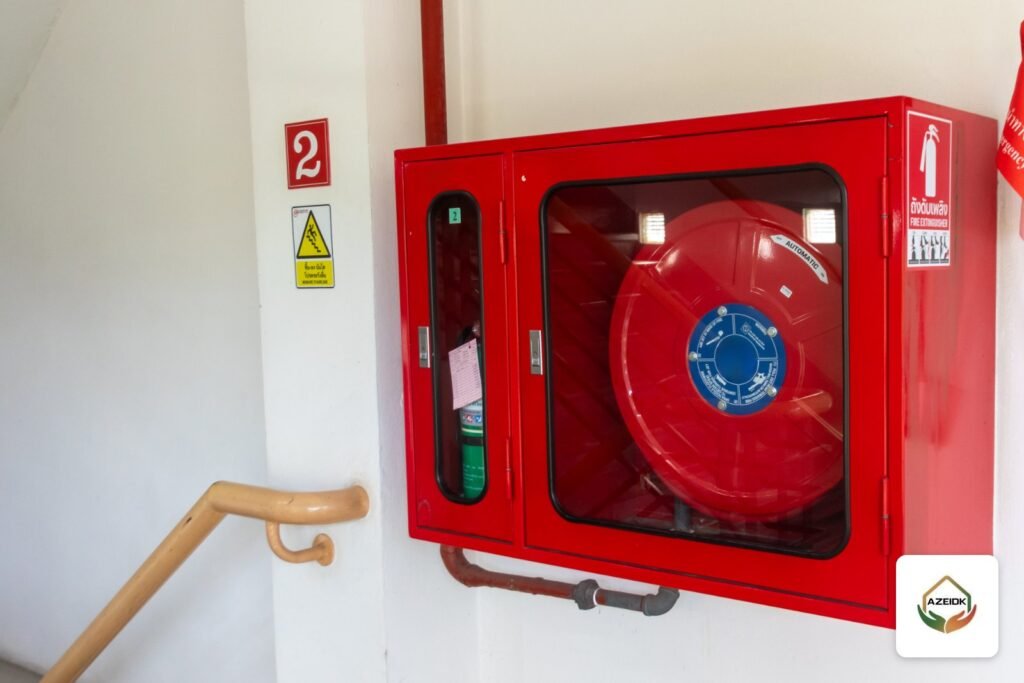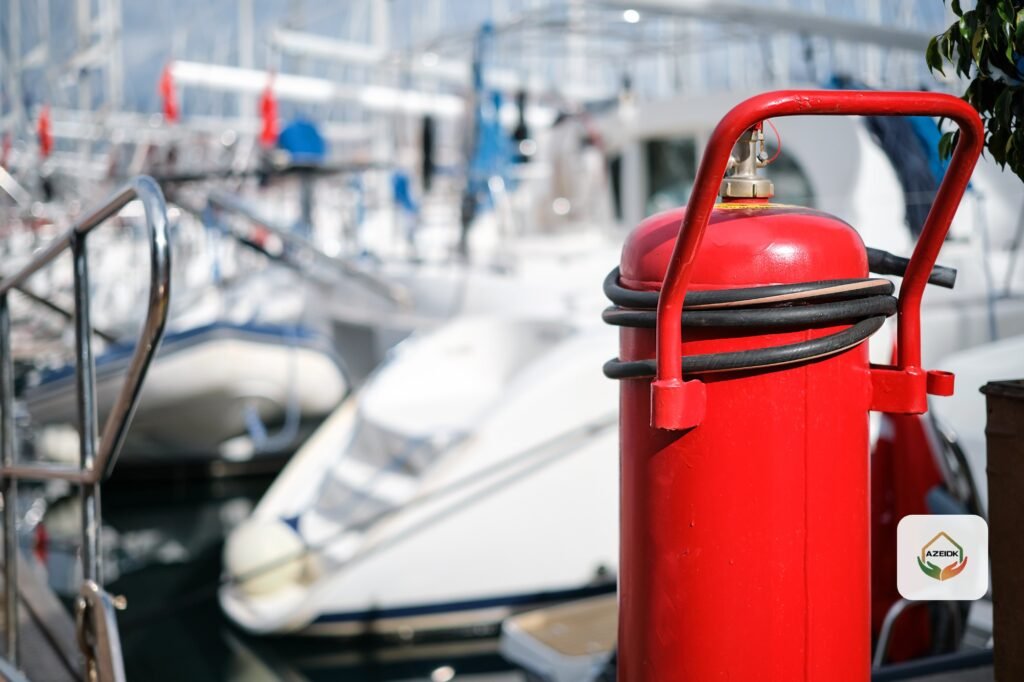
A hand-held extinguisher is enough for a small fire caught early. A loading yard, a flammable liquids store or a large workshop may need more agent and a longer throw than any hand-held unit can give. That is the job of a wheeled fire extinguisher: a larger unit on a wheeled carriage that one person pushes to the fire and operates.
This guide explains when a wheeled unit makes sense, how to choose the agent, the capacity and the pressurisation type, and what to inspect. It also lists the specifications of the PYRAMID wheeled dry powder extinguishers available through AZEIDK Egypt fire extinguisher solutions.
Key takeaways
- NFPA 10 defines a wheeled extinguisher as a portable extinguisher on a carriage and wheels, designed to be moved to the fire by one person.
- NFPA 10 says wheeled units should be considered where a fire risk assessment shows high hazard areas, or limited staff who need a higher flow rate, longer stream range and more agent.
- The European standard EN 1866-1 covers mobile extinguishers with a total mass above 20 kg, operated by a person on foot.
- Wheeled units add to the hand-held extinguisher layout. They do not replace it.
- PYRAMID wheeled dry powder extinguishers come in 25 kg and 50 kg, with ABC-E powder and a 5 m hose.
In this article
- What is a wheeled extinguisher and which references apply?
- When do you need a wheeled fire extinguisher instead of hand-held units?
- Choosing the agent by hazard
- Choosing the capacity: 25 kg or 50 kg?
- Pressurisation: cartridge or stored pressure?
- PYRAMID wheeled dry powder extinguishers from AZEIDK Egypt
- Parking position and periodic inspection
- Common mistakes with wheeled extinguishers
- Frequently asked questions
- Conclusion
What is a wheeled extinguisher and which references apply?
NFPA 10, the US Standard for Portable Fire Extinguishers (latest edition 2026), defines a wheeled fire extinguisher as a portable extinguisher fitted with a carriage and wheels, intended to be taken to the fire by one person. In Europe the same equipment is called a mobile fire extinguisher and falls under EN 1866-1. That standard applies to powder, water-based and CO2 units with a total mass above 20 kg that are manoeuvred by an operator on foot. Part 2, EN 1866-2, covers construction, pressure resistance and mechanical tests.
In Egypt, the binding requirements are those of civil protection and the Egyptian Code for the Design and Implementation of Fire Protection for Buildings, 2026 edition, together with what the General Directorate of Civil Protection (Ministry of Interior) approves on the project drawings and at inspection. NFPA 10 and EN 1866 are technical references for selection, layout and inspection. Neither replaces the authority’s requirements.
When do you need a wheeled fire extinguisher instead of hand-held units?
NFPA 10 gives a practical test. Consider wheeled extinguishers where a fire risk assessment shows high hazard areas, or where only a few people are available to respond, so the unit must offer a higher agent flow rate, a longer stream range and a larger agent capacity. Put simply, one trained person with a large unit can do what would otherwise take several people with hand-held extinguishers.
Typical places where the question comes up:
- Factories and large production halls, especially with oils or solvents.
- Stores, warehouses, and loading and unloading yards.
- Flammable liquid stores and fuel handling areas.
- Large workshops and equipment or vehicle parks.
A wheeled unit does not count as an automatic substitute for hand-held extinguishers. Work out the number of hand-held units and their travel distances first, based on the hazard classification, as explained in our guide to how many fire extinguishers you need. Then add wheeled units where the hazard calls for them. The approved design sets their number and positions.
Choosing the agent by hazard
Wheeled units come with different agents, and the rule is the same as for hand-held extinguishers: choose the agent for the expected fire and the nature of the space. Fire classes and agent suitability are covered in our guide to fire extinguisher types and uses. The table below sums up the differences from a wheeled-unit point of view.
| Agent | Typical fit | Watch out for |
|---|---|---|
| Multi-purpose dry chemical powder (ABC) | Warehouses, factories and loading yards where solid materials and flammable liquids are mixed | Leaves residue, cuts visibility when discharged indoors, and is not suited to sensitive electronics |
| AFFF foam | Flammable liquid areas where a film over the liquid surface is needed | Water-based, so do not use it on live electrical equipment unless the manufacturer’s instructions allow it |
| Carbon dioxide (CO2) | Electrical equipment and spaces that cannot tolerate residue | Reduces oxygen, so use in enclosed or occupied spaces must follow the manufacturer’s instructions and safety requirements |
In many industrial and storage sites, ABC powder is the practical first choice for a wheeled unit, because one unit covers more than one fire class. CO2 or foam is kept for areas where the type of hazard demands it.
Choosing the capacity: 25 kg or 50 kg?
No single number fits every case. The decision balances the size of the hazard against site conditions. These questions help:
- Size of the hazard: the larger the exposed area or the volume of flammable liquid, the more agent and discharge time you need.
- Route to the fire: can the carriage pass through the aisles and doorways? Are there ramps, steps or rough floors? A bigger unit is heavier to push and harder to steer.
- Staff and training: one person runs the unit, but that person must be trained to unroll the hose, aim the nozzle and control the discharge.
- Number of units: two 25 kg units in two locations can be better than one 50 kg unit, because they shorten the travel distance.
- Parking position: the unit needs a fixed, designated spot that is visible, close to the hazard and clear of stored goods.
Confirm the final choice with the design engineer and the civil protection requirements for the activity.
Pressurisation: cartridge or stored pressure?
A wheeled extinguisher works in one of two ways:
- Cartridge-operated (external gas cylinder): the agent sits unpressurised in the body. On operation, the gas cylinder valve is opened, the body is pressurised and discharge begins.
- Stored pressure: the body is kept under pressure by a propellant gas at all times (nitrogen in the PYRAMID units), and a pressure gauge shows its condition at inspection.
Inspection and maintenance steps differ between the two. The cartridge is checked by weight or pressure as the manufacturer instructs, while a stored-pressure unit is checked on its gauge. In both cases follow the datasheet for the specific model.
PYRAMID wheeled dry powder extinguishers from AZEIDK Egypt
AZEIDK Egypt supplies PYRAMID wheeled dry powder extinguishers in 25 kg and 50 kg, manufactured locally in Egypt. The PYRAMID page on the AZEIDK site lists them as conforming to EN 1866 and Egyptian Standard ES 1494, with powder to EN 615 and Egyptian Standard ES 4833. The datasheet published on the same page gives these specifications:
| Item | Value per datasheet |
|---|---|
| Capacity | 25 kg / 50 kg |
| Extinguishing agent | ABC-E dry chemical powder |
| Pressure (bar) | Working 17.5, test 35, burst 70 or more |
| Propellant | External cartridge; also available as stored pressure (nitrogen) |
| Operating temperature range | -20 °C to +70 °C |
| Cylinder | Cold-drawn steel to Egyptian Standard ES 1110 |
| Valve | Nickel-chrome plated brass, with pressure gauge and safety valve to release excess pressure |
| Discharge | 5 m hose with a nozzle for intermittent or continuous discharge |
| Carriage | Two main wheels and a front swivel castor, with chemical-resistant rubber tyres |
| Finish | Red electrostatic polyester coating, weather resistant |
| Approval | Egyptian Quality Mark to Egyptian Standard ES 1494/2007 |
According to the datasheets on the same page, the PYRAMID range also includes wheeled AFFF foam units in 25 L and 45 L, and wheeled CO2 units in 10, 20 and 30 kg. Check each model’s own datasheet for its specifications.
Parking position and periodic inspection
NFPA 10 treats wheeled units differently from hand-held ones at installation. A wheeled extinguisher stands in a designated location. The wall-mounting rules and installation height limits for hand-held extinguishers do not apply to it. Mark its position clearly and keep the route to it free.
On top of the normal checks for any extinguisher, NFPA 10 adds items specific to wheeled units:
- Condition of tyres, wheels, carriage, hose and nozzle at every inspection.
- Fully uncoil the discharge hose and examine it for damage every year.
- Where a pressure regulator is fitted, test its static outlet pressure and flow rate every year.
These items are NFPA 10 technical guidance, not Egyptian legal text. Apply them together with the manufacturer’s instructions and the authority’s requirements. For the full inspection and recharging programme, see our guide to fire extinguisher maintenance and recharging.
Common mistakes with wheeled extinguishers
- Relying on one wheeled unit in a large facility and cutting the required hand-held extinguishers.
- Parking the unit in a far corner or behind goods and pallets that block it.
- Choosing 50 kg for a space with ramps or narrow aisles that prevent manoeuvring.
- Leaving the hose coiled for years without unrolling and checking it, so cracks show up only when it is needed.
- Neglecting the tyres and swivel castor until the unit no longer rolls.
- Having no one on the shift trained to operate it.
- Choosing powder for a room of sensitive electronic equipment where CO2 fits better.
Frequently asked questions
Does a wheeled fire extinguisher replace hand-held units?
No. Hand-held extinguishers are laid out first, based on the hazard classification and travel distances. Wheeled units are added in high hazard areas or where more flow and capacity are needed.
How many people does it take to operate a wheeled extinguisher?
It is designed to be moved and operated by one person, according to the NFPA 10 definition and the scope of EN 1866-1. That person still needs training beforehand.
What is the difference between a 25 kg and a 50 kg wheeled powder unit?
The amount of powder, the discharge time and the weight you push. Choose the capacity by hazard size, the route to the fire and the number of units on site.
Is a wheeled extinguisher hung on the wall?
No. It stands on the floor at a fixed, designated spot. The NFPA 10 mounting and height rules apply to hand-held extinguishers.
Which standards do PYRAMID wheeled powder extinguishers meet?
The PYRAMID page at AZEIDK Egypt lists conformity with EN 1866 and Egyptian Standard ES 1494. The datasheet states the Egyptian Quality Mark to ES 1494/2007.
Conclusion
A wheeled fire extinguisher is the answer where the hazard is bigger than a hand-held unit can handle, or where there are too few people to attack a fire with several units at once. Start with the risk assessment, then the right agent, then the capacity the site lets you move. Give the unit a fixed, clearly marked position and inspect it regularly, wheels and hose included.
Planning where wheeled extinguishers go in your factory or warehouse? Send us the floor area and the materials you store, and we will help you choose the PYRAMID capacity and agent, with datasheets. Talk to the AZEIDK Egypt team