


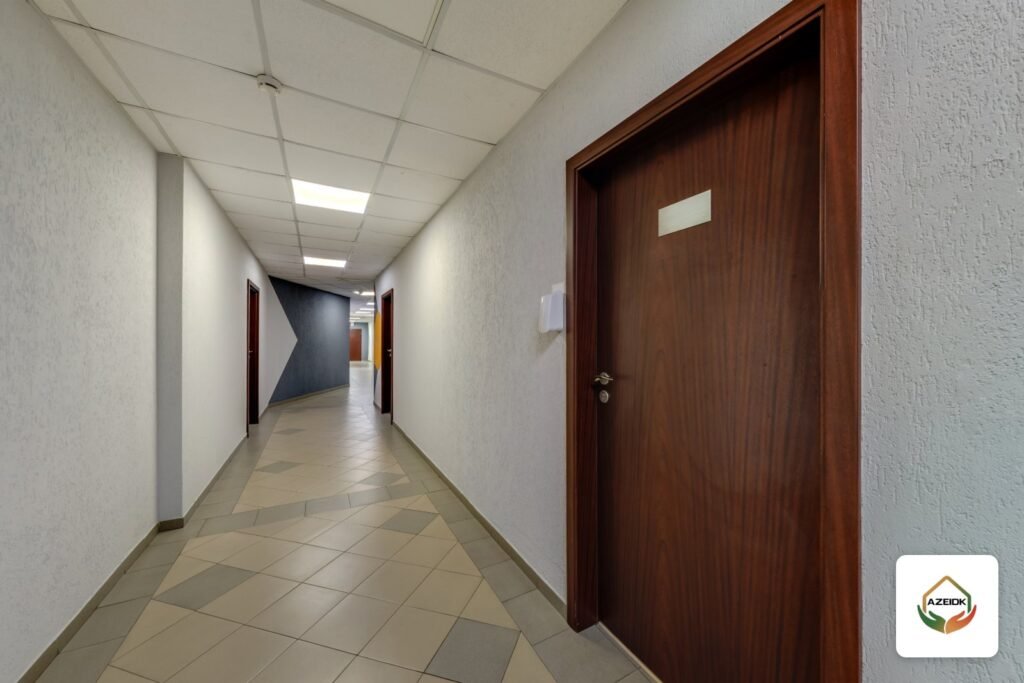
A university hostel or student residence is a building where hundreds of young people sleep in rooms side by side, cook in shared floor kitchens and charge phones and devices all night. That makes fire safety in student housing close to hotels in its risks, but different in resident behaviour, floor density and the way the building is run.
This article covers what public and private university housing and private student residences in Egypt need in fire detection and alarm, extinguishers and floor kitchen protection, within the solutions supplied by AZEIDK Egypt. It complements our article on fire protection in schools and universities, which focuses on teaching buildings.
Key takeaways
- The biggest risk in student housing is a night fire while residents sleep, so early detection in rooms and corridors comes first.
- As a technical reference, NFPA 101 treats group sleeping for more than 16 people as a dormitory, within its hotels and dormitories chapters.
- Floor kitchens need heat detectors rather than smoke detectors to cut false alarms, plus a suitable extinguisher and gas control.
- Large multi-storey buildings suit an addressable system that pinpoints the room or corridor.
- Repeated false alarms are the biggest threat to safety, because they teach students to ignore a real alarm.
In this article
- Why student housing differs from teaching buildings
- Alarm in rooms and corridors
- Conventional or addressable for university housing
- Floor kitchens and extinguishers
- False alarms and students’ trust in the alarm
- The role of housing management and supervisors
- Common mistakes in fire safety in student housing
- Frequently asked questions
- Conclusion
Why student housing differs from teaching buildings
A faculty building fills by day and empties at night, with staff awake throughout. Student housing fills at night, and residents are asleep in the hours when fire is detected slowest. Students also bring their own electrical items such as small heaters, kettles, chargers and multi-plug adaptors, and may cook in rooms despite the rules.
NFPA 101 (2024 edition) treats a building that provides group sleeping for more than 16 people who are not one family, under one management and without separate cooking in each unit, as a dormitory within its hotels and dormitories chapters. That is a useful design reference. The binding requirement in Egypt is the 2026 Egyptian fire code and Civil Protection requirements based on building height and capacity.
Alarm in rooms and corridors
According to a published technical summary of NFPA 101 for hotels and dormitories, new dormitories require a fire alarm system and smoke alarms in every sleeping room, with visible notification for people with hearing impairment. In Egyptian university housing, detection can be arranged as follows:
| Space | Detector or device | Note |
|---|---|---|
| Bedrooms | Optical smoke detector | Early warning for sleeping occupants |
| Corridors | Optical smoke detector, sounders and beacons | Sound must be heard inside closed rooms |
| Floor kitchens | Heat detector | Reduces false alarms from cooking vapour |
| Laundry and ironing rooms | Heat or smoke detector as conditions require | Irons and dryers are continuous heat sources |
| Electrical and meter rooms | Smoke detector | With a CO2 extinguisher by the door |
| Entrances and stair landings | Manual call points and smoke detector | A call point at every exit |
Context Plus Series 65A detectors include optical smoke and heat detectors, and addressable sounders are available at 91, 96 and 103 dB with beacons, as covered in Context Plus addressable sounders. Sound level and number of devices depend on corridor length and how well room doors insulate.
Conventional or addressable for university housing
A private student residence in a small building of a few floors may suit a conventional system with a Context Plus CFP or FP panel, one zone per floor. Large university housing with hundreds of rooms across several buildings suits an addressable system with ZFP panels. The panel shows which detector triggered, meaning the exact room or corridor, so the supervisor reaches it within minutes instead of searching a whole floor.
An addressable system also allows a planned verification delay in some areas and linking buildings to a central security room. The difference is explained in Context Plus fire alarm panels.
Floor kitchens and extinguishers
The shared floor kitchen is the most likely place for a fire to start, especially with oil cooking and food left on the stove. Practical protection includes:
- A heat detector in the kitchen instead of a smoke detector, because cooking vapour causes repeated false alarms.
- A suitable extinguisher near the kitchen door, and no water on an oil fire.
- Shutting off gas at the end of the day, and no gas cylinders in rooms.
- If the kitchen becomes a central commercial kitchen for the campus, it needs a hood suppression system such as HoodSafer.
In corridors, PYRAMID powder extinguishers of suitable size are placed near stairs, with CO2 units by electrical rooms. Hose reel cabinets connected to the fire water network can be added as the building design requires.
False alarms and students’ trust in the alarm
In student housing, false alarms come from cooking in rooms, smoking, shower steam and sometimes tampering with call points. Each false alarm makes students less willing to leave when a real one sounds, and management may be tempted to silence the system, the most dangerous decision possible.
The fix starts at design: the right detector type for each room, detectors kept away from bathroom doors, protective covers on call points in areas exposed to tampering, then tracking the alarm log and analysing causes. See choosing smoke and heat detectors for detector selection.
The role of housing management and supervisors
The best alarm system will not protect students without management that follows it up. In university and private housing, management should set clear written responsibilities:
| Responsibility | Who | Suggested frequency |
|---|---|---|
| Watching the alarm panel and logging every fault or alarm | Building security or duty supervisor | Every shift |
| Walking corridors and exits to confirm they are open and clear | Floor supervisor | Daily, especially at night |
| Visual check of extinguishers and pressure gauges | Housing safety officer | Monthly, as NFPA 10 recommends |
| Reviewing which electrical items are allowed in rooms | Housing management | Start of every semester |
| Periodic maintenance of alarm, extinguishers and hose cabinets | Specialist maintenance company under contract | As per contract and manufacturer instructions |
Housing rules should list the items banned in rooms, such as open-element heaters and cooking appliances, and each student should receive a copy with a short explanation of the escape route from their room at check-in.
Common mistakes in fire safety in student housing
- Relying on corridor extinguishers with no detection in rooms.
- Smoke detectors in floor kitchens causing daily alarms, so they get disconnected.
- Sounders that cannot be heard inside closed rooms.
- Chaining a floor exit shut at night for security reasons.
- Allowing multiple adaptors and small heaters in rooms without control.
- No evacuation drill at the start of the academic year, coordinated with housing management.
Frequently asked questions
Does student housing need a fire alarm system?
The Egyptian code and Civil Protection requirements set the obligation by building size and use. As a technical reference, NFPA 101 requires a fire alarm in new dormitories.
Where should smoke detectors go in university housing?
In bedrooms, corridors, entrances and electrical rooms, with heat detectors in kitchens and laundry rooms.
Why not fit a smoke detector in a floor kitchen?
Cooking vapour triggers repeated false alarms. A heat detector suits that space better.
Which system suits a large university campus?
An addressable system, because it shows the room or corridor where the alarm started and links easily to a central security room.
Which extinguisher goes in student housing corridors?
An ABC powder extinguisher of suitable size near the stairs, with a CO2 unit by electrical rooms.
How can false alarms be reduced in student housing?
Choose the right detector for each space, keep it away from steam sources, protect call points and track the fault log.
Are lifts used to evacuate student housing?
No. Evacuation is by the stairs and marked escape routes, and housing management should explain the way out from each floor at the start of the year.
Conclusion
Fire safety in student housing starts from a simple fact: residents are asleep during the most dangerous hours. Detection in rooms and corridors comes first, then an alarm that can be heard behind closed doors, heat detectors in kitchens to prevent false alarms, extinguishers in corridors, and management that maintains the system instead of silencing it. The earlier these elements are planned at design stage, the lower the cost of later changes and the smoother the Civil Protection approval.
Planning university housing or a private student residence? Send us the number of floors, rooms and floor kitchens and we will suggest a suitable alarm system and extinguishers. Talk to the AZEIDK Egypt team
Related guides
- 1000 GPM Fire Pump from 3PUMP at 10 bar: Datasheet, Curve and Fit
- AFC BFW-300 and BFG-300 Butterfly Valves: Types and Tamper Switch
- Fire Protection BOQ in Egypt: Writing Alarm, Firefighting, Pump and Extinguisher Items
- Fire Extinguishers for Factories in Egypt: Choosing Type and Size for Production Halls, Stores and Electrical Rooms





