A paint or chemical plant differs from other factories in one way: the product it makes and stores can itself be the fuel. Solvents, thinners, resins and flammable liquids make paint factory fire protection a design question from day one, not a few extinguishers hung on the wall before the inspection.
This article covers the hazard zones inside paint and chemical plants in Egypt’s industrial areas, the choice of AFFF foam, dry powder and CO2 extinguishers from PYRAMID, early detection and the fire water network, within the fire extinguisher and fire protection solutions supplied by AZEIDK Egypt.
Key takeaways
- Solvent and flammable liquid fires are Class B. An AFFF foam extinguisher suits them well because it covers the liquid surface and limits re-ignition.
- The solvent store, mixing room and filling area are the highest-risk points and need wheeled units as well as portable extinguishers.
- Under NFPA 10, extra hazard travel distance to a Class B extinguisher is 9.1 m for a 40-B rating and 15.25 m for 80-B.
- High stores are usually covered by beam detectors; small rooms by heat or smoke detectors depending on conditions.
- In Egypt the binding rules are the 2026 Egyptian fire code and civil protection requirements; NFPA is a design reference.
In this article
- Paint factory fire protection: why the risk is higher
- Hazard zones inside the plant
- AFFF foam extinguishers and solvent storage
- Extinguisher numbers and travel distance
- Early detection and alarm
- Fire water network and pumps
- The Egyptian framework
- Common mistakes in paint and chemical plants
- Frequently asked questions
- Conclusion
Paint factory fire protection: why the risk is higher
In most factories a fire starts in a solid such as cardboard or timber and spreads relatively slowly. In a paint plant it can start from solvent vapour that has collected near the floor and reached a spark from a motor or a switch. Many of these vapours are heavier than air, so they travel away from the source and ignite where nobody expects.
One plant can hold several hazards at once: drums of solvent and thinner, pigment and filler powders, resins, plastic and metal containers, packing cardboard, and electrical panels feeding mixers and mills. One extinguisher type for the whole plant is not enough, and neither is one detector type.
Hazard zones inside the plant
| Zone | Hazard | Typical fit |
|---|---|---|
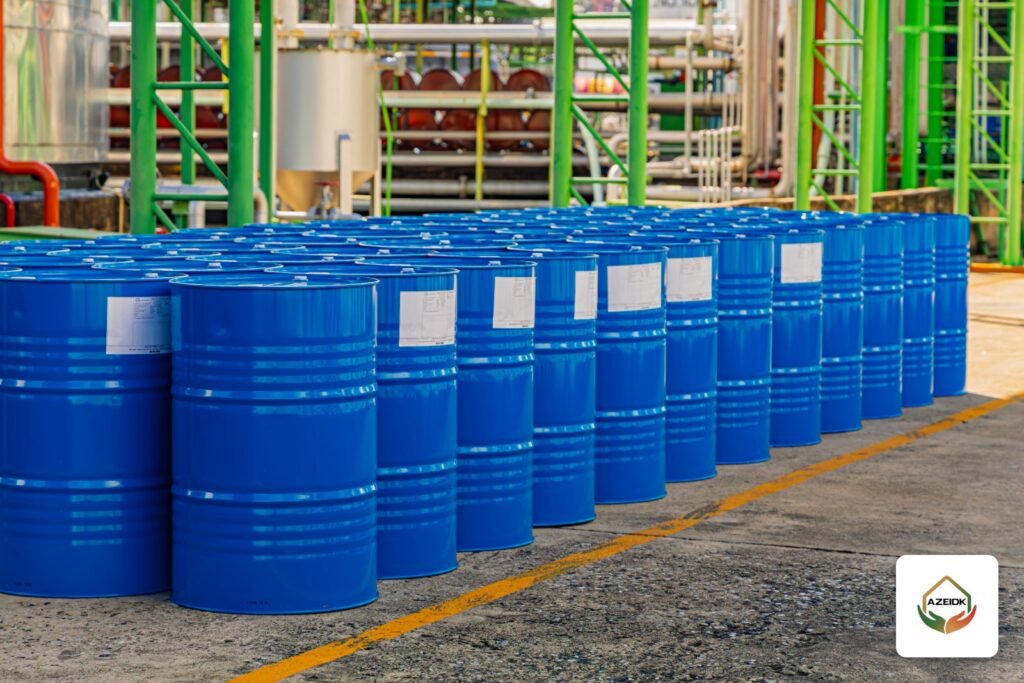
| Solvent, thinner and drum store | Flammable liquids and vapour | Portable and wheeled AFFF foam, heat or beam detection depending on height |
| Mixing and milling room | Solvent vapour, pigment dust, motors | AFFF foam and ABC powder, heat detectors |
| Filling and packing line | Liquid in open containers, cardboard, plastic | AFFF foam and powder, nearby hose cabinets |
| Finished goods store | Closed containers on high racks | Beam detectors, hydrants around the building, wheeled extinguishers |
| Electrical and motor control rooms | Electrical fire | CO2 extinguishers, smoke detectors |
| Laboratory and QC | Small amounts of solvent and samples | CO2 and a small foam extinguisher |
AFFF foam extinguishers and solvent storage
An AFFF foam extinguisher forms an aqueous film over the burning liquid. It separates the vapour from the air and reduces the chance of flashback after the fire is out, which is why it is the first choice for solvent stores and filling areas. AZEIDK Egypt supplies PYRAMID foam extinguishers in 6 and 9 L portable and 25 and 45 L wheeled sizes, to EN3 and Egyptian standard ES 711, approved by the Egyptian Organization for Standardization and Quality (EOS).
In a large drum store a portable unit alone may not match the area of a spill. A 45 L wheeled unit gives a second line of defence that one person can move. See wheeled fire extinguishers for sizing.
Storage habits that support protection
- Separate the solvent store from finished goods and from electrical rooms.
- Keep drums closed and do not leave open containers after the shift.
- Provide a bund or floor slope so a spill stays inside the store.
- Keep clear aisles to extinguishers and hose cabinets.
- Ventilate to stop vapour build-up, with electrical fittings suited to the area as specified by the consultant.
These are good practice points. The binding details come from the Egyptian code and civil protection requirements for each project. Designers usually refer to NFPA 30 as the technical reference for flammable liquid storage.
Extinguisher numbers and travel distance
NFPA 10 sets the maximum travel distance to a Class B extinguisher by rating: in extra hazard areas 9.1 m for a 40-B unit and 15.25 m for an 80-B unit. Class A extinguishers must be within 22.9 m. Solvent and filling areas are usually treated as extra hazard in design.
NFPA 10 also sets mounting height: for extinguishers up to about 18 kg the top must be no more than 1.53 m above the floor, heavier units no more than 1.07 m, with at least 102 mm clearance below. More detail in how many extinguishers you need.
Early detection and alarm
In high stores, point detectors on the roof are hard to maintain, so a beam detector such as TANDA TX7130 or Context Plus 55000-268 is used; each covers a wide area of ceiling along the beam path. In mixing rooms with vapour and dust a heat detector is usually preferred, because dust can cause false alarms in smoke detectors.
AZEIDK Egypt supplies Context Plus conventional and addressable panels. In a medium or large plant an addressable panel shows exactly where the alarm came from, which matters when stores and halls are spread across the site. Detector selection is covered under fire alarm systems.
Fire water network and pumps
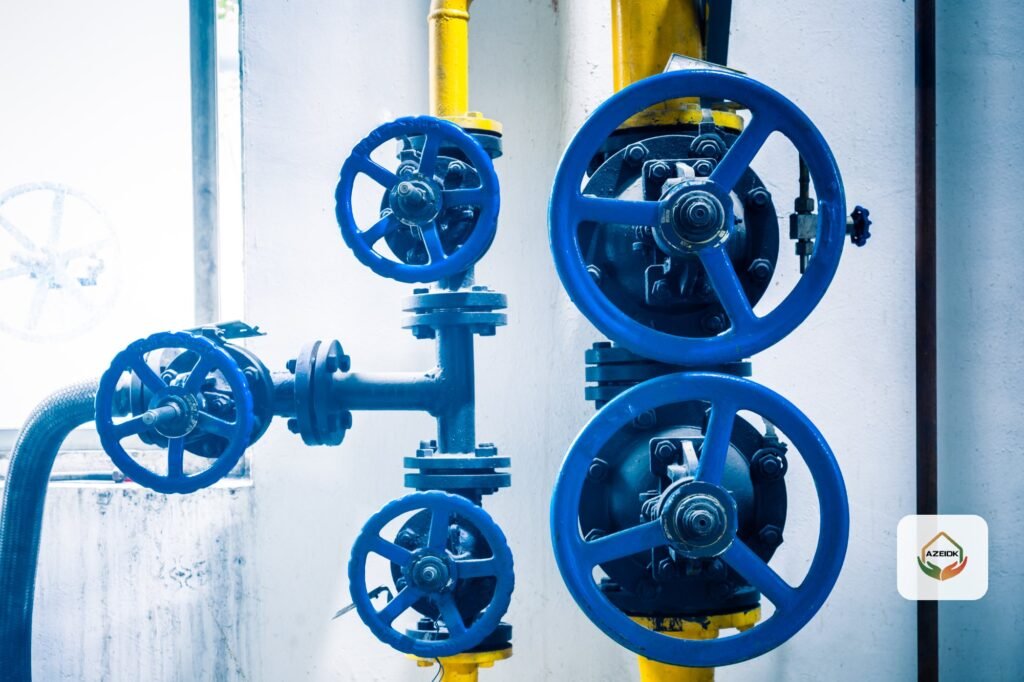
Extinguishers only deal with a fire at its start. The plant needs a fire fighting network with a pump set such as 3PUMP (electric, diesel and jockey on a common base), Falcon Gold hose cabinets in the halls, AFC FW-9000 hydrants around the buildings, and a fire department (Siamese) connection so fire engines can feed the system. 3PUMP sets supplied in Egypt are Non-Listed; UL/FM versions are manufactured and supplied on request.
For solvent stores the consultant may call for a foam system or special sprinkler design. That decision depends on quantities and area, and no number of extinguishers replaces it.
The Egyptian framework
In Egypt the obligation comes from Building Law No. 119 of 2008 and its regulations, the Egyptian Code for the Design and Implementation of Fire Protection for Buildings, 2026 edition (Ministerial Decree No. 355 of 2026), and the General Directorate of Civil Protection (Ministry of Interior), which reviews drawings and inspects before occupancy. There is also an Egyptian code for fire protection of industrial and storage facilities. NFPA 10 and NFPA 30 are technical design references, not a substitute for the Egyptian code.
Common mistakes in paint and chemical plants
- Relying only on powder extinguishers in a solvent store, where AFFF foam suits liquid fires better.
- Putting a water jet directly on a burning liquid, which spreads the liquid and the fire.
- Stacking drums in front of extinguishers and hose cabinets.
- Fitting smoke detectors in a dusty milling room, then disabling them after false alarms.
- Leaving open containers and solvent-soaked rags at the end of the day.
- Skipping inspection of extinguishers after a drill or a minor incident.
Frequently asked questions
What is the best extinguisher for a thinner and solvent store?
AFFF foam is the best fit for flammable liquid fires, with a wheeled unit in large stores and ABC powder as a complement.
Can CO2 extinguishers be used in a paint plant?
Yes, mainly for electrical panels, the lab and small rooms. In open areas the gas disperses quickly, so it should not be the only protection for solvents.
What travel distance applies in a solvent area?
NFPA 10 extra hazard: 9.1 m for a 40-B unit or 15.25 m for 80-B. The binding distance for your project comes from the Egyptian code and the consultant.
Which detector suits a mixing room?
Usually a heat detector, since dust and vapour can trigger false alarms in smoke detectors. The final choice follows the alarm design.
Are extinguishers enough to license a chemical plant?
No. A plant normally needs a fire network and alarm system under the Egyptian code and civil protection requirements; extinguishers are one part.
What foam extinguisher sizes does AZEIDK Egypt supply?
PYRAMID AFFF in 6 and 9 L portable and 25 and 45 L wheeled sizes.
Conclusion
Paint factory fire protection starts with accepting that the liquid itself is the hazard. Separated solvent storage, portable and wheeled AFFF foam in the right places, detection suited to dust and height, and a fire network sized on real demand all belong to one design, reviewed by the consultant and approved by civil protection.
Fitting out a paint or chemical plant? Send us the layout and the list of stored materials and we will review the extinguishers and detectors with you. Talk to the AZEIDK Egypt team
Related guides
- Wet and Dry Risers in Egyptian Buildings, Towers and Malls: How to Identify Your Riser and Inspect It
- Mixed-Use Building Fire Protection in New Capital and Fifth Settlement
- Fire Alarm Battery Calculation: 24-Hour Standby, Alarm Time and a Worked Example
- Wheeled Fire Extinguishers: When You Need One, Capacity and Agent