In a residential compound, fire protection does not stop at the door of each building or villa. An external network runs under roads and landscaping, linking the central pump room to fire hydrants across the site, and sometimes feeding the building systems as well. A compound fire hydrant network is designed once at the start, yet it serves the site for decades, and planning mistakes are hard to fix once roads are paved and gardens are planted.
This guide explains how the external network is planned in Egyptian residential compounds: the ring main, sectional valves, hydrant locations, the central pump room and phased delivery, using American Fire Control and 3PUMP products supplied by AZEIDK Egypt as part of its fire fighting systems.
Key takeaways
- A ring main that feeds hydrants from two directions, with sectional valves, lets you isolate part of the network for repair without shutting down the whole compound.
- Under NFPA 24, a fire hydrant is not located closer than 40 ft (about 12.2 m) to the building it protects.
- The AFC FW-9000 is a wet barrel hydrant with one 4.5 in pumper outlet, two 2.5 in hose outlets and a 6 in flanged inlet, rated for 0 to 80 °C operation.
- The central pump room is sized for the largest demand on the whole site, allowing for later phases.
- The approved design under the 2026 Egyptian fire code and civil protection approval are binding. NFPA 24 is a technical reference.
In this article
- What a compound fire hydrant network includes
- Ring main and sectional valves
- Hydrant locations in a compound
- The AFC FW-9000 hydrant in a compound network
- Central pump room and phased delivery
- Testing, handover and operation after handover
- Common mistakes in compound fire networks
- Frequently asked questions
- Conclusion
What a compound fire hydrant network includes
The external network in a compound usually consists of the fire water tank, a central pump room, buried mains, isolation and sectional valves, fire hydrants along the internal roads, and supply connections to the buildings that need hose cabinets or sprinklers. Each building keeps its fire brigade inlet (Siamese connection) so fire engines can boost the internal system.
The hydrants are not for residents. They serve the fire brigade and the trained on-site security team, protecting buildings from outside and supplying hose lines to any building or service area. So their layout is based on reaching every building from the road, not only on the distances between villas.
Ring main and sectional valves
The simplest network is a single line running from the pump room to the far end of the site. Its weakness is that any break in the middle cuts water to everything beyond it. Common engineering practice on large sites is therefore a ring main (loop) around the buildings that feeds each hydrant from two directions, with sectional valves dividing the loop into segments. For a repair, only two valves are closed and the rest of the compound stays protected.
Each hydrant branch also gets an isolation valve, so the hydrant can be serviced or replaced without closing the main. AFC valves supplied by AZEIDK Egypt include the A-3000 and AG-3000 OS&Y gate valves with flanged or grooved ends, and the A-3150 flanged and A-3500 grooved check valves. See our articles on AFC OS&Y gate valves and AFC A-3150 and A-3500 check valves.
The practical rule is that every valve must have a known location and a number on the final as-built drawing and on site. Years later, the maintenance team will not find a valve buried under a garden unless it was recorded.
Hydrant locations in a compound
NFPA 24, as applied in guidance based on its 2022 edition, says a fire hydrant shall not be closer than 40 ft (about 12.2 m) to the building it protects. The reason is practical: a hydrant right next to a burning building may be unreachable because of heat or falling facade parts.
| Planning item | What to check | Note |
|---|---|---|
| Distance from the building | Not less than 40 ft (about 12.2 m) per NFPA 24 | Unless the approved design states otherwise |
| Access | At the edge of an internal road a fire engine can reach | Not behind villa walls or inside private gardens |
| Protection from vehicles | Away from road bends and car park entrances | Review vehicle movement on site |
| Visibility | Not hidden by trees or signs | Coordinate with the landscape design |
| Coverage | Every building and service area reachable by hose | Per the approved design and the Egyptian code |
| Branch valve | An isolation valve on each hydrant branch | For maintenance without closing the main |
The AFC FW-9000 hydrant in a compound network
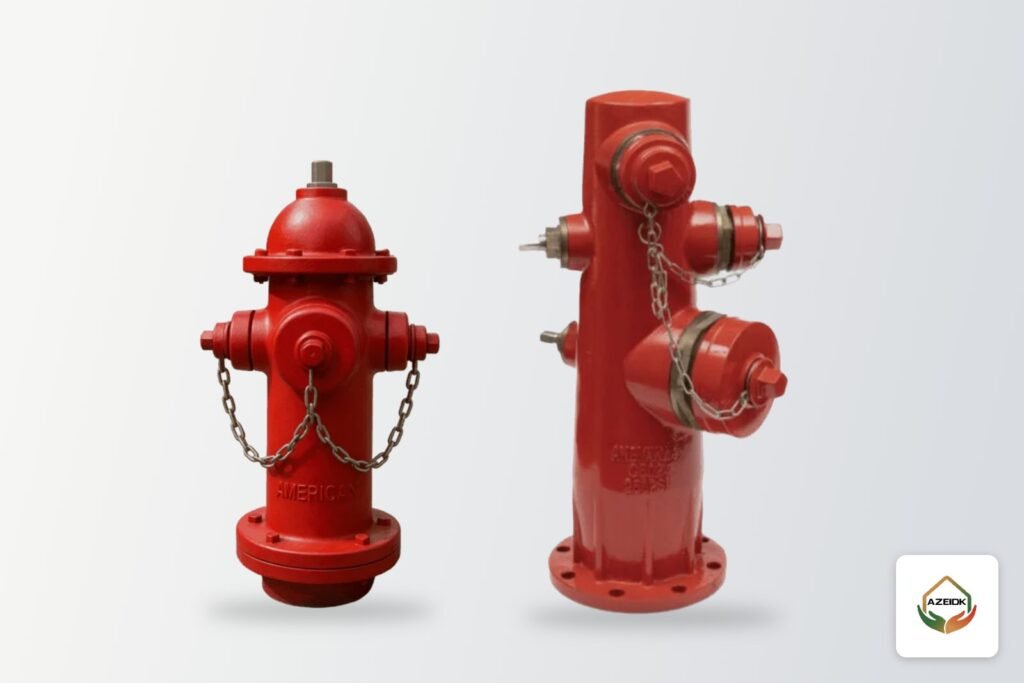
A wet barrel hydrant is filled with water up to the outlets, and each outlet has its own valve. It suits the Egyptian climate, where water does not freeze in the hydrant. The AFC FW-9000 is a wet barrel hydrant with one 4.5 in pumper outlet for the fire engine, two 2.5 in hose outlets, a 6 in Class 150 flanged inlet, a 250 psi working pressure and an operating temperature range of 0 to 80 °C, according to its datasheet, which also states that every unit is factory tested at 500 psi. That is the factory test of the hydrant itself; the site test of the network is covered in the testing section below. Because the inlet is 6 in, the hydrant branch and the main are sized to suit.
Full specifications, installation and acceptance tests are covered in our article on AFC FW-9000 fire hydrants in Egypt, so we do not repeat them here.
Central pump room and phased delivery
Most compounds in Egypt are delivered in phases. A frequent mistake is to size the pump room for phase one only, then discover in phase three that a bigger pump or a second room is needed. The better approach is to calculate the largest demand for the whole site from the start and to leave ready connections and valves on the main for future extensions.
3PUMP sets are available in Egypt at 500 GPM @ 8 bar, 750 @ 9, 1000 @ 10, 1500 @ 10 and 1500 @ 12 bar (datasheet coming soon). Each set has an electric main pump, a diesel standby pump and a jockey pump with controllers on a single base. The sets available in Egypt are Non-Listed, and UL/FM versions are manufactured and supplied on request. Duty point selection is covered in our article on selecting 3PUMP fire pump sets, and the pump room fit-out in our article on fire pump rooms in Egypt.
Testing, handover and operation after handover
Before final backfilling and handover of any part of the network, it is pressure tested. NFPA 24 (2022 edition, as cited by Sacramento Metropolitan Fire District) calls for a hydrostatic test of the piping and appurtenances at 200 psi for at least two hours, or at 50 psi above the system working pressure where that is higher. Lines are flushed until the water runs clear, and thrust blocks or restraint are installed where the pipe changes direction. With phased delivery, each new section is tested before it is connected to the live network.
After handover, responsibility usually passes to the compound management company. It needs three things: a clear as-built drawing showing valves and hydrants, a routine inspection and maintenance schedule, and a maintenance contract with a specialist. What such a contract covers is explained in our article on fire system maintenance contracts in Egypt.
Common mistakes in compound fire networks
- A single-line network with no loop and no sectional valves, so the whole site stops at any break.
- Hydrants right against building facades or inside villa walls.
- Trees and signs that hide hydrants after handover.
- Sizing the pump room for phase one only.
- Buried valves with no numbering and no as-built drawing.
- Connecting a new phase to the live network before pressure testing and flushing it.
Frequently asked questions
Why is a ring main better than a single line?
It feeds each hydrant from two directions, and with sectional valves only the damaged segment is isolated while the rest of the compound stays protected.
What is the minimum distance between a hydrant and a building?
Under NFPA 24, not less than 40 ft (about 12.2 m) from the building it protects, unless the approved design states otherwise.
Is a wet barrel hydrant suitable for Egypt?
Generally yes, because water does not freeze inside the hydrant in the Egyptian climate. The AFC FW-9000 operates from 0 to 80 °C.
Does every building in the compound need its own pump?
Not necessarily. Many compounds use a central pump room feeding the external network and the buildings. The decision depends on the approved design and building heights.
How is the compound network tested before handover?
A hydrostatic test at 200 psi, or 50 psi above the system working pressure where that is higher, for two hours per NFPA 24, plus flushing and operating every hydrant.
Conclusion
A compound fire network is planned once to serve for many years: a ring main with sectional valves, visible hydrants on the roads set back from buildings, a central pump room sized for the whole site, testing of each phase before connection, and an as-built drawing that tells the maintenance team where every valve is. These decisions are cheap on paper and very expensive if they are left until after paving and planting.
Planning a fire network for a new compound or an extension phase? Send us the master plan and the number of phases, and we will review hydrants, valves and the pump set duty point with you. Talk to the AZEIDK Egypt team