A fire alarm system depends on its fire alarm cables: the wiring that links the panel to detectors, manual call points (MCPs) and sounders. They must keep carrying signals and power after a fire starts, while the building raises the alarm and evacuates. Being red or labelled “fire alarm” is not enough: the cable must be tested to a named standard and installed so it keeps that performance.
This guide covers cable types, the standards used in specifications, installation, testing and common site mistakes.
Key takeaways
- The binding reference in Egypt is the 2026 Egyptian fire code, whose third part covers electrical, detection and alarm requirements. BS, EN, IEC and NFPA are technical references.
- BS 5839-1:2025 separates “standard” fire-resisting cable (PH30 plus a water spray test) from “enhanced” cable (PH120 plus BS 8434-2).
- FPL, FPLR and FPLP under the US National Electrical Code (NEC) rate burning behaviour and location. They do not keep a circuit working in a fire.
- Plastic fixings that fail early can bring down a fire-resisting cable run. The fixing method is part of the performance.
- Before handover, conductors are tested for stray voltage, ground faults, short circuits and loop resistance. Disconnect devices before any high-voltage insulation test.
In this article
- Why fire alarm cables differ from ordinary cables
- Types of fire alarm cable
- British, European and international standards
- Cables under the NEC and NFPA 72
- What drives cable selection on an Egyptian project?
- Installation requirements on site
- Testing fire alarm cables before commissioning
- Common mistakes with fire alarm cables
- Context Plus and fire alarm solutions from AZEIDK Egypt
- Frequently asked questions
- Conclusion
Why fire alarm cables differ from ordinary cables
An ordinary cable loses its insulation once fire reaches it, causing a short or open circuit. In an alarm system that can silence sounders on floors the fire has not reached, cut the link between panels, or lose a control signal such as an AHU shutdown.
This is the idea behind circuit integrity: a cable keeps carrying its signal or current for a set time while exposed to flame. BS 5839-1 recommends fire-resisting cable for critical signal paths and the panel mains supply. The designer decides which circuits must stay live.
Types of fire alarm cable
The types most often seen in Egyptian specifications and offers:
| Type | Technical reference | What it provides | Note |
|---|---|---|---|
| Ordinary cable (PVC or low smoke zero halogen, LSZH) | The cable’s own product standard | Signal transmission in normal conditions | Does not maintain the circuit in a fire |
| Standard fire-resisting cable | BS EN 50200 (PH30) with water spray annex, per BS 5839-1 | Circuit kept for at least 30 minutes in test | Suits most buildings under BS 5839-1 |
| Enhanced fire-resisting cable | BS EN 50200 (PH120) and BS 8434-2 | Circuit kept for 120 minutes in test | Large or complex buildings, or long evacuation times |
| Fire-resistant cable to IEC 60331 | IEC 60331-1 / IEC 60331-2 | Circuit integrity in flame of at least 830 °C with mechanical shock | Common in European and Asian manufacturers’ catalogues |
| FPL / FPLR / FPLP cables | NEC Article 760, UL 1424 | Cable for power-limited fire alarm circuits, rated by installation location | Not a fire-resisting cable in the sense above |
| 2-hour circuit integrity (CI) cable | UL 2196, used to meet NFPA 72 survivability levels | Circuit kept for two hours as part of a tested system | Install with the accessories and spacing in its listing |
British, European and international standards
BS 5839-1:2025: standard and enhanced
The new edition of BS 5839-1 came into effect on 30 April 2025, replacing the 2017 edition. It keeps two grades of fire-resisting cable. Standard cable must achieve PH30 when tested to BS EN 50200, together with the water spray test in its Annex E. Enhanced cable must achieve PH120 to BS EN 50200 and pass BS 8434-2, which includes water spray. The minimum conductor size stays at 1 mm². Red is the preferred colour for fire alarm cables, and black or white cables should not be used.
BS EN 50200 and BS 7629-1
BS EN 50200 (2015 edition) is a test method, not a product specification. It covers cables up to 20 mm diameter and 600/1000 V, exposed to direct flame at a nominal 842 °C. BS 7629-1 is a British product specification for 300/500 V fire-resistant screened cables with low emission of smoke and corrosive gases.
IEC 60331
The IEC 60331 series tests circuit integrity of cables under fire. Part 1 (2018 edition) covers cables over 20 mm in diameter, in flame of at least 830 °C with mechanical shock. Part 2 covers smaller cables. “Complies with IEC 60331” on a datasheet means little unless the part and test duration are stated.
Cables under the NEC and NFPA 72
On projects that follow US references, you will see FPL for general use, FPLR for vertical risers between floors, and FPLP for air-handling spaces (plenums), under NEC Article 760, listed to UL 1424. This rating covers flame and smoke spread and location, not circuit survival.
Circuit survival is handled in NFPA 72 through pathway survivability levels. Level 2, for example, is met by one of several methods, including a 2-hour fire-rated circuit integrity (CI) cable, a 2-hour fire-rated cable system, or a route inside a 2-hour fire-rated enclosure. These cables are usually tested to UL 2196, and the listing covers the fixing method and accessories.
What drives cable selection on an Egyptian project?
Part three of the Egyptian Code for the Design and Implementation of Fire Protection for Buildings — 2026 edition (Ministerial Decree No. 355 of 2026) sets the binding framework for electrical requirements and detection and alarm. The General Directorate of Civil Protection (Ministry of Interior) reviews drawings and systems before occupancy. The project specification usually adopts one reference set for cables, British or American. Do not mix them in one system. For the legal framework, see our guide to fire protection requirements in Egypt.
Practical selection points:
- Circuit function: detector loop, sounder circuit, panel-to-panel network, mains supply, or a control signal to another system.
- Required survival time: standard or enhanced, or a defined NFPA 72 survivability level, based on building size and evacuation strategy.
- Panel manufacturer’s requirements: conductor size, maximum loop length, loop resistance and capacitance, and whether screened cable is needed, as given in the installation manual for that model.
- Sounder circuit voltage drop: calculate it from device current and cable length.
- Installation environment: damp, exposed or buried-conduit routes need the right sheath and mechanical protection.
- Documents: datasheet and independent test certificates for the same cable type and size.
Installation requirements on site
Fixings and support
A fire-resisting cable is tested while fixed in a specific way. With plastic clips or unsupported plastic trunking, the run can drop when the clips melt, before the cable fails. Fire alarm standards therefore call for fixings and supports that survive the fire for the same time, usually metal. BS 7671 also requires wiring to be supported against premature collapse in a fire, so hanging cables do not trap firefighters.
Segregation from other cables
Keep fire alarm cables apart from power and other systems. The NEC, for example, asks for at least 2 inches (about 50 mm) between fire alarm cables and power conductors outside raceways, or a listed barrier where they share a raceway. Under British references, follow BS 5839-1 and BS 7671.
Loops, joints and penetrations
- In an addressable system, route the outgoing and return legs of a loop separately where possible, so a single incident cannot cut both.
- Minimise joints. On fire-resisting circuits, use junction boxes and terminals that keep the fire performance.
- Earth the screen only at the point the panel manufacturer specifies.
- After cabling, seal penetrations through fire-rated walls and slabs with tested firestop materials.
Testing fire alarm cables before commissioning
The acceptance test table in NFPA 72 (2025 edition) lists four tests for metallic conductors before the system is connected and energised:
| Test | Purpose | Acceptance criterion |
|---|---|---|
| Stray voltage | Confirm there is no unwanted voltage between conductors or to ground | Not more than 1 V ac or dc, unless the manufacturer states otherwise |
| Ground fault | Confirm that ungrounded conductors are isolated from ground | Per the equipment manufacturer’s instructions |
| Short circuit | Confirm conductors are isolated from each other | No connection between conductors not meant to be joined |
| Loop resistance | Measure each circuit’s resistance with its far end shorted | Within the equipment manufacturer’s limits |
Under British practice, cables are insulation-tested with an insulation tester (“megger”) at the test voltage and minimum value set by BS 5839-1 and the cable manufacturer. Disconnect detectors, modules and devices first, because the test voltage can damage them. Record results on the as-built drawings. For periodic inspection after handover, see AZEIDK Egypt services.
Common mistakes with fire alarm cables
- Supplying red cable as “fire-resisting” without a test certificate for that exact type and size.
- Treating FPLR or FPLP cable as fire-resisting, or mixing US and British references in one specification.
- Fixing fire-resisting cable with plastic clips or in plastic trunking without metal support.
- Running the outgoing and return legs of a loop on the same route, which defeats the purpose of a closed loop.
- Exceeding the loop length or resistance allowed in the panel installation manual.
- Megger testing with devices still connected.
Context Plus and fire alarm solutions from AZEIDK Egypt
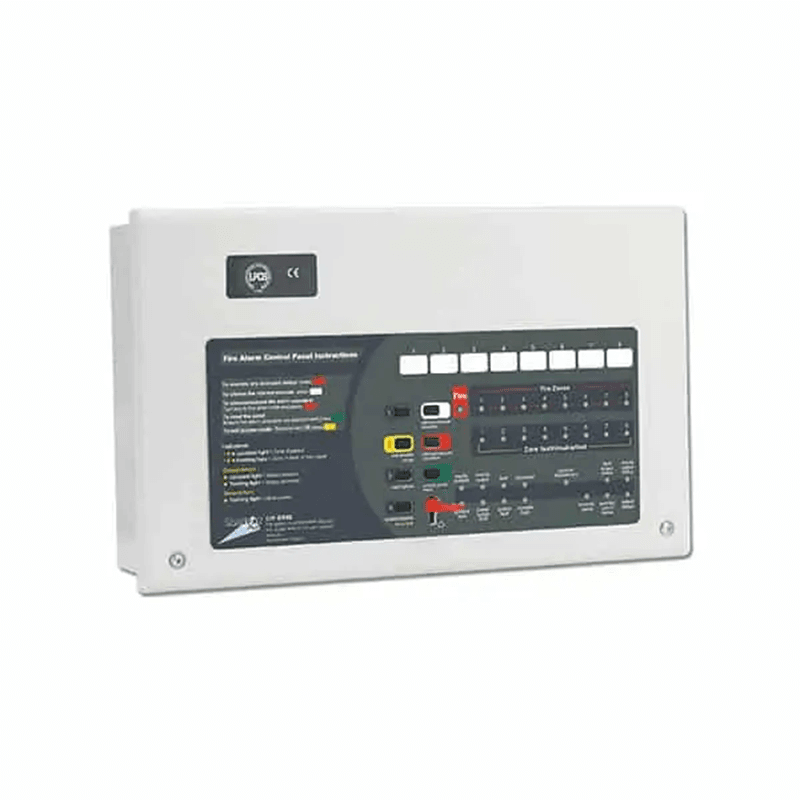
As part of its fire alarm solutions, AZEIDK Egypt supplies equipment from British manufacturer Context Plus: conventional and addressable panels, detectors, manual call points, sounders and beacons, and input/output modules. Approvals vary by model (EN 54 conformity or UL listing), so check each datasheet. Each panel’s installation manual sets the cable specification and loop lengths for the BOQ. For a comparison of the two system types, see conventional vs addressable fire alarm systems.
Frequently asked questions
Is every red cable marked “Fire Alarm” fire-resisting?
No. Colour and marking do not prove performance. Fire resistance is proven by a test certificate to a named standard, such as BS EN 50200, IEC 60331 or UL 2196, for that exact cable type and size.
When is enhanced cable needed instead of standard?
Under BS 5839-1, standard cable suits most buildings. Enhanced cable is for large or complex buildings or longer evacuation. The designer decides.
Does FPLR cable keep the circuit working in a fire?
No. FPLR is a rating for fire alarm cable allowed in vertical risers, based on how it behaves when burning. Circuit survival needs CI cable or a rated protective system.
What cable size suits an addressable loop?
The panel installation manual sets it, based on loop length, number of devices and their current. BS 5839-1 sets a 1 mm² minimum, but the calculation may need more.
Conclusion
Fire alarm cable is part of system performance, not a minor BOQ line. Start with circuit function, survival time and the adopted reference set, then the panel manufacturer’s requirements and the cable’s test certificate. On site, fixings, segregation and testing decide whether it works in a fire.
Preparing a cable specification for a fire alarm system? Send us the panel model, number of loops and building layout, and we will review the cable requirements and approval documents with you. Talk to the AZEIDK Egypt team