A cloud kitchen in New Cairo, Sheikh Zayed or Nasr City serves no dine-in customers, but it runs long hours for several brands under one roof: fryers, grills and gas ranges side by side, hoods and ducts that may be shared, and delivery orders that never stop. That is why cloud kitchen fire suppression needs different planning from a single restaurant kitchen with one owner and one hood.
This article covers how to split a cloud kitchen into stations, whether to fit one system per hood or one system along the whole hood line, which extinguishers the store and packing areas need, and who maintains what when tenants change. The AZEIDK Egypt solution here is kitchen fire suppression with HoodSafer systems.
Key takeaways
- Each cooking station’s hood needs a fixed suppression system over the appliances, in the plenum and at the duct. A portable extinguisher alone is not enough.
- A separate system per station makes responsibility and maintenance clear when a tenant changes. A shared system needs clear coordination between operator and brands.
- HoodSafer HS is fully mechanical, actuates automatically on heat or manually from a pull station, and shuts the gas valve on discharge.
- NFPA 96 lists quarterly grease inspection for high-volume cooking such as 24-hour operation, charbroiling and wok cooking.
- Licensing includes an inspection with civil protection, and the binding reference is the Egyptian fire code, 2026 edition.
In this article
- What makes a cloud kitchen a special case?
- Cloud kitchen fire suppression: one system per hood or a shared system?
- How HoodSafer works at a cloud kitchen station
- Gas valve and alarm interface
- Extinguishers in a cloud kitchen: not only at the cooking line
- Cleaning and maintenance when brands change
- Licensing and civil protection
- Common mistakes in cloud kitchens
- Frequently asked questions
- Conclusion
What makes a cloud kitchen a special case?
A traditional restaurant has one owner, one kitchen and a head chef who knows every appliance. A cloud kitchen is usually a building or floor run by one operator who leases stations to different brands, each bringing its own appliances and cooking style. A burger brand with a grill and two fryers, a fried chicken brand with deep fryers, an Asian brand with high-flame woks, all on one line.
That mix changes three things. Grease load in the ducts is higher because cooking is continuous. Appliances change whenever a tenant changes, so a system designed for the old brand may not match the new one. And responsibility is split between the operator, who owns the building and duct, and the brand, which owns the appliances and cooks on them.
Cloud kitchen fire suppression: one system per hood or a shared system?
The working rule is that each hood is protected by a system covering three zones: the appliance surfaces below, the filter plenum and the duct opening. The HoodSafer model is chosen by the number of flow points needed: HS-4, HS-8 and HS-16 mean 4, 8 and 16 points. Flow point counting is explained in choosing a restaurant and cafe kitchen system, so we will not repeat it. In a cloud kitchen the real question is how to divide the system.
| Option | When it fits | What to watch |
|---|---|---|
| Separate system per station and hood | Separate stations per brand, each with its own hood | One discharge does not stop other stations, and maintenance and responsibility are clear per brand |
| One system for a long hood line serving several stations | Continuous hood over a row of appliances run by the operator | Any appliance change at one station means reviewing the whole design, and more than one cylinder may need linking per the manufacturer’s manual |
| Common vertical duct for several hoods | Buildings that collect exhaust into one riser to the roof | Duct opening protection at every hood, and a cleaning schedule for the shared riser under the operator |
In most cloud kitchens that lease separate stations, a system per station is the clearest choice: an outgoing brand takes its appliances, and the incoming brand’s system is reviewed against its own equipment. The final decision sits in the design approved by civil protection.
How HoodSafer works at a cloud kitchen station
HoodSafer HS is fully mechanical and needs no pressurised components for actuation. Fusible links hang on a tensioned cable inside the hood. When heat rises, a link breaks, the release mechanism operates, wet chemical agent flows to the nozzles and the gas valve closes at the same moment. It can also be operated manually from the pull station. The HSP series uses pneumatic detection.
Link temperature matters in a cloud kitchen because neighbouring stations differ. The system manual published by AZEIDK lists three ratings: 141, 182 and 260 °C, the last for grills and open flame. Put a low-rated link over a new brand’s grill and the system may discharge with no fire, stopping the kitchen at peak time. Components are covered in HoodSafer kitchen system components.
The system is tested to EN 17446:2021, holds BSI Kitemark KM 767382 and is approved by the General Directorate of Civil Protection in Egypt.
Gas valve and alarm interface
In a cloud kitchen, gas may come from a main line branching to the stations. The design sets what closes when one station’s system discharges: that station’s valve only, or the main valve. What matters is that no gas appliance keeps running under a hood whose system has discharged. Where the building has a fire alarm system, the discharge signal goes to the alarm panel so the operator knows which station is affected, and the hood fan is stopped or kept running as the design specifies.
Extinguishers in a cloud kitchen: not only at the cooking line
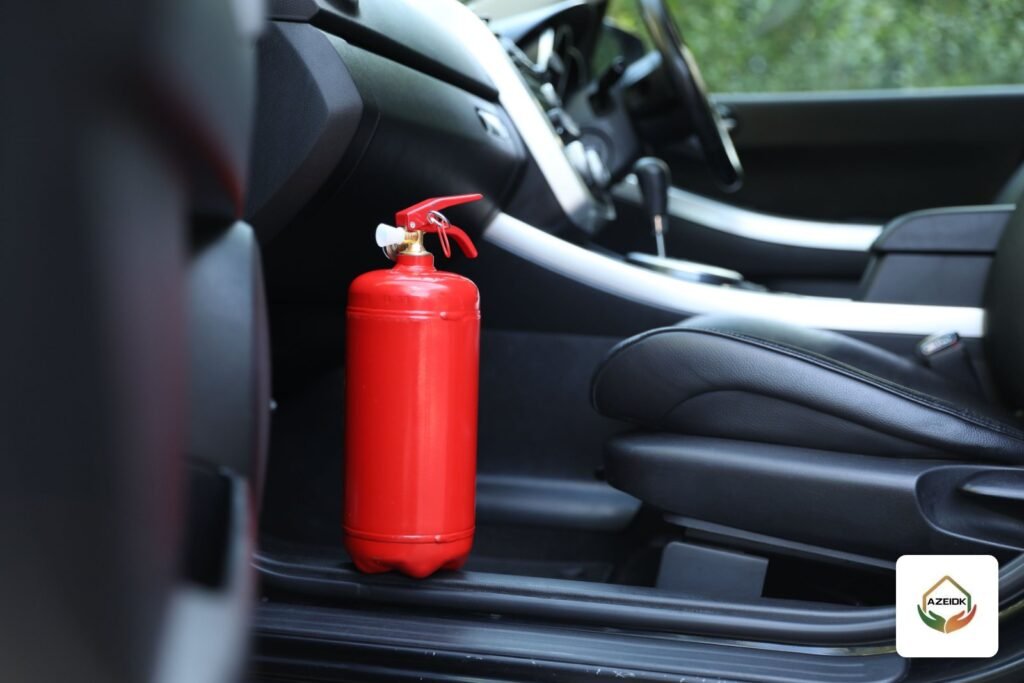
NFPA 10 classes cooking areas as extra hazard and limits travel distance from cooking appliances to a Class K extinguisher to 9.1 m (30 ft). A cloud kitchen also has areas customers never see: the cardboard and packaging store, the order packing and rider pick-up area, and electrical panels feeding dozens of appliances.
| Area | Suggested protection |
|---|---|
| Hood line and appliances | Fixed HoodSafer system, plus a nearby Class K extinguisher per NFPA 10 |
| Cardboard and packaging store | ABC dry powder extinguisher from PYRAMID, for example 6 or 9 kg depending on area |
| Electrical panels | PYRAMID CO2 extinguisher, which leaves no residue |
| Order pick-up and corridors | ABC dry powder extinguisher on the exit route |
PYRAMID dry powder and CO2 extinguishers conform to the Egyptian standards for each type and are approved by the Egyptian Organization for Standardization and Quality. The Class K extinguisher is chosen per the design and does not replace the fixed system over the appliances.
Cleaning and maintenance when brands change
A Massachusetts fire services guide reproduces the NFPA 96 (2011 edition) grease inspection schedule for exhaust systems: monthly for solid fuel cooking such as charcoal, quarterly for high-volume cooking such as 24-hour operation, charbroiling or wok cooking, and every six months for moderate-volume cooking. A cloud kitchen running from noon to dawn is usually closer to high volume. These are NFPA reference figures; what binds you is the approved design and civil protection.
The suppression system itself needs periodic inspection and link replacement per the manufacturer’s manual, covered in HoodSafer kitchen system maintenance. In a cloud kitchen, add two points to the lease: a system review whenever a new brand moves in or changes appliances, and who pays for periodic maintenance and cleaning of the shared duct.
Licensing and civil protection
Licensing of public establishments falls under Public Establishments Law No. 154 of 2019. The pre-licence inspection includes a civil protection representative, and administrative closure is allowed for violations of safety and civil protection requirements, as explained in the Ministry of Local Development and Environment guide reported by Masrawy in July 2026. The guide also sets out safety rules for activities handling gas, kitchens and ovens. For the equipment usually checked, see civil protection requirements for shops.
Common mistakes in cloud kitchens
- Designing the system for the first brand’s appliances, then a new brand moves in with different equipment and no review.
- Leaving the shared duct opening without a nozzle at each hood.
- Fitting the same link rating at every station despite different appliances.
- Placing extinguishers in the kitchen only and forgetting the cardboard store and electrical panels.
- Not assigning shared duct cleaning between operator and tenants.
- Running a gas appliance under a discharged hood before the system is recharged.
Frequently asked questions
Does every tenant in a cloud kitchen need its own suppression system?
If each brand has its own station and hood, a separate system per station is the clearest choice. Under a continuous shared hood, one system can be designed, provided it is reviewed after any appliance change.
Which HoodSafer model suits a station with two fryers and a grill?
The model follows the number of flow points for appliances, plenum and duct, then HS-4, HS-8 or HS-16 is chosen to cover them.
Is a fire extinguisher enough in a cloud kitchen?
No. The extinguisher supports the fixed system over the appliances; it does not replace it.
How often should a cloud kitchen duct be cleaned?
The NFPA 96 schedule lists quarterly grease inspection for high-volume cooking, with cleaning whenever inspection finds buildup.
Is HoodSafer approved in Egypt?
Yes. It is approved by the General Directorate of Civil Protection, tested to EN 17446:2021 and holds a BSI Kitemark.
Who maintains the system in a cloud kitchen?
The lease should say. Typically each brand covers its station system and the operator covers the shared duct.
Conclusion
A cloud kitchen is several restaurants in one place, and protecting it starts with clear stations. A fixed system per hood covering appliances, plenum and duct, link ratings that suit each brand’s equipment, a gas valve that closes on discharge, and extinguishers in the store, packing area and electrical rooms. Then a lease that states who reviews the system when a tenant changes and who cleans the shared duct.
Fitting out a new cloud kitchen or bringing a new brand into an existing station? Send us the hood layout and the appliance list per station, and we will propose the right HoodSafer model and extinguisher layout. Talk to the AZEIDK Egypt team
Related guides
- Fire Pump Power Calculation: HP and kW with a 3PUMP 1000 GPM Example
- Fire Extinguisher Expiry: How Long It Lasts, When to Refill and When to Replace
- Hotel Fire Safety in Egypt: Guest Room Alarms, Kitchens, Sprinklers and Upgrades While Operating
- Underground Car Park Fire Protection in Egypt: Sprinklers, Alarm Valves, Heat Detectors