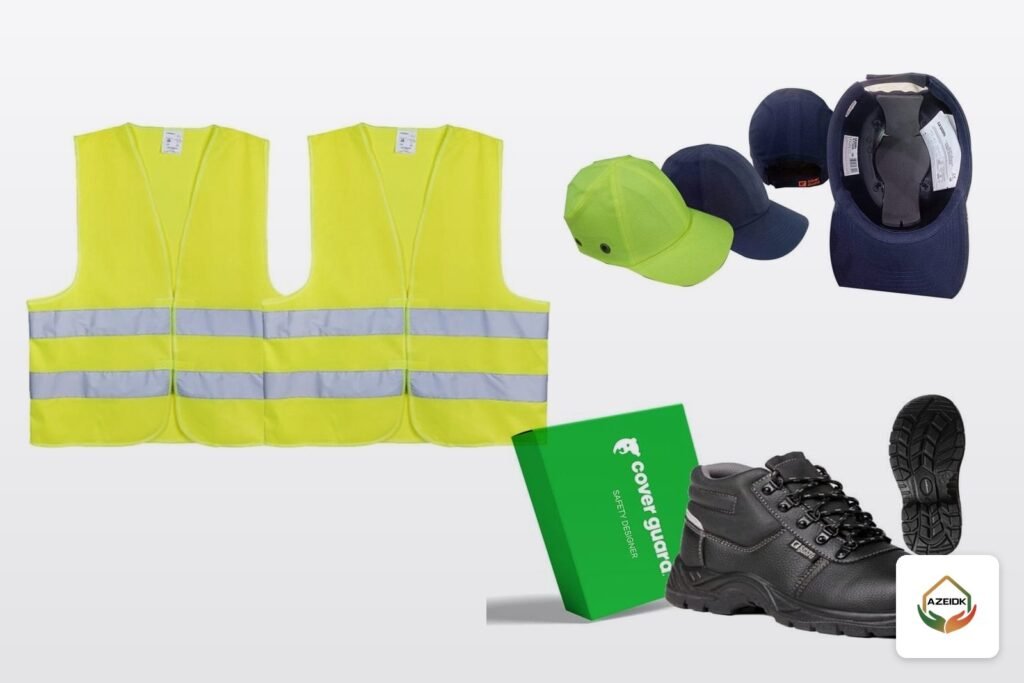
Safety shoes, high-visibility vests and bump caps look like simple items, but on the Saudi market they fall under the SASO Technical Regulation for Personal Protective Equipment and Clothing. The regulation sets what the supplier must provide before a product is placed on the market, which certificate is required, and which standard each product is measured against.
This guide is for procurement staff, facility safety officers and contractors who buy PPE for a site. It summarises the regulation as published by SASO and turns it into a checklist for buying Coverguard or any other PPE.
Key points
- The regulation covers the PPE listed in its Annex 1 and excludes equipment intended for medical or military use.
- A conformity certificate is required from a SASO-accepted body under conformity model Type 3 of ISO/IEC 17067.
- Annex 1 references SASO-ISO-20345 for safety footwear, EN 812 for bump caps and GSO 2596 for high-visibility apparel.
- Products carrying the Saudi Quality Mark are deemed to meet the regulation.
What the regulation is
The SASO Board approved the regulation at its meeting No. 165 on 5 July 2018, and it was published in the Official Gazette on 29/03/1440 AH (7 December 2018). The version on the SASO website is the first issue, amendment 2.
It applies to the personal protective equipment and clothing listed in Annex 1 that is intended to protect users from potential hazards, and it excludes PPE intended for medical or military use. It states that the product list and customs codes on the SABER platform are the current approved version.
Supplier obligations
The supplier means the manufacturer or the importer. Article 5 requires the supplier to:
- meet the technical requirements of the standards in Annex 1; conformity with the relevant standard is sufficient evidence of meeting the essential requirements;
- determine the protection category and levels of the product according to those standards;
- supply the instructions and guides needed for safe use with the equipment;
- consider reasonably foreseeable use, not only intended use, and the safety of non-users where relevant.
The regulation also requires all information in the labelling to be correct, proven and verifiable. In practice, the protection class printed on a safety shoe or a vest label must be backed by testing, not by marketing wording.
Conformity certificate and technical file
Article 7 requires a conformity certificate from a SASO-accepted body under model Type 3 of ISO/IEC 17067 (Annex 3). Only the conformity procedures in the regulation apply; different conformity requirements written in a standard are not used.
| Item | Technical file content required by the regulation |
|---|---|
| a | Supplier’s declaration of conformity in the Annex 4 format |
| b | Risk assessment document |
| c | Country of origin |
| d | Product drawings, designs, components and explanations needed to understand and use it |
| e | List of standards applied, per Annex 1 |
| f | Product description and potential uses |
Products in scope that hold the Saudi Quality Mark are considered compliant. See the Saudi Quality Mark and the SABER platform guide for buyers.
Reference standards for common site PPE
| Product | Standard in Annex 1 |
|---|---|
| Safety footwear | SASO-ISO-20345 |
| Protective footwear | SASO-ISO-20346 |
| Industrial safety helmets | EN 397 |
| Industrial bump caps | EN 812 |
| High-visibility safety apparel | GSO 2596 |
| Hearing protectors | EN 352-1, EN 352-2, EN 352-3 |
| Full body harnesses for fall protection | EN 361 |
| Firefighters’ gloves and footwear | EN 659, EN 15090 |
| Clothing for heat and flame protection | SASO-ISO-11612 |
| Welding clothing and gloves | SASO-ISO-11611, EN 12477 |
| Insulating gloves for live working | SASO-IEC-60903 |
Note that industrial helmets and bump caps have different standards. A bump cap is for minor contact with fixed objects and does not replace a helmet where objects can fall, as our product page explains.
Market surveillance and transition
Inspection authorities may check conformity documents with shipments at ports and factories, take random samples for laboratory testing, and charge suppliers the test costs. Non-conforming products are withdrawn from warehouses and penalties applied.
The transitional provisions applied the regulation within 180 days of publication and gave suppliers up to 365 days to correct their position. Both periods ended years ago.
Buying checklist
- Start from the site risk assessment: falling objects, nails, slippery floors, moving vehicles, low ceilings.
- Choose the model whose class covers that hazard, reading the class from the datasheet or label, not from the trade name.
- Ask the supplier for proof of conformity with the regulation, such as the conformity certificate or the Saudi Quality Mark.
- Make sure instructions for use come with the product.
- Record what each worker receives and check condition periodically.
Coverguard PPE available from AZEIDK
AZEIDK supplies Coverguard safety equipment, including professional safety shoes, the high-visibility safety vest and the protective bump cap. These pages present each item as a product category and state that protection levels and materials vary by model and must be confirmed from the datasheet, so we agree the model and class for each task before supply.
Related reading: Coverguard in Saudi Arabia and choosing PPE for a work site.
Frequently asked questions
Are safety shoes regulated in Saudi Arabia?
Yes. Safety footwear is listed in Annex 1 of the SASO PPE regulation with SASO-ISO-20345 as the reference standard.
Which conformity model applies to PPE?
Type 3 under ISO/IEC 17067, certified by a SASO-accepted body.
Which standard applies to high-visibility vests?
Annex 1 lists high-visibility safety apparel under GSO 2596.
Can a bump cap replace a safety helmet?
No. They have different standards; the bump cap is for minor bumps against fixed objects, the helmet for falling-object hazards.
Does the regulation cover medical PPE?
No. PPE intended for medical or military use is excluded.
Equipping a site or warehouse with PPE? Send us the headcount and the hazards, and we will propose suitable models. Request a quote from AZEIDK
Related guides
- Public Address and Background Music Systems in Commercial Buildings
- Steel Plant Fire Protection: Hydraulic Oil, Electrical Rooms and Cable Tunnels
- Sprinkler Test and Drain Valve: How It Works, Choosing the Test Orifice, and the Giacomini A61
- CCTV Supply and Installation Contract Template: Clauses to Include