A fire extinguisher cover protects an extinguisher installed outdoors from direct sun, dust and tampering. It comes in three forms: a plastic or fabric cover that slips over the unit, a metal cage, and a box or cabinet. The rule is the same for all three: protection must never slow down access. The extinguisher has to come out in seconds, stay visible to occupants and to the Civil Defense inspector, and its pressure gauge has to be checkable during inspection. This guide explains when an extinguisher needs a cover, a cage or a cabinet, and how to choose between them for Saudi heat and dust.
Key Points
- An extinguisher in an exposed location needs protection from sun, dust and impact, and the right answer depends on the site.
- Falcon Gold datasheets set the upper operating temperature for powder, CO2 and foam units at +60°C, and the Amerex ABC powder SDS says to protect the unit from sunlight and not expose it to more than 50°C.
- A plastic or fabric cover handles sun and dust, a cage handles impact and tampering, and a cabinet handles both with a tidy finish.
- In practice, choose a cover that comes off with one hand and no tools, is red or clearly marked, and does not hide the extinguisher sign.
- A cover does not replace the monthly check: lift it and look at the gauge, pin, seal and hose.
In this article
- Why Outdoor Extinguishers Need Protection in Saudi Arabia
- Fire Extinguisher Cover Types: Covers, Cages and Cabinets
- When Is a Plastic Fire Extinguisher Cover Enough?
- Fire Extinguisher Cages: Against Impact and Tampering
- Extinguisher Cabinets for External Corridors and Facades
- Wheeled Fire Extinguisher Covers
- Common Mistakes When Covering Extinguishers
- Monthly Inspection of a Covered Extinguisher
- Choosing the Right Option for Your Site
- Frequently Asked Questions
- Summary
Why Outdoor Extinguishers Need Protection in Saudi Arabia
Extinguishers in open car parks, fuel stations, warehouse yards, construction sites, rooftops, farms and rest houses spend long hours in sun and dust. That affects the unit in several ways:
- Heat: Falcon Gold datasheets give a temperature range of -30 to +60°C for powder and CO2 units and +5 to +60°C for foam, and up to +55°C for the FG wet chemical unit; SFFECO gives a storage range of -20 to +60°C for its CO2 units. The Amerex ABC powder SDS states that the unit should be protected from sunlight and not exposed to temperatures above 50°C.
- Pressure gauge: the Amerex owner’s manual notes that the gauge reading varies slightly with temperature but should always stay in the green. Read gauges on sun-exposed units carefully and follow up any reading outside the green.
- Dust and sand: it builds up on the head, handle, horn outlet and hose, and covers the label and operating instructions.
- Paint and labels: sun fades the red finish and damages the label, making the unit harder to recognise.
- Tampering and impact: in public areas and car parks, units get pulled, seals get broken and vehicles hit them.
Some protection is built into the extinguisher. The Falcon Gold powder datasheet lists a corrosion and impact resistant polyester finish, a polypropylene base with a UV stabiliser, and a safety release valve that prevents cylinder bursting at high temperature. None of that makes all-day sun exposure acceptable, and the SDS instruction is clear on that point.
Fire Extinguisher Cover Types: Covers, Cages and Cabinets
| Type | Protects against | Suits | What to check |
|---|---|---|---|
| Plastic or fabric cover | Direct sun, dust and rain | Units on external walls, in car parks and on equipment | UV resistant, red or printed “Fire Extinguisher”, a clear window over the gauge or easy to lift |
| Metal cage | Impact, theft and tampering | Car parks, factories, yards and forklift routes | Opens without a key or with a quick release, does not hide the unit |
| Box or cabinet (enclosure) | Sun, dust, impact and tampering together | External corridors, facades, covered parking and stations | Internal size fits the unit, easy-open door, clear marking, vision panel where possible |
| Wheeled extinguisher cover | Sun and dust on the cylinder and hose | Fuel stations, warehouses and yards | Covers the whole unit including the hose and pulls off in one move |
When Is a Plastic Fire Extinguisher Cover Enough?
A plastic or fabric cover is the simplest and cheapest option. It suits a unit on an external wall or a car park column, where the main problems are sun and dust rather than tampering. When choosing one, check that it:
- is UV resistant, because ordinary plastic cracks and fades in the sun;
- is red or printed “Fire Extinguisher” so the unit is recognisable from a distance;
- comes off in one pull, with a quick clip, hook-and-loop strap or elastic hem, not a row of buttons or a zip that can jam;
- has a clear window over the gauge, or lifts easily for inspection;
- fits the unit size: a 6 kg cover is not a 9 or 12 kg cover.
A cover gives no impact protection and does not prevent theft. Where vehicles or forklifts pass, use a cage or a cabinet.
Fire Extinguisher Cages: Against Impact and Tampering
A metal cage surrounds the unit so it cannot easily be knocked or pulled, while keeping it visible. Cages are used in car parks, warehouse aisles, production areas and anywhere equipment could hit the extinguisher. Two points decide whether a cage works:
- Quick opening: if the cage has a lock, it must open without hunting for a key, through an emergency release or a breakable seal. A cage whose key sits with the guard fails in the first minute of a fire.
- Sun: a cage gives no shade. In exposed locations, combine it with a UV cover or use a cabinet instead.
Locking and mounting height rules under NFPA 10 are covered in our fire extinguisher cabinet guide, and the same logic applies to cages.
Extinguisher Cabinets for External Corridors and Facades
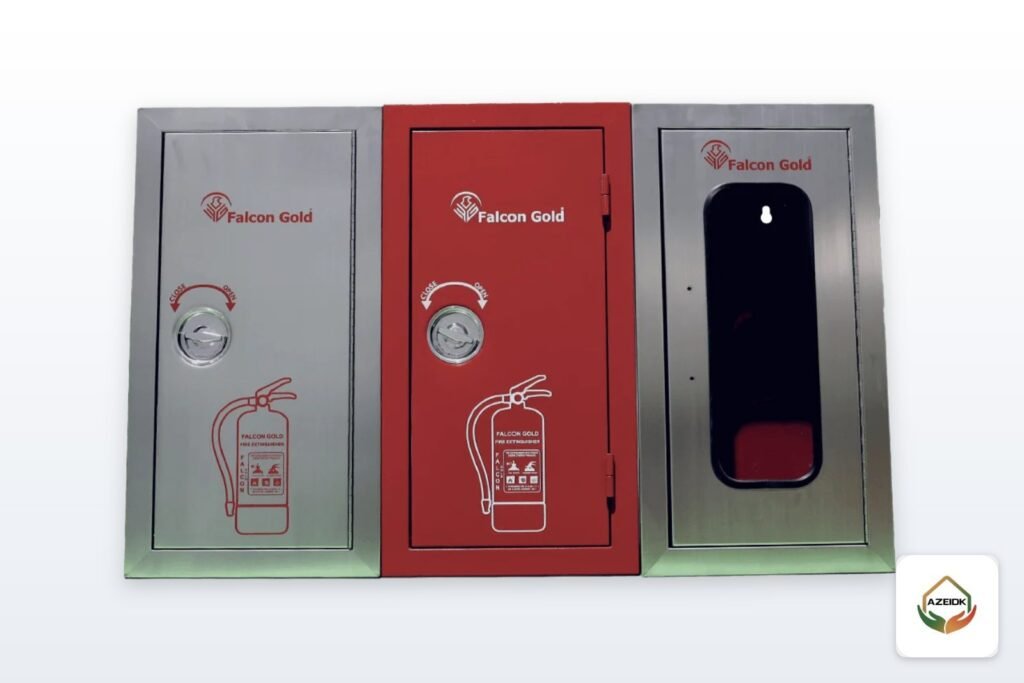
A box or cabinet combines protection from sun, dust and tampering in one unit and keeps facades and corridors tidy. AZEIDK supplies the Falcon Gold FG-400 recessed fire extinguisher cabinet from Falcon Gold in three fronts: FG-400SG with a stainless steel door and fiberglass vision panel, FG-400M in red powder-coated mild steel, and FG-400S with a full stainless steel door, with a body of roughly 280 × 600 × 180 mm per the product page. The FG-400SG vision panel lets you see the unit without opening the door. The product page does not state a rating for installation exposed to direct rain, so confirm this before fitting it on an exposed facade, and choose stainless or painted steel to suit the site.
A recessed cabinet needs enough wall depth; where the wall does not allow it, use a surface-mounted box. In every case, measure the unit at full height including the head and compare it with the internal size before ordering. Other Falcon Gold cabinets are in our fire cabinets category, and the differences between models are explained in our Falcon Gold cabinet selection guide.
Wheeled Fire Extinguisher Covers
Wheeled extinguishers usually stand in open yards such as fuel stations and warehouses, and they are too big for a wall cabinet. One example is the Falcon Gold FDP50 powder extinguisher: 50 kg, 1040 mm overall height and a 5 m hose. The right cover wraps the cylinder, head and hose together, pulls off in one move and is never tied to the wheels or the ground. A shaded spot near the hazard is preferable. More in our wheeled extinguisher guide.
Common Mistakes When Covering Extinguishers
- A grey or black cover that makes the extinguisher look like any other equipment.
- A cover tied with several straps or wired on, taking a full minute to remove.
- A cage or cabinet locked with a key nobody can find.
- A cover or cabinet that hides the extinguisher sign, or is placed where the sign cannot be seen. Sign size and height are covered in our fire extinguisher sign guide.
- Leaving a cover on for years without lifting it, so dust and moisture build up underneath unnoticed.
- Wrapping the unit in an ordinary plastic bag, which traps heat and moisture and falls apart within weeks.
Monthly Inspection of a Covered Extinguisher
A cover or cabinet does not exempt the unit from inspection. The Amerex owner’s manual asks the periodic check to confirm that the unit is undamaged, the discharge outlet is not blocked, it is fully charged, the seal is intact and the operating instructions are clearly visible, and to look for corrosion or leakage. So lift the cover or open the cabinet at every check, clean dust off the head and horn, then refit the cover.
The monthly and annual schedule and hydrostatic test intervals are covered in our extinguisher maintenance guide. Extinguishers and their cabinets can be included in our periodic maintenance contracts for fire and safety systems.
Choosing the Right Option for Your Site
Start with what actually threatens the extinguisher:
- Sun and dust only, on a wall or column: a UV resistant, quick-release cover.
- Impact or tampering in a shaded area: a cage with quick release.
- Sun, dust and tampering together, or a facade that must look tidy: a surface or recessed cabinet.
- A wheeled unit in an open yard: a full cover and a shaded position.
On a new site, the extinguisher type, size and cabinet are chosen together. Through our technical supply service, the AZEIDK team can help you select fire extinguishers and Falcon Gold cabinets for each location.
Frequently Asked Questions
Is it allowed to cover a fire extinguisher?
Yes, as long as the cover comes off immediately, the unit stays recognisable and visible, and the cover does not prevent inspection. Check with the consultant or Civil Defense on sites with special requirements.
What colour should a fire extinguisher cover be?
Red, or any cover clearly printed “Fire Extinguisher”, so the unit is not mistaken for other equipment.
Does sun damage a fire extinguisher?
Falcon Gold datasheets set +60°C as the upper operating limit, and the Amerex ABC powder SDS says to protect it from sunlight and keep it below 50°C. Exposed units should be shaded or covered.
What is the difference between a cover and an enclosure?
A cover slips over the unit and protects against sun and dust only; an enclosure or cabinet is a fixed unit that also protects against impact and tampering.
Does an extinguisher cage need a lock?
Not necessarily. If it has one, it must have a quick emergency release that needs no key.
Are there covers for wheeled extinguishers?
Yes, full covers that wrap the cylinder, head and hose and pull off in one move.
Summary
A fire extinguisher cover, cage or cabinet extends the life of an exposed unit and keeps it ready, provided it never slows access or hides the extinguisher. Choose by what threatens the unit at its location, whether sun, dust, impact or tampering, and never let a cover become a reason to skip the monthly check.
Equipping open car parks or yards with extinguishers? Send us photos of the locations and the number and types of units, and our team will propose suitable Falcon Gold extinguishers and cabinets. Contact the AZEIDK team
See the fire extinguishers and fire fighting systems AZEIDK supplies.
Related guides
- Fire Alarm Companies in Jeddah: Comparing Distributors, Consultants and Contractors
- Furniture Factory Fire Safety: Wood Dust, Spray Shops and Upholstery Stores
- Dahua Camera Specifications: WizMind, WizSense, Lite and Full-color, 2/4/5 MP, HDCVI or IP, and Drawbacks
- CCTV Poles: Height, Concrete Base, Cable Routing and Earthing for Car Parks and Perimeters