Furniture factory fire safety rests on three main hazards: wood dust from sawing and sanding, paint and spray finishing with flammable materials, and foam and upholstery stores that burn fast with dense smoke. Each needs different detection and suppression, plus daily housekeeping that stops dust building up. This article links each area of a furniture factory or joinery workshop to the right alarm, sprinkler and extinguisher choices, then explains the licensing route through the Salamah platform, as part of AZEIDK solutions for factories and industrial facilities.
Key takeaways
- Wood dust can be combustible, and housekeeping is as much a part of protection as the systems themselves.
- Spray finishing has its own standard, NFPA 33, and its own chapter on flammable finishes in the Saudi Fire Protection Code.
- Plastic-upholstered furniture and foam mattresses are a higher storage hazard than wooden furniture.
- Wholesale wood trading is in phase one of the third-party insurance requirement for Civil Defense licensing (August 2026).
- Extinguishers are chosen by area: water or foam for wood, CO2 near electrical panels.
In this article
- Furniture factory fire safety: what are the hazards in each area?
- Is wood dust a fire and explosion hazard?
- How are paint and spray shops protected in furniture factories?
- Why are upholstered furniture and mattress stores a higher hazard?
- Which fire alarm setup suits a furniture factory?
- Which extinguishers suit joinery and furniture plants?
- How does insurance relate to licensing wood businesses?
- How does a furniture factory get its Civil Defense licence?
- How does a furniture factory project run with AZEIDK?
- Frequently asked questions
- Conclusion
Furniture factory fire safety: what are the hazards in each area?
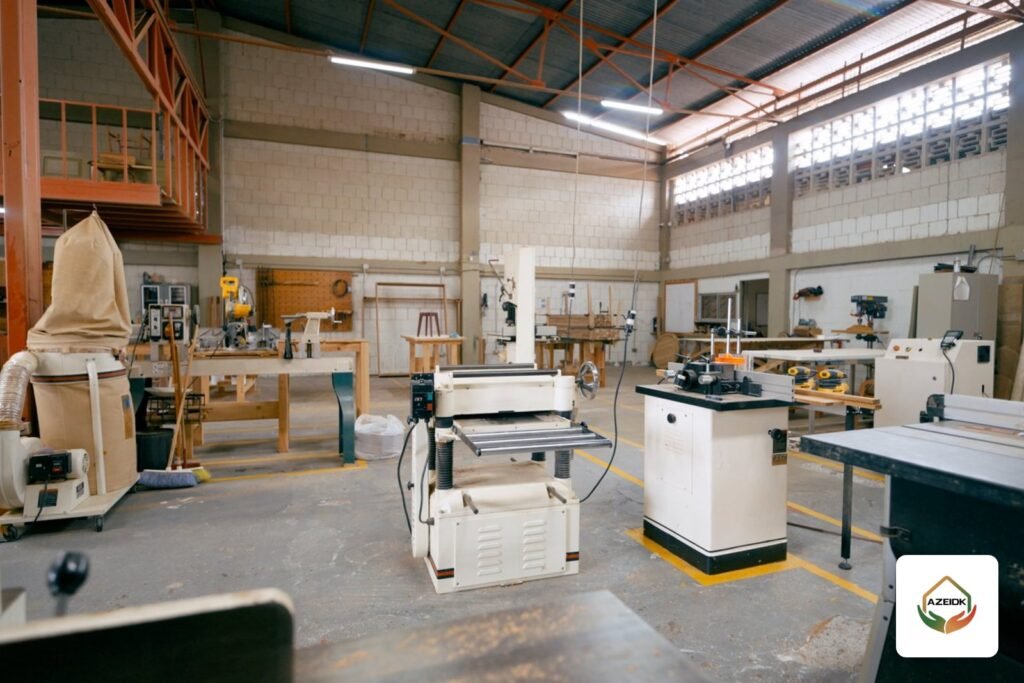
On a furniture plant survey we split the site into zones, because each behaves differently in a fire:
| Area | Hazard | Detection to consider | Suppression |
|---|---|---|---|
| Sawing, routing, sanding | Wood dust, shavings, dust extraction | Heat detectors where dust causes false alarms | Sprinklers, water or foam extinguishers, dust collector protection as the study requires |
| Paint and spray shop | Flammable solvent vapours and coatings | Per the spray booth design | Booth and exhaust duct sprinklers per NFPA 33, extinguishers for flammable liquid fires |
| Upholstery and foam cutting | Polyurethane foam and fabrics | Smoke detectors | Sprinklers designed for the commodity class |
| Furniture and bedding store | Wrapped furniture, foam, cartons | Smoke, or beam detectors for high roofs | Sprinklers to commodity class and storage height, hose cabinets |
| Electrical and compressor rooms | Electrical faults | Smoke detectors | CO2 extinguishers, special suppression where needed |
Is wood dust a fire and explosion hazard?
Yes. Fine dust from sanding and sawing can be combustible, and dust layers on surfaces, beams and machines turn a small fire into a large one. The US reference for this hazard was NFPA 664 for wood processing and woodworking facilities, now consolidated with the other dust standards into NFPA 660 (2025 edition). SBC 801 includes a chapter on combustible dust-producing operations and a chapter on lumber yards and woodworking facilities (per the table of contents of the ICC study companion for the 2018 SBC 801).
In practice, this is what we recommend in joinery workshops:
- A central dust extraction system that runs with the machines, and regular emptying of shavings bins.
- Daily cleaning of floors and high surfaces, without blowing dust around with compressed air.
- A dust hazard analysis by a specialist in larger plants, to define what protection the extraction system needs.
- Hot work permits for welding and cutting, keeping sparks away from dusty areas.
How are paint and spray shops protected in furniture factories?
The paint shop is the most dangerous point in many furniture plants: solvent vapours are flammable, and residue on booth walls and exhaust ducts is ready fuel. The reference standard is NFPA 33 on spray application using flammable or combustible materials (2024 edition), and SBC 801 has a chapter on flammable finishes, per the same table of contents.
What we review with the consultant: sprinkler protection of the booth and exhaust duct as designed, interlocking ventilation with spraying, removing ignition sources, storing paints and solvents in a dedicated room in limited quantities, and extinguishers for flammable liquid fires near the booth. The sprinkler network falls under fire fighting systems.
Why are upholstered furniture and mattress stores a higher hazard?
Furniture is not one commodity in sprinkler design. The commodity examples in IFC Section 3203, the International Fire Code on which the Saudi code is based, make the point: wood furniture without plastic coverings or foam cushioning is Class III, wood furniture with plastic coverings is Class IV, and furniture and bedding with foam cushioning, foam mattresses and polyurethane are high-hazard commodities (Group A expanded plastics) in the current editions of the classification table.
So a store designed for wooden furniture may not be enough once it fills with sofas and foam mattresses. Any change in stock type or storage height needs a review in engineering design and calculations.
Which fire alarm setup suits a furniture factory?
Dust is the main enemy of smoke detectors in joinery shops. It causes false alarms that push operators to isolate the system. We place detectors by zone: heat detectors in dusty areas, smoke detectors in offices, stores and electrical rooms, and beam detectors in high-roof stores. Causes of false alarms and how to avoid them are covered in fire alarm false alarm causes. AZEIDK supplies Context Plus addressable and conventional panels and detectors for fire alarm systems.
Which extinguishers suit joinery and furniture plants?
Wood and fabric fires are Class A, suited to water, foam and multipurpose powder extinguishers. Use CO2 near electrical panels and machines, and extinguishers rated for flammable liquids near the paint shop. In large areas, wheeled units help, such as the Falcon Gold 25 L foam extinguisher. Browse AZEIDK fire extinguishers, and use the fire extinguisher calculator for a first estimate; the design sets the final number.
How does insurance relate to licensing wood businesses?
On 17 August 2026, as reported by Okaz, the General Directorate of Civil Defense announced that third-party cooperative insurance is required to issue and renew licences, with phase one covering wholesale wood trading of all kinds, alongside general warehouses, paint manufacturing and other activities. If your plant includes a wholesale timber store or a large paint shop, check whether the requirement applies before your renewal date, and keep your alarm and suppression systems and their maintenance records ready, since the licence itself depends on them.
How does a furniture factory get its Civil Defense licence?
Licensing goes through Salamah. Engineering consultancy offices issue the technical report; AZEIDK supplies and installs the systems and then issues the safety equipment installation certificate for its own work, as part of Civil Defense approval support. After handover comes the annual maintenance contract for fire, safety and alarm systems, which is separate from the CCTV and low current maintenance contract.
How does a furniture factory project run with AZEIDK?
We run the project in clear steps, each with a deliverable for the owner:
- Site survey: visiting the site and recording the zones, storage method and any existing systems, under technical site inspection and assessment.
- Design and calculations: choosing the protection method, running the hydraulic calculation and laying out detectors, then shop drawings and coordination with other trades.
- Supply and installation: supplying equipment with datasheets and an approved submittal, then installation on site.
- Testing and commissioning: pressure tests and alarm and pump trials before handover, under testing, commissioning and handover.
- Certificate and maintenance: issuing the safety equipment installation certificate, then a routine maintenance contract for fire, safety and alarm systems.
In existing furniture plants we usually start by assessing what is already there, because some grow step by step, adding a paint shop or foam store without changing the systems. The assessment shows what can stay and what must change before renewal.
Frequently asked questions
Do joinery workshops need a fire alarm system?
SBC 801 decides this by occupancy and area, together with the Salamah licensing requirements. When installed, heat detectors are used in dusty areas to avoid false alarms.
Can wood dust explode?
Fine dust can be combustible, and dust standards such as NFPA 660 address it. Prevention starts with dust extraction, daily housekeeping and a dust hazard analysis in larger plants.
Which standard covers spray booths?
NFPA 33 (2024 edition), together with the flammable finishes chapter of the Saudi Fire Protection Code.
Which extinguisher suits a furniture factory?
Water, foam or multipurpose powder for wood fires, and CO2 near electrical panels. The design sets number and spacing.
Do furniture stores need special sprinklers?
Sprinkler design follows the commodity class. Plastic-upholstered furniture and foam mattresses rank higher than wooden furniture, so the store must be designed for what it actually holds.
Is insurance required to license timber stores?
Civil Defense announced in August 2026 that phase one of the third-party cooperative insurance requirement covers wholesale wood trading. Check whether it applies to your activity.
Conclusion
Furniture factory fire safety combines systems with daily discipline: dust extraction and housekeeping in joinery areas, spray booth protection to NFPA 33, store sprinklers designed for what is really stored, detectors chosen to avoid false alarms, and extinguishers placed by zone. Then a Salamah licence and a regular maintenance contract.
Running a furniture plant or joinery workshop and need a fire system review? Send the layout, plant sections and stock types, and the AZEIDK engineering team will review them with you. Talk to the AZEIDK team
Related guides
- Fire Protection Valves in Saudi Projects: Types and Applications
- Fuel Storage Tank Fire Protection with Foam: Foam Chambers and Pourers Under NFPA 11
- Fire Extinguishers in Dammam and Al Khobar: Supply and Maintenance for Workshops, Warehouses and Industrial Sites
- Material Submittal for Fire and Security Equipment: Contents and Consultant Review Codes