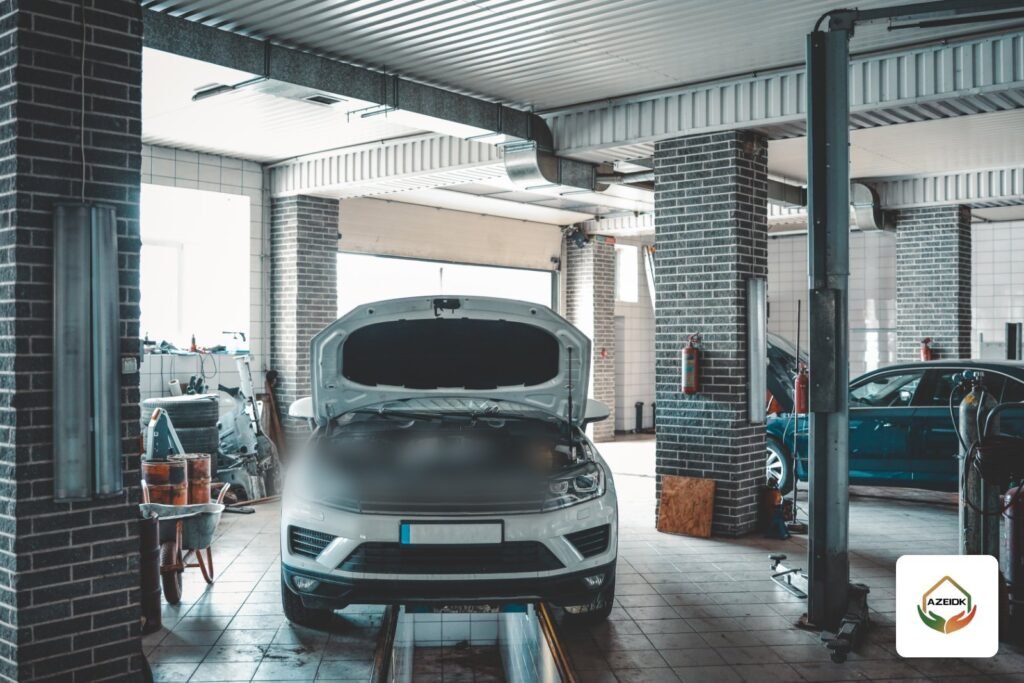
Civil Defense requirements for workshops that repair vehicles in Saudi Arabia start with one rule: a vehicle repair workshop cannot get its municipal licence before Civil Defense approval. The Ministry of Municipalities and Housing states this plainly in its requirements for vehicle repair workshops. Approval runs through the Salamah platform, which looks at the registered activity and the safety equipment installed on site: extinguishers suited to oil and fuel fires, fire alarm where the code calls for it, and how oils and gas cylinders are stored.
This guide covers what a workshop needs before it applies and what is checked afterwards, and separates official requirements from good practice. To equip the workshop and prepare the file in one step, AZEIDK’s Civil Defense approval support covers supply, installation and the safety equipment installation certificate, alongside the full range of fire extinguishers.
Key takeaways
- The Ministry of Municipalities and Housing requirements for vehicle repair workshops (1447 AH edition) require Civil Defense approval before the licence is issued.
- For fire protection, the same document refers to the Saudi Fire Protection Code (SBC 801), after requiring Civil Defense approval in a separate clause.
- According to the Salamah product overview published by Elm, the licensing path depends on risk: instant, direct (safety equipment invoice or technical report), or indirect (safety company contract and inspection).
- A workshop mixes Class B fires (oil, fuel, solvents) with Class A materials and electrical equipment, so one extinguisher type does not fit every area.
- The municipal rules ban gas lighting and require an oil interceptor inspected at least every 3 months, plus a dedicated used-oil tank.
In this article
- Who sets the Civil Defense requirements for workshops?
- Salamah licence for a car workshop: how the application flows
- Workshop safety equipment: what goes in before you apply
- Which extinguisher for which workshop area?
- Storing oils and gas in the workshop
- Does a workshop need a fire alarm system?
- Occupational safety in the workshop after licensing
- Common mistakes that delay a workshop licence
- FAQ
- Summary
Who sets the Civil Defense requirements for workshops?
Three bodies are involved, and owners often mix them up:
- Ministry of Municipalities and Housing (Balady): issued the “Requirements for Vehicle Repair Workshops”, covering location, design, operation, cleanliness and environment, and requiring Civil Defense approval before licensing (clause 2.1).
- General Directorate of Civil Defense (Salamah): issues the safety licence, defines the safety equipment for each activity and has the final word on acceptance.
- Saudi Building Code: clause 4.9 of the workshop requirements refers to the code’s fire protection provisions, which set classification, separation and fixed systems by area and use.
NFPA standards, including NFPA 30A for motor fuel dispensing facilities and repair garages (2024 edition) and NFPA 10 for extinguishers, are technical references the designer uses for detail. They are not a standalone legal requirement in the Kingdom.
Salamah licence for a car workshop: how the application flows
Salamah is Civil Defense’s online portal for issuing, renewing and cancelling safety licences. Its product overview, published by Elm, describes three paths:
| Path | Activities | What is required |
|---|---|---|
| Instant | Low risk | Licence issued once the data is complete |
| Direct | Low to medium risk | Safety equipment invoice or technical report, depending on the activity |
| Indirect | High risk | Contract with a safety company and maintenance contracts, then a Civil Defense inspection |
The path depends on the registered activity code, the area and the work carried out, and the platform decides it, not the applicant. A small oil-change bay is not the same as a service centre with painting, welding and parts storage. Picking a lower-risk activity to speed things up can be rejected at verification or inspection; common reasons are covered in Salamah application rejection reasons.
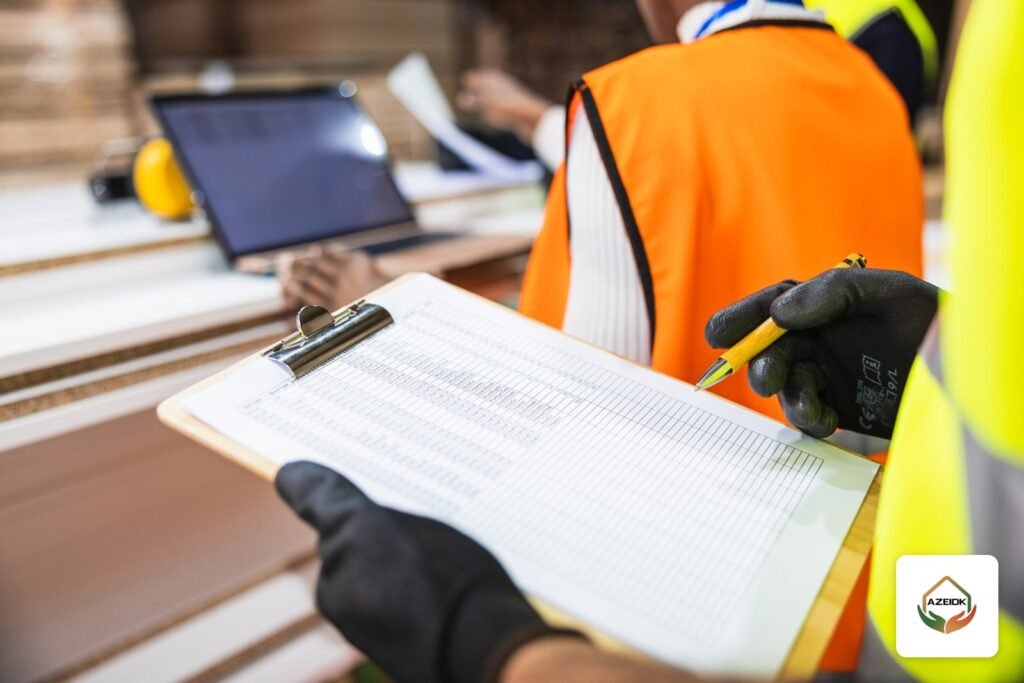
According to the same document, the licence is valid for one year from final approval and renewal can be requested a month before expiry; the platform itself is the final reference for these periods at the time of applying. Technical reports come from engineering offices approved on the platform; approved safety companies issue the equipment invoice and installation certificate. For the general retail route, see Salamah certificate for shops.
Workshop safety equipment: what goes in before you apply
The platform sets the final list for your activity, but a workshop usually needs the following, installed where it will be used rather than kept in the store:
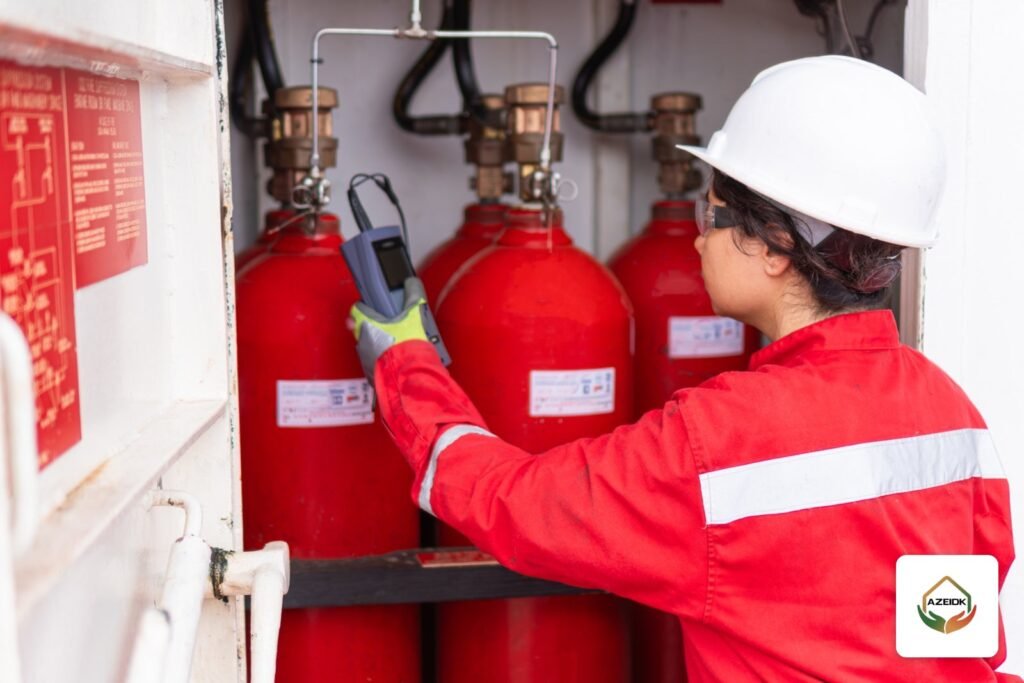
- Fire extinguishers matched to each area (see the next section), on brackets or in cabinets, with a sign above each one.
- Fire alarm where the code or Civil Defense requires it by area and classification, with detectors suited to an environment with exhaust and fumes.
- Emergency lighting and exit signs, with exit routes kept clear of cars and parts.
- A first-aid kit, an explicit municipal requirement (clause 5.1).
- A fire blanket near welding and cutting, as good practice.
Through technical supply, AZEIDK provides extinguishers with cabinets and brackets, Falcon Gold first-aid boxes, and Context Plus conventional and addressable alarm panels, each with its datasheet.
Which extinguisher for which workshop area?
The most common mistake is one dry powder unit type everywhere. A workshop has oil, fuel and solvent fires (Class B), solids such as tyres, cartons and rags (Class A), and electrical panels and chargers. Distribute by hazard. The table below is common engineering practice for guidance, not text from the municipal requirements or Civil Defense regulations:
| Area | Main hazard | Typical extinguisher |
|---|---|---|
| Lift bays and mechanical repair | Oil, fuel and solids | ABC dry powder |
| Oil change and drum storage | Flammable liquids (B) | AFFF foam or powder; a wheeled unit for larger quantities |
| Electrical panel, compressor, diagnostic equipment | Electrical equipment | CO2 |
| Paint room and colour mixing | Flammable solvents and vapours | Foam or powder per the designer’s assessment |
| Reception and waiting area | Ordinary materials, office equipment | ABC powder or CO2 |
Numbers, capacities and travel distances follow Civil Defense requirements and the code, with NFPA 10 as the designer’s technical reference. A large lift bay usually needs more units than the waiting area, because the hazard is higher and a fire can start under a vehicle.
Storing oils and gas in the workshop
What the municipal requirements say
- A store for low-hazard, activity-related materials is allowed, up to 25% of the licensed area or 150 m2, whichever is less; the clause allows up to 50% under specific conditions (clause 4.8).
- Storing materials unrelated to the activity is prohibited (clause 5.1).
- An oil interceptor must keep oil out of the sewer, be inspected at least every 3 months or as needed and be logged; used oil goes into a dedicated tank and is handed to a recycler or approved waste carrier (clause 5.8).
- Floors must be finished with materials that do not absorb oil (clause 4.5), and spill clean-up equipment provided (clause 5.8).
- Gas lighting is banned inside and outside the workshop (clause 4.7).
Good practice inspectors usually look for
- Oil and solvent drums kept away from sparks from grinders, welding sets and battery chargers.
- Welding and cutting gas cylinders chained upright, valves closed after work, and separated from oils.
- Ventilated battery charging, and oily rags in a closed metal bin rather than piled in corners.
- A hot work permit for welding near combustibles, with NFPA 51B as the technical reference.
Which oil and fuel quantities count as high hazard, and whether separation or a separate storage licence is needed, is decided case by case by the code and Civil Defense. If the workshop sits within a fuel station, see fuel station fire safety requirements.
Does a workshop need a fire alarm system?
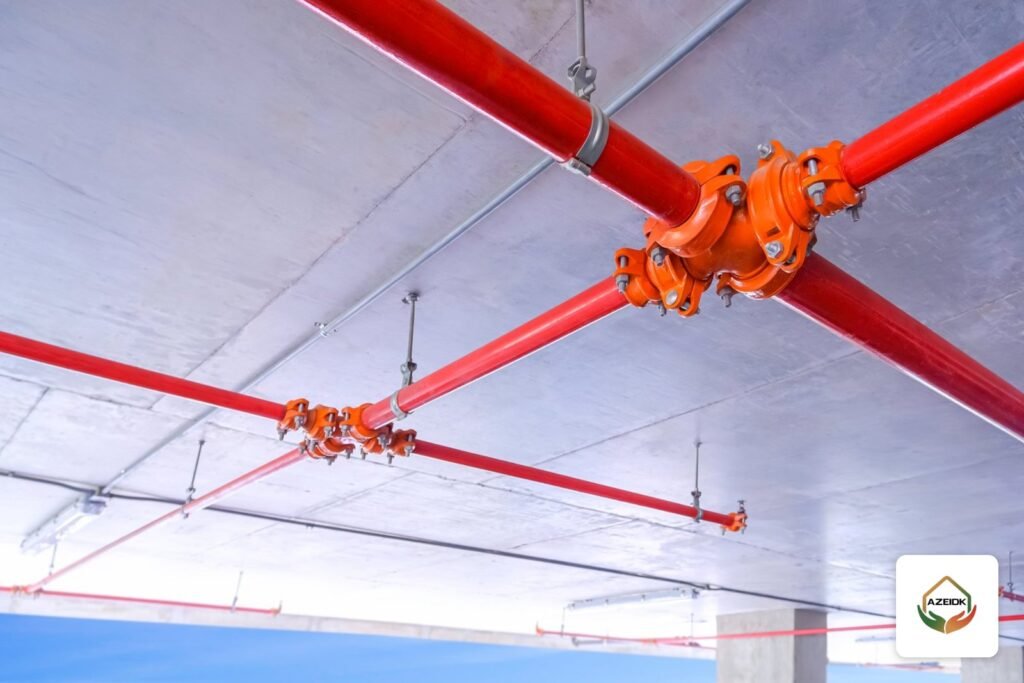
There is no single answer. The municipal requirements do not name a specific alarm system; they refer to the fire code, which ties alarm and sprinklers to classification, area and number of storeys. Civil Defense may require what it considers necessary at review or inspection.
In practice, many medium and large service centres are fitted with an alarm. Exhaust and fumes in the work area can cause false alarms with standard smoke detectors, so the designer chooses the detector type per area. See AZEIDK’s fire alarm systems, including Context Plus conventional panels for small sites and addressable panels for larger centres.
Occupational safety in the workshop after licensing
The licence is renewed every year and inspections can come at any time, so workshop safety is an ongoing routine:
- Monthly visual check of extinguishers: gauge, seal, hose, and nothing blocking access.
- Periodic servicing, and recharging after any use, even partial, per the manufacturer and Civil Defense requirements.
- Alarm panel and system tests at the intervals set in the maintenance contract.
- Exit routes and doors kept clear, in line with the municipal requirement to keep external stairs and pavements free of obstructions for evacuation (clause 4.4).
- Staff trained on using an extinguisher, isolating power and the assembly point.
AZEIDK services extinguishers with its own team as part of preventive and periodic maintenance contracts for fire and alarm systems, producing the records owners need at renewal.
Common mistakes that delay a workshop licence
- A registered activity that does not match the real work, such as painting and bodywork without meeting their separation conditions.
- Dry powder units only, with no CO2 near electrical panels.
- Extinguishers installed but hidden behind a car or shelf, or overdue for service.
- Open oil drums next to welding or charging areas.
- No oil interceptor, or no inspection log for it.
- Part of the store turned into a warehouse for unrelated goods.
- Safety equipment bought from a supplier that cannot issue an invoice or installation certificate accepted on the platform.
Offices and grocery stores have their own checklists; see Civil Defense requirements for offices and grocery store requirements in Saudi Arabia.
FAQ
Does a car workshop need Civil Defense approval before the municipal licence?
Yes. The Ministry of Municipalities and Housing requirements for vehicle repair workshops require Civil Defense approval before the licence is issued.
Is a workshop Salamah licence instant?
It depends on the activity code and its risk level. Salamah places the activity on an instant, direct or indirect path, and the platform decides which.
What safety equipment does a workshop usually need?
Extinguishers suited to oil and electrical fires, signs, emergency lighting, a first-aid kit, and a fire alarm where the code requires it. The platform sets the final list.
What is the best extinguisher for a car workshop?
No single type covers every area. ABC powder for repair bays, CO2 near electrical panels and foam where oils and fuel are stored.
Who issues the technical report for a workshop?
Engineering offices approved on Salamah. Approved safety companies issue the safety equipment invoice and installation certificate.
Summary
Meeting Civil Defense requirements for workshops starts with the right sequence: Civil Defense approval comes before the municipal licence, and Salamah sets the path by activity. On site, three things matter most: extinguishers distributed by hazard in each area, controlled storage of oils and gas with a logged oil interceptor, and a fire alarm where the code requires one. Getting these in place before applying saves time and reduces inspection notes.
Preparing a workshop or service centre for licensing? Send us the floor area and type of work, and we will propose the right extinguishers and safety equipment, install them and issue the installation certificate. Contact the AZEIDK team
Related guides
- IP Phone for the Office: Choosing Fanvil, Grandstream or Cisco
- Bakery Safety Requirements in Saudi Arabia: Gas, Tannour, Hood and Kitchen Extinguisher
- Factory and Industrial Fire Protection: Engineering Guide
- Printing and Checking a Civil Defense Licence on Salamah: Steps, Licence Number and What to Do If It Is Missing