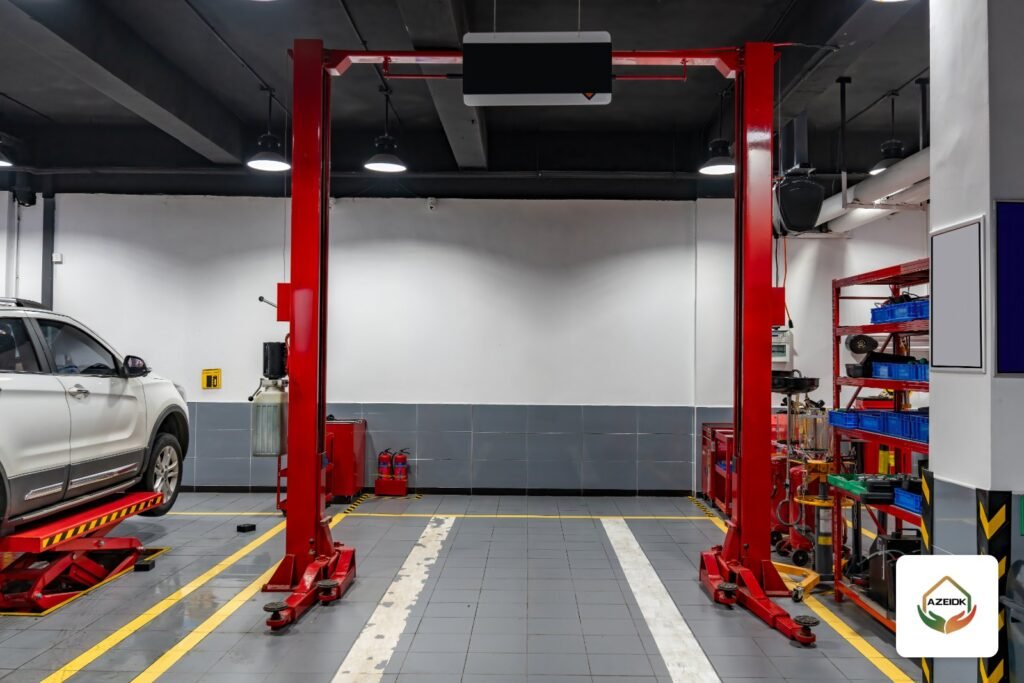
Sprinklers for auto repair workshops are designed differently from office or retail sprinklers. A service bay holds engine oil, fuel in vehicle tanks, tyres, plastic parts and welding work in the same space. NFPA 13 therefore places repair garages in Ordinary Hazard Group 2, which calls for a higher design density and smaller coverage per sprinkler than light hazard buildings.
This guide explains how a workshop is classified, what decides the number and type of sprinklers, where sprinklers alone are not enough, and what an owner should check before drawings are approved. It sits under AZEIDK’s fire fighting systems and the car showrooms and workshops sector page.
Key points
- NFPA 13 lists repair garages and service bays as Ordinary Hazard Group 2 in its occupancy examples.
- Since the 2022 edition, parking garages and vehicle showrooms have also moved from Group 1 to Group 2.
- Group 2 starts at a minimum density of 0.20 gpm/ft², with a maximum of 130 ft² (about 12 m²) per standard spray sprinkler.
- Paint booths, tyre stores and oil stores have their own requirements and are not treated as part of the bay.
- Whether the building needs sprinklers at all is set by SBC 801 and Civil Defense requirements; NFPA 13 is the design standard the engineer adopts.
In this article
- Does a car service workshop need a sprinkler system?
- How does NFPA 13 classify a car workshop?
- Sprinklers for auto repair workshops: density and coverage
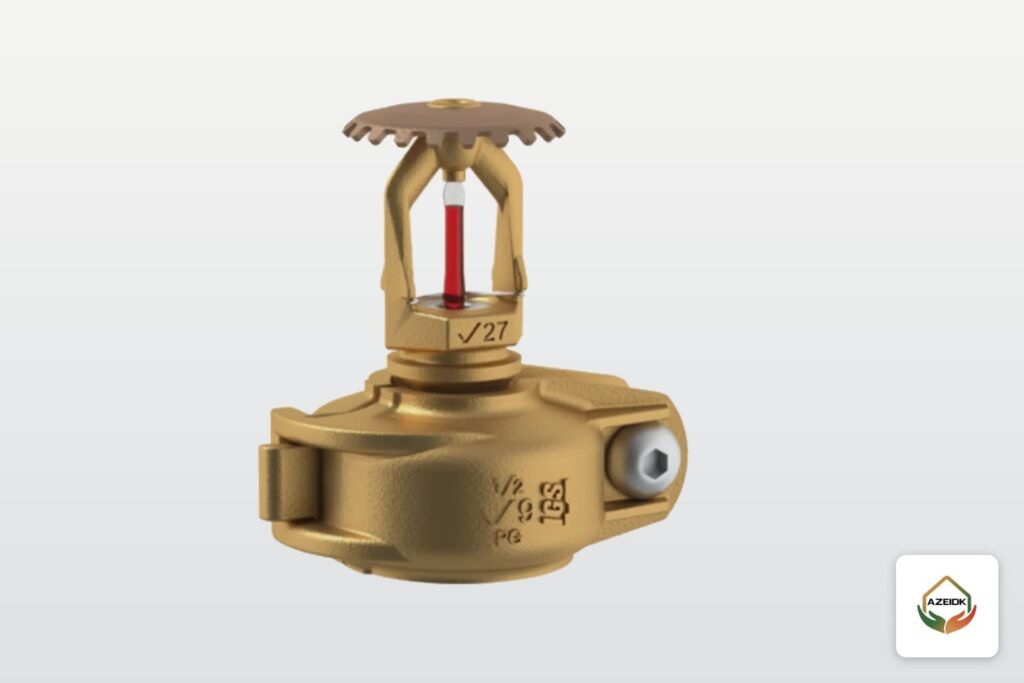
- Which sprinkler suits a service bay?
- Obstructions: lifts, ducts and mezzanines
- Where sprinklers alone are not enough
- Water supply and the alarm valve station
- Common workshop sprinkler mistakes
- Frequently asked questions
- Summary
Does a car service workshop need a sprinkler system?
There is no single answer. It depends on how the building is classified under the Saudi Building Code, its area and number of storeys, and whether the workshop stands alone or sits inside a mixed-use complex or a dealership with a showroom and parts store. A small stand-alone workshop may only need the extinguishers and alarm required for licensing, covered in our article on Civil Defense requirements for auto workshops. Large dealer service centres and workshops inside mixed-use buildings often fall within automatic sprinkler scope.
In practice, design should not start until the designer has confirmed the governing SBC 801 requirement for that specific building. The system is then designed to NFPA 13.
How does NFPA 13 classify a car workshop?
NFPA 13 divides occupancies into light hazard, ordinary hazard (two groups) and extra hazard (two groups). Its annex examples place repair garages and service bays in Ordinary Hazard Group 2, alongside metalworking and welding shops, because the combustible load is moderate to high and oils raise the expected fire severity.
The 2022 edition changed the picture for showrooms and car parks. The National Fire Sprinkler Association (NFSA) notes that the edition reclassified automobile parking and showrooms from Group 1 to Group 2 to address modern-day vehicle fires. A dealership with a showroom and a workshop may now be designed to one hazard group for both areas when a recent edition is adopted.
| Area | NFPA 13 reference classification | Design note |
|---|---|---|
| Service and mechanical bays | Ordinary Hazard Group 2 | Oils, grease, welding, many ceiling obstructions |
| Vehicle showroom | Group 2 from the 2022 edition | High ceilings, glazing, coordination with interiors |
| Parts store | Depends on commodity, storage method and height | High racks may bring storage criteria into play |
| Tyre store | Dedicated tyre storage criteria | Bay design is not enough |
| Paint booth | NFPA 33 with NFPA 13 | Protection inside the booth and exhaust ducts |
Sprinklers for auto repair workshops: density and coverage
Once the hazard group is set, the designer uses the NFPA 13 density/area values, which are design references and do not replace SBC 801. For Ordinary Hazard Group 2 the minimum density is 0.20 gpm/ft² (about 8.1 L/min/m²) over the selected design area, compared with 0.15 for Group 1 and 0.10 for light hazard. A standard spray sprinkler in ordinary hazard covers up to 130 ft² (about 12.1 m²); extended coverage sprinklers listed for the use may cover more according to their listing.
These figures are only the starting point. Hydraulic calculations set pipe sizes and the required pump pressure, and hose stream allowances are added as the standard requires. Moving from Group 1 to Group 2 raises the required flow and can change the size of the fire pump and water supply.
Which sprinkler suits a service bay?
Temperature rating
The bulb rating must sit above the highest expected ceiling temperature. In closed workshops in summer, or near drying ovens and exhaust outlets, an intermediate rating may be needed instead of ordinary. Check it against each model’s datasheet.
Upright or pendent
Bays with exposed structure and visible pipework usually take upright sprinklers above the pipe; areas with suspended ceilings, such as reception offices, take pendents. Where lifts or vehicle doors could strike a low sprinkler, a sprinkler guard listed with that model is fitted.
Brand and listing
AZEIDK supplies TYCO and Victaulic sprinklers in Saudi Arabia. In a workshop what matters is that the model is listed for the use, hazard and coverage, and that its datasheet goes into the submittal to the consultant.
Obstructions: lifts, ducts and mezzanines
A service bay is full of things that stop water reaching the floor: extraction and ventilation ducts, hanging air and oil reels, overhead cranes and mezzanine floors for parts. NFPA 13 sets minimum distances between sprinklers and obstructions and requires extra sprinklers below obstructions wider than the limit in the standard. Many handover comments come from obstructions added after design, such as a new HVAC duct or tall rack, so the sprinkler layout should be coordinated with the HVAC and electrical drawings before installation.
Where sprinklers alone are not enough
- Paint booth: covered by NFPA 33 for the booth interior and exhaust ducts. See paint booth fire suppression.
- Tyre store: stacked tyres burn intensely and need dedicated storage criteria, covered in tyre storage fire protection.
- Oil and fluid store: the stored quantity and handling decide whether extra protection or a separate room is needed; the designer decides.
- Service pits: unventilated pits collect heavier-than-air vapours, and NEC Article 511 treats them as classified locations, so pit ventilation and electrical fittings are reviewed with the fire design.
Water supply and the alarm valve station
The workshop network is fed from a fire pump or a supply with adequate pressure per the calculations, through a wet alarm valve station at the riser base with a flow switch and a supervisory switch on the control valve. These switches must report to the fire alarm system so staff know at once that a sprinkler has operated or a valve has been closed. Hose cabinets are added at exits as designed.
Common workshop sprinkler mistakes
- Designing the whole dealership as light hazard because part of it is offices.
- Treating a high-rack parts store like an ordinary bay.
- Ordinary temperature sprinklers above heating or drying areas.
- Adding lifts and ducts after installation without reviewing sprinkler positions.
- Leaving a control valve unsupervised, so it stays closed after maintenance.
AZEIDK’s engineering design and calculations service settles classification and hydraulics before purchase, and our NFPA 13 guide covers the rest of the standard.
Frequently asked questions
What is the NFPA 13 hazard class of a car workshop?
Repair garages and service bays appear in the standard’s examples as Ordinary Hazard Group 2.
Is a car showroom designed like a workshop?
From the 2022 edition, showrooms and car parks moved to Group 2, so the two areas may be close. The designer confirms the edition adopted for the project.
How many sprinklers does a 500 m² workshop need?
Not simply area divided by coverage. A standard ordinary hazard sprinkler covers about 12 m², but obstructions, ceiling shape and aisles add more; the drawing and calculations decide.
Can sprinklers be used inside a paint booth?
Sprinklers or other suppression are used inside the booth per NFPA 33 and the designer’s decision, with exhaust duct protection. The booth is not treated as part of the bay.
Can extinguishers replace sprinklers in a workshop?
No. If the code and Civil Defense require sprinklers, extinguishers do not replace them; extinguishers are needed anyway for first response.
Who approves workshop sprinkler drawings?
A qualified engineering office or contractor prepares them, the consultant reviews them, and Civil Defense requirements apply at licensing.
Summary
Workshop sprinkler design starts with classification, not quantity. Ordinary Hazard Group 2 means higher density and smaller coverage, and special areas such as paint booths and tyre stores need separate treatment. Reviewing obstructions and future expansion at design stage costs far less than changing the network after commissioning.
Planning a service centre or dealership? Send us the architectural drawing and the use of each area, and we will review the hazard classification, sprinkler scope and pump needs with you. Contact the AZEIDK team
Related guides
- ISO Certificates for Companies and Contractors in Saudi Arabia: ISO 9001, 14001 and 45001 in Tenders
- Mall and Commercial Building Fire Safety: Engineering Guide
- Fire System Maintenance Companies in Jeddah: What to Ask Before Signing a Maintenance Contract
- FM-200 System Maintenance: Semiannual Checks and Cylinder Testing